| | Member News
| Border(land) Museums as Sites of Remembering and Forgetting: Between Lieux de Mémoire and Lieux d’Oubli
| | 2026 marked the start of a three-year project “Border(land) Museums as Sites of Remembering and Forgetting: Between Lieux de Mémoire and Lieux d’Oubli” (2026-2028) funded by the French-Nordic program and led by Ekaterina Mikhailova, Associate Professor in Border Studies at the Centre for Geopolitics, Peace and Security, UiT – The Arctic University of Norway. The project team includes Virpi Kaisto (postdoctoral researcher at the University of Eastern Finland), Anne-Laure Amilhat Szary (Professor at the University of Grenoble Alpes) and Machteld Venken (Professor in Contemporary Transnational History at the University of Luxembourg).
| By mobilising the concept of lieu de mémoire developed by French historian Pierre Nora alongside its opposite, lieu d’oubli, developed by Israeli historian Guy Beiner, the project aims to uncover the complex memory negotiations unfolding at borderlands among national centres, European institutions, local communities and their cross-border neighbours. The project team will conduct multi-researcher ethnography in selected museums on internal and external Schengen borders and examine how borderland museums represent and shape collective memory in Europe.
| The project launch took place in March 2026 at the B-SHAPES/NARDIV conference “Narratives of Europe in Uncertain Times” where Dr. Mikhailova convened a double panel “Borders and Museums” together with Dr. Karolina Radłowska, Assistant Professor at University of Białystok. The panel gathered eight presentations given by both scholars of museums, museum directors and art curators setting the scene for rich discussions on how museums and other exhibition venues address the topic of borders and bordering.
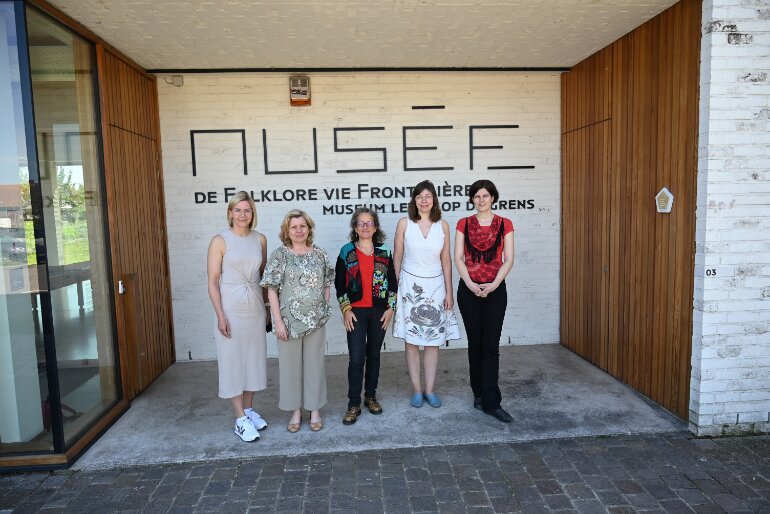
| The first project fieldwork took place in May 2026 when the project team visited the European Museum Schengen (Luxembourg) and Mouscron Museum of Folklore and Border Life (Belgium).
|
|
|
|
| New Border Art Archive and Exhibition
| | Grensekunstarkivet, or Border Art Archive (BAA), was launched as an online platform documenting artwork, artistic projects and exchanges in the Norwegian-Russian-Finnish border areas of Sápmi in the years spanning 1990 to 2022. This archive is work in progress led by independent curator Hilde Methi in collaboration with Dušan Barok (artist), Camilla Fagerli (artist-curator, Artistic Director at Tromsø Kunstforening) and Ekaterina Mikhaliova, Associate Professor in Border Studies at the UiT - The Arctic University of Norway.
| Grensekunstarkivet is accompanied by a curation of new exhibitions, seminars and events. The first iteration of the BAA took a form of an exhibition called 'For History, Change Position', which was on display at the Tromsø Kunstforening/Romssa Dáiddasiida//Tromssan Taitopiiri from 30 May 2026 until 30 August 2026 and included a vernissage, thematic guided tours and a finissage. Other exhibitions drawing on the BAA are planned for 2027-2028.
| To learn more about the exhibition 'For History, Change Position', please read the exhibition brochure.
|
|
|
|
| | | Gülsel Çiftci
| Presents on Climate-Related Heritage Risks in Border Regions at COST Action CA24125- CRICULT Conference
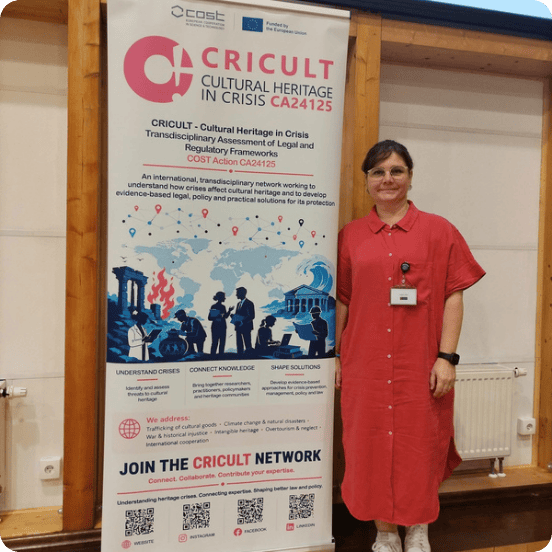
| Dr. Gülsel Çiftci, Associate Professor at Trakya University's Faculty of Applied Sciences (Edirne, Türkiye) and member of the Association for Borderlands Studies Board, presented her paper "Climate-Related Heritage Risks in Border Regions: A Comparative Governance Analysis of the Edirne–Thrace Tri-Border Area and the Adriatic Heritage Landscape" at the international conference Intangible Cultural Heritage in Times of Crisis: Transformations, Risks and Governance, held 17-18 September 2026 at Collegium Polonicum in Słubice, Poland.
| The conference was organized by the Chair for Heritage Studies at the European University Viadrina (Frankfurt/Oder, Germany), in cooperation with Collegium Polonicum, within the framework of COST Action CA24125- CRICULT (Cultural Heritage in Crisis), funded by the European Union.
|
|
| | | Delivered in the conference's closing session, "Intangible Cultural Heritage Between Law and Governance," Dr. Çiftci's paper offered a comparative governance analysis of climate-related risks facing heritage sites in two border regions: the Edirne-Thrace tri-border area (Türkiye-Bulgaria-Greece) and the Adriatic heritage landscape. Her presentation examined how institutional and cross-border coordination mechanisms shape resilience and risk management in heritage landscapes situated at national and cultural boundaries.
|
|
|
|
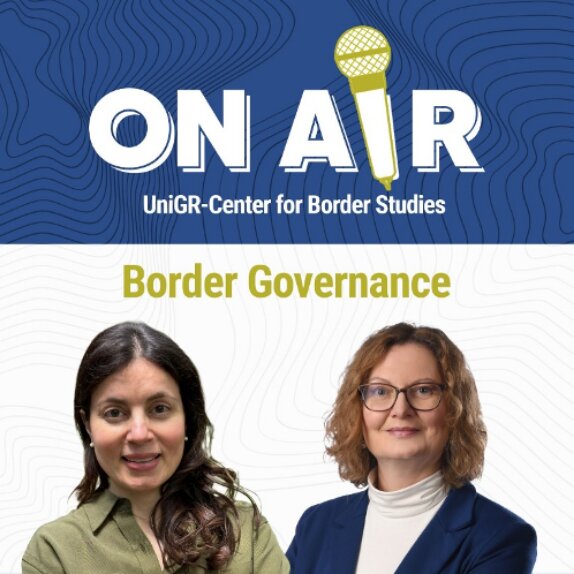
| | ON AIR – The Podcast Series of the UniGR-Center for Border Studies
| The podcast series of the UniGR-Center for Border Studies features border research from UniGR-CBS members and international guest researchers in English, French and German.
| In the latest episode, Karina Pallagst (Rheinland-Pfälzische Technische Universität Kaiserslautern-Landau (Germany)) talks with former UniGR-CBS Fellow María Verónica Elías (The University of Texas at San Antonio) about border governance and spatial planning. Drawing on perspectives from the US–Mexico border and the Greater Region, they discuss how political priorities, institutions and planning systems shape cross-border cooperation.
| Listen to the new episode here: https://rss.com/podcasts/on-air-unigr-center-for-border-studies/3180814/
| Learn more about María Verónica Elías (The University of Texas at San Antonio) and her stay at the UniGR-Center for Border Studies in the conversation about governing border regions:
| https://center-border-studies.uni-gr.eu/en/news/gouverner-les-regions-frontalieres-un-entretien-avec-maria-veronica-elias-fellow-unigr-cbs
| |
|
|
|
| | Christopher Brown was one of a select number of border researchers invited to participate in The Border Water Horizon Workshop that the Claudio X. Gonzalez Center for Mexico and the U.S. at Rice University convened in April of 2026. The outcome of the workshop was the establishment of the U.S.-Mexico Water Task Force, and Brown will be taking the lead on "Working Group 1: Shared strategic information for water resources management” as the Task Force moves forward.
|
|
| | Christopher Brown
| To recognize Christopher Brown’s teaching work at NMSU, Brown was awarded the NMSU Teaching Academy’s Truly Innovative Teaching Award. Prominent in the nomination for this award was Brown’s work promoting a high level of student engagement while taking classes into an asynchronous modality. Of note, one of these classes asks students to do applied environmental planning research; one of Brown’s students is doing his PhD research into environmental justice issues related to a massive AI data center being built right on the US-Mexico border.
| To recognize Christopher Brown’s service achievements at NMSU, Brown was awarded the NMSU College of Arts and Sciences Faculty Service Award, and prominent in the nomination for this award put forward by Brown’s Department Head was Brown’s service as an ABS officer and Board member, and his work on previous ABS Bylaws revisions.
|
|
|
|
| The Border Policy Research Institute
| New interactive maps and data illustrate local economic impact of declining border traffic. “Whatcom County’s Cross-Border Retail Economy,” a regional analysis from the BPRI aims to develop a more complex understanding of the relationship between Canadian visitors and Whatcom County’s retail sales tax to help community leaders better plan for and respond to economic uncertainty.
| | Find the project here: https://storymaps.arcgis.com/stories/21574dd280144cdc9188052a3c1afe20
| |
|
|
|
| | | Events
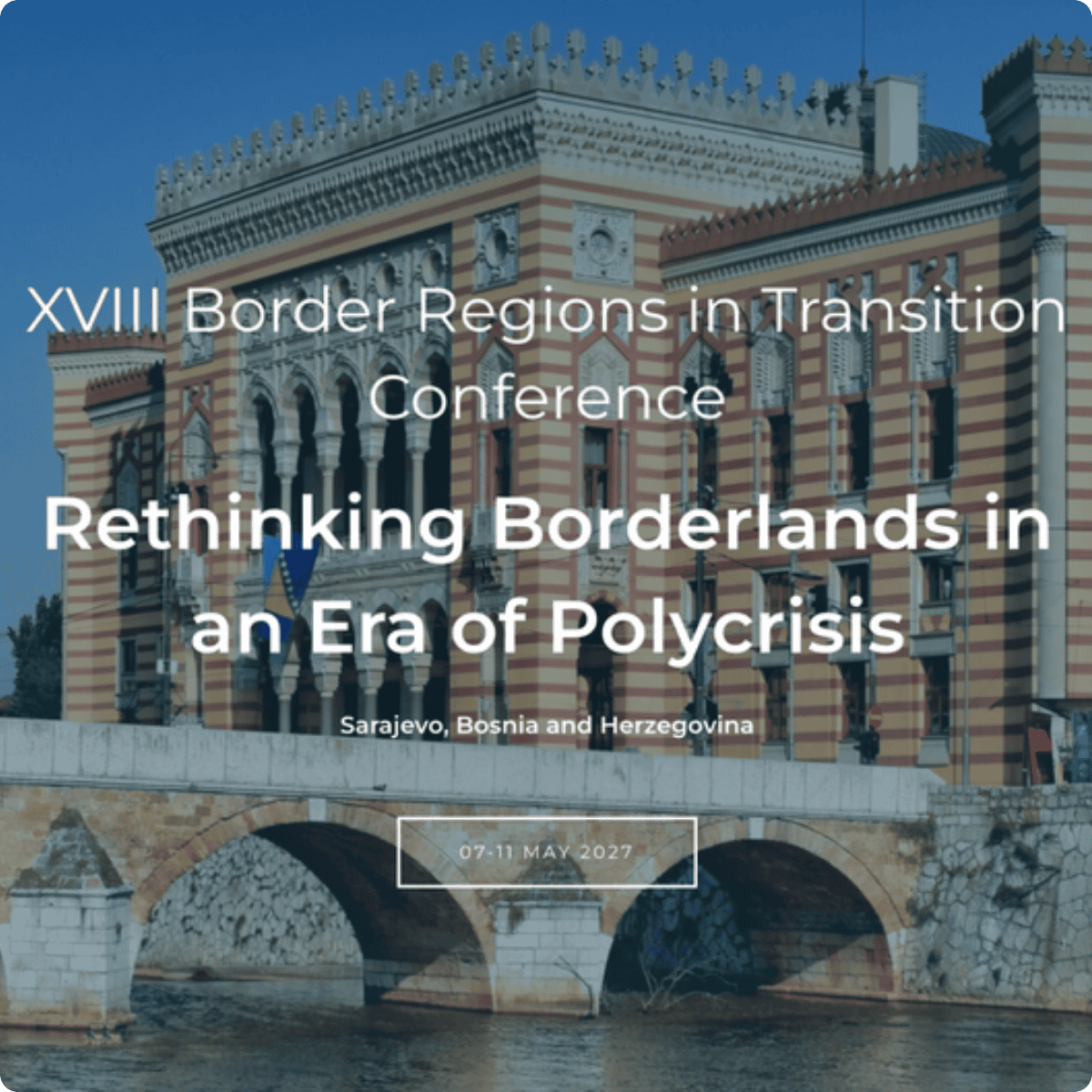
| XVIII Border Regions in Transition Conference
| Rethinking Borderlands in an Era of Polycrisis
| 7 – 11 May 2027, Sarajevo, Bosnia and Herzegovina
| BRIT XVIII brings together scholars, practitioners and civil society actors from around the world to examine how borders and borderlands are being reshaped by intersecting geopolitical, environmental, economic, demographic and social transformations.
| Hosted in Sarajevo, Bosnia and Herzegovina, the conference offers a particularly relevant setting for dialogue on changing borders, territoriality, cross-border cooperation, migration, identity and everyday life in borderlands.
| The conference welcomes interdisciplinary perspectives and seeks to encourage geographical diversity, conceptual plurality and exchange between academic research and practice.
| Call for Papers
| |
|
|
|
| Law, Space and Borders: A CLG symposium in Palermo
| A new event of the Critical Legal Geographies Network: a symposium titled "Law, Space and Borders. Critical Legal Geographies of Contemporary Borderscapes".
| Location/Date: Palermo (Italy), on 25–26 February 2027.
| Call for papers/sessions, and complete information at: https://www.clg.place/apps/b9b74751982f4305a4058175fa453438/explore
|
Deadline for submissions: 8 November 2026.
|
|
|
|
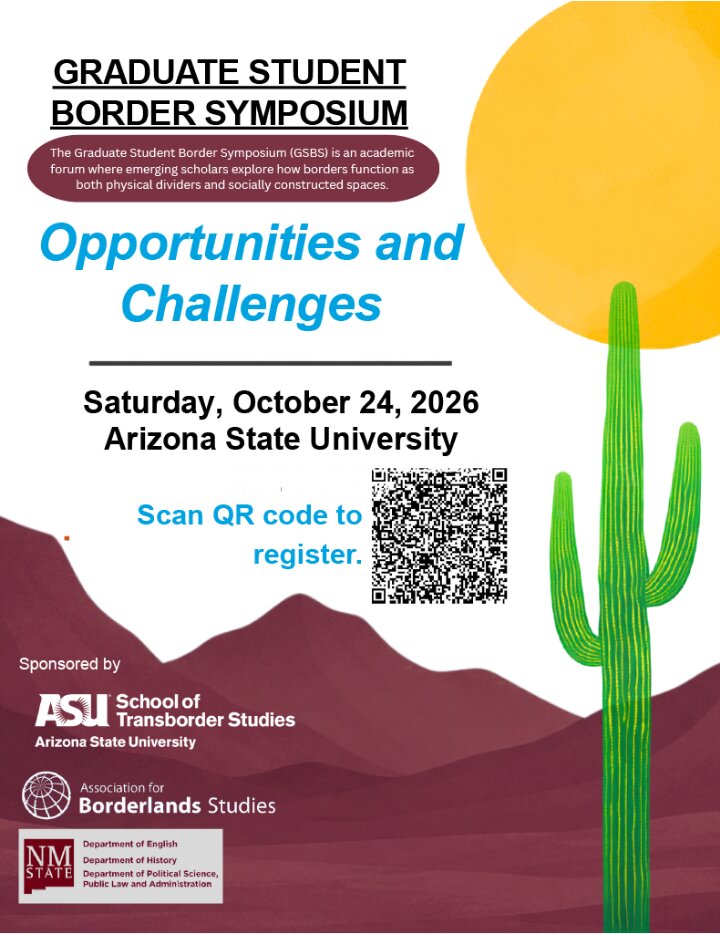
| | | Graduate Student Border Symposium: “Opportunities and Challenges”
| The Second Annual Symposium will take place on Saturday, October 24, 2026, at Arizona State University in Tempe, with hybrid attendance options available. Supported by ASU’s School of Transborder Studies, the Association of Borderlands Studies, and NMSU’s Departments of English, Government, and History, the symposium brings together emerging scholars and interested individuals for a day of collaborative discussion on borders, borderlands, migration, mobility, identity, sovereignty, culture, and related topics. Rather than a traditional conference, GSBS emphasizes transdisciplinary exchange, constructive peer engagement, and conversations about the opportunities and challenges facing emerging scholars in border studies. Interested attendees are encouraged to register using the QR code.
| | |
|
|
|
| “Borders and Borderlands” Section 69th Annual WSSA Conference
| Call for presentations: “Borders and Borderlands” Section
| 69th Annual WSSA Conference
| March 31-April 3, 2027
| Denver, Colorado, the USA
| This Section focuses on the interdisciplinary study of borders, engaging researchers from various disciplines such as geography, sociology, political science, economics, history, cultural studies, and anthropology. It aims to promote an understanding of border issues, and generate knowledge on borders and cross-border processes. The Section encompasses various thematic tracks, including but not limited to:
| | 1. | Borders, territory and sovereignty
|
| | 2. | Migration and human mobility
|
| | | 4. | Border cultures and identities
|
| | 5. | Law, policy and governance
|
| | 6. | Environment and public health
|
| | | | 9. | Historical perspectives
|
| | 10. | Colonial and postcolonial borders
|
| | 11. | Security and militarization
|
| Border scholars use a range of methods, such as qualitative, quantitative, and mixed method approaches to better understand, analyze, and assess the functions and effects of borders.
| ATTENTION: Please note that this is not the ABS Annual Conference. It is an ABS coordinated section; therefore, the ABS Business Meeting and Reception will not be held, and travel grants and best paper awards will not be offered. Instead, the 2027 ABS Annual Conference has been merged with the 2027 ABS World Conference, which will be held in Elvas, Portugal, and Badajoz, Spain, on September 2–5, 2027.
| More information here: https://wssaconference.com/home
|
|
|
|
| | | | Opportunities
| Associate/Full Professor of Border Studies
| We are looking for a leader in border studies research connected to the U.S. - Mexico border--someone who can collaborate across a broad range of projects and constituencies and is comfortable with interdisciplinary collaboration. The ideal candidate will be an accomplished border scholar with a strong record of publication and external funding to join the faculty of the Sociology and Anthropology department. The candidate will teach and mentor students in our doctoral program. A strong preference will be given to scholars with expertise and focus on the U.S. - Mexico border, but we are open to other regions. Other expertise could include border communities, labor, environment, and migration among others. In addition to their role as a tenured member of the Sociology and Anthropology Department, the faculty member will serve as the director of the state-funded Center for Inter-American and Border Studies. We seek someone with innovative ideas to drive border studies forward and grow CIBS. CIBS provides stimulation and collaboration in border studies across the university, binational community, Texas and Chihuahua, and globally.
| More details here: https://utep.interviewexchange.com/candapply.jsp?JOBID=205007#pageTop
|
|
|
|
| | Book Features
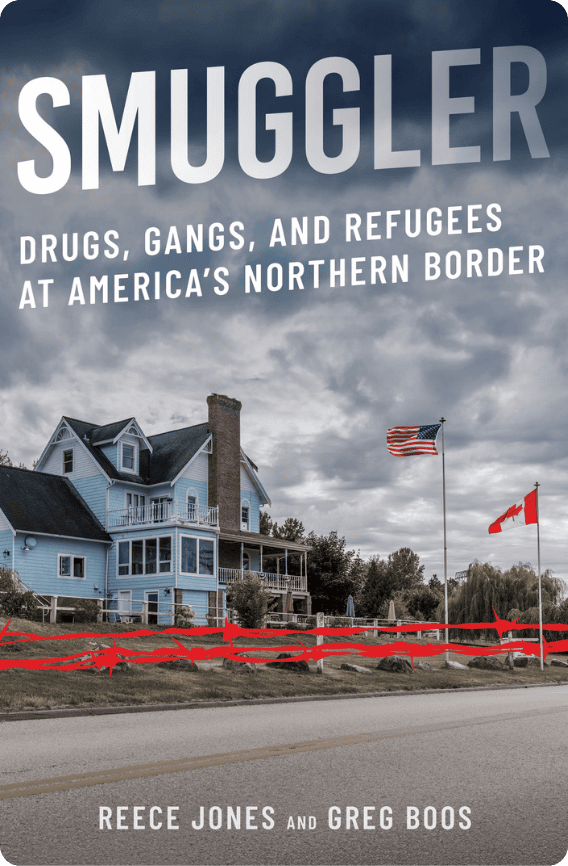
| | When an ordinary man is thrust into the dangerous world of smuggling at America’s northern border, he risks his own freedom to protect refugees from violent immigration policing.
| Soon after conservative businessman Bob Boulé opens the Smuggler’s Inn, a quirky bed-and-breakfast directly on the US-Canada border, refugees, drug traffickers, and ICE agents all trust him with their secrets. The refugees tell Bob heartbreaking stories of persecution and death. The drug traffickers and ICE agents try to recruit him to their side in the dangerous game of smuggling at the border. Bob is forced to make a series of risky decisions that draw him deeper and deeper into the murky border underworld, putting his own freedom at risk. Bob’s secret life comes crashing down after a violent confrontation with a Border Patrol agent, leading him to question his core beliefs as he finds his true purpose in life.
|
|
| | Smuggler: Drugs, Gangs, and Refugees at America’s Northern Border - Reece Jones & Greg Boos
| From the Taliban-controlled countryside of Afghanistan to the infamous La Joya prison in Panama, the stories featured in Smuggler converge in the misty forests of the Pacific Northwest in the borderlands between Seattle and Vancouver. There are car chases, drug deals, and over a thousand people who slip quietly across the border to safety in the dead of night. After the confrontation with the Border Patrol agent, Bob’s complaint goes all the way to the US Supreme Court, whose landmark decision in Egbert v. Boule paves the way for the apparent impunity of ICE agents on American streets. In this gripping exposé featuring personal interviews, in-depth research, and a propulsive narrative, border expert Reece Jones and immigration lawyer Greg Boos tell the true story of how the Smuggler’s Inn became the epicenter of debates about refugee protections and violent immigration policing in the United States.
| Find the Book Here
|
|
|
|
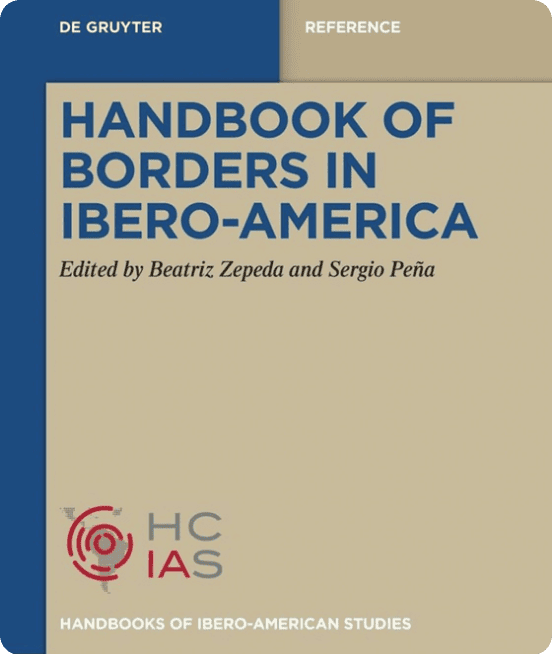
| | | Handbook Of Borders in Ibero-America - ed. by Beatriz Zepeda & Sergio Peña
| While borders have been historically studied from a state-centric perspective, the past few decades have seen the emergence of new approaches to border studies. These new conceptual and theoretical proposals have been applied to the study of European and North American borders, but have yet to be put to the test in the case of Ibero-America.
| The present handbook aims to do so by offering theoretically informed states of the art on Ibero-American borders. It addresses a broad range of topics, including the history of borders in the region, economic de-bordering and regionalism, cross-border cooperation and governance, as well as the relationships between Ibero-American borders and informal actors, indigenous peoples, mobility, culture, and the environment.
|
|
| | | Mustering contributions from both well-established and emerging border scholars from over ten different countries, the handbook offers the most comprehensive overview available to date on the borders of Ibero-America, their complexities and complementarities. By incorporating a common theoretical understanding in all the chapters, it transcends the descriptive dimension that characterize most handbooks to provide insights into the scope and limitations of the prevailing theoretical frameworks of border studies.
| Find the Book Here
|
|
|
|
| | Publications
| Articles
| Bertram, D., Hippe, S., Barvíř, R., Chilla, T., McMaster, I., Pászto, V., & Günther, E. (2026). Mapping point and line densities of cross-border governance: the example of the Interreg cooperation programme. Journal of Maps, 22(1). https://doi.org/10.1080/17445647.2026.2720503
| This article addresses the question of how point- and line-density approaches can be used to represent European cross-border governance structures. To this end, we map 5,618 Interreg-A projects and 17,929 partners. The findings show that point density effectively represents the spatial concentration of actors, while line density better captures the directionality and intensity of cooperation axes. The study demonstrates that combining both approaches provides a more comprehensive understanding of European cross-border governance and supports evidence-based spatial development.
| Please find the high-resolution map accompanying the article here: https://doi.org/10.6084/m9.figshare.33845626
| Bretschneider, Falk / Grimm-Hamen, Sylvie / Wagner, Hedwig / Leutloff-Grandits, Carolin / Wille, Christian (Hg.) (2026): Spatialities, Temporalities and Materialities of Border Complexities. (Border Studies. Cultures, Spaces, Orders 13). Baden-Baden, Nomos. https://doi.org/10.5771/9783748922308
| Chilla, T., Paul, H., & Sommer, C. (2026). Border region economies: The role of proximity. Environment and Planning A: Economy and Space. https://doi.org/10.1177/0308518X261483621
| This article reflects on the functioning of border economies: Using three exemplary value chains - soy, beer, and pork - we show that national borders change ‘proximities’: Borders alter institutional, organizational, cultural and spatial proximities, and that makes a decisive difference to how border economies function.
| Coronado, I., & Staudt, K. (2026). From Invisibility to Mainstreaming? Women and Gender in the Association for Borderlands Studies. Journal of Borderlands Studies, 1–17. https://doi.org/10.1080/08865655.2026.2681035
| Jakob J., Sohn C. (2026) Divided by a river, connected by a bridge”: The border as a semiotic resource in the case of Frankfurt (Oder) and Słubice. Journal of Borderlands Studies (Published online 6 July 2026). DOI: 10.1080/08865655.2026.2698950
| Kiryukhin, Oleksiy / Wille, Christian / Yampolskyi, Daniil / Yampolskyi, Mykyta (2026): Application of Dynamical Systems Theory for Cross-Border Cooperation in the Greater Region. UniGR-CBS Working Paper 29, UniGR-Center for Border Studies. https://doi.org/10.5281/zenodo.18412271
| Laine, Jussi. (2026). Unbounded inclusiveness and the ethics of bordering: domination, responsibility, and epistemic justice beyond the open/closed divide. Ethics & Global Politics. 1-17. https://doi.org/10.1080/16544951.2026.2740264.
| Laine, J. P. (2026). The Elastic Sky: Airspace, Volumetric Bordering, and Geopolitical Crisis, Global Studies Quarterly, Volume 6, Issue 3, July 2026, ksag133, https://doi.org/10.1093/isagsq/ksag133
| Reconceptualise airspace as a dynamic, algorithmically mediated and politically elastic form of volumetric bordering that unsettles territorial understandings of sovereignty.
| Laine, J. P. (2026). Border Breathing and the Governance of Refugee Presence in Uganda’s West Nile. Journal of Borderlands Studies, 1–22. https://doi.org/10.1080/08865655.2026.2714793
| Reframes Uganda’s refugee response as a form of everyday borderwork, showing that borders are not only drawn at territorial edges but are continually enacted through routine governance of displacement.
| Laine, J. P. (2026). Cooperation across contested spaces: rethinking borderlands as sites of resilience. Annales Scientia Politica, Vol. 15, No. 1 (2026), pp. 5–21. Link to online publication https://www.unipo.sk/sites/default/files/content/86416/01_asp_2026_1_laine.pdf
| Reconceptualises European borderlands as adaptive and democratically productive spaces, showing that resilience in these regions emerges not from securitised control but from relational, institutional and civic capacities that sustain continuity amid chronic geopolitical uncertainty.
| Mikhailova, E. (2026) Central Asian nations are finally resolving border disputes after Soviet collapse. Science Norway, April 1.
| This opinion piece is author’s English-language summary of their Norwegian-language journal article “Sentral-Asias grenser etter 2022: fra grensekonflikter til prioritering av regionalt samarbeid” published in Nordisk Østforum. The article discusses the latest developments in delimitation of Central Asian borders and concludes that following the adoption of two historical agreements, the Kyrgyzstan-Tajikistan border agreement and the agreement determining the tri-point of Kyrgyzstan, Tajikistan and Uzbekistan, a new phase has begun in regional cooperation in Central Asia. Thus, in 2025, Central Asia presents a rare case of de-bordering amid global re-bordering trends.
| Mikhailova, E. (2025). Changing Functions of a Border Festival: Insights from Friendship/Slavic Unity Festival at the Triple Border of Ukraine, Russia and Belarus. Geopolitics, 1–30. https://doi.org/10.1080/14650045.2025.2562292
| This article introduces a heuristic model for studying the changing functions of border festivals, identifying ten such functions. Using the Friendship/Slavic Unity Festival, held annually since 1969, initially at the tri-point of Ukraine, Russia, and Belarus, the article tests the proposed model as a tool for cross-national and cross-temporal comparisons. The article shows that the Festival has had at least five out of the ten border festival functions over its half a century of existence. By examining the disruptions and resignifications that the Festival was subjected to, the article provides a new perspective on how the short-lived, authentic dialogue among Ukraine, Russia and Belarus and their border regions was replaced with a performance of dialogue.
| Mikhailova, E., & Horák, S. (2026). Ripping Up the Ties: Tracing Rising Alienation in Bilateral and Cross-Border Relations of Turkmenistan and Uzbekistan, 1991–2006. Journal of Borderlands Studies, 1–27. https://doi.org/10.1080/08865655.2026.2727642
| This article is a foundational study of a largely unstudied borderland between Turkmenistan and Uzbekistan. Drawing on Oscar Martinez’s typology of cross-border interactions, it shows what it means to become an alienated borderland through the lens of everyday and political realities and illuminates what borderland alienation entails in the authoritarian context. The article underlines that Turkmenistan, the weaker state with a harsher authoritarian regime, has been the main driver of the measures that led to border closures.
| Sohn C., Bembnista K., Kakob J., (2026) Exploring border images as visual discourses. The example of Basel trinational urban agglomeration. Oxford Intersections: Borders: Theory and Practice (Published online 1 July 2026). DOI: 10.1093/9780198945222.003.0076
| Sohn C. (2026) Resourcing the border in CaliBaja’s megaregional imaginary. International Journal of Urban and Regional Research (Published online 9 September 2026). https://doi.org/10.1111/1468-2427.70138
| Wille, Christian (2026): Bordering ist plural. Warum Grenzforschende häufig aneinander vorbeireden. UniGR-CBS Working Paper 30, UniGR-Center for Border Studies. https://doi.org/10.5281/zenodo.19499938
| Reports
| Bettis, Jennifer, Catalano, Frank (2026): Whatcom County Businesses and the Decline in Canadian Travel: Survey Findings and Business Perspectives. Border Policy Research Institute Publications. Volume 22. https://mabel.wwu.edu/do/5d7861a8-2b78-4094-b1f1-a48f86a9e51b#page/4/mode/2up
| Books
| Citizenship, Nationality, and Rights: Rohingya Children in Bangladesh,’ in Nasreen Chowdhory and Priya Singh (Eds.), New Frontiers in the Register of Migration and Refugee Studies. Springer. 2026. https://link.springer.com/book/10.1007/978-981-95-4465-3
| Book Reviews
| Staudt,Kathleen (2026). Review / Reseña: Border Afterlives: Migrant Deaths, Forensic Investigations, and the Politics of Haunting. By Gabriella Soto. 2026. Middle Atlantic Review of Latin American Studies. Volume 10, Issue 1, PP 237-240. DOI: 10.23870/marlas.577
| Blogs / Essays
| Mikhailova, E. (2024). Maps beyond Icons: Semiotic Analysis of Maps of Ukraine During the Russo-Ukrainian War. Ukrainian Analytical Digest, (8), 2-8. https://doi.org/10.3929/ethz-b-000696568
| This essay employs a semiotic approach to examine the new meanings and functions the map of Ukraine has acquired since 2022. Drawing on Peirce’s typology of signs, it argues that the map’s indexicality and symbolic significance have intensified. The essay concludes that, amidst the ongoing war, the map of Ukraine has become a prominent feature of daily life for Ukrainian citizens, serving as a vital tool for receiving updates, consuming news, and staying connected with colleagues, family, and friends.
| Mikhailova, E. (2026) Notes of a border scholar turned amateur archivist. UiT forskerhjørnet. June 26.
| This essay shares the observations, discoveries, reflections, and emotions of a border scholar inspired by their contribution to creating the first personal border art archive for the Norway-Finland-Russia borderland.
| Laine, J. P. (2026). A world turned upside down: Using law to protect our values and defend our borders. Speech delivered by Professor Jussi P. Laine at the 2nd Annual Transatlantic Alliance for Law, Outreach, and National Security (TALONS) Conference, held on 27–29 May 2026 in Joensuu. Available at: https://blogs.uef.fi/puheenvuoroja/2026/06/15/a-world-turned-upside-down-using-law-to-protect-our-values-and-defend-our-borders/
| Laine, J. P. (2026). The Border Isn’t Where I Thought It Was. The Karelian Institute Blog 2026/09/03. https://blogs.uef.fi/ktl/2026/09/03/the-border-isnt-where-i-thought-it-was/
| Venken, Machteld (2026). Community Archiving Border Studies in Arizona https://www.uni.lu/c2dh-en/articles/community-archiving-border-studies-in-arizona/
| Venken, Machteld (2026). Digital repositories for testimonies of persons in border regions. An encounter in Mexico https://www.uni.lu/c2dh-en/articles/digital-repositories-for-testimonies-of-persons-in-border-regions/
| Addresses
| Laine, J. P. (2026). Borders as a Guarantee of Security? Festive address at the annual celebration of the Finnish Cultural Foundation’s North Karelia Regional Fund on 23 May 2026. Available at https://skr.fi/en/news/borders-as-a-guarantee-of-security/
| Presentations
| Dr. Sreetapa Chakrabarty presented a paper on ‘Identity, belonging and Childhood: Insights from Rohingya Refugee camps in Bangladesh’ at the 3rd Graz/Puerto Rico International Conference on Human Rights from an Inter-American Perspective on the theme ‘Camps, Belonging and Abolition Democracy’ organized by the Center for Inter-American Studies of the Graz School of Interdisciplinary Transnational Studies, University of Graz, together with the Institute of Caribbean Studies and the Department of English at the University of Puerto Rico, Río Piedras Campus. University of Graz, Austria. June 4-7, 2026.
Dr. Sreetapa Chakrabarty presented a paper on ‘Borderlands and Belonging: Citizenship, Home and Rohingya children in Bangladesh’ at the 50th Anniversary Conference of the Association for Borderlands Studies with the theme ‘Celebrating 50 Years of Border Studies: Past, Present and Future.’ Albuquerque, New Mexico, USA. March 25-28, 2026.
| Dr. Sreetapa Chakrabarty presented a paper on ‘Xenophobia, Education and the Geopolitics of Aid: Rohingya Children in Bangladesh’ at the State-Level Seminar cum Workshop on ‘Understanding World Politics: Challenges and Opportunities’ organized by the Department of Political Science, Rabindra Bharati University, India, in collaboration with IQAC, RBU. February 24- 25, 2026.
|
|
|
|
| | Thank you!
| ¡Muchas gracias!
| | | Let us know what you’d like to see in future newsletters!
| ¡Haznos saber qué te gustaría ver en los próximos boletines!
| |
|
| | | |
|