IBANYS Weekly E-Newsletter | | |
-
The Fed this afternoon approved its first interest rate hike in over three years and indicated another to come as part of an effort aimed at combating inflation. The Federal Open Market Committee voted 12-0 to increase its key interest rate by a quarter percentage point (25 basis points). https://www.cnbc.com/2026/09/16/fed-rate-decision-september-2026.html. It brought the overnight funds rate to a target range of 3.75%-4%. The hike “will correspond with a rise in the prime rate and immediately send financing costs higher for many forms of consumer borrowing, putting some U.S. households under increased financial strain.” https://www.cnbc.com/2026/09/16/fed-rate-hike-consumer-borrowing-and-savings-rates.html. The FOMC noted: “Inflation remains elevated. Today’s policy action will support a timelier return to the Committee’s 2% goal…” Updated projections released showed a strong majority of officials think another rate hike is possible later this year. The "dot plot grid” of individual officials’ expectations indicated 16 of the 18 participants expected another hike (with four of those seeing two more hikes as possible). Two expected the committee to stop at one hike. There are no increases penciled in for subsequent years, with one cut each indicated for 2028 and at least one for 2029. Officials also nudged up their expectations for inflation this year.
. . . .
We are past the mid-point of September as we head toward the final quarter of 2026. That means we are just a few short weeks from our EXECUTIVE LEADERSHIP SYMPOSIUM, followed soon after by Election Day and the final stretch to the 2027 state legislative and congressional sessions. . . With all this in mind -- WE NEED TO HEAR FROM YOU ON TWO IMPORTANT MATTERS:
-
We’re bumping up against the deadline (THIS FRIDAY, Sept. 18) for YOU & YOUR TEAM TO REGISTER FOR OUR EXECUTIVE LEADERSHIP SYMPOSIUM OCT. 5-7 at the 1000 Island Harbor Hotel in Clayton, NY. Bank presidents will have the chance to discuss issues facing your organizations at our “Presidents Roundtable” panel moderated by Hartman Executive Advisors. Register today: ALSO note: sponsorship are nearly gone! For full details, see below or visit IBANYS’ website: www.ibanys.net.
-
WE NEED YOUR INPUT ON TOPICS & ISSUES YOU WANT ADDRESSED AS WE DEVELOP OUR 2027 STATE LEGISLATIVE POLICY AGENDA. IBANYS plans to share our thoughts and priorities with Senate Banks Chair Sanders (D-Queens) and Assembly Banks Chair Vanel (D-Queens)—and, we want to be prepared to get bills through the legislative process. To succeed, we need your ideas and suggestions. . .email me your comments at Johnw@ibanys.net. See below in our Albany section for details.
A few More Notes To Flag For You:
-
IBANYS is pleased to announce a strategic partnership with KreditIQ, Inc., developer of an agentic AI platform for commercial loan underwriting. KreditIQ becomes an IBANYS associate member and preferred solutions partner and will work with the association to bring governed agentic underwriting capability to member institutions through education programming, member briefings, and structured evaluation support. KreditIQ represents a major leap forward in streamlining the commercial loan process for community banks. Every bank wants to cut down the time spent reviewing loans, and this platform makes that possible while still keeping the banker directly involved in the review. I see it as a genuinely valuable tool for community banks to rely on throughout their loan decisioning process. As KreditQ CEO noted: “IBANYS is a great advocate for the community banks in New York State, and it has consistently given its members what they actually need (including) rigorous, leading technology reviews. That standard is exactly why this is the right partnership." Contact me (Johnw@ibanys.net) or Mike Persichini (mike@kreditiq.ai)
-
ICBA’s Compensation and Benefits Report offers your bank access to: Compensation data from over 246 full-time and 30 part-time roles nationwide; An interactive dashboard for easy analysis of 100 compensation and benefit metrics at the national, regional, and asset-size levels, and Exclusive insights to support recruitment, retention, and strategic planning for 2027. Learn more.
. . .John
| | IBANYS EXECUTIVE LEADERSHIP SYMPOSIUM | | |
🚀LEAD. CONNECT. GET AHEAD.
2026 IBANYS Executive Leadership Symposium
October 5–7 | Clayton, NY
10 CPE Credits. Powerful insights. Meaningful connections.
👉 Register Today!
| | | | Fishing Boat & Golf Refreshment Cart | | Dinner Wine - Tuesday & Golf Tee | | | Cocktail Hour - Monday & Golf Tee | | | Associate and Preferred Partners | | |
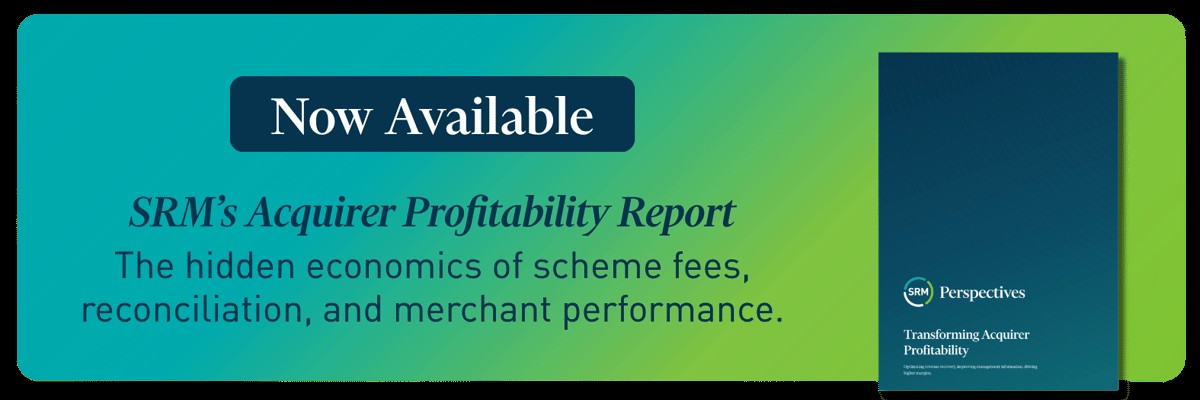
Merchant acquirers are operating in an increasingly complex environment, where hidden factors are quietly eroding margins.
Scheme fees, settlement activity, and merchant performance are often managed as separate operational concerns. Together, they shape the economics of acquiring. When that activity is aggregated into monthly reporting, leaders may see a variance without understanding the transactions, classifications, or merchant behaviors behind it.
In our newest Perspectives Report, Transforming Acquirer Profitability, SRM Europe's payments team examines the merchant acquiring industry, margin erosion, industry pressures, and how SRM is working to solve these issues through data and intelligence.
Inside, we look at profitability challenges such as:
- Complex scheme fees across products, channels, and geographies
- Under-recovered fees and gaps in merchant billing
- Transactions that are mispriced, mislabelled, or misclassified
- Settlement discrepancies that surface after the fact
- An incomplete view of performance across merchants and portfolios
| | |
Will Nowik
Principal & Chief Information Security Officer
(617) 428-5469
wnowik@wolfandco.com
| | |
About Wolf & Company
Wolf & Company is a national, independent CPA and business consulting firm with more than 115 years of experience. The firm combines deep industry expertise with a high-touch, senior-level approach to help organizations navigate complex financial, operational, regulatory, and strategic challenges.
Wolf & Company offers four core areas of service: Advisory, Assurance, Digital, and Tax. Its offerings include business and strategic consulting, audit and assurance, cybersecurity and risk management, digital transformation and data solutions, tax planning and compliance, and specialized services tailored to industries such as banking, fintech, asset management, healthcare, technology, manufacturing, and private clients.
| | |
Susan Salecky
SVP, Chief Marketing Officer
(860) 678-0444
susan.salecky@cocc.com
| | |
About COCC
COCC is a client-owned financial technology (fintech) company that provides technology, core banking, digital banking, and related services to community banks and credit unions. Founded in 1967, COCC has more than 55 years of experience serving financial institutions, primarily across the Northeastern United States.
COCC differentiates itself through its client-owned cooperative model. The company was founded by financial institutions to give clients greater control over technology, costs, and the delivery of their technology needs. COCC emphasizes long-term partnerships, modern technology, flexibility, security, and personalized customer service.
Today, COCC describes itself as an industry-leading fintech provider offering modern, standards-based core and digital banking solutions, supported by APIs that enable integration with other fintech products and services. Its goal is to help community financial institutions remain competitive by providing the technology, support, and expertise they need to succeed.
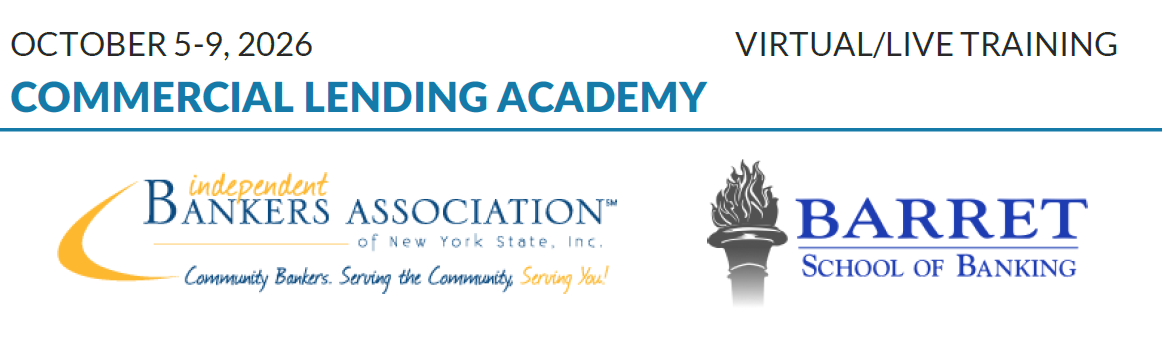
| | This virtual/live workshop is designed to provide immediate, tangible training for employees new to commercial lending and to improve skills of less-experienced commercial lenders. | | | |
Instructor:
Richard Hamm
President of Advantage Consulting and Training
Huntsville, AL
| | |
Legislative Matters
-
AN IMPORTANT REMINDER: IBANYS is preparing our 2027 state legislative policy agenda and is asking for input from our member banks on their top priorities and issues. IBANYS President & CEO John Witkowski has met with NYS Senate Banks Committee Chair Sanders (D-Queens) and other key NYS leaders – we are working to have three or four important bills ready to go into the legislative process by early January, when the newly elected Legislature will convene. Among the subjects IBANYS wants to address: Updating and improving some existing programs to reflect today’s banking environment.
-
Banking Development Districts – Easing the application process and increasing the funding for new branches;
-
Reciprocal Deposits - We are waiting for Governor Hochul to sign the bill allowing for reciprocal deposits to collateralize funding for BDD’s. Also, increase the level of deposits from the state to seed the branch.
-
Community Deposit Program – Developing a user friendly, less expensive, and flexible community deposit program to increase economic development into your communities.
-
Regarding NYS DFS: We discussed some reasons why banks are moving to a federal charter. Senator Sanders plans to schedule a meeting soon with DFS.
PLEASE e-mail me any and all of your your suggestions: John Witkowski at Johnw@ibanys.net.
Regulatory Notes
-
Acting NYS DFS Superintendent Asrow issued new cybersecurity guidance outlining expectations for DFS-regulated entities’ on conducting risk assessments sufficient to inform their cybersecurity programs. It outlines requirements regarding scope, frequency, and the role of risk assessments in informing entities cybersecurity programs. It does not impose new obligations or requirements on regulated entities -- it clarifies regulatory requirements under DFS’s cybersecurity regulation and shares best practices entities should consider implementing. The DFS guidance is available on its newly refreshed Cybersecurity Resource Center for cybersecurity guidance, resources, and FAQs. Read the DFS press release: https://www.dfs.ny.gov/reports_and_publications/press_releases/pr20260910
. . .
Economic & Political Items
-
Business activity increased modestly in New York State in September, according to the Federal Reserve Bank of New York’s Empire State Manufacturing Survey. New orders edged up, shipments declined slightly, employment increased at a solid pace, and firms maintained an optimistic outlook for business activity.
-
Sen. Gillibrand (D-NY) voted to block the Clarity Act crypto bill, despite privately urging fellow Democrats to support the bill just hours before, The Intercept reports.
| | |
Congressional News
- After yesterday’s procedural vote to advance the Clarity Act failed in the Senate, ICBA said the vote showcases the power of community banks. The Clarity Act digital assets market structure bill failed to advance on a 49-50 vote following more than a year of advocacy by ICBA, IBANYS and community bankers, who have advocated for amending the bill to include a robust prohibition on stablecoin interest, yield, and rewards.
-
Read ICBA’s message to community bankers.
-
In a video from Capitol Hill after the vote, ICBA thanked community bankers for their work in supporting local communities.
-
Read a joint statement from ICBA and other groups signaling support for a strong regulatory framework for digital assets, saying Congress can accomplish that goal while protecting the bank lending that drives economic growth.
-
Legislative Outlook: The failed vote is essentially the end of the road for consideration of the Clarity Act in the current Congress, though Romero Rainey noted the fight is not over as ICBA continues pushing policymakers to extend the GENIUS Act’s yield prohibition for stablecoin issuers to crypto exchanges, affiliates, and other intermediaries. (ICBA had worked with Sens. Moran (R-Kan.) and Reed (D-R.I.) to prepare an amendment with a strong stablecoin prohibition for introduction if the Clarity Act bill had advanced.)
-
Punchnowl News noted: "Tuesday marked a low point for the crypto industry’s time in Washington. The collapse of the Clarity Act will be felt for a long time. The Senate rejected legislation that would reshape the U.S. financial system for the sake of digital assets. The Clarity Act ran into a buzzsaw of bipartisan resistance — partly thanks to the crypto entanglements of President Donald Trump.” The article notes the administration still has time to give the digital assets industry much of the regulatory clarity advocates have been seeking: Leaders of the SEC and CFTC say “they’re prepared to issue rulemakings to legitimize crypto.” However, “rules and regulations don’t have the staying power of legislation, and a potential Democratic administration could wipe out those gains quickly.
Regulatory Items
-
Testifying before the House Financial Services Committee, Treasury Secretary Bessent reiterated the administration’s commitment to reducing unnecessary Bank Secrecy Act/anti-money laundering regulatory burdens on community banks He discussed raising thresholds for smaller banks related to suspicious activity reporting and other BSA/AML requirements, and said Treasury wants to focus AML requirements on effectiveness and targeting actual criminal activity rather than creating unnecessary compliance burdens. ICBA has told federal regulators proposed rules to reform AML and counter-terrorism-financing program requirements must be workable, risk-based, and appropriately tailored for community banks.
-
Federal bank regulatory agencies issued an interim final rule increasing the number of community banks eligible for an 18-month exam cycle. The 21st Century ROAD to Housing Act increased the total asset threshold from $3 billion to $6 billion for certain supervised institutions to qualify for an extended 18-month on-site exam cycle. Extending the exam cycle for these small non-complex firms from 12 months to 18 months appropriately reduces burden, including time and resources spent, for these low-risk institutions. The extended cycle applies to small banks with relatively low-risk profiles, but the agencies would continue the current supervisory practice of offsite monitoring between scheduled exams. The rule also makes parallel changes to the agencies’ regulations governing the on-site examination cycle for U.S. branches and agencies of foreign banks. Read the interim final rule from the FDIC, OCC, and Federal Reserve. Read ICBA’s news release strongly supporting the rule.
-
Federal banking regulators issued a proposal to replace existing third-party risk management guidance with guidance focused on tailoring risk-management practices to the level of risk involved. The FDIC, OCC, and Federal Reserve in 2023 published Interagency Guidance on Third-Party Relationships: Risk Management. The regulators said any finalized guidance would replace the 2023 guidance and certain third-party risk management resources. Comments on the proposed guidance are due 60 days after publication in the Federal Register. ICBA plans to provide input on behalf of community bank. ICBA commended the federal banking regulators for issuing a joint statement to provide clarity on their supervision of core service providers. Read joint statement from the FDIC, OCC & Fed and ICBA’s national news release.
-
The FDIC announced its board will meet tomorrow (Sept. 17) at 10:00 a.m. to discuss proposed rules for merger transactions and state bank parity. The meeting will be open to the public via webcast.
-
Federal regulators announced that beginning with the 2027 reporting year, institutions will have the option to submit annual CRA aggregated data through Reporting Central, the Fed's secure web-based reporting application. FFIEC noted details are on its CRA website.
Economic & Political Notes
-
The U.S. Labor Department reported the Consumer Price Index increased a seasonally adjusted 0.4% in August following a 0.1% increase in July. It is up 3.4% over the past 12 months. Meanwhile, The University of Michigan’s preliminary index of consumer sentiment for September dropped 7.5% for the month and 13.2% for the year. Year-ahead inflation expectations jumped to 4.6%, the highest reading since June.
-
The National Association of Realtors reported existing-home sales decreased by 2.0% in August and were down 1.2% from a year ago.. The median sales price was $429,100, up 1.6% from one year ago. Meanwhile, Freddie Mac reported the rate for 30-year fixed-rate mortgages averaged 6.76% this week, up from 6.71% last week. The 15-year FRM averaged 6.09%, up from 6.04% a week ago.
-
On Tariffs: President “Trump’s trade wars have helped push costs higher, which Democrats are hammering on the campaign trail. The escalation with Canada — one of America’s biggest trading partners — shows how painful the tariffs have been for the GOP.” Hardest hit: border and farm states. Senate Majority Leader Thune (R-SD) is letting his battleground incumbents and candidates break from the administration over the Canadian dispute, acknowledging it’ll be “more of a political issue” in states with heavy bilateral trade. Senate Minority Leader Chuck Schumer (D-NY) plans to squeeze GOP senators on the trade wars again today, attempting to pass a bill blocking Trump’s new tariffs, including the levies on Canada.
-
With fewer than 50 days until the midterms, Democrats have developed a clear advantage over Republicans, and the president has lost the public’s trust on the economy, according to a new national poll from The New York Times and Siena University. The President’s unpopularity and intense frustration over his management of cost-of-living issues “have deepened GOP vulnerabilities as Democrats push to win control of both the House and Senate.” Likely voters favored Democratic candidates over Republicans by close to 9 percentage points in their congressional district — a metric closely watched by both parties as a leading indicator of political momentum. “A majority of voters disapproved of Mr. Trump’s handling of every major issue included in the poll: The economy, immigration, tariffs, the war and, especially, the cost of living.” Only 10% of independent voters said the economy was better today than a year ago, and only only 27% of independents approve of Trump’s job performance overall.
-
Roll Call reported that with the midterm primary season nearly complete and the general election is less than two months away, there’s still plenty of uncertainty in the House and Senate battlegrounds. Read more...
-
Roughly half of U.S. voters view socialism unfavorably in a new poll conducted by The New York Times and Siena University, showing that despite democratic socialists scoring significant victories against the Democratic establishment, the movement remains unpopular with much of America, the Times reports.
| | | | |