|
In this month's issue:
- No-cost mental health resources for Connecticut schools
- New Performance Improvement Center for state FFT-FC foster care program
- Strong outcomes from CT's Urgent Crisis Centers
- Outreach tips for CBITS and Bounce Back clinicians
- Latest TF-CBT annual report
- Welcoming new staff
- We're hiring!
And be sure to check out this month's timely featured Kids Mental Health Training course: School Refusal.
| | Resources + Initiative Updates | | Supporting Student Mental Health in the New School Year: Resources for Connecticut Schools | | As schools across Connecticut start the 2025-26 year, some educators may be concerned about how to continue supporting their students’ mental health and well-being during a time of constant change. To help, we've compiled this list of no-cost school mental health programs and resources, developed by CHDI, our partners, and colleagues from around the country: | | |
New Performance Improvement Center Aims to Strengthen State's Functional Family Therapy - Foster Care Program
| | | | CHDI will serve as the Performance Improvement Center (PIC) for the State of Connecticut's Functional Family Therapy - Foster Care (FFT-FC) program through a new contract with the Connecticut Department of Children and Families (DCF). In this role, we will partner with DCF, provider agencies, model developers, families, and others to support the implementation and delivery of the FFT-FC model. | | Connecticut Urgent Crisis Centers Continue to Demonstrate Excellent Outcomes in Second Year of Operation | | |
Connecticut's Urgent Crisis Centers (UCCs) for youth continued to demonstrate strong performance and outcomes in their second year of operation, as detailed in the FY 2025 Annual Report just published by CHDI.
Data from the three community-based UCCs* indicate that they are, as intended, successfully diverting a significant number of youth who would have otherwise gone to hospital emergency departments, with 51.7% of families indicating they would have sought help at the ED if UCCs were not available.
Other highlights from FY2025 (July 1, 2024 - June 30, 2025) include:
- 1,328 episodes of care provided
- 99.4% of children served met treatment goals
-
Harm/risk of harm to self was the most common presenting problem
-
Schools were the most common referral source
- 89% of children showed improvement from intake to discharge
To learn more about the UCCs' work in FY2025, read the full Annual Report, prepared by CHDI in our role as Performance Improvement Center for the state's UCCs:
| | *A fourth UCC is currently operating out of the Yale-New Haven Children's Hospital emergency department; their data will be analyzed separately due to differences between hospital- and community-based UCCs. | | CBITS and Bounce Back: Outreach Tips for School-Based Clinicians | | | | Many school-based clinicians identify students to participate in groups from their existing caseloads. But due to the high prevalence of childhood trauma, we encourage school-based clinicians offering Cognitive Behavioral Intervention for Trauma in Schools (CBITS) or Bounce Back to expand their outreach to the wider school population. | | This one-page tip sheet offers tips to help you talk with school staff and families about the impact of traumatic stress and how CBITS/BB groups can help: | | FY 2024 Data Reveals High Satisfaction with TF-CBT Treatment Among Youth and Families | | |
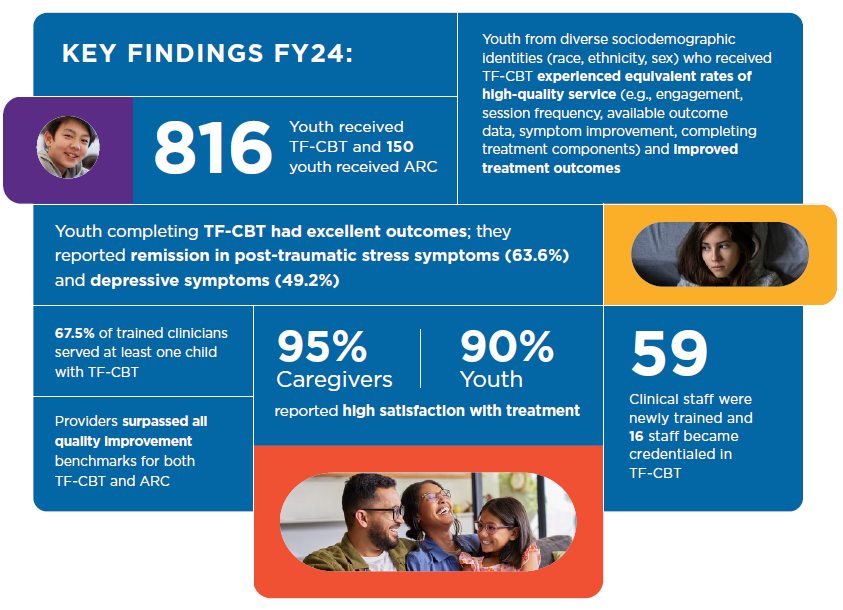
Trauma-Focused Cognitive Behavioral Therapy (TF-CBT) is an evidence-based treatment for children who experience symptoms related to trauma exposure. As Connecticut's TF-CBT Coordinating Center, CHDI provides training, credentialing, implementation support, site-based consultation, data collection and reporting, and ongoing quality improvement to a network of 49 TF-CBT providers statewide.
Our recently published FY 2024* TF-CBT Annual Report, which summarizes the work and outcomes of these Connecticut providers, shows extremely high satisfaction rates among families and youth served and excellent treatment outcomes across all population groups. This infographic shares more highlights:
| Download the full FY24 annual report to learn more about TF-CBT providers' work and outcomes last year: | | *FY 2024 was July 1, 2023 through June 30, 2024 | | | | |
School refusal or avoidance is an extreme pattern of avoiding school that can cause problems for a child. This online course introduces the four functional profiles of school refusal and strategies to address common obstacles to attendance.
This self-paced, on-demand course is taught by Dr. Scott Hannan, clinical psychologist at the Anxiety Disorders Center at the Institute of Living. It's appropriate for anyone working with children, including clinicians, school staff, pediatric providers, caseworkers, and others.
| | |
Kids Mental Health Training is an online learning portal that provides convenient, evidence-based training on a variety of children’s behavioral health topics for clinicians, educators, pediatric providers, and other youth-serving professionals.
All KMHT courses are available at NO cost!
Browse catalog: www.KidsMentalHealthTraining.org
| | | Chris Marino to Lead New Performance Improvement Center | | | | |
Please help us welcome Chris Marino, MS, LPC, to the CHDI team as Director of the new Functional Family Therapy – Foster Care Performance Improvement Center.
Chris brings a wealth of clinical and leadership experience in community mental health, school, and private practice settings, most recently serving as Service Development Director at Community Mental Health Associates (CMHA). He holds a Master’s in Professional Counseling and Rehabilitation from CCSU. Welcome, Chris!
| | Meghan Flynn Takes on New Role | | |
We're excited to share that Meghan Flynn, PhD, who recently completed CHDI's one-year Postdoctoral Fellowship, will be staying on as a Senior Project Coordinator.
In this new role, Meghan will primarily be working on the Students Supporting Students peer support initiative and a range of other projects. Glad you're sticking around, Meghan!
| | | |
CHDI is seeking a Project Coordinator - System Development to support efforts to strengthen the children’s behavioral health system in Connecticut. The focus of this work will be strengthening the pipeline, retention, and competencies of the children’s behavioral health workforce.
Application process closing soon!
| | | | |