|
The Real Driver of Execution, Culture, and Performance
Intensity creates moments. Consistency creates culture.
Every business owner has had a moment of intensity — the all-hands rally before a big launch, the fired-up speech after a rough quarter, the late night pushing a team across the finish line. Those moments matter. They can inspire, refocus, and unlock short bursts of extraordinary effort.
But moments fade. Culture doesn't run on moments. It runs on what leadership does every day, week, month, and quarter whether anyone is watching or not.
That is the difference between a business that performs occasionally and one that performs predictably. It comes down to one thing, leadership cadence.
Why Intensity Isn't a Strategy
Intensity feels like leadership. It's visible, energetic, and easy to point to as proof that the owner cares. But intensity is reactive by nature. It shows up when something is wrong, when a deadline is close, or when results have slipped. Teams learn to read that pattern quickly. They start waiting for the fire drill instead of building the discipline to prevent one.
Consistency works differently. It doesn't wait for a crisis. It shows up on a schedule, in the same way, with the same expectations, regardless of how the week is going. Over time, that repetition doesn't just support the culture. It reinforces it, day after day, until the standard is no longer something leadership has to state. People stop guessing what leadership cares about, because leadership shows them over and over, in the same rhythm.
The Leadership Cadence
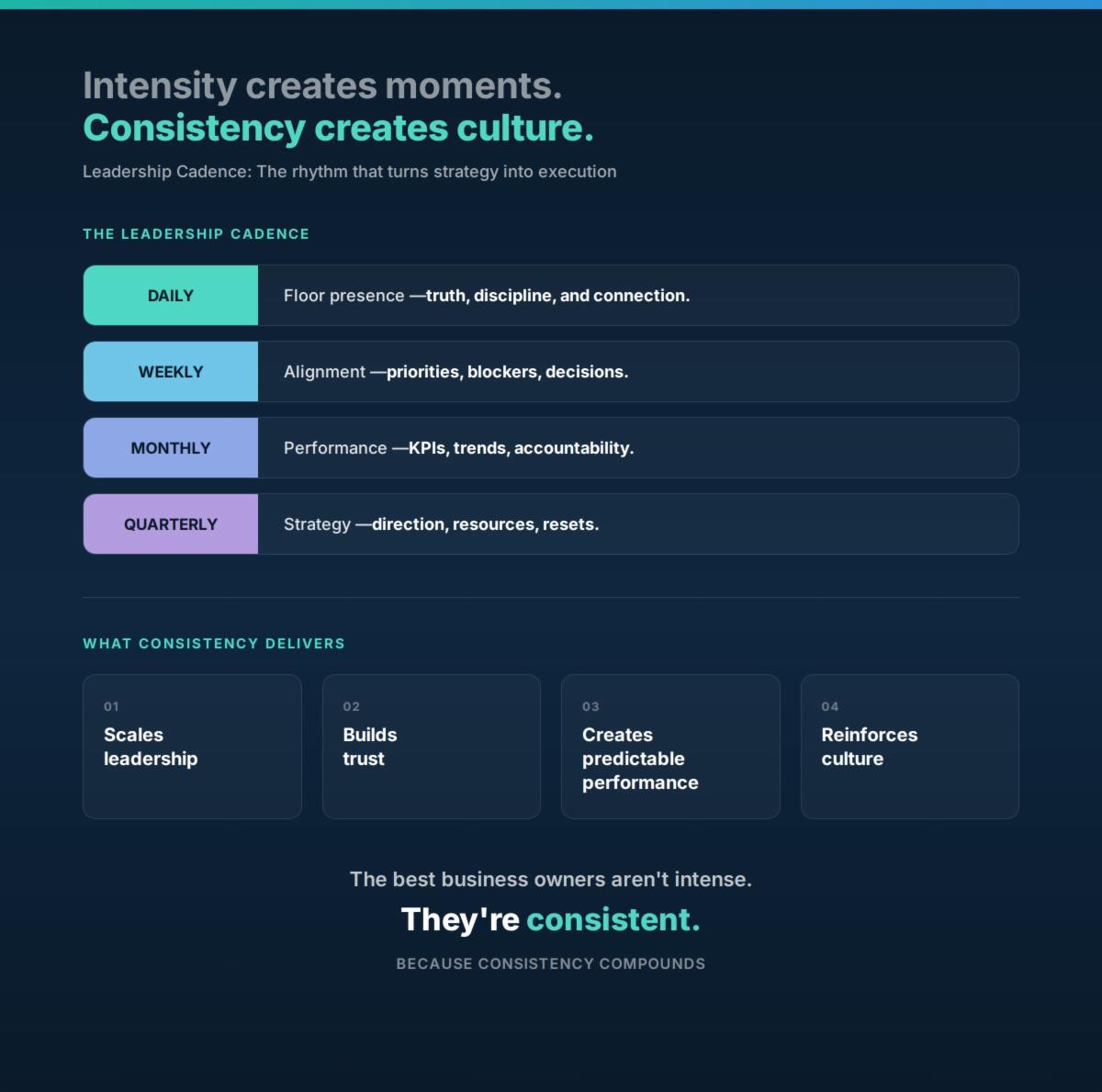
Consistency isn't a mindset. It's a system, built on a rhythm that touches the business at every altitude:
Daily floor presence = truth, discipline, and connection.
Being where the work happens, every day, tells the team the truth about how things are actually going — not the version that gets reported up the chain. It reinforces discipline because standards are being observed, not just stated. It builds connection, because people trust leaders who show up consistently more than leaders who show up only when something breaks.
Weekly alignment = priorities, blockers, decisions.
A weekly rhythm keeps the leadership team focused on what matters most right now, surfaces what's in the way, and forces decisions instead of letting issues linger. Without it, priorities drift and small blockers become large ones.
Monthly performance = KPIs, trends, accountability.
Zooming out once a month reveals the trend behind the noise of daily activity. It's where accountability gets real — not based on effort or intentions, but on results measured against the numbers that matter.
Quarterly strategy = direction, resources, resets.
Every quarter, leadership has to step back far enough to ask whether the business is still pointed at the right target, whether resources are allocated to support that direction, and where a reset is needed before small misalignments compound into bigger problems.
Each layer of this cadence serves a different purpose. None of them replace the others. Daily presence without quarterly strategy produces a business that's busy but directionless. Quarterly strategy without daily presence produces a plan that never touches the floor. The cadence only works as a complete system. Every time it runs on schedule, it reinforces the culture a little more deeply than the time before.
Consistency Scales Leadership
A business owner's intensity does not scale. It can push a team through a single crunch, but it can't be everywhere, every day, indefinitely — and it burns people out when it tries.
A cadence scales. Once daily, weekly, monthly, and quarterly rhythms are built into how the business operates, leadership's influence doesn't depend on the owner's personal energy that day. It's embedded in the system — and in the culture that system reinforces. Managers run their own version of the cadence. Expectations repeat themselves without the owner having to repeat them personally, because the culture itself now carries the standard.
That's what allows a business to grow past the point where the owner can control everything directly. Consistency is what lets leadership multiply itself through the organization instead of being bottlenecked by one person's attention.
Consistency Builds Trust
Trust is built through predictability. When leadership shows up the same way, asks the same questions, and holds the same standards regardless of mood or circumstance, people learn they can rely on it. That reliability is what allows teams to take initiative, make decisions, and move without waiting for permission because they trust the framework. Inconsistent leadership erodes that trust quickly, even when intentions are good. A leader who is highly engaged one week and disengaged the next teaches the team that engagement is unpredictable. A leader who holds a standard sometimes and lets it slide other times teaches the team that the standard is optional. Trust isn't lost through one bad moment — it's lost through inconsistency over time.
Consistency Creates Predictable Performance
Performance that depends on intensity is volatile. It spikes around deadlines and dips in between. Performance that depends on cadence is steady, because the business isn't waiting for a push — it's running on a rhythm that surfaces problems early, keeps priorities visible, and holds accountability constant.
That predictability is what makes a business valuable, scalable, and less dependent on any single person, including the owner. It's also what makes growth manageable instead of chaotic because the systems that drive performance don't have to be reinvented every time the business gets bigger.
Consistency beats Intensity
The most effective business owners aren't the ones who show up loudest during a crisis. They're the ones whose presence, standards, and expectations are so consistent that a crisis rarely gets the chance to build in the first place. Their teams aren't waiting for a signal to perform. They already know what's expected, because it hasn't changed in months. That repetition is what turns a stated value into a lived one. Culture isn't built by what an owner says once. It is reinforced by what an owner does on repeat.
This is a harder discipline than intensity. Intensity is easy to summon for a day. Consistency requires showing up the same way on the days that feel unremarkable — the slow Tuesday, the quiet month, the quarter where nothing is on fire. Those are exactly the moments where consistency does its most important work, because they're the moments no one expects leadership to matter.
The Business Owner's Job Is to Make Consistency the Brand
Every leadership team eventually reflects the standard the owner keeps — not the standard the owner announces. If the daily, weekly, monthly, and quarterly cadence is real, it becomes the operating rhythm of the business. If it's occasional, it becomes optional for everyone else too. Culture is not built in the announcement. It's built in the repetition — and every repetition either reinforces the culture an owner wants or quietly erodes it.
The business owner's job isn't to be the most intense person in the room. It's to be the most consistent one — to build a cadence the rest of the organization can set its clock to, and to protect that cadence even when it would be easier to skip it for a week. Every time that cadence holds, it reinforces the culture a little more. Every time it slips, it reinforces the opposite lesson just as effectively.
Because consistency compounds. Every daily walk of the floor, every weekly alignment meeting, every monthly performance review, and every quarterly reset adds to the one before it. None of them look like much on their own. Together, over quarters and years, they don't just support the culture — they become it. That is what intensity alone can never do.
The question isn't whether you should make this shift. It is what's keeping you from starting today?
Question for You to Ponder
Are you ready to lead your business to its Pinnacle?
Outcome (if you act)
More profit and a better quality of life.
Call to Action
-
Ask me for a copy of the Path to Pinnacle
- Schedule a Meeting with Me
Our Mission: Accelerate Profitable Growth and Improve Execution
|