Wednesday Weblog April 8, 2026

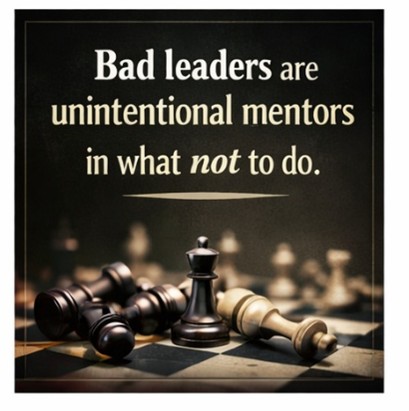
Quote of the Week

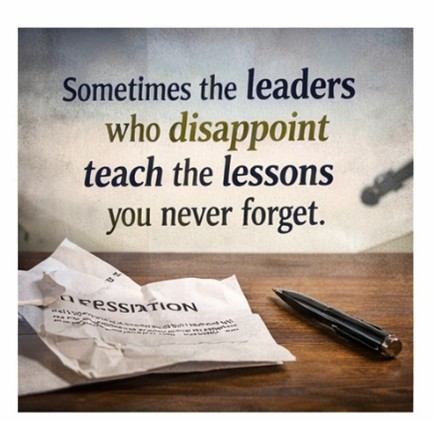
Leading Off: Bad Bosses Teach Too

If you are a reading this and you are a leader, you've accumulated a lot of knowledge over the years, but one of the sources of knowledge that is rarely talked about are the terrible leaders you had at some time in your past.


We've all had bad bosses. It was terrible working for them. But what we don't think about very often is how much those poor leaders taught us or impacted our style moving forward.


In one of my earlier blogs I wrote about a bad boss and my way of dealing with him. I realized there were only three answers when he was trashing me:

  1. I 'messed' up (you know what I mean)
  2. I'm on my way.
  3. I 'messed' up and I'm on my way.


We don't stop to think about how much of any of our 'good' leadership style is a function of what we learned NOT to do. A recent Instagram post motivated me to explore this kind of leadership development.

Leadership Development the Hard Way

Occasionally I have been accused of being a good leader. And I’ve talked about the training I’ve received that helped me get there.


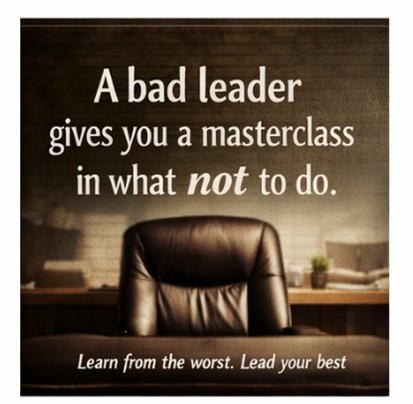
But what I haven’t shared is how I learned the most about leadership. I learned what NOT to do from bad leaders. If you pay attention to bad leaders, and how they make you feel, you can become a good leader faster and be more effective. At least that’s how it worked for me.

  • There’s a version of leadership development that doesn’t show up in any training manual.
  • You don’t sign up for it. You don’t get a workbook. And there’s no certificate at the end.
  • You just… experience it.

Most people can point to a great leader who shaped them.


But if you’re honest—and most people are, eventually—you can also point to a bad one who taught you even more. Not by what they did right but by what they got wrong.


I’ve seen it over and over again in organizations. The leaders people remember most clearly are often the ones who missed the mark—because the impact lingers. It sharpens your awareness. It forces you to decide what kind of leader you’re going to be. And sometimes, that education shows up in powerful ways.

This Instagram post is the story of ‘Emma.’


Her resignation letter made the CEO go silent for twenty minutes... Emma cleared out her desk at 5 AM. Left the letter on his chair. No drama. No scene. Just two pages of gratitude. "Thank you for teaching me what leadership isn't." Then came her lessons:

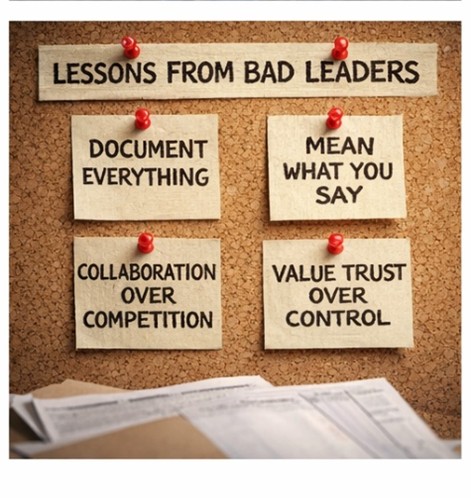
·        "When you took credit for the Harrison campaign, you taught me to document everything."

  • "When you promised three promotions that never materialized, you taught me words without action mean nothing."
  • "When you ranked us against each other quarterly, you taught me competition inside kills collaboration."
  • "When you called weekend meetings for Monday's agenda, you taught me fake urgency is about control, not deadlines."

Fifteen examples. Fifteen lessons. Each one specific. Each one true. The worst part? She meant every word. No sarcasm. No bitterness. Just genuine appreciation for the education.


"You showed me exactly the leader I refuse to become." He found it Monday morning. Read it once. Read it again. Read it again. Called her cell. Straight to voicemail. His assistant heard something she'd never heard: Nothing.


For twenty minutes, he sat there. One of his best people. Gone. No notice. No warning. And every word aimed at him. When he finally emerged, he asked: "How many others feel this way?" His assistant looked at the floor. That told him everything.


Emma? She's running her own team now. They've never met her old boss. But they know him. Through every decision she doesn't make for them. Every credit she doesn't take from them. Every promise she keeps to them. Her team thinks she's a natural leader. They're wrong. She was trained by the worst. And learned exactly what not to do. Sometimes the best teachers are the ones who show you exactly who you never want to be.

There’s something about that story that sticks. Not because it’s dramatic—but because it’s believable.


Most people won’t write the letter. But many have lived some version of it.


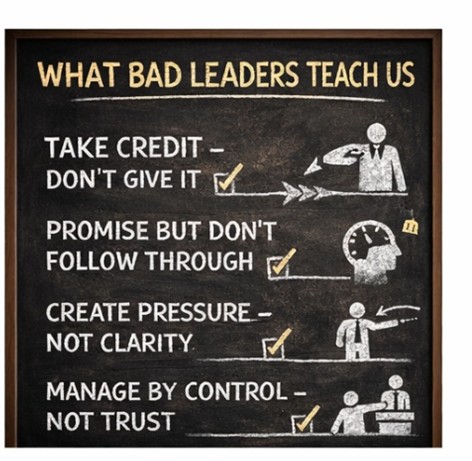
They’ve worked for someone who:

  • Took credit instead of giving it
  • Promised instead of delivering
  • Created pressure instead of clarity
  • Managed through control instead of trust

And here’s the part that matters… They didn’t just experience it—they learned from it.


That’s the pivot. Bad leadership, by itself, just creates frustration. But reflected on, it becomes instruction.


It teaches you:

  • What trust actually looks like
  • Why consistency matters more than charisma
  • How quickly credibility erodes
  • And how closely people are always watching

In a strange way, some of the clearest leadership standards are formed in the presence of poor leadership. Because you feel the impact. And once you feel it, you don’t forget it.


The real question isn’t whether you’ve worked for a bad leader. Most people have.


The question is: What did you do with that experience?


Did it make you cynical? Or did it make you intentional? Because the best leaders I know didn’t just move on—they made decisions.

They decided:

  • “I will always give credit.”
  • “I will say what I mean—and follow through.”
  • “I will create clarity, not chaos.”
  • “I will have the conversation instead of avoiding it.”


They didn’t become great in spite of bad leadership. In many ways, they became great because of it.

There’s a line I’ve come to believe over time:


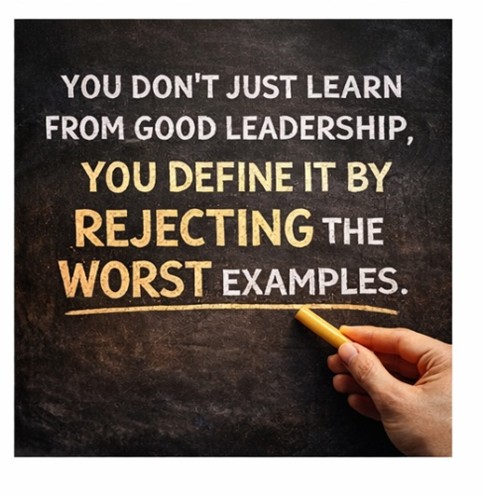
You don’t just learn leadership from the best examples. You define it by rejecting the worst ones.


And if you’re leading today, there’s a quiet responsibility that comes with that.


Because whether you intend to or not… You’re teaching someone.


The only question is: what are they learning?

Surprise Photo at the End:

Joe's Positive Post of the Week

Join the Smart Subscribers

If you are reading this on a social media platform, click below and you'll automatically receive a 'different' story every week on Wednesday.

The Roll Call of states and countries where readers reside: Arizona, California, Colorado, Connecticut, Delaware, Florida, Georgia, Hawaii, Illinois, Indiana, Iowa, Kansas, Kentucky, Louisiana, Maine, Massachusetts, Michigan, Mississippi, Missouri, Montana, New Hampshire, New Jersey, New Mexico, New York, North Carolina, North Dakota, Ohio, Pennsylvania, Puerto Rico, Rhode Island, South Carolina, South Dakota, Tennessee, Texas, Vermont, Virginia, Washington and Washington DC, Wisconsin plus Canada, Conch Republic, Australia and the United Kingdom.

Weblog Archive

Refer a friend to Sign Up for the Wednesday Weblog


Ed Doherty

774-479-8831

www.ambroselanden.com

ed-doherty@outlook.com

Forgive any typos please.