Weekly update from the National Housing Conference | | News from Washington | By Brittany Webb | | |
21st Century ROAD to Housing Act passes the House
An amended version of the 21st Century ROAD to Housing Act passed the U.S. House of Representatives by an overwhelming bipartisan vote of 396-13, marking the latest movement of historic affordable housing legislation within Congress. The bill represents a much-negotiated set of provisions that span the breadth of the housing industry: including removing the permanent chassis requirement for manufactured housing, increasing the public welfare investment cap that banks use to invest in Low-Income Housing Tax Credits, updating the HOME Investment Partnerships (HOME) program, decoupling rural housing rental assistance from maturing mortgages, streamlining environmental regulations, studying small dollar mortgages, and strengthening community bank role in housing, among many others. Notably, a Build-to-Rent exception was added to the institutional investor language, addressing a major criticism from housing advocates that called for further negotiations after the Senate passed its bill including a wide prohibition. Institutional investors that own over 350 homes will still be blocked from purchasing additional existing single-family homes that are not being built specifically as rental homes under the House bill, a priority for both President Trump and Elizabeth Warren (D-Mass.) who co-led the Senate bill with Tim Scott (R-S.C.) as leadership of the Senate Banking Committee.
The bill will now head back to the Senate for consideration of its changes with the support of the White House and many housing advocates behind it. The Trump administration, after an earlier push for the House to take up the Senate’s version without any changes, issued a formal statement of support for the House amendment in the hours before the vote.
“Today, we proved Washington still works. After months of bipartisan, bicameral negotiations – and with the partnership of the Trump Administration – the House delivered to make housing more accessible and affordable for American families. I urge the Senate to move expeditiously to get our amended bill to President Trump’s desk and deliver the relief Americans have been waiting for,” stated House Financial Services Committee Chairman French Hill (R-Ark.).
The bill’s next steps are unclear, though hopeful. Senators Scott and Warren issued a joint statement after the House passed their amendment, noting that they also passed “a strong, bipartisan housing bill because families across this country need relief from unaffordable housing costs and a fair shot at the American Dream…There’s still work to be done and we are committed to continuing to work with the White House and our colleagues in the House on a housing bill that can pass the Senate and get to the President’s desk.”
NHC issued a statement in strong support of the House bill and joined a coalition with many other housing stakeholders celebrating its passage, and will continue advocating for final passage.
“This package reflects substantial bipartisan collaboration and incorporates many policies that have previously received broad bipartisan support in both chambers of Congress. The House legislation represents significant progress and a strong foundation for further action,” NHC stated. “We urge the Senate to move quickly to take up this legislation and continue the bipartisan work needed to address the nation’s housing affordability crisis. While no single piece of legislation is perfect, this bill reflects meaningful cooperation across party lines and provides a strong foundation for expanding housing supply and improving affordability in communities nationwide.”
| | | |
Sponsorship Opportunities Available
Aligning your organization with the Gala and its honorees enhances your visibility, engagement, and networking opportunities. Supporting one another and working collaboratively across sectors, we strengthen our collective ability to address the nation’s most pressing affordable housing challenges.
Please consider supporting this year’s honorees and NHC by purchasing a ticket and/or becoming a Gala sponsor. Sponsorship opportunities begin at $3,500. You can also show your support by placing an ad in the Gala Tribute Book. New for 2026, we’re offering the opportunity to display a digital ad onsite at the Anthem.
It’s a meaningful way to celebrate the accomplishments of this year’s honorees or highlight your commitment to our shared mission. Tribute Book ads start at $750 and digital ads start at $325. You can also choose to have your name listed in the Gala Tribute Book for $250. Click here to learn more about these opportunities and here to view a list of current sponsors.
| |
HUD releases recommendations for construction streamlining
The U.S. Department of Housing and Urban Development (HUD) released a new report calling for broad deregulation and reductions to federal barriers slowing housing development. The report, titled State and Local Best Practices for Home Construction, offers a list of suggested best practices divided into three categories: Cost, Land, and Time. It responds to an Executive Order from President Trump telling HUD to outline permitting and zoning practices that encourage housing development. Recommendations span a range of topics, including streamlining environmental reviews, modernizing building requirements, reducing zoning and land-use restrictions, and simplifying federal housing programs in an effort to increase affordable housing supply and lower development costs.
“HUD is encouraging our state and local partners to take inventory of their regulations and policies and make changes that will lower the cost to build and enable more efficient housing supply growth. These Best Practices are an initial list of recommendations to facilitate growth while respecting communities’ unique needs. Adding efficiency to local building processes will result in more affordable homeownership opportunities for all Americans,” stated HUD Secretary Scott Turner.
HUD’s research arm, PD&R, also recently reflected on how to accelerate housing production through overview of various supply playbooks and guides to increase the supply of housing.
| |
House releases THUD funding bill
The House Appropriations Subcommittee on Transportation, Housing and Urban Development, and Related Agencies (THUD) released its draft FY27 appropriations bill and voted to advance it to the House Appropriations Committee, due to vote on it June 4. The bill appropriates a total of $71.38 billion for HUD, $5.94 billion below FY26.
The bill provides $38.08 billion for Tenant-Based Rental Assistance, a small reduction from FY26, and $18.98 billion for Project-Based Rental Assistance, a small increase from FY26. Homelessness assistance grants are provided $4.16 billion, a six percent decrease. It would further decrease funding for Public Housing operating and capital funds. In a deviation from the President’s Budget request, $500 million in funding is provided for the HOME Investment Partnerships (HOME), a positive sign despite representing a $750 million decrease from FY26. Community Development Block Grant (CDBG) programs are also provided $100 million and the Family Self Sufficiency program $125 million; both had been zeroed out in the President’s budget. The bill would further exempt FY27 and prior-year funding for HOME, CDBG, Public Housing Operating and Capital Funds, the Self-Help Homeownership Opportunity Program, and Native American Programs from Build America, Buy America requirement- welcome news to many supply-focused affordable housing advocates.
"The Fiscal Year 2027 Transportation, Housing and Urban Development, and Related Agencies Appropriations bill builds on the work we accomplished last cycle to ensure our nation’s transportation and housing infrastructure and programs best serve the needs of the American people…. It also invests in housing and wrap‑around services for our nation’s most vulnerable – such as women, children, and veterans – while advancing policies that make housing more affordable for all Americans,” said THUD Subcommittee Chair Steve Womack (R-Ark.).
|
| | |
Labor groups call on HUD to revise BABA waivers
A coalition of eight unions sent a letter to HUD urging the department to streamline implementation of Build America, Buy America (BABA) requirements for affordable housing projects, arguing that delays in the waiver process are slowing housing production. BABA has strong support from labor in requiring that construction materials and manufactured products used in federally funded infrastructure projects are produced domestically. However, affordable housing advocates have sought exemptions on the requirements for years in order to reduce the cost of developing much needed affordable housing. A waiver process for affordable housing projects is in place, but heavily criticized as inefficient and ineffective.
The labor letter recognizes this need directly, stating that it is “critical that HUD adopt a more targeted, transparent, and predictable waiver process that ensures timely project delivery while supporting the domestic manufacturing goals of Buy America. Without timely administrative improvements, HUD risks undermining housing delivery, construction and manufacturing jobs, and the domestic manufacturing investments that BABA is intended to support.” The groups recommended accelerating project-specific waiver reviews, improving transparency through online tracking tools, and dedicating additional staffing resources to waiver processing.
The BABA waiver process was also raised at a Senate appropriations hearing, Senate Appropriations Chair Susan Collins (R-Maine) criticized HUD’s waiver system, calling it “the black hole where affordable housing dies”, while Transportation-HUD Appropriations Subcommittee Chair Cindy Hyde-Smith (R-Miss.) called for improvements to the process. HUD Secretary Scott Turner responded that the department is working to streamline waiver reviews and improve internal systems.
| |  | |
AHF releases top 50 developers and owners
Affordable Housing Finance (AHF) released its annual rankings of the nation’s top affordable housing developers and owners, highlighting continued activity in affordable housing production and preservation despite ongoing market headwinds. The developer list is topped by Lincoln Avenue Communities, Kittle Property Group, and LDG – while the owner list is topped by Starwood Capital Group, The Michaels Organizations, and L+M Cos.
The rankings come as affordable housing construction activity has slowed. According to the publication’s related market survey, higher interest rates, elevated insurance costs, construction expenses, tighter financing conditions, and delays in obtaining subsidies have contributed to declining construction starts across the sector. Developers started construction of nearly 45,000 units in 2025, a 2.3% drop compared with 2024’s cohort. Affordable unit completions, however, increased by 18% over the same period for a total of 42,217 units. The 50 firms project starting 56,000 units in 2026.
| | | |
Housing prices outpace incomes across U.S. metros
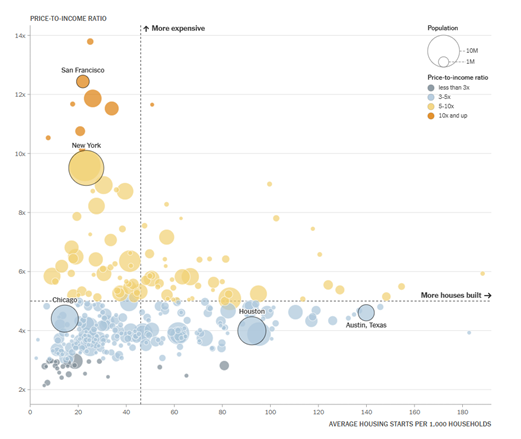
Newly published research from the Editorial Board at The New York Times shows where price-to-income ratios have climbed to record or near-record highs, arguing the Board’s opinion that America needs to build more housing. When comparing price-to-income ratio with average housing starts across cities, major cities like San Francisco and New York sit at the top with high ratios and low housing starts, while some smaller metros like Atlanta and Austin show more homes built and consequently lower housing cost burdens. Other cities like Bend, Oregon and Las Vegas are building housing but prices remain high. The data exemplifies that supply- constraints drive a large gap in housing affordability and greater price-to-income pressures throughout the country, and the Board recommends loosening zoning laws and reviewing bureaucratic processes for building to help address pricing pressures.
| | |
An article from HousingWire examines how lenders are grappling with pricing loans fairly as the industry shifts to modern credit scores like VantageScore 4.0 and FICO 10T. The article explains that many lenders are using temporary score adjustments and multiple-model checks because the new scores can produce very different results, raising concerns about default risk, prepayment risk, and loan pricing. It also highlights worries about cherry-picking and model calibration suggesting the transition will require ongoing monitoring.
The GAO published findings from the Federal Reserve Bank of New York on Hurricane Maria’s effect on Puerto Rico’s mortgage market – which were ultimately mild or short-lived. It notes that delinquency rates, which were already above 10% when Maria hit, roughly tripled by November 2017 but returned to pre-Maria levels within a year, while foreclosures declined during the foreclosure moratorium and then rose briefly before settling back to prior trends. The report also found that mortgage insurance and government guarantees helped limit bank losses, and that Puerto Rico’s homeownership rate in 2017 was similar to the mainland’s even though fewer owners held mortgages.
The Wall Street Journal reported that home builders are facing a wave of construction-defect claims tied to issues like cracked walls, sticking doors, and other workmanship problems. The article says the disputes are creating major legal and financial pressure for builders, while some industry voices argue that lawyers are driving homeowners to file more claims than before. The piece notes a Nevada couple that had bought a new home, only to be told by the engineer that their foundation had settled several inches. Individual homeowner cases are becoming a major issue for the industry, especially for large builders that have expanded rapidly in recent years.
Urban Institute published a blog highlighting that better local data are key to understanding affordability pressures in Asian American, Native Hawaiian, and Pacific Islander communities. The article notes that 63% of AA and NHPI New Yorkers do not earn enough to meet their true cost of living, compared with 44% of White New Yorkers, and argues that broad averages hide major differences within AA and NHPI groups. It also points to wide poverty-rate variation across detailed racial and ethnic groups and says New York City’s data-equity efforts and community-led approaches could help make affordability policy more responsive to local needs.
| | |
Monday, May 25
Happy Memorial Day!
Tuesday, May 26
Wednesday, May 27
Returning Home: Supporting Senior Homeowners | Enterprise, 12:00 PM – 1:30 PM PT
NSPIRE for Vouchers Webinar: "Get Ready", 2:00 PM – 3:30 PM ET
Thursday, May 28
Rethinking Federal Place‑Based Policy: What Comes Next? | Urban Institute, 1:00 PM – 2:00 PM ET
DRGR for PRICE and PRO Housing Grantees Webinar Series: Action Plan, Activities, and Budgets, 2:00 PM – 3:30 PM ET
Friday, May 29
| | The National Housing Conference is a diverse continuum of affordable housing stakeholders that convene and collaborate through dialogue, advocacy, research, and education, to develop equitable solutions that serve our common interest. | | Defending Our American Home since 1931 | | Copyright © 2024. All Rights Reserved. | | | | |