Monthly News & Opportunities


October 8, 2026 | V3 #10


Three CNTR Studies--COVER, BRIDGE & CryoFIRST--Now Enrolling Patients

Three studies in CNTR’s clinical research portfolio have reached an exciting milestone: Combined OFM & Vacuum-assisted therapy for Expedited Regeneration over exposed structure (COVER); Bridging Readiness in Deployed Neurotrauma Gaps for Excellence (BRIDGE); and Cryoprecipitate for Immediate Resuscitation in Severe Trauma (CryoFIRST) are now enrolling patients. 


The studies tackle very different challenges in trauma care—from complex wounds and penetrating brain injuries to life-threatening hemorrhage—but share the goal of generating evidence that can improve outcomes for injured patients.


Reaching active enrollment is a major milestone in the life of any clinical study, requiring months—and often years—of collaboration among investigators, research teams, participating sites, funders and partners.


With all three studies now enrolling, these projects are moving from planning and preparation to the patients and data that can ultimately help advance trauma care.


Founding Board Member Dr. Don Jenkins Receives Innovation Award


Donald H. Jenkins, MD, FACS, a pioneering trauma surgeon whose career has helped reshape both military and civilian trauma care, received the 2026 Innovative Clinical Care Award from BioMedSA at its annual awards ceremony in September.


A founding member of the National Trauma Institute (the precursor to CNTR), Dr. Jenkins is professor of surgery and vice chair for quality at UT Health San Antonio. He was selected for innovations that have had a profound impact on trauma care in South Texas and nationwide.


Among his most notable contributions is his leadership in developing and implementing the region’s whole blood rotation system—known nationally as the “San Antonio Model”—which makes low-titer O-positive whole blood available to emergency responders before injured patients reach the hospital.


The approach provides lifesaving blood earlier while creating a sustainable system that minimizes waste, and it has since been adopted in communities across the country.

Trainees Advance Access to Prehospital Blood

What began as a collection of independent research projects has grown into a coordinated effort to expand access to prehospital blood products.


The Students, Residents, and Fellows Trauma Advocacy Coalition (SRFTAC)—a new CNTR Affiliate Member—brings emerging clinicians together to turn evidence into practical tools for improving trauma care.


In a recent conversation with CNTR, Hannah Borland, a fourth-year medical student at UT San Antonio, described the group’s evolution. Projects conducted under the mentorship of Donald Jenkins, MD, provided the foundation, while research resident Alex Bowers, MD, subsequently helped formalize those efforts into a structured organization spanning medical schools and trauma centers. Its members bring perspectives from medical training, military service, and emergency medical care.


A central achievement is the development of advocacy materials for all 50 states. Combining sample letters to governors, cost analyses, and research summaries, these packets give advocates a starting point for making the case for whole blood programs.


The materials are available through the coalition’s online resource library.


The group contributed utilization data and per-capita cost modeling to support advocacy in Texas, where lawmakers last year approved $10 million for a statewide prehospital whole blood pilot program.

Three Years of Patient Partnership: IREP Looks Ahead to 2027


For three years, members of CNTR’s Injury Research Engagement Panel (IREP) have brought an essential perspective to trauma research: the voices of patients, family members and caregivers who have experienced traumatic injury and its aftermath.


Since October 2023, 28 patients and caregivers have joined the panel, 26 projects have been reviewed, and 15 investigators have invited panelists to serve as patient partners on their studies. Three IREP members have won PCORI travel scholarships to attend its annual meeting, and several more served on a committee of the International Consortium for Health Outcomes Measurement that defined a globally standardized set of patient-centered outcomes measures for adults with major injury.


Panel members recently took time to reflect on their work together, discussing what the panel has meant to them, what has worked well, what they might like to change, and how they should evolve in the years ahead. The milestone also comes with a fresh look: the group adopted a new logo!


Bring Your Research to IREP

IREP was created to make it easier for trauma investigators to meaningfully engage patients and caregivers as they conceptualize and conduct research. The panel represents a range of lived experiences with injury and is designed to help investigators ensure that their research questions and outcomes are meaningful, respectful, trauma-informed and relevant to the people ultimately affected by the work.


Investigators can bring studies and proposals to IREP at any stage of development. 


Next Session:

February 17, 2027, from 6:00–7:15 p.m. CT

REMINDER: The NTRR Has Closed, But CDE Use is Still Strongly Encouraged!


Although the National Trauma Research Repository (NTRR) has closed, CNTR remains committed to data harmonization and has made available on its website the small set of core common data elements (CDEs) and five sets of basic CDEs that were identified and defined through the course of the NTRR project.


These CDEs are appropriate for collection in studies that focus on the care environments of epidemiology, prehospital, acute hospital, outcomes & rehabilitation, and social determinants of health (SDOH). Using CDEs ensures interoperability of data and enables secondary analyses that can answer new questions.

CNTR Investigator Resources

Visit Our Trauma Research Methodology Webinar Archives

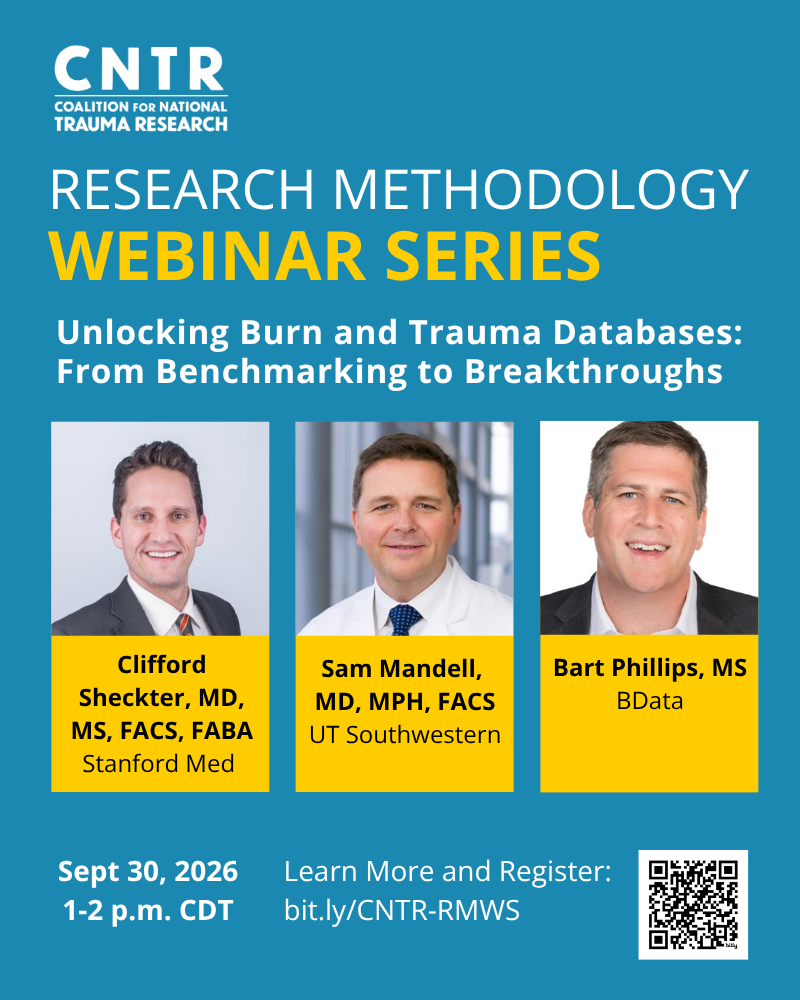
To assist surgeon-scientists and the researchers that support them in study design, conduct and analysis, we developed the CNTR Research Methodology Webinar Series. This educational series is designed to provide the specialized expertise that will help researchers conduct studies with impact.


A recording of the most recent session, "Unlocking Burn and Trauma Databases: From Benchmarking to Breakthroughs," has been added to the webinar archive. Our next topic and date will be announced soon.

 
LinkedIn