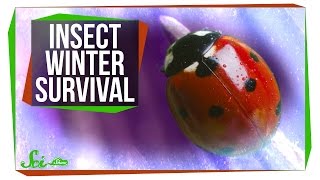
This week's LIO focuses on all the insects around us during these cold winter months! Learn all about the unique and creative solutions that help many insects survive the harsh elements and how climate change is impacting our ecosystem. Some insects like the monarch butterfly migrate in the winter to warmer climates, but many insects gain shelter and nourishment through the winter in a variety of micro-habitats. Some, like snow fleas, burrow in the soil or in leaf litter to escape the cold. Others, like dragonflies, spend winter beneath the ice. Honey bees remain semi-active in hollow trees with caterpillars.


Even though it may seem like nature is quieting down around us during this time of the year, there is a ton of activity that we can observe and learn about! Be sure to check out our Step Outside Nature Guide to learn more about Active Winter Insects!


Grades K-4

Snow Fleas

This simple activity offers teachers an easy and enjoyable means of getting students outside in winter. It provides suggestions for organizing a successful search for snow fleas/springtails that include helpful hints about the best times and locations to find and observe these active winter insects in the schoolyard. While written for use in primary grades, the activity itself will be of interest to older students as well.


Activities

Grades 5-8

How Do Insects Survive the Winter?

Birds fly south, humans bundle up, but what do insects do to survive the winter? From creating antifreeze-like alcohols to burrowing in the ground, insects have a few solutions of their own. Learn more about diapause, natural antifreeze and those that throw in the towel when the temperatures drop, but not before helping their eggs and larvae prepare for the winter. Discover how climate change is affecting the overwintering strategies of some insects.


Activities

  • Watch Snow Fleas to learn more about these insects. Get outside with some magnifying glasses and look for snow fleas
  • Walk through the schoolyard or nearby park and have students look for strange things on stems, branches, or plants' leaves. Look for things that are different. Have them remove a gall from a plant for the Bugsicles experiment below
  • Try Bugsicles – A Frozen Insect Larva You Can Find! students will freeze a gall fly larva, open it and observe it as the larva revives
  • Get outside and play Winter Survival to learn what animals need to survive the winter

Grades 9-12

Deer in the Yard

This engaging outdoor activity will allow students to experience first hand the stress that winter places on many of our iconic animal species. This simulation allows students to investigate further some of the species' key adaptations for winter survival. Students become white-tailed deer and measure the physiological stress that navigating deep snow has on their bodies. 


Activities

  • Get outdoors and have students race through deep and shallow snow to simulate how white-tailed deer adapt to winter conditions
  • These lesson plans have students better understand white-tailed deer biology, adaptations, habitat requirements, management, and impacts on forest sustainability
  • Listen to the podcast Snow Fleas: 400 Million Years Old and Still Springing to learn more about this ancient insect and its ability to produce an antifreeze protein that allows them to survive the winter
  • Animals have some unique adaptations to stay warm. Discover what conduction of heat and insulation have to do with staying warm!

About Learning Inside Out


Above you will find a selection of activities, broken down by various grade levels. These guides will be released biweekly and archived on our Learning Inside Out page, so you can always access the full catalogue.


Some of the activities have been modified from resources on our R4R database, simplified and adapted for both outdoor learning in the school yard or at-home as needed. The activity descriptions above should contain all the information and links that you need!


We want this guide to work for you, so your feedback is invaluable to us.

Please complete the feedback form below, or email us at info@LSF-LST.ca.


Follow us on social media for continued weekly highlights & other exciting opportunities through the school year!

Facebook  Twitter  Instagram  Linkedin  

Please share widely with any parents and teachers in your life!

Learning for a Sustainable Future (LSF) is a Canadian charity with over 25 years of experience working within the education system. Our Resources for Rethinking (R4R) database is an award-winning collection of resources that are peer-reviewed by certified teachers and connected to curriculum in all provinces and territories. R4R is recommended on many Ministry of Education websites.