|
October 2026
Fun activities, aligned with the Pennsylvania Early Learning Standards,
to help prepare children for school success!
| |
Babies
Help your baby notice moving objects outside. Draw their attention to the leaves blowing in the wind, the birds hopping from branch to branch, and the children on their bicycles. Try using touch and smell when appropriate to engage more senses. Get closer, get down on your baby's level, and view how they see the world.
Toddlers
Lay a rope on the ground and have your toddler follow or walk directly on it. Start with it in a straight line, then move it to different shapes (zig-zag, circle, wiggly, etc.). With it in a straight line, ask them to show how they can move across the rope if they're pretending to be an animal, such as a turtle or kangaroo. Watch videos with animals moving to give your toddler more information on how animals move. For children with limited mobility, ask them to try moving the rope with their fingers or eye movements.
Preschoolers
Encourage your preschooler to use a magnifying glass to examine objects found outside. Ask them what they see when looking at different objects using the magnifying glass. Do they see anything with the magnifying glass that they couldn't see without it? This is an excellent opportunity to introduce new vocabulary through braille, sign, written, and spoken words. Explore not only what is seen, but also how it feels and smells.
Kindergartners
Take advantage of the sun by creating shadow monsters! Ask your kindergartner to make different shadow shapes with their body and encourage them to watch how their shadow changes as they move. How does it change when they hold items in their hand (like a ball), open their jacket, or have your hand? Use this opportunity to teach descriptive words like tall, short, small, and round. Make predictions about movement in relation to the shadow. Engage all senses when playing in the sun with shadows, like asking your kindergartner how the sun feels on their skin and what it smells like.
Get more early learning activities on the PA's Promise for Children website!
| |
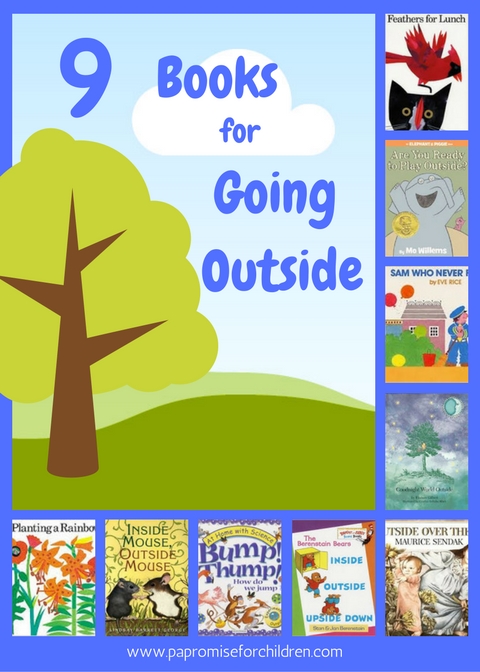
9 Books about going outside
Planting a Rainbow by Lois Ehlert
Inside Mouse, Outside Mouse by Lindsay Barrett George
Bump! Thump! How do we jump? by Janice Lobb
Inside Outside Upside Down by Stan Berenstain
Outside Over There by Maurice Sendak
Are You Ready to Play Outside? by Mo Willems
Feathers for Lunch by Lois Ehlert
Goodnight World Outside by Frances Gilbert
Sam Who Never Forgets by Eve Rice
Print this list!
| |
Share Your Family Engagement Story
Submission deadline Oct. 23, 2026
Meaningful family engagement happens every day, and the Pennsylvania Office of Child Development and Early Learning (OCDEL) wants to hear your story! Family engagement refers to an ongoing partnership between families and professionals, in which families’ strengths, knowledge, experiences, and voices are valued to support their children and families and to strengthen programs, communities, and the broader early childhood system.
In celebration of November’s National Family Engagement Month, OCDEL invites families, early childhood educators, and partners to share a brief story about meaningful family engagement.
Stories can be submitted by a family, by a professional or provider, or jointly by a family and a professional. OCDEL welcomes stories that highlight partnerships happening in many different places and ways, including:
- In the home, as families and professionals work together to support children and family goals
- In early childhood programs and services, where families and professionals partner in planning, learning, and decision-making
- In communities and systems, where family voices and leadership help shape programs, services, policies, and practices
- Stories might highlight Family Voice & Leadership, Family-Professional Partnerships, Systems Change & Impact, or Innovation & Success.
- Through family engagement and leadership initiatives, such as workshops, trainings, Parent Cafés, advisory groups, peer support opportunities, and other activities that help families build leadership skills, connect with other families, and contribute to positive change in their communities and systems.
Selected stories may be featured throughout November to celebrate families and professionals working together, elevate varied family experiences, and inspire meaningful family engagement and leadership across Pennsylvania.
Share your story in the format that works best for you! Submissions may be:
- A written story or article of up to 300 words, or
- A 3–5-minute video sharing your experience and the impact of the partnership.
Submit your story by October 23, 2026.
For Professionals and providers submitting a story: Please obtain consent before sharing stories on behalf of families. If your submission or any accompanying materials (e.g., photos, videos, flyers, or brochures) include images or identifiable information of a child or family, please ensure you have the appropriate permission to submit and share those materials.
Every story matters! While not every submission may not be featured during National Family Engagement Month, OCDEL will continue to look for opportunities to highlight and celebrate shared stories beyond November through future communications and other opportunities.
For questions, please contact OCDEL’s Family Engagement and Leadership Coordinator, Sadia Batool, at c-sabatool@pa.gov.
| |
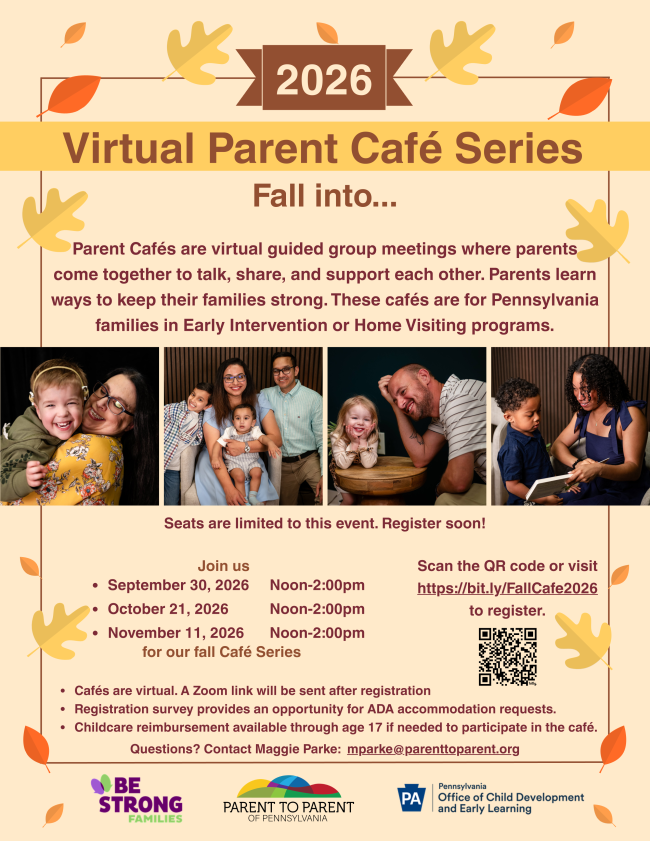
Register Now for the Virtual Parent Cafe' Series!
Parent to Parent of Pennsylvania is offering a Fall 2026 Virtual Parent Café Series for Pennsylvania parents and caregivers whose families are involved with Early Intervention or Home Visiting programs.
Parent Cafés are guided virtual conversations where parents can connect with one another, share experiences, and offer support in a welcoming space. The cafés give families an opportunity to build connections, reflect together, and learn ways to help keep their families strong.
Fall Parent Café Dates:
- October 21, 2026 | Noon–2:00 PM
- November 11, 2026 | Noon–2:00 PM
All cafés will be held virtually on Zoom, and registered participants will receive the Zoom link after registration. Seats are limited, so families are encouraged to register soon.
Register online for the Cafe Series.
The registration survey includes an opportunity to request ADA accommodations. Childcare reimbursement is available for children through age 17 when childcare is needed for a parent or caregiver to participate in the café.
Questions may be directed to Maggie Parke at mparke@parenttoparent.org.
| |
Want to learn more about Pennsylvania’s early learning programs?
Have you ever wondered how Certification and Keystone STARS help ensure children are safe as they grow and learn? Curious if programs like PA Pre-K Counts, Early Intervention, or Family Support might be the right fit for your child?
The Pennsylvania Office of Child Development and Early Learning (OCDEL) has created brand-new videos for families like yours! These short, easy-to-follow videos share everything you need to know.
Take a look—and don’t forget to pass them along to friends and family who might find them helpful too!
The short, family-friendly videos are available in English and Spanish.
-
Pennsylvania's Child Care Certification: What it means for you, English and Spanish
-
Pennsylvania's Child Care Works: Helping Families Afford Safe Child Care English and Spanish
-
Pennsylvania's Early Intervention: Supporting Young Children English and Spanish
-
Pennsylvania's Family Support Programs for Pregnant or Parenting Families of Young Children, English and Spanish
-
Pennsylvania's Keystone STARS: Quality in Child Care English and Spanish
-
Pennsylvania's Pre-K Counts: Providing a Strong Start in School English and Spanish
| |
Reduce the Risk of Choking in Young Children at Mealtimes
Children under the age of four are at a high risk of choking while eating. Created for parents and caregivers of young children, this colorful four-page resource from the USDA Food and Nutrition Services includes tips on:
- Preparing foods to make them easier to chew
- Choking hazards to avoid
- Ways to model and teach good eating habits
- And more!
Download this resource in English or Spanish.
| |
10 Kids' Books about Being Afraid
It’s normal for children to have fears—whether it’s the dark, bedtime, or trying something new. As they grow, those fears may change, and sometimes they may be hard for us to fully understand. But to a child, those feelings are very real.
If your child’s fears seem overwhelming or are getting in the way of daily life, it’s always a good idea to talk with their teacher, doctor, or another trusted health care professional.
Another helpful way to support your child is by reading together. Stories can show children that they’re not alone—and that others have found ways to face their fears, too.
PA’s Promise for Children has put together a list of 10 wonderful children’s books all about being afraid. Check them out and share a story that might bring comfort, courage, and connection.
| |
Encouraging the Development of Fine Motor Skills
From the very beginning, children are busy building their fine motor skills! These small movements of hands and fingers help them explore, play, and learn.
Babies practice by grabbing your finger, holding a rattle, or passing a toy from one hand to another. Toddlers use fine motor skills while eating, playing, and discovering the world around them. By preschool and kindergarten, those early skills grow into big milestones—like writing, cutting with scissors, buttoning clothes, and building with blocks.
Fine motor skills are little movements with a big impact!
Tips to help your child learn fine motor skills
-
Give your child opportunities to explore and manipulate age-appropriate objects. Put your baby down for tummy time to help strengthen their arm, leg, and back muscles. Encourage them to reach and grasp by holding rattles, teethers, or other toys. As your child gets older, they can use their hands to explore items like foods, textures, and more.
-
Encourage use of both hands. Did you know that being left- or right-handed can come from either parent? A study shows that the same genetic markers associated with left-handedness may also play roles in brain development and communication between different brain areas. Although children may not prefer to use one hand until they are as old as six, encouraging them to use either hand means they can explore their world more fully and learn.
-
Expect a mess. Messes can be learning experiences! When your toddler eats spaghetti with their hands or your preschooler digs into the dirt, these are learning experiences that build fine motor skills.
-
Use sign language skills. Before they can talk, babies as young as 4-6 months can begin to learn basic sign language, like more, all done, or milk. These basic signs are ways to communicate and can be steps towards building fine motor skills.
| |
Why Lead is Harmful and How to Keep Kids Safe
Lead has been used in many products, like paint, gasoline, and plastics. However, unlike healthy minerals such as zinc or copper, lead does not benefit the body. In fact, it’s harmful. Once lead enters the body, it stays there for a long time, sometimes decades.
Lead can affect every organ, and because children’s bodies are still growing, they are especially sensitive to its toxic effects.
The good news: there are steps you can take to protect your child from lead exposure. Learn more about how to keep your family safe and healthy! Find out what you can do to keep your child safe from exposure to and the effects of lead.
| |
30 Healthy Snacks for Active Kids
What should you feed your kids before their practice, game, or play? The answer may be more straightforward than you think. Kids know when they are hungry and need a boost of energy. Often that’s after school or child care. Does that mean choosing between spending hours preparing fun snacks and expensive, not-so-healthy fast-food options? No! Homemade kid-friendly after-school snacks can be simple, cheap, quick, and nutritious. Learn more on the Active for Life website.
| |
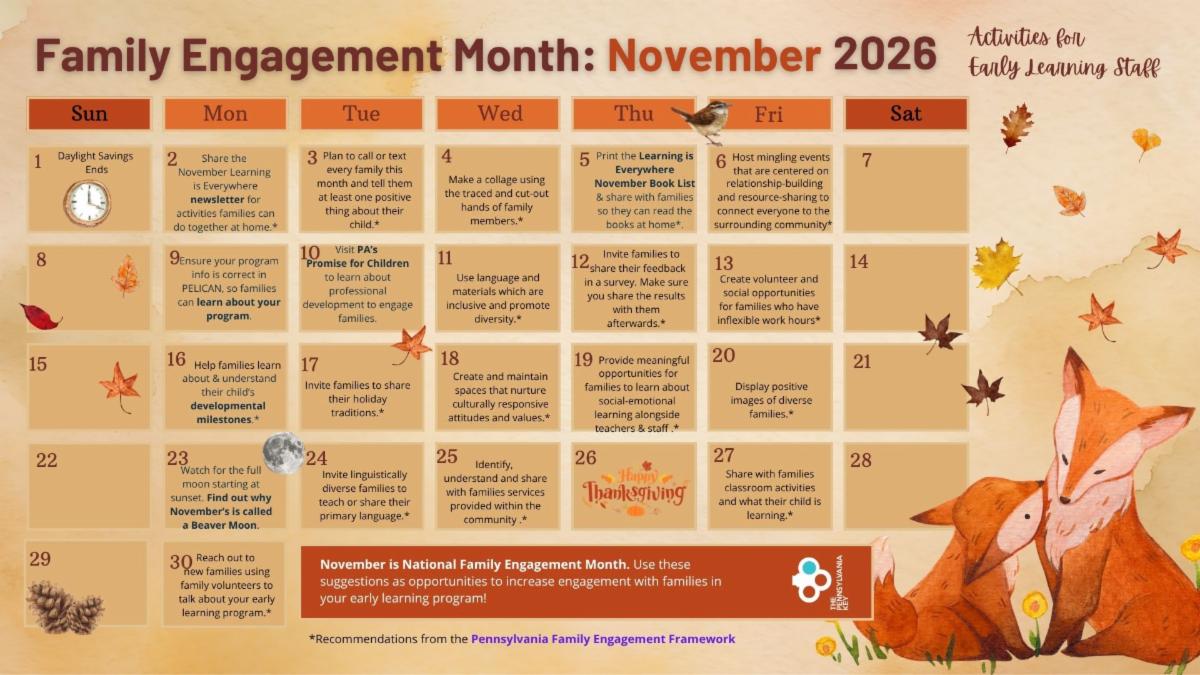
Plan Now for November's National Family Engagement Month: Celebrate Partnerships That Help Children Thrive
November is National Family Engagement Month, a time to recognize that families are a child’s first and most important teachers. Strong partnerships between families and early learning professionals help support children's social-emotional development, school readiness, and long-term success.
To celebrate, early learning programs across Pennsylvania are encouraged to participate in family-focused activities that strengthen relationships and create meaningful opportunities for engagement. The PA Promise for Children Early Learning Calendar of Activities offers simple, fun ways for staff to connect with families throughout the month, including sharing family stories, promoting literacy activities, celebrating family strengths, and creating opportunities for two-way communication and learning.
Whether it's hosting a family reading event, inviting families to share traditions and cultures, sending home engaging learning activities, or highlighting community resources, every effort helps build a welcoming environment where children and families can thrive together.
| | | | |