Spread the Word:
LinkedIn Share This Email

Lecanemab: A $17 Billion Dollar Scam

June 2023

Quick Links


Professional Tutoring Website


Join Me on Youtube


50 Great NCLEX-RN Practice Questions with Thoughtful, Informative Rationales


Visit My Digital Store


Register for My 4-Hour NCLEX Prep Class on Saturday July 22nd

For the latest information please:

Join Our Mailing List!
Schedule a Private NCLEX Prep Class 

To schedule a class please contact us here


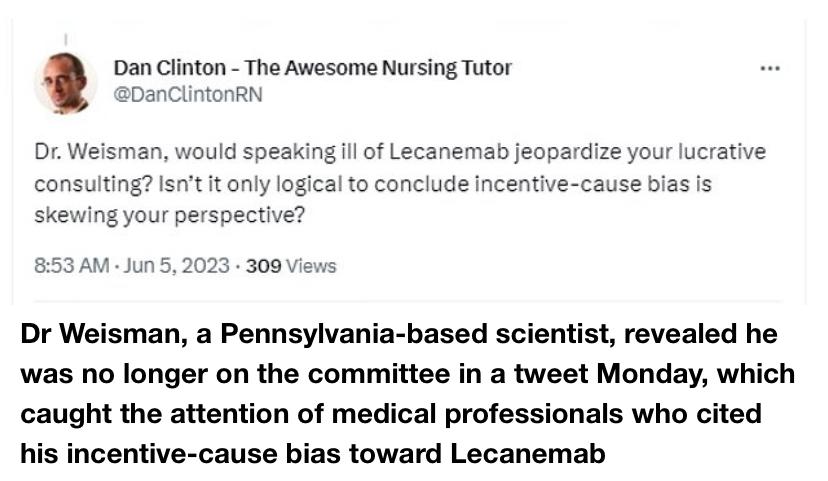
I achieved a very important milestone recently. I was mentioned in a British tabloid. Even better, I did it without having to kiss Madonna or start a fight with Sir Elton John (though I side with Tina Turner in their dust up at Divas 99). One of my tweets was quoted in an article for the Daily Mail as shown below. They actually do some good science reporting. Dr. David Weisman is a neurologist who was set to serve on an FDA Advisory Committee to determine whether to recommend the FDA approve the new Alzheimer's drug lecanemab (Leqembi).


He had received a waiver to serve on the committee after declaring that he was currently consulting for both of the companies (Biogen and Eisai Pharmaceuticals) that own lecanemab. I asked him a fair question in the context of a group discussion.

I believed, and continue to believe, his current employment by the companies in question was a disqualifying conflict of interest because even the most noble, honest, strongminded person could not avoid being influenced by incentive-cause bias in such a situation. Conflicts of interest are common and thought to be inevitable because those perceived as expert enough to serve on the committees almost universally also consult for drug companies and run manufacturer-funded clinical trials. I'd love to see nurses begin to serve on these committees to better safeguard the American people from unsafe drugs.


Others in the conversation reached out to the head of the FDA to express their concerns about such an overt conflict of interest. Dr. Weisman was removed from the committee the next day. Yet, on June 9th the FDA Advisory Committe voted unanimously 6-0 lecanemab showed clinical benefit paving the way for the drug to receive traditional approval which is expected by July 6th.


They're wrong. Lecanemab is neither safe nor effective.

Lecanemab is not safe

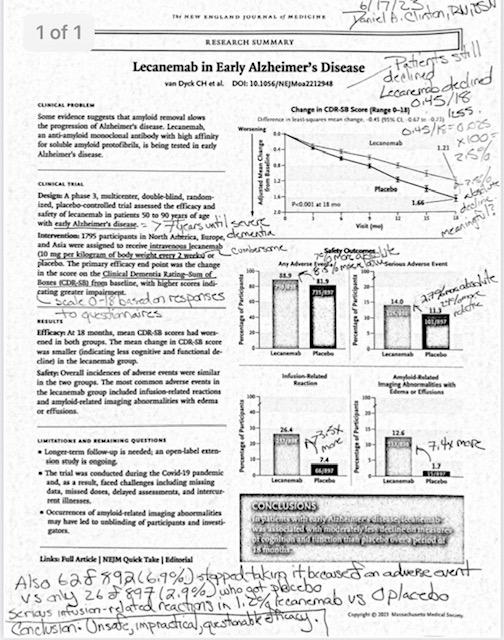
Lecanemab is a monoclonal antibody that removes amyloid-beta protofibrils from the brain. Amyloid plaques are believed to accumulate in the brain causing Alzheimer's disease. It's a feat of biochemistry and drug development that they could design an antibody for such a purpose. The drug was shown on subsequent MRIs to decrease amyloid burden. Regrettably, the drug is unsafe as shown below:

Lecanemab was given intravenously every 2 weeks for 18 months. That's cumbersome and impractical and almost certainly contributed to the 17.2% drop out rate. What concerns me is that the removal of the amyloid protein can damage the brain called Amyloid-related imaging abnormalities (ARIA).


1.2% of patients develop serious ARIA which can cause permanent, severe, irreversible brain damage. Patients with early Alzheimer's still have on average more than 7 years to go until severe dementia. To date, 3 deaths have been linked to lecanemab.

Adapted from Lecanemab in Early Alzheimer's Disease


Lecanemab (N =898)

Placebo (N =897)

ARIA with edema

(brain swelling)

113 (12.6%)

15 (1.7%)

Symptomatic ARIA with edema

25 (2.8%)

0

ARIA with microhemorrhage

126 (14%)

81 (9%)

ARIA with macrohemorrhage

5 (0.6%)

1 (0.1%)

Serious infusion-related reactions

1.2%

0

Based on these results we could logically argue the placebo offers a lower risk of brain damage than lecanemab. There was an 80% lower risk of macrohemorrhage, no symptomatic brain swelling, and no serious infusion-related reactions with placebo! This placebo stuff is starting to sound pretty good. In fact, I could create a drug called Clintoncebo that has a normal saline base plus proprietary secrets. And if patients alternated Clintoncebo for lecanemab (e.g. 1 dose lecanemab, 2 weeks later Clintoncebo, 2 weeks later lecanemab) adverse neurological outcomes would just about halve.

Lecanemab is not meaningfully effective

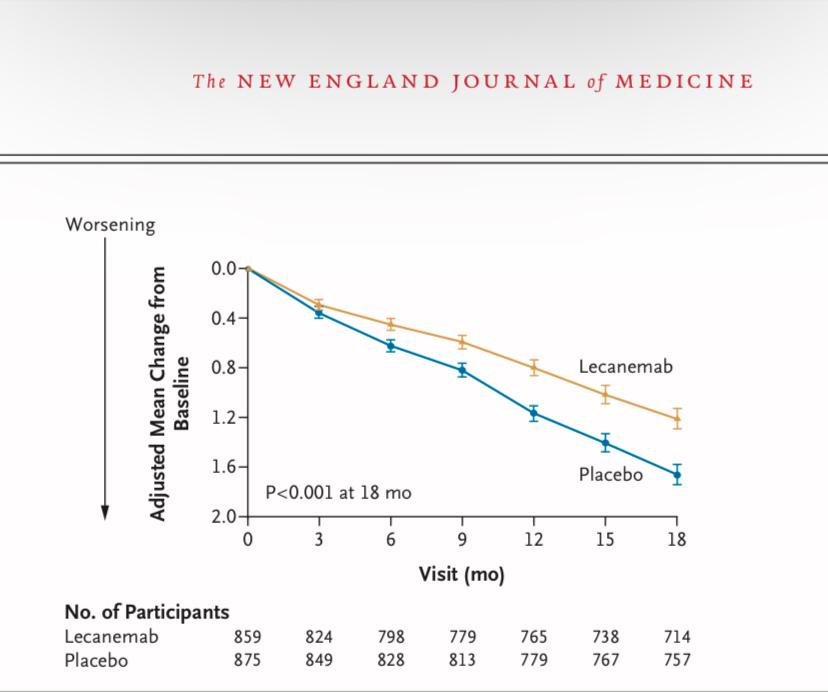
The cognition of patients who received lecanemab continued to decline. It just declined ever-so-slightly less than the placebo group on a scale used to stage Alzheimer's that goes from 0 - 18 based on the results of questionnaires to test memory, orientation, judgment and problem solving, community affairs, home and hobbies, and personal care. That 0.45/18 difference is the same as a 2.5% absolute difference, 27% relative risk reduction. Meaning after 18 months of infusions every two weeks that seriously brain damaged 1.2% and caused 6.9% to withdraw from the study those who got the drug scored 2.5% better on a test given by those funded by the manufacturer in one study designed by the manufacturer that was paid for by the manufacturer whose results were processed by the manufacturer and whose study results were written by the authors in collaboration with medical writers hired by the manufacturer. That is insufficient to establish efficacy.


The authors claim "a definition of clinically meaningful effects in the primary end point of the CDR-SB score has not been established." Previously, a change of 1 (5.55%) was suggested. Professor Alberto Espay describes the difference between the two groups as "If 100 words represented perfect recall and we started the trial remembering 82, after 18 months with biweekly infusions, we could remember 75 or 76, and without, 73," in a petition to the FDA opposing lecanemab's approval.

They want $26,500 per year for this garbage drug

If the FDA fully approves a drug Medicare is required to pay for it. At last we arrive at what's really going on here. There are about 6.5 million Americans with Alzheimer's disease. If 10% of that population is treated with lecanemab Medicare will be forced to pay more than 17 billion dollars for this valueless drug that is neither safe nor effective. This is an attempted robbery of the American people via Medicare. It is a wealth transfer from the American government to Biogen and Eisai. Lecanemab doesn't help those with Alzheimer's; it steals money from those with Alzheimer's. The only ones who will benefit from its approval are the manufacturers. The opportunity cost of spending 17 billion dollars without saving one life while bankrupting Medicare will be felt throughout the country.

Final Thoughts

Lecanemab:


1) Did not improve cognition in patients with early Alzheimer's

2) Slowed decline a virtually unnoticeable 2.5% vs placebo in one manufacturer funded, designed, and processed study that had a 17.2% drop out rate and saw 6.9% of patients leave the treatment group because of adverse effects

3) Requires intravenous infusions every two weeks

4) Causes serious brain damage in 1.2% of patients

5) Caused symptomatic brain swelling in 2.8% of patients

6) Costs $26,500 per year

7) Will be covered by Medicare if the FDA fully approves it costing up to 17 billion per year if 10% of Alzheimer's patients are treated in the U.S.

8) Is noncurative

9) Does not offer a mortality benefit

10) Is a scam being perpetrated on the American people because of a dysfunctional drug approval and health insurance system


To approve such a drug because of a barely perceptible slowed rate of descent noted in one manufacturer-funded study is an act of madness. To waste $26,500 per year on it is a crime. Lecanemab is unsafe and impractical. On a macroeconomic level, it is an opportunity cost and scam exploiting weaknesses in our drug regulatory system. On a patient level, it severely damages the brain of about 1 in 100 who receive it. That's simply too high. Lecanemab is a story of absurd cost, perverse financial incentives, inadequate drug safety, dysfunctional government, statistical sleight of hand, and the illusion of progress while doing harm.


Best,

Dan

About The Author

Dan Clinton is a Registered Nurse, Professional Nursing and NCLEX tutor, Researcher, Writer, Entrepreneur, Father, and author of "50 Great NCLEX-RN Practice Questions with Thoughtful, Informative Rationales." Dan strives to fulfill the American dream of succeeding through altruism, hard work, persistence, entrepreneurship, and ingenuity. As a professional tutor, Dan helps his clients reach (and often exceed) their goals. Dan has helped clients who had failed the NCLEX up to nine times previously succeed and begin their career as a Registered Nurse. Dan recently turned 39, making it hard for him to fool himself he's still 25ish.


Note: These newsletters speak generally about health topics and should not be interpreted as medical advice. Truly, the best advice if you have a medical concern is to discuss it with your doctor.