STAY INFORMED – TALKING POINTS – ACTIONS TO CONSIDER – STORIES MAKING NEWS | |
Ancient Hate Fuels Today’s Anti-Jewish Violence
| |
Anti-Jewish narratives have boiled over from fringe spaces and online chat rooms to political campaigns and public conversations – without shame or constraint. Vile and violent antisemitic messages are spewing from across the political spectrum – and by very different voices. At the center of it all is a familiar lie: that the Jewish people or the Jewish state wields hidden power – controlling governments, driving global events and manipulating public discourse.
The Iran war is not the cause – it is the accelerant shaping how Americans understand war, politics and Jews today.
Far-Right Antisemitism: Conspiracies and Control
A longstanding antisemitic narrative – that Jews control governments and drive nations into war – has resurfaced in American politics. This devious trope has been prevalent for centuries, from medieval accusations of Jewish influence over monarchs to modern conspiracy theories. The forged and poisonous Russian Protocols of the Elders of Zion, published in 1903, falsely claimed Jews were orchestrating global control.
Recently, former Director of the National Counterterrorism Center Joe Kent claimed in his resignation letter that the U.S. entered the Iran war because of “pressure from Israel and its powerful American lobby,” and that Iran posed no imminent threat. However, in 2020, Kent tweeted to President Trump: “We should not sit and wait for the next attack, wipe Iran's ballistic capability out” – exactly what the U.S. and Israel are doing now.
Kent resigned amid a report that he was under FBI investigation for unauthorized disclosures of classified information. He also has claimed that the ISIS attack that killed his wife while she was serving in Syria was the result of “a war manufactured by Israel.” In an interview with Tucker Carlson, he reiterated these claims and further alleged that Israel was involved in the assassination of conservative activist Charlie Kirk.
These claims have reached broader audiences through amplification by prominent commentators. Candace Owens praised Kent as an “American hero” for his views on the Iran war and Kirk’s murder. Kent made similar claims in an interview with Megyn Kelly.
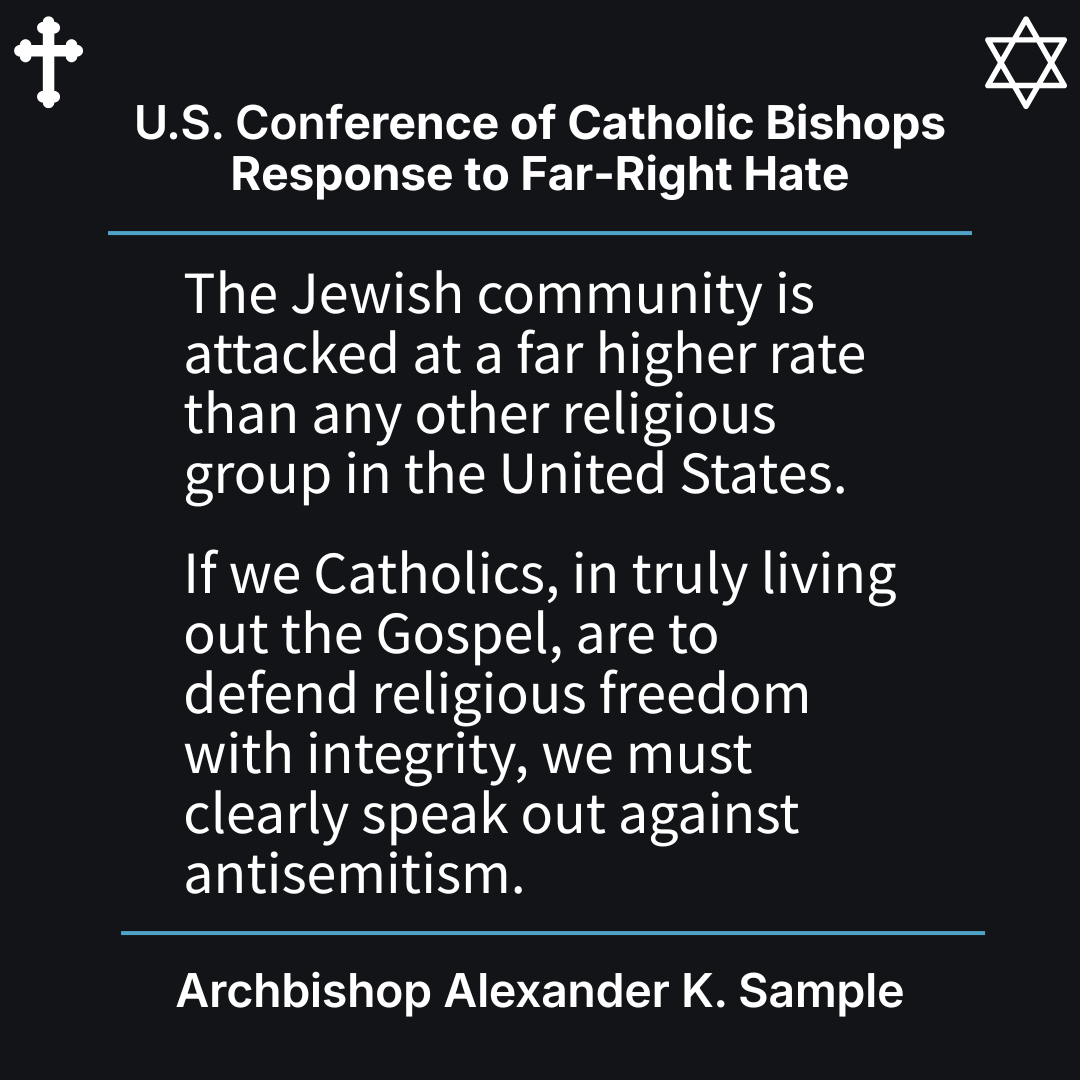
Religious institutions are responding to these false narratives. After a fringe Catholic group expressed support for these media personalities, the U.S. Conference of Catholic Bishops released a statement calling on Catholics to reject anti-Jewish hatred. The Conference signaled concern over the spread of rhetoric portraying Jews or Israel as exerting hidden control over American policy and global events. Archbishop Alexander K. Sample stated: “As Catholics, we are called to walk in the truth and so to reject the conspiracies and lies that lead to harassment and even violence against our Jewish brothers and sisters.”
| |
Far-Left Antisemitism: Antizionism and Dehumanization
Antisemitic narratives on the left have moved out of the shadows and onto the main stage – exhibited through anti-Israel activism that brands Jews or Israel as uniquely evil, often using language that echoes longstanding tropes of Jewish power. They also invoke the blood libel that dates back 3,000 years. The false accusation that Jews murdered children for rituals fueled deadly violence in medieval Europe – including one of the earliest recorded instances in Norwich, England, in 1144.
NYC Mayor Zohran Mamdani recently accused Israel of ‘genocide’ again – this time in public remarks at the city’s annual St. Patrick’s Day celebration. The American Jewish Committee condemned Mamdani’s “dangerous” language for “fueling antisemitism at a moment when Jews are already under threat.” Elisha Wiesel, son of Holocaust Nobel Peace Prize laureate Elie Wiesel, condemned Mamdani for “spreading the vicious blood libel against the Jews.”
Recently, anti-Israel activists staged another blood libel display near the White House. Actors wore masks of President Trump, Israeli Prime Minister Benjamin Netanyahu and sex offender Jeffrey Epstein while dismembering and devouring fake babies.
Islamist Antisemitism: Incitement and Violence
Anti-Jewish voices portray Jews and Israel as enemies of Islam and global stability and use this as an excuse for violence. This incitement is often pushed by Islamist extremists who use religious justifications to promote violence. Similar rhetoric has fueled deadly attacks on Jewish communities, including the 1941 Farhud pogrom in Baghdad, where a pro-Nazi Arab mob slaughtered nearly 200 Jews and injured hundreds more.
In London, three masked terrorists burned and destroyed four Jewish community ambulances outside a synagogue. The vehicles served all local residents, regardless of religion. An Iran-linked terrorist group, Islamic Movement of the Companions of the Righteous, claimed responsibility and for recently detonating explosives outside a Belgian synagogue. The terrorist organization is threatening to attack U.S. and Israeli targets around the world.
In response to the UK attack, the Campaign Against Antisemitism warned that “people spewing obsessive conspiracy theories about Jews, Zionists and Israelis are not social justice warriors.” British Chief Rabbi Ephraim Mirvis emphasized: “Our volunteer ambulance corps is an extraordinary service, whose sole mission is to protect life – Jewish and non-Jewish alike.”
At recent Quds Day rallies – an annual Iran-backed event named for the Arabic word for Jerusalem – chants and signs combined longstanding antisemitic tropes with modern anti-Israel rhetoric. Protesters in NYC chanted, “stop eating babies” and “we support Iran here!” In Dearborn, Michigan, poet and lawyer Hassan Salamey told the crowd that “Zionists are devil worshipping, satanic, sacrificing monsters who will lie and fabricate, and create false flag attacks.” Nazi and Soviet imagery also appeared at the worldwide protests.
A broad pattern of recent attacks and threats targeting Jewish communities are accelerating worldwide – from the attempted synagogue massacre of young children in Michigan to bombings outside of synagogues across Europe.
| | |
1. Blaming Jews for global events is a resurgent form of historic hate
The claim that Jews or Israel are responsible for wars and global instability is not new – it is a centuries-old antisemitic narrative that has repeatedly surfaced during moments of crisis. Now, that same idea is being repackaged across political and ideological movements, portraying Jews as controlling governments, driving conflicts and manipulating world events. This is not legitimate political criticism or a policy debate – it blames all Jews for complex global events and reinforces one of the oldest forms of anti-Jewish hatred.
2. Focusing on “left vs. right antisemitism” misses the larger pattern
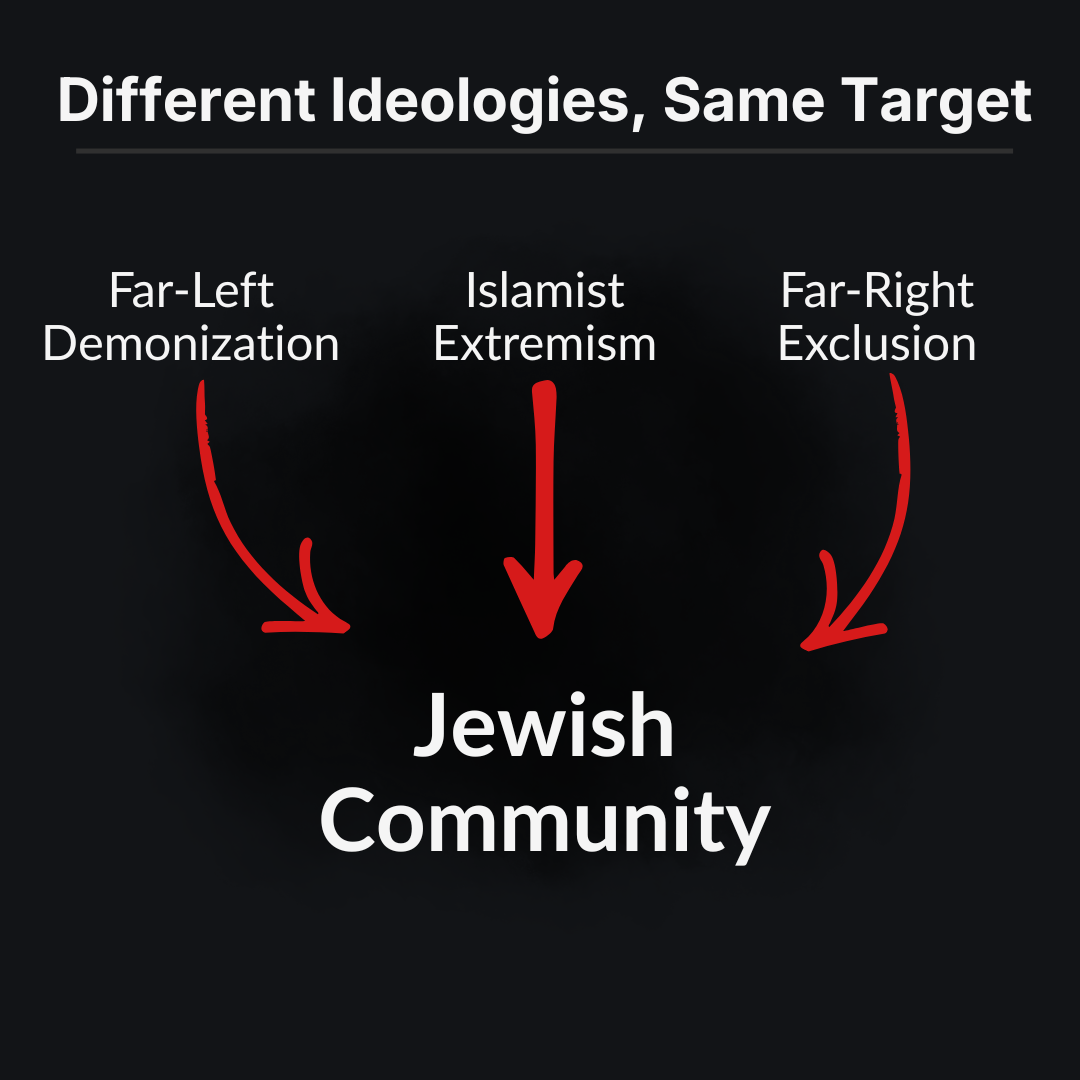
Debates over which form of political antisemitism is ‘worse’ obscures a more dangerous reality. While these movements differ in ideology and messengers, they share the same goal of demonizing Jews and Israel – and sowing discord in society. This convergence spreads its poison through the news, across social media and even from politicians – reinforcing one another and expanding its reach.
3. Antisemitic language is becoming normalized in public and political discourse
Antisemitic narratives that once circulated on the fringes are now appearing in political campaigns, protests, media coverage and high-profile interviews. Claims about Jewish or Israeli control are reaching broader audiences through political platforms and social media. At the same time, dehumanizing language portraying Jews as monsters, child-killers or global manipulators is becoming more visible and more accepted. As these ideas are repeated across mainstream spaces, they gain legitimacy and influence – making extreme rhetoric seem normal.
4. The normalization of blaming Jews creates real-world danger
Antisemitic narratives do not remain words – they shape perception, justify hostility and can lead to violence. History shows that when Jews are consistently blamed for societal problems, attacks often follow because historically what begins with the Jews doesn’t end with only the Jews. Ideas and content spread lightning fast across social media – from neo-Nazi movements to communist circles and Islamist networks – inciting followers and increasing the risk of violent attacks. When protesters chant “stop eating babies” in NY or ambulances serving communities are burned in London, these are not abstract ideas – they are attacks on real people.
| | |
Jewish communities and their allies can take practical steps to push back against antisemitic rhetoric, remain vigilant and respond effectively as these narratives spread across public discourse.
-
Respond to antisemitic rhetoric safely and effectively: When public figures or other individuals promote claims that Jews control governments, drive wars or are uniquely evil – choose how to respond based on context. In personal or professional settings, ask clarifying questions, correct false claims with verified facts and keep the conversation focused. Online, avoid escalating hostile exchanges – report harmful content to the social media platform and prioritize safety over engagement.
-
Encourage allies to speak out: If you are affiliated with non-Jewish organizations or coalitions, urge their leaders to clearly condemn antisemitism within their own communities. Statements carry more weight when they come from within – as demonstrated by recent responses from religious and civic leaders, such as the U.S. Conference of Catholic Bishops. Silence or selective outrage allows harmful narratives to spread unchecked.
-
Push back against misinformation: False narratives blaming Jews for global events can fuel harassment and violence. Challenge misinformation when it appears in public discourse or online. Share accurate reporting, credible sources and historical context to counter conspiracy theories and antisemitic rhetoric.
| | |
Berkeley Forced to End Discriminatory Antizionist Policies
The Louis D. Brandeis Center for Human Rights Under Law recently secured a landmark settlement with the Univ. of California, Berkeley, requiring the school to dismantle discriminatory ‘antizionist’ bylaws that had effectively excluded Jewish students from campus life. More than 20 student organizations had adopted policies barring speakers who support Israel or Zionism – regardless of the topic. They also limited access to academic programs, networking opportunities and leadership roles. Following the Oct. 7 massacres in Israel, this environment contributed to harassment, threats and physical intimidation targeting Jewish students.
Under the agreement, UC Berkeley must rescind these policies, adopt the IHRA definition of antisemitism, implement mandatory training and strengthen enforcement and reporting mechanisms to protect Jewish and Israeli students. Kenneth L. Marcus, chairman of the Brandeis Center, called the case “a cautionary tale,” warning that “universities, unions, corporations and political parties cannot create an antizionist exception to their conduct code. If left unaddressed, antisemitic bigotry only continues to expand.”
Stories Impacting American Jews
Stories Impacting the U.S. and Israel
Stories from Around the World
| | CLICK BELOW TO ACCESS ADDITIONAL FOCUS PROJECT RESOURCES: | |
Want to Read More of Our Talking Points? | Did you miss a recent edition of The Focus Project? No need to search your inbox. Our most recently published editions are available on our website. Click below to continue reading. | | | | |
The Focus Project develops and distributes news, background, history and weekly talking points on timely issues to inform individuals and organizations about issues affecting the American Jewish community and Israel, and help readers speak with more consistency and clarity. The editions also provide potential responses for addressing incidents of antisemitism and anti-Zionism. With input from a spectrum of major American Jewish organizations, we focus on that which unites us, rising above political and individual agendas.
Recognizing that hatred of Jews comes in many forms and directions, we strive to address all sources as they arise, and educate our growing audience on topics ranging from inter-religious relations to relevant international developments. From week to week, we may focus on issues arising from the political left, university campuses, from the political right and from institutions, government, and corporations. We don’t try to address all issues in each edition. We hope you will find this information useful in your writing and/or speaking. We are always open to your feedback: info@focus-project.org.
| | | | |