|
Protect You or Your Client's Medicaid Eligibility with a Pooled Trust
If your monthly income exceeds Medicaid’s financial limits, you may still be able to qualify for Community Medicaid and long-term care services through a Pooled Supplemental Needs Trust. A pooled trust allows eligible individuals with disabilities to deposit excess income into a trust account.
Funds deposited into the trust may not be counted when Medicaid determines financial eligibility, helping individuals maintain needed benefits while preserving money for approved living expenses such as rent, utilities, and other supplemental needs.
A pooled trust can be an effective tool for individuals seeking to maintain Medicaid eligibility while meeting their monthly expenses.
For example, a recent client received a notice from DSS informing her that she had a $210 spenddown amount due to earning over the Medicaid income limit. Legal Services of Long Island’s Public Benefits Paralegal, Diana Amaya, assisted the client in establishing a pooled trust, which allowed the client to use the $210 to pay for part of her rent and keep her Medicaid eligibility.
For more information about whether a pooled trust may be right for you, please contact the Public Benefits Unit.
The Public Benefits Unit provides legal assistance to persons who experience problems with public benefits programs that are administered by the local Departments of Social Services, including:
- Welfare (TANF and Safety Net)
- Medicaid
- Food Stamps (SNAP)
- Child Care Assistance
- HEAP
- Emergency shelter for the homeless
- Unemployment insurance appeals and overpayments
- Other emergency assistance programs
We also assist low-income households in establishing Supplemental Needs Trusts to eliminate the Medicaid spend-down and assist homeless families in obtaining rent supplements from DSS to enable families to leave the shelters or retain permanent housing. Nassau residents can call 516-292-8100, and Suffolk residents can call 631-232-2400.
| | |
Health Insurance Changes and Guidance in New York
As a result of federal funding cuts, New York State of Health has announced plans to eliminate Essential Plan eligibility for New Yorkers earning between 200 and 250 percent of the federal poverty level. Beginning July 1, 2026, New Yorkers enrolled in the Essential Plan with household incomes over 200 percent of the federal poverty level will no longer be eligible for that coverage. New Yorkers can only purchase or change health insurance plans during open enrollment and special enrollment periods triggered by qualifying life events such as losing coverage, moving, getting married, having a baby, or experiencing certain changes in income. The loss of Essential Plan coverage is considered a qualifying event, meaning impacted New Yorkers can enroll in a new health insurance plan through the New York State of Health marketplace any time before September 1, 2026. New Yorkers who enrolled in health insurance through New York State of Health can get free help renewing or changing coverage from New York State of Health-certified enrollment assistors by visiting nystateofhealth.ny.gov or calling 1-855-355-5777. New Yorkers who enrolled in Medicaid through their county Medicaid office or the New York City Human Resources Administration can also get free help renewing their coverage by contacting the office where they originally enrolled. The New York agencies that administer Medicaid, Child Health Plus, and Essential Plan benefits will never charge New Yorkers to enroll or re-enroll. New York Attorney General Letitia James has released guidance to help New Yorkers understand their health insurance options and avoid scams as major changes to New York’s Essential Plan take effect.
|
Rental Arrears Assistance Programs Available
Suffolk County's Tenant-Based Rental Assistance Program is currently at capacity, and no new applications are being reviewed at this time. However, any new applications will go on a waitlist. The Program will supplement rental housing costs for families of low-to-moderate income for up to 24 months (based on funding availability and lease dates). Please note this is not for rental arrears but for a security deposit or rental assistance going forward. Please visit Suffolk County's website for program guidelines and to download a copy of the application.
Town of Brookhaven Home ARP Rental Arrears Assistance Program opened on October 1, 2025. This program provides assistance for eligible residents on a first-come, first-served basis until all funds are exhausted. For more information and to apply, please visit Long Island Housing Partnership's website.
Town of Babylon's Tenant-Based Rental Assistance Program opened on December 18th, 2023. This program is for extremely low-income households who are in rental arrears to help residents regain housing stability and prevent homelessness. For more information and to apply, please visit Long Island Housing Partnership's website.
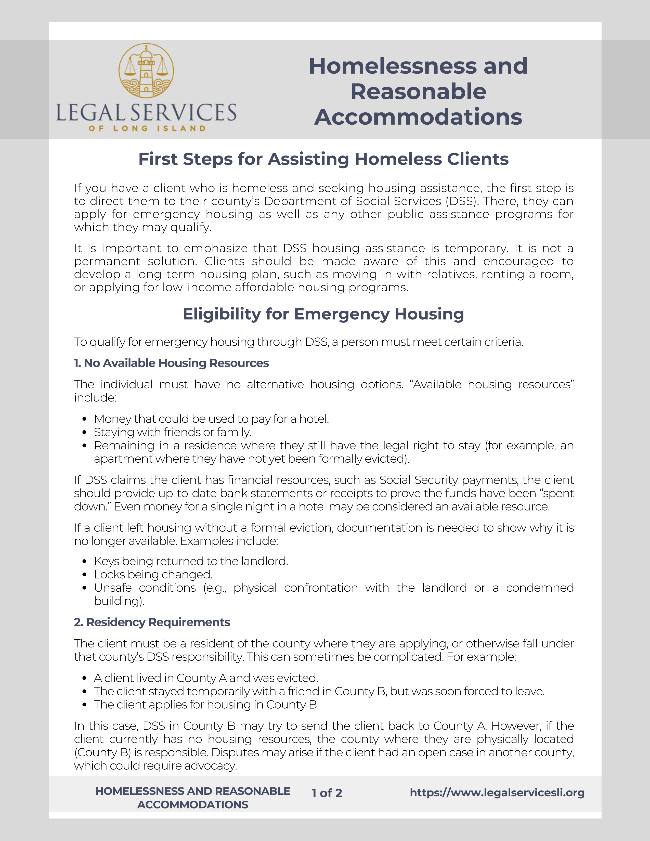
Legal Services of Long Island, in partnership with Empire Justice Center, can now assist Nassau and Suffolk residential tenants with housing-related legal problems (like eviction) and a household income of up to 80% of the Area Median Income. Services are available through this partnership regardless of immigration status. Please call the office closest to you to see if you are eligible for legal services. Interpreters are available. Suffolk residents west of 112 can call 631-232-2400, and east of 112 can call 631-369-1112. Nassau residents can call 516-292-8100.
| |
New York Coerced Debt Law Goes Into Effect June 17, 2026
New York's Coerced Debt Law went into effect on June 17th, 2026. The coerced debt law applies to coerced debt incurred after June 17, 2026, by survivors of domestic violence, human trafficking, elder abuse, child abuse, and caregiver abuse. The new law establishes a procedure for survivors to notify a creditor that a debt was coerced and dispute it, requiring a creditor to conduct an investigation and pause collection activities. In addition, this law provides a defense in the event a creditor sues a survivor on a coerced debt. Please note that debts secured by real property are largely excluded from the coverage of this new law. In addition, debts secured by personal property, such as motor vehicles, are subject to a limited exemption. If you or a client believes they have a coerced debt (incurred after June 17, 2026), the first step is to contact the creditor and start the procedure to dispute the debt.
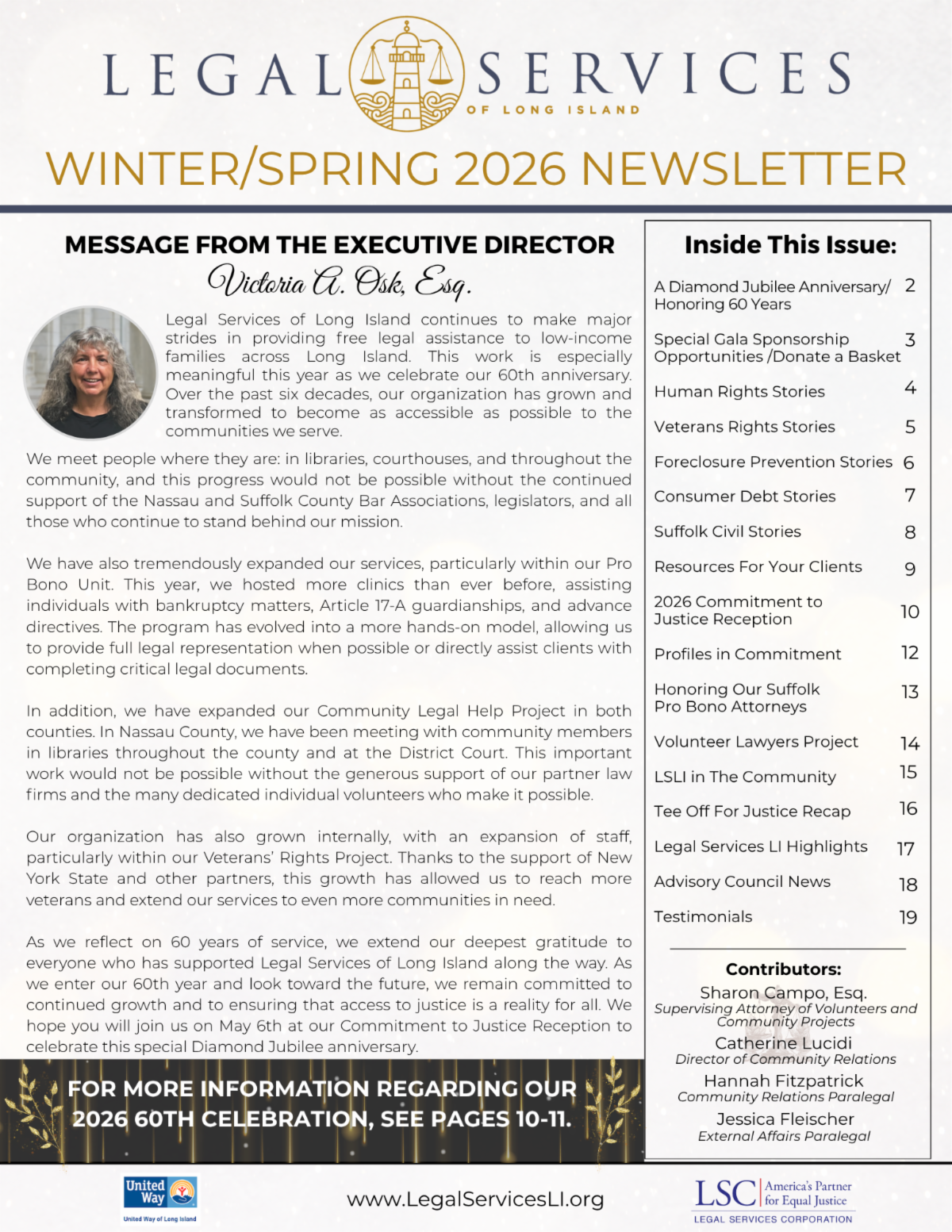
| | Read the Winter/Spring 2026 Newsletter | | |
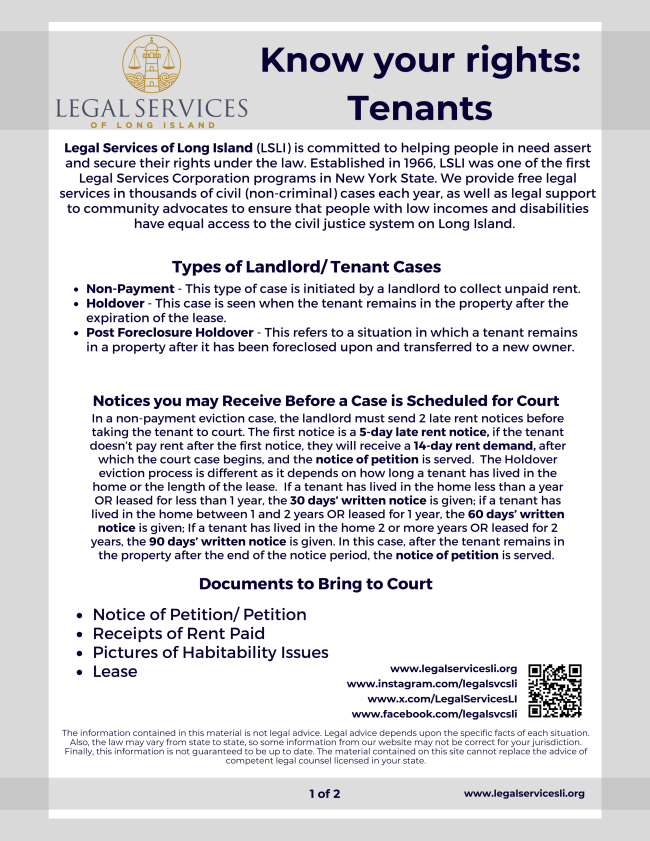
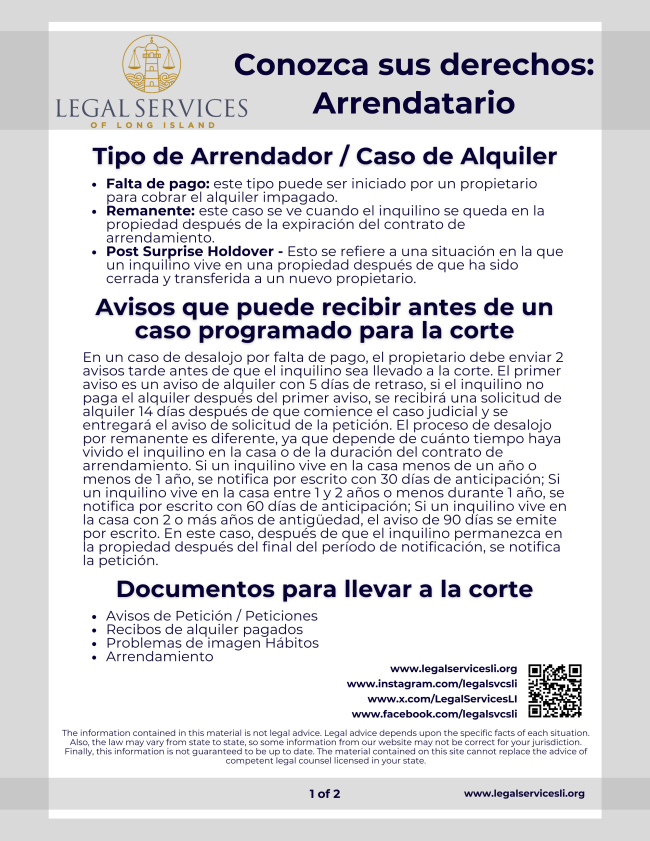
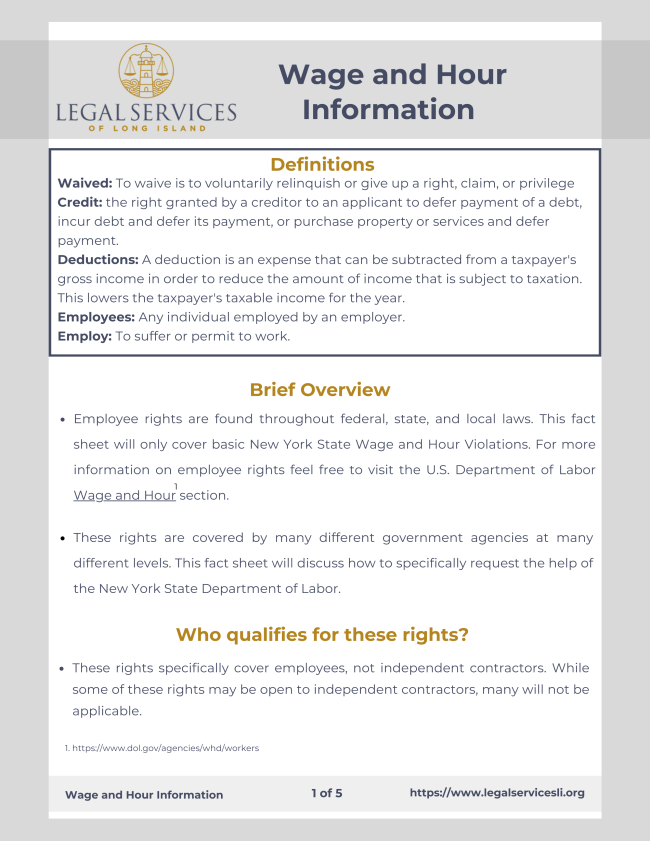
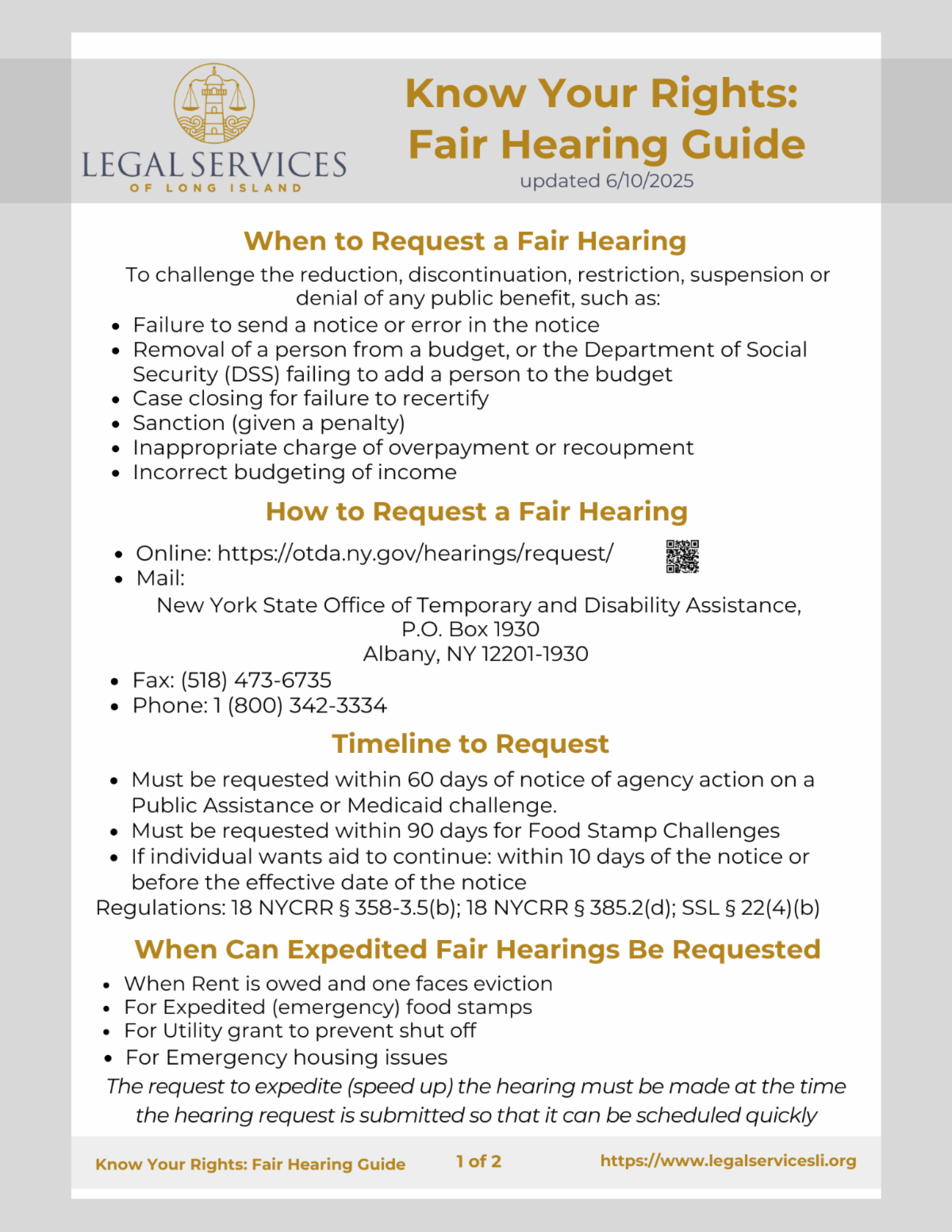
Know Your Rights Tenant fact sheets in
English, Spanish, and Creole.
| | |
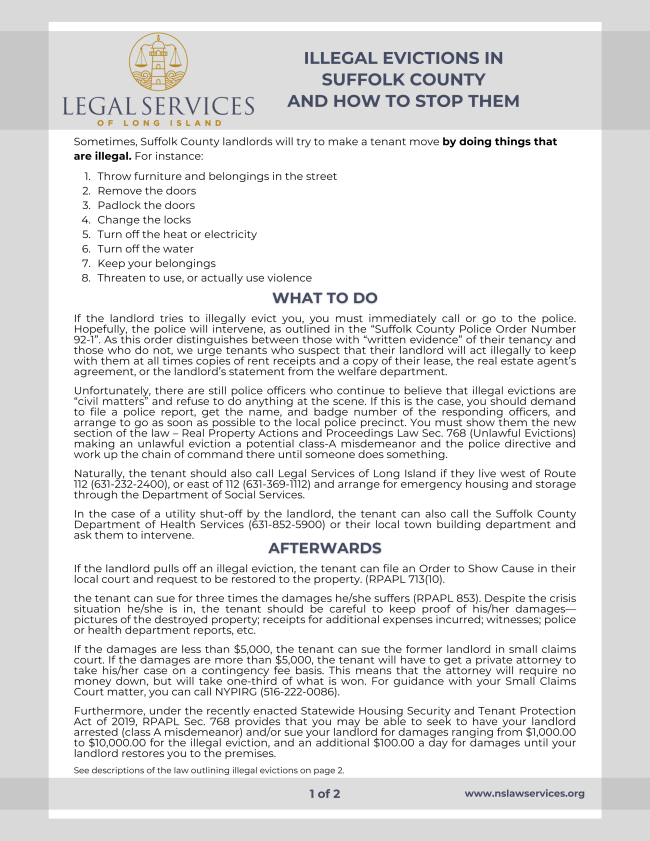
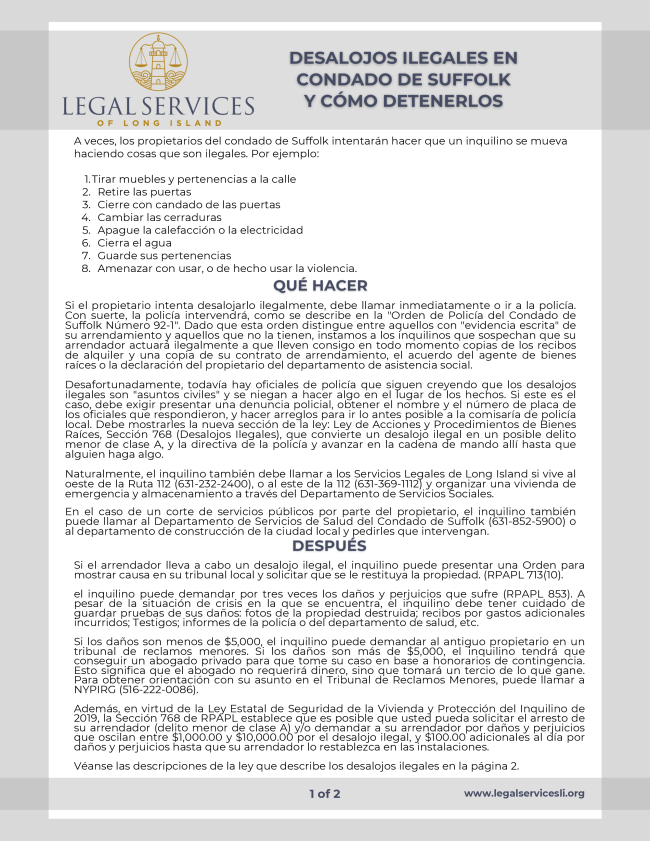
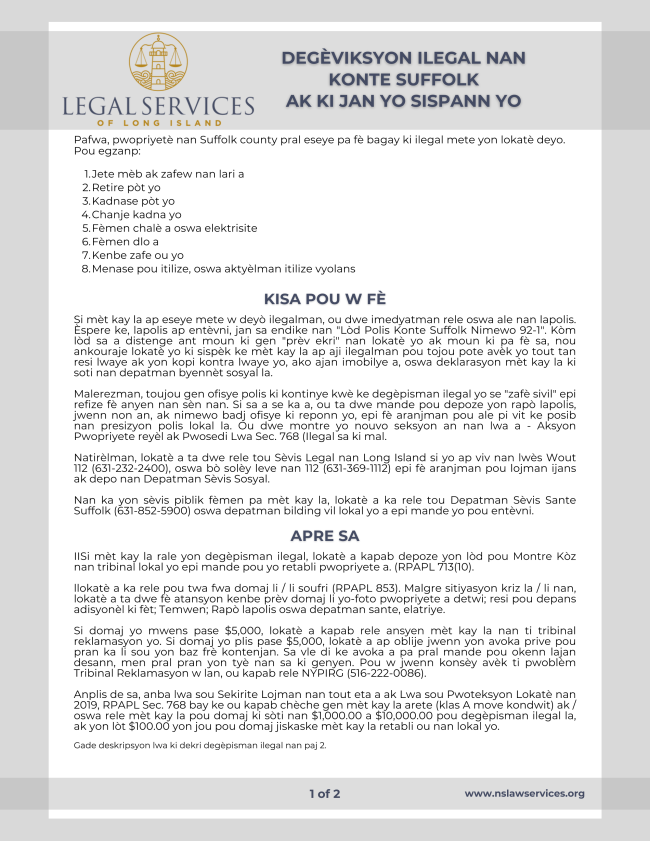
Fact Sheets on Illegal Evictions in Suffolk County in
English, Spanish, and Creole
| | |
Did you miss our past LSCA presentations?
Check them out today!
On April 16th, the Legal Support Center for Advocates presents “Understanding the Family Law Legal Process involving Victims of Domestic Violence.” We learned how the legal process works when victims of domestic violence are seeking orders of protection. In addition, we reviewed the procedure for child support and child custody. Lastly, we reviewed the expansion of our Domestic Violence Unit in Nassau County and how you or your clients can receive services. View the recording on our YouTube Channel. Slides are available on our website.
On March 31st, 2026, the Legal Support Center for Advocates presented, “Gimme Shelter Share: How To Challenge a DSS Shelter Share Requirement.” We learned what a shelter share is, how it is calculated, steps DSS must take before they discontinue Temporary Housing Assistance (THA) based on a failure to pay the shelter share, and the defenses against discontinuation. View the recording on our YouTube Channel. Slides are available on our website.
On Thursday, March 12th, 2026, the Legal Support Center for Advocates presented “Student Loans 2.0: Navigating Changes to the System Under the New Budget Bill.” This informative session is designed to help you navigate upcoming changes to the federal student loan system under the One Big Beautiful Bill Act (OBBBA). We covered how changes to borrowing limits and repayment plans will affect current and future borrowers, and we reviewed important information for those with Parent Plus loans. Whether you're planning ahead or preparing for repayment, this workshop equips you with the tools to make smart, informed decisions. View the recording on our YouTube Channel. Slides are available on our website.
On February 26th, 2026, the Legal Support Center for Advocates presented on “Introduction to Long Term Care Services through Medicaid Managed Care.” LSLI Staff Attorney Kimberly Bolk introduced home and community-based long-term care services provided by Medicaid that help elderly and disabled Long Island residents receive home care and other services in their homes. In addition, she provided information about how the consumer can pick a family member or friend to provide in-home caregiving services paid for by Medicaid (otherwise known as CDPAP). View the recording on our YouTube Channel. Slides are available on our website.
On October 23rd, 2025, the Legal Support Center for Advocates and the Education Debt Consumer Assistance Program (EDCAP) presented “Student Loans- The Changing Landscape: What Borrowers Need to Know.” We discussed the big changes coming to the federal student loan system—and how they’ll impact every borrower. From the end of the SAVE Plan to new borrowing limits, repayment structures, and forgiveness options, the rules are shifting fast. View the recording on our YouTube Channel. Slides are available on our website.
On June 25th, 2025, the Legal Support Center for Advocates and the Education Debt Consumer Assistance Program (EDCAP) presented "Big Changes, Big Decisions: Navigating Student Loans in Uncertain Times." We gave important updates on student loans and an overview of repayment options, a review of forgiveness programs (including Public Service Loan Forgiveness (PSLF)), and tips for managing delinquent and defaulted debt. View the recording on our YouTube Channel. Slides are available on our website.
On April 24th, 2025, the Legal Support Center for Advocates and the Education Consumer Assistance Program (EDCAP) presented “Weathering the Storm: Managing Student Loans in Uncertain Times." We covered student loan repayment options and forgiveness, discharge programs, and updated you on the latest developments affecting the federal student loan system. View the recording on our YouTube Channel. Slides are available on our website.
The Legal Support Center for Advocates presented “Introduction to ICAN and Community-Based Managed Long-Term Care” on Wednesday, April 9th, 2025. Staff Attorney Amanda Davis discussed the introduction to home and community-based long-term care provided by Medicaid that helps elderly and disabled Long Island residents receive home care and other services in their homes, as well as an introduction to the Independent Consumer Advocacy Network (ICAN) and how they can help. Slides are available on our website. View the recording on our YouTube Channel.
Links to all of our prior trainings can be found on our website.
Did you miss any of our Programs of Legal Services of Long Island Presentations? Feel free to watch them on our YouTube Channel!
| | |
We are pleased to share our 2024 Annual Report, which summarizes the achievements and progress of Legal Services of Long Island over the last fiscal year.
Your support benefited 13,648 Long Islanders by providing access to the legal help they needed to resolve issues threatening their housing, financial stability, health and safety, or limiting their access to opportunities to enrich their lives and communities.
Thank you for your continued support and thank you to all of our staff who assisted in editing and contributing to the 2024 Annual Report. We hope you enjoy reading our 2024 Annual Report and feel free to share it with your family, friends, and fellow Long Islanders
| | | | Upcoming Community Legal Help Project locations, dates, and times for Nassau and Suffolk County can be found on our website. CLHP will be at the Riverhead Library every 4th Wednesday of the month starting January 2025! | | Pro Bono Attorneys Needed | | |
A little more about our volunteer needs:
Nassau County
Volunteer Lawyers Project
In partnership with the Nassau County Bar Association, the Volunteer Lawyers Project is an innovative pro bono program to expand the availability of legal services to Nassau County residents in need. The Project provides opportunities for attorneys to represent clients and volunteer their time and expertise by providing free legal services. The Volunteer Lawyers Project needs pro bono assistance in the areas of Chapter 7 Bankruptcy, Divorce, Article 17A Guardianships, Health Care Proxies, Name Changes, Power of Attorney, and Wills.
Contact: Reisa Brafman, Esq., 516-292-8100 ext. 3380, rbrafman@legalservicesli.org
Bankruptcy Clinics through the Volunteer Lawyers Project
Currently, clinic appointments are one-on-one with attorneys consulting with clients in person, by phone, or virtually. Volunteer attorneys guide those considering bankruptcy, screening for referral to pro bono attorneys for filing of Chapter 7 petitions. This is a limited engagement, though participating attorneys may also be referred cases.
Contact: Reisa Brafman, Esq., 516-292-8100 ext. 3380, rbrafman@legalservicesli.org
Community Legal Help Project
The Community Legal Help Project recently expanded into Nassau County. We are looking for attorneys to provide pro bono half-hour consultations with Nassau County Residents. The areas of law most in need are immigration, family, matrimonial, elder, and bankruptcy.
Contact: Roberta Scoll, Esq., 516-292-8100 ext. 3115, rscoll@legalservicesli.org
Suffolk County
Pro Bono Project
In partnership with the Suffolk County Bar Association, the Pro Bono Project is an innovative pro bono program that expands the availability of legal services to Suffolk County residents in need. The Project provides opportunities for attorneys to represent clients and volunteer their time and expertise by providing free legal services. The Pro Bono Project needs pro bono assistance in the areas of Chapter 7 Bankruptcy, Divorce, Article 17A Guardianships, Foreclosure, Health Care Proxies, Power of Attorneys, and Wills.
Contact: Kiersten Bartolotta, Esq., 631-232-2400 ext. 3311, kbartolotta@legalservicesli.org
The Suffolk County Pro Bono Project is now on Paladin! Please take a look at our current volunteer attorney opportunities and connect with us!
Community Legal Help Project
The Community Legal Help Project (CLHP) is a partnership of legal providers created by the NYS Permanent Commission on Access to Justice and the Suffolk County Access to Justice Committee. The CLHP’s network of non-profit partners and pro bono volunteers currently provides legal information and referrals, and limited-scope representation through a phone line and brief in-person consultations at public libraries. Attorneys with a background in immigration, family, elder and/or matrimonial law are needed to assist the community. Volunteer attorneys can dedicate their time monthly, bi-monthly, quarterly, or at their leisure.
Contact: Rashika Hettiarachchi, Esq., 631-232-2400 ext. 3391, rhettiarachchi@legalservicesli.org
| | | |
Legal Services of Long Island is a 501(c)(3) and your donation is 100% tax-deductible. Join us in our mission to provide free, quality civil legal representation to Long Island’s neediest residents.
| | | | | |