$1.54 Million Post-Trial and Post-Appeal Settlement on Unjust Enrichment Claim Over Finder's Fee | | |
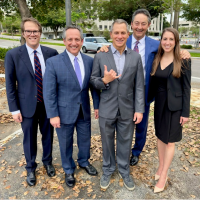
Rabin Kammerer Johnson (RKJ), Rafferty Domnick Cunningham & Yaffa (RDCY), and Harris Appeals recently settled a case in the U.S. District Court for the Southern District of Florida (Matthew Hayden v. Steven F. Urvan v. Brew First, Inc., Case No. 9:21-CV-82051-MATTHEWMAN) for $1.54 million. The parties vigorously litigated the case for nearly 4 years, including appeals of the merits and attorneys’ fees judgments.
In January 2023, RKJ attorneys Adam Rabin and Lauren Johnson were successful in having the court dismiss the defendant’s claims against third-party defendant Brew First, Inc. In March 2024, attorneys Adam Rabin and Lauren Johnson along with Fred Cunningham and Matt Christ from RDCY were successful in obtaining a $500,000 jury verdict for plaintiff Matthew Hayden on a claim for unjust enrichment. To continue, click here.
| | DOJ Reports Another Year of Big Recoveries in Whistleblower Qui Tam Lawsuits | | |
by Adam Rabin
Per a recent announcement from the U.S. Department of Justice (“DOJ”), settlements and judgments under the False Claims Act (“FCA”) resulted in more than $6.8 billion recovered during DOJ’s fiscal year that ended on September 30, 2025. The dollar amount recovered set a record for the largest amount recovered in a single year in FCA history. Whistleblowers also filed 1,297 qui tam cases, the highest number in a single year, and the Government commenced 401 independent investigations under the FCA.
Of the more than $6.8 billion recovered, over $5.7 billion arose from FCA cases involving healthcare fraud, which recoveries typically reimburse federal programs including Medicare, Medicaid, and TRICARE (the U.S. Military healthcare program). In the healthcare arena, DOJ remained committed to three main types of cases: prescription drugs, managed care, and medically unnecessary treatment cases. Notably, Rabin Kammerer Johnson was involved in representing one of the whistleblowers in the national opioid qui tam case against Walgreens that contributed $300 million to the above recoveries. To continue, click here.
| |
How Can Corporations Prevent Spoliation of Electronic Evidence with a Proper Legal Hold Notice? | | |
by Lauren Johnson
Our previous blog on electronic discovery provided 10 tips for creating an electronic discovery plan to help potential litigants understand the process of electronic discovery and how to work with their lawyers to reduce the associated time and costs. This blog will focus on creating a proper legal hold notice to prevent spoliation of electronically stored information, or ESI.
Before any lawsuit is filed, a party’s duty to preserve and hold ESI generally arises when the party “reasonably foresees” that a dispute could lead to future litigation. If ESI is not preserved or is somehow destroyed, it can lead to claims of spoliation by the other side during litigation, which can have significant consequences. This is where a legal hold notice comes in, particularly for corporations with multiple employees who may have relevant evidence that needs to be preserved. To continue, click here.
| | How Do You Rescind, Cancel, or Reform a Contract or Other Legal Instrument? | | |
by Christopher Kammerer
Rescission, cancellation, and reformation are separate and distinct actions to undo or correct contracts and other legal instruments and have different legal consequences.
Rescission avoids a contract or other legal instrument ab initio; it is the retroactive annulment, abrogation, or unmaking of an agreement or instrument and places the parties in the position they were in prior to entering into the agreement or instrument. When a contract or other legal instrument is rescinded, it is as if the contract or legal instrument never existed in the first place; the contract or legal instrument is abrogated from its inception. To continue, click here.
| | The New Requirements for Objecting to a Request for Documents Under the Amended Florida Rules | | |
by Janet Furness, RFP
Effective January 1, 2025, the Florida Supreme Court adopted significant amendments to various rules in the Florida Rules of Civil Procedure, including Rule 1.350, which governs requests for documents from a party. The key changes to Rule 1.350 include:
- The grounds for an objection to a document request must be stated with "specificity" and "include the reasons for the objections." This means that boilerplate or general objections are no longer permitted.
- The objection must state whether any responsive materials are being withheld from production because of the objection.
- An objection to part of a request for production must specify the part of the request to which the objection is asserted and produce the documents to the balance of the request to which there is no objection.
To continue, click here.
| | Qui Tam Corner: Understanding the Public Disclosure Bar to Whistleblower Qui Tam Claims | | |
by Havan Clark
The False Claims Act (“FCA”) empowers whistleblowers—known as relators—to bring lawsuits on behalf of the Government when they discover fraud involving federal funds. But not every whistleblower case can move forward. One of the most litigated obstacles is the FCA’s public disclosure bar, which requires dismissal of the case if the allegations in a qui tam complaint are “substantially the same” as information that has already entered the public domain.
This post explains what “substantially the same” means, how courts evaluate public disclosure arguments, and why this matters for potential whistleblowers. To continue, click here.
| | Register Now for the Civil Practice CLE Seminar on Best Practices for Using AI in Your Cases and Law Practices | | |
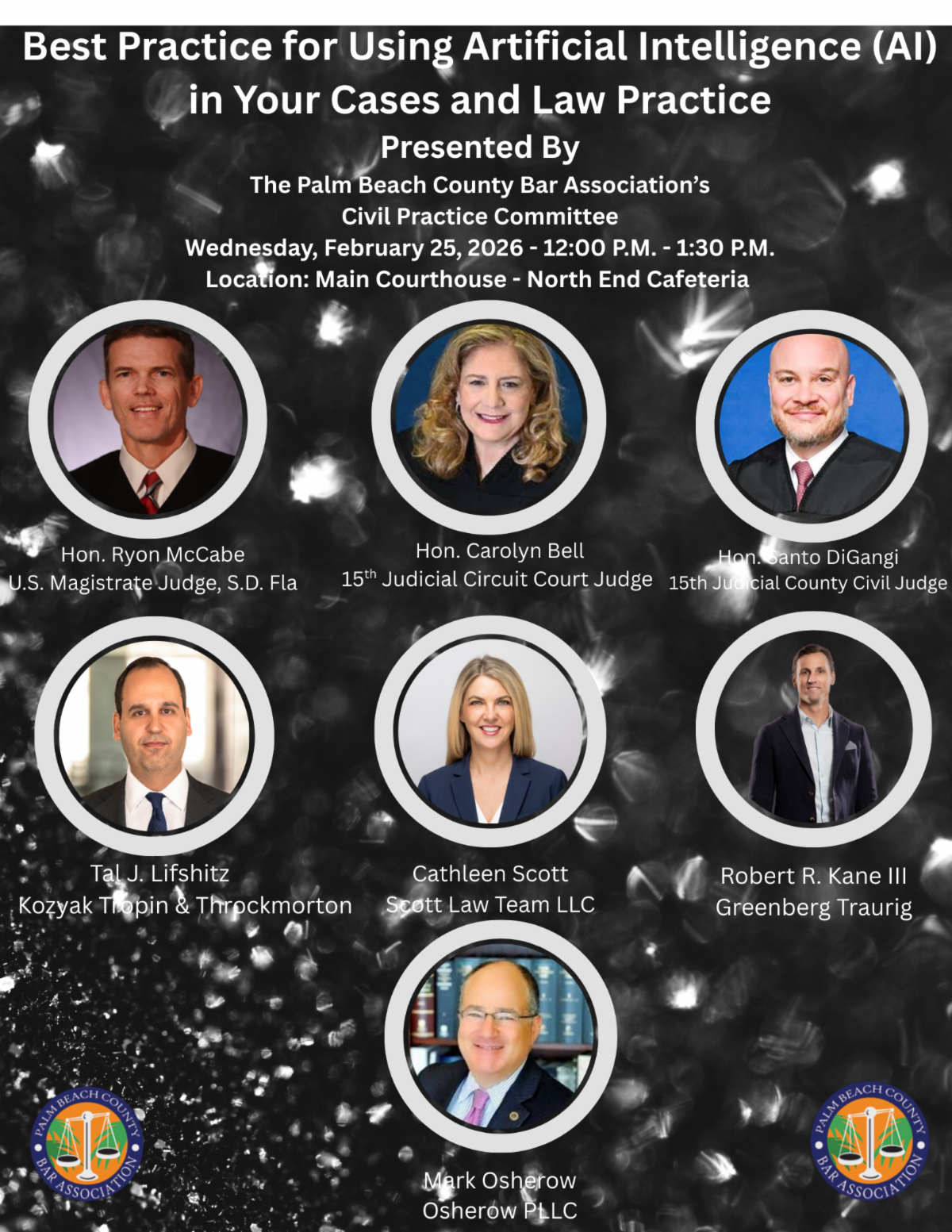
On February 25, 2026, the Palm Beach County Bar Association's Civil Practice Committee, co-chaired by Adam Rabin, will be hosting a CLE seminar on Best Practices for Using Artificial Intelligence (AI) in Your Cases and Law Practice. The seminar, organized by committee members Rebecca Vargas and Donna Krusbe, and moderated by committee member Ron Ponzoli, will focus on the proper use of AI in litigation, avoiding pitfalls that can harm your client's case, and how business of law and practice management are changing through over-the-counter and proprietary AI tools.
To review the seminar agenda, click here. To register for the seminar, click here.
| | 11th Circuit Reinstates Client's Whistleblower Claims on Ground That Amended Complaint Was Permitted to Allege New Facts Learned During Discovery | | |
On July 25, 2025, in United States ex rel. Sedona Partners LLC v. Able Moving & Storage, Inc., 146 F.4th 1032, 2025 WL 2087871 (11th Cir. 2025), the Eleventh Circuit Court of Appeals issued an opinion in a False Claims Act case reversing the dismissal of a whistleblower’s second amended complaint on the basis that the whistleblower relied on information learned during discovery to bolster its allegations and, without relying on such information, the operative complaint could not state a claim.
The district court adopted the magistrate judge’s report and recommendation to dismiss the operative complaint under Federal Rule of Civil Procedure 9(b)—which requires fraud to be pled with particularity—and to strike the allegations learned through discovery. To continue, click here.
| | |
Rabin Kammerer Johnson | 561-659-7878 |
1601 Forum Place, Suite 201, West Palm Beach, Florida 33401 |
www.ComplexBusinessLitigation.com
| | | | |