Whistleblower Qui Tam Case Arising From Walgreens' Opioid Dispensing Practices Results in DOJ Settlement for $300 Million
| | |
In a landmark case for justice and public health, Rabin Kammerer Johnson (RKJ) and Searcy Denney Scarola Barnhart & Shipley—served as co-counsel for a former Walgreens’ pharmacist in a whistleblower qui tam action against Walgreens that resulted in a $300 million settlement for the U.S. Department of Justice. The case, which was filed by four different whistleblowers, alleged widespread Medicare fraud and violations of the Controlled Substances Act arising from Walgreens’ unlawful dispensing of dangerous opioids that helped fuel the nation’s opioid epidemic.
Under the settlement, Walgreens will pay $150 million under the False Claims Act and $150 million under the Controlled Substances Act. The company also agreed to enter into a seven-year Memorandum of Agreement with the DEA and a five-year Corporate Integrity Agreement with HHS-OIG to ensure stricter oversight and prevent future violations.
RKJ attorneys Adam Rabin and Havan Clark, along with Searcy Denney Scarola Barnhart & Shipley’s Sia Baker-Barnes, served as co-counsel in the case. To continue, click here.
| |
Lauren Johnson Installed as President of the
Florida Association for Women Lawyers, PBC Chapter
| | |
On June 12, 2025, at a sold-out luncheon, RKJ Partner Lauren Johnson was installed as President of the Palm Beach County Chapter of the Florida Association for Women Lawyers (PBC FAWL). During the upcoming year, Lauren will focus on honoring past leaders and inspiring future leaders of PBC FAWL.
Over the last several years, Lauren has served the Chapter in various roles, including as President-Elect, Secretary, a member of the Board of Directors, and Chair of the Grant Writing Committee. To continue, click here.
| |
Florida Law Levels the Playing Field On
One-Sided Attorney's Fee Clauses
| | |
by Christopher Kammerer
Section 57.105(7), Florida Statutes, makes reciprocal all contracts with unilateral attorney’s fee provisions that benefit one party over the other. Under the statute, where a contract contains an attorney’s fee provision that benefits only one party to the contract, a court may award attorney’s fees to the other party when that party prevails “in any action, whether plaintiff or defendant, with respect to the contract.”
In 2020, the Florida Supreme Court in Ham v. Portfolio Recovery Assoc., LLC, 308 So. 3d 942 (Fla. 2020) and Page v. Deutsche Bank Tr. Co. Ams., 308 So. 3d 953 (Fla. 2020), analyzed section 57.105(7) and held that two statutory conditions must be met for reciprocal application of an otherwise unilateral attorney’s fees provision in a contract: (1) the contract must contain a provision awarding attorney’s fees to a party when that party is required to take any action to “enforce the contract,” and (2) the other party must prevail in an action with “respect to the contract.” To continue, click here.
| |
The CHOICE Act: Florida's New Noncompete Statute
Impacting High-Earning Employees
| | |
by Adam Rabin
As of July 1, 2025, a new Florida law has taken effect that governs covered noncompete agreements for certain high-earning employees and covered “garden leave agreements” for employees who continue to receive compensation from their employer after giving notice of their intent to resign and are restricted from competing during the notice period. The new law is titled the Florida Contracts Honoring Opportunity, Investment, Confidentiality, and Economic Growth Act, now referred to as the CHOICE Act (Fla. Stat. §§ 542.41-542.45).
Under the CHOICE Act, except for healthcare practitioners who are exempt from the statute, a “covered employee” is an employee or individual contractor who earns or is reasonably expected to earn a salary greater than twice the annual mean wage of the Florida county in which he employer maintains its principal place of business, or the Florida county in which the employee resides if the employer’s principal place of business is not in Florida.
To continue, click here.
| | 10 Tips for Creating a Good Electronic Discovery Plan | | |
by Lauren Johnson
The ever-changing technology landscape has increased the volume, complexity, and costs of discovery in litigation. Many clients who find themselves in litigation, however, are not as familiar with the rules, practices, and protocols related to electronic discovery. The purpose of this blog is to help potential litigants understand the process of electronic discovery and how to work with their counsel to reduce the associated time and costs.
Courts typically expect parties to agree on practical electronic discovery protocols such as search methods, custodians, search terms, privilege screens, and/or production formats, to avoid unnecessary judicial involvement. But before the parties can meaningfully confer on these issues, it’s important for the client to meet with their counsel to develop an internal plan for identification, collection, review, and production of electronically stored information (ESI). To continue, click here.
| |
Can We Talk? Florida's New Conferral Rule
for Non-Dispositive Motions in State Court
| | |
by Janet Furness, FRP
Under new Florida Rule of Civil Procedure 1.202, the moving party must 1) confer in good faith with the opposing party prior to filing a non-dispositive motion; and 2) file a statement certifying that the movant has conferred with the opposing party and state whether the opposing party agrees on the resolution of the motion.
With the constraints of available hearing times, the parties are expected to confer and attempt to resolve some or all the issues raised in the motion before filing the motion. The rule aims to reduce the workload of the courts by encouraging parties to resolve minor issues before seeking judicial intervention. The new rule intends to reduce the number of motions set for hearing dockets, or at least shorten the hearings by narrowing the issues. To continue, click here.
| |
Prior Whistleblower Retaliation Claim
Bars Later Qui Tam Claim Under Res Judicata
| | |
by Havan Clark
A recent decision by the Eleventh Circuit Court of Appeals affirmed the district court’s dismissal of a False Claims Act (FCA) qui tam action as barred under the doctrine of res judicata due to the whistleblower’s previously filed and dismissed retaliation case. The court’s opinion highlights the importance of bringing both FCA qui tam and retaliation claims in the same action to avoid one set of claims later being barred by res judicata.
The opinion also addresses an argument FCA defendants sometimes make at the dismissal stage—that a whistleblower’s non-qui tam claims (e.g., FCA retaliation or common law claims) must be dismissed for failure to comply with Federal Rule of Civil Procedure 4(m)’s 90-day service requirement while the complaint containing qui tam claims was statutorily under seal. To continue, click here.
| |
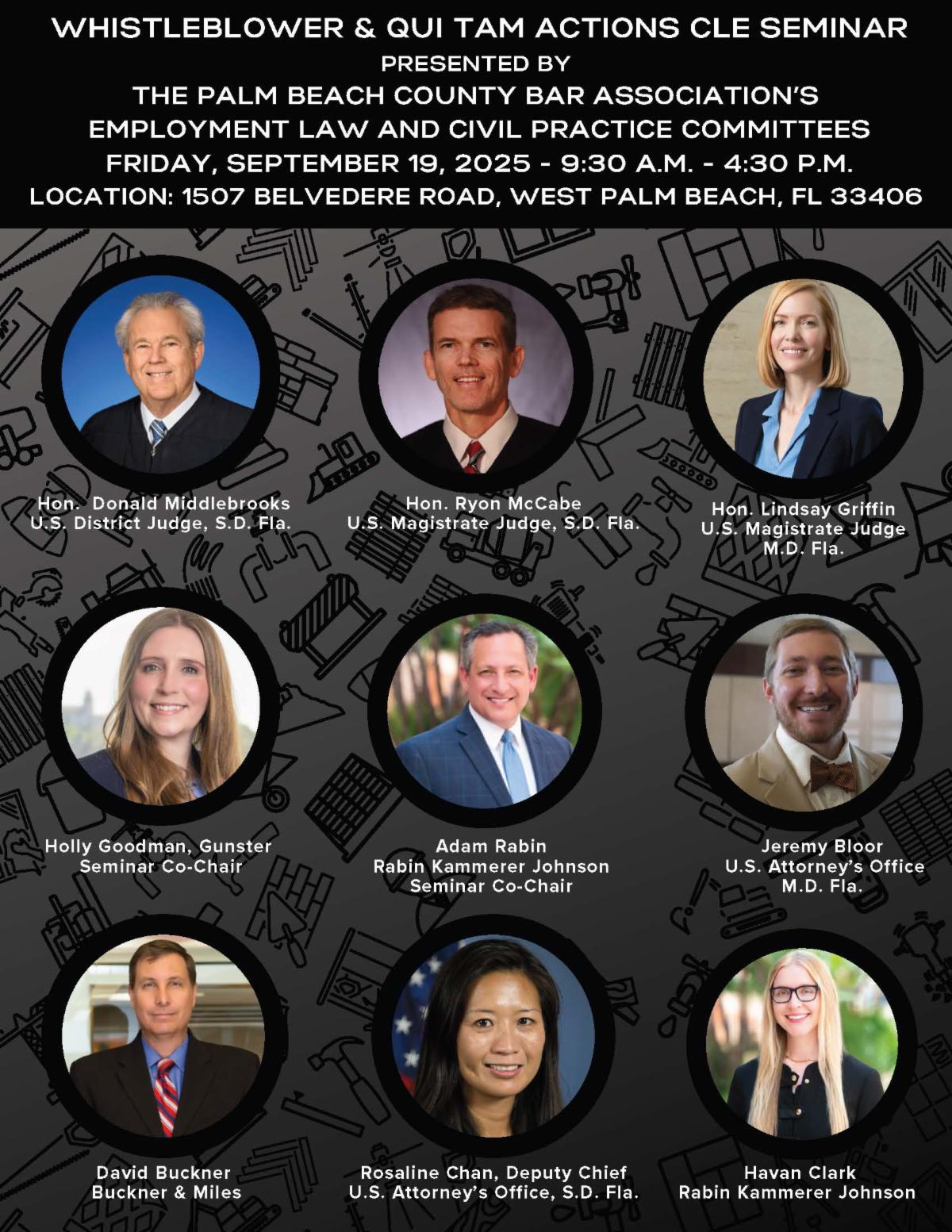
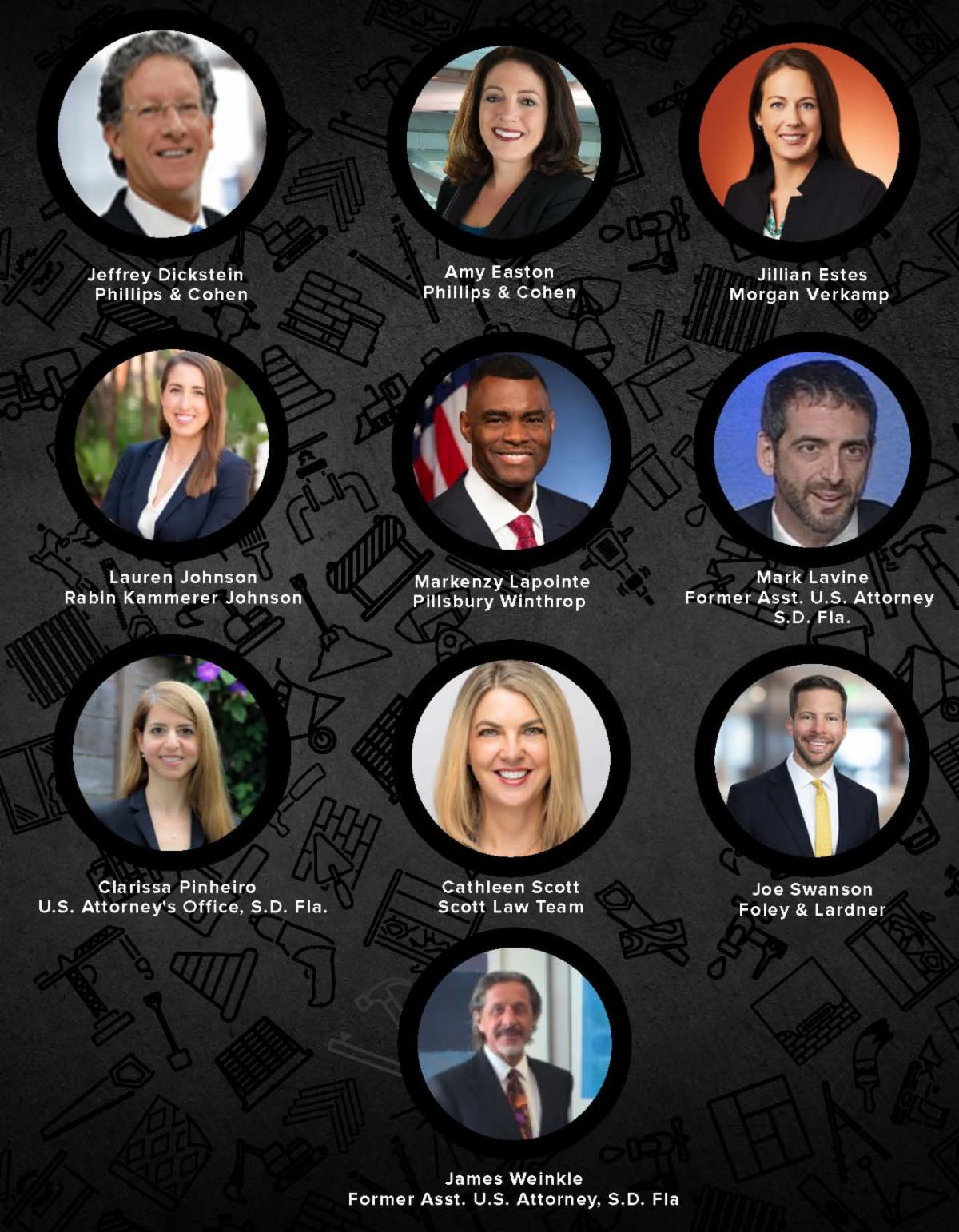
Whistleblower & Qui Tam Actions CLE Seminar
Friday, September 19, 2025
| | "This CLE Seminar on Whistleblower & Qui Tam Actions is expected to be the best seminar on this subject matter in Florida. The speakers and panelists include sitting federal judges, current and former federal prosecutors, and private practitioners with renowned expertise in the area. You do not want to miss it!" – Adam Rabin, Seminar Co-Chair | | |
Rabin Kammerer Johnson | 561-659-7878 |
1601 Forum Place, Suite 201, West Palm Beach, Florida 33401 |
www.ComplexBusinessLitigation.com
| | | | |