A titan in a time of jump racing giants, Virginia-based trainer Peter Howe knew the importance of bloodlines in the thoroughbred world
|
|
A racehorse riddle: What’s the X-factor when it comes to producing a champion? Nature or nurture?
Peter Howe
(©Douglas Lees) knows from experience that it’s a blend of science and art, but he says all of it is required to attain premium performance. He recognized the duality over a 40-plus year career training multiple champions out of Marion du Pont Scott's Montpelier - they were born to it, and he sees it now in daughter Jill Byrne - raised from day one with the skillset to have her hand on the helm of Virginia's Colonial Downs.
In the best horses, Howe says, as with daughter Jill, he learned early to recognize that uncanny ability to leave long and land running. Literally with horses, figuratively with people.
“Tingle Creek would do that,” says the 81-year-old trainer, still elegant and upright at 6 feet and still living near his beloved Red Horse Farm in Barboursville, Virginia. The soft-spoken Howe has been retired from racing nearly 20 years, but he keeps up with it through friends, through Jill and through televised racing on TVG. “You’d have to be a very good horse to get away with standing off like that,” Howe says. He had years in the show ring and jumped thousands of show fences to develop this precision sense of timing. “Tingle Creek, Soothsayer, Neji. Horses like that could do it. It takes a good athlete with a lot of courage.
“Other trainers would sometimes try and send out a ‘rabbit’ as an entry to try and hook up with Tingle Creek to pressure him into making a mistake. That never worked.”
As for his daughter, Howe says she’s done a masterful job recreating the long-shuttered Colonial Downs, opened for the first time last year after it last hosted racing in 2013. “It took courage there, too,” he says. “She’s always been her own person, I saw that when she was just a kid working in the barn. She’s really showed what she’s made of helping bring that place back.”
As the Colonial Downs meet gets underway in central Virginia this week – including jump races scheduled every Monday plus a special make-up card this Sunday, we wanted to hear from the vice president of racing to see how it’s going at the summer turf festival, and we wanted to hear from her father Peter Howe, to learn how it all began a few miles down the road at Montpelier.
|
|
Meet Jill Byrne
Jill Howe Byrne was born at her family’s Red Horse Farm in Barboursville, Virginia. She was asked, but she declines to reveal her age. “A lady never tells her age, (but) I’m old enough to know better.”
Byrne’s father Peter Howe was Marion du Pont Scott’s trainer at Montpelier, and Byrne remembers a “magical” childhood growing up at the estate.
“My mom would pick my sister Debbie and I up from Grymes Memorial School in Orange, and we would go to Montpelier to have tea with Mrs Scott,” she recalls. “Mrs. Scott loved my mother; they were very close.” Tea parties were held in the Red Room, wall-to-wall win photos, awards and books on Thoroughbred racing and pedigrees.
“We (kids) had to sit and be polite until we were given the clear to go, then we’d run through the halls of Montpelier as if it were our own. We’d be running up and down the stairs, up and down all the corridors where there's millions of dollars' worth of old paintings and old chairs James Madison had sat in, and of course we're not thinking at the time.”
|
The field for the 1971 Noel Laing races in front of the house at Montpelier.
©Douglas Lees
|
No surprise since her father had his start on show hunters and jumpers before launching his race-training career, Byrne started out riding pony hunters, training with legendary Virginia horseman Jimmy Lee. She says her show career was short-lived. “When my dad put me up on my first racehorse when I was 12, that was the end of that. No more show horses for me.”
Byrne galloped for her father at the estate, schooling jumpers and working horses on the turf and on the sand training track. She continued to ride while at boarding school in New York near Scott’s private barn on the Belmont Park backstretch.
The Masters School in Dobbs Ferry was 45 minutes to Belmont, Byrne says. “I’d go there on weekends and gallop horses for my dad.”
|
A young Jill riding her pony Coquette, whom she credits with teaching her the basics of "everything equine."
Photo courtesy of Jill Byrne
|
She studied at University of Virginia, and after graduation continued to work as an exercise rider and assistant trainer, first for future Hall of Famers Scotty Schulhofer and John Veitch, and later for future husband Patrick Byrne (they’re now divorced.) Patrick Byrne conditioned champions Favorite Trick and Countess Diana, and 1998 Breeders' Cup Classic winner Awesome Again. Other top horses include graded stakes winner Pass Rush and 2012 Florida Derby winner Take Charge Indy.
While they were together, in addition to helping gallop and around the shedrow, Byrne worked as Patrick’s media liaison, which led to her making new connections. “David Loignon and Jeff Lifson were working for Kentucky’s WHAS news station and were following Favorite Trick while he was racing,” Byrne said in an interview. “They didn’t know much about horse racing," until Byrne schooled them.
Lifson eventually rose to executive vice president of West Point Thoroughbreds, and Loignon developed his own production company. Both went to work at TVG when it formed in 1999.
“I would be on the track on the pony, and Lifson was standing there asking me all these questions about the Kentucky Derby horses, how they looked, what they were doing. He asked if I could come on and talk about horses. I love talking about horses, so that sounded pretty fun.”
Producer Tony Alavato asked Byrne to work as a television host.
“It was something I could do while being involved with horses and their people, but it pulled me in a new direction,” Byrne says. “I had the credibility with the horsemen already and found it easy to go into barns and ask questions.”
|
Jill Byrne working Kentucky Derby weekend during her career with Churchill Downs.
Photo courtesy of Jill Byrne
|
Her father was close with Charlsie Cantey, a pioneer for women in racing broadcasting. “She is a beautiful rider, a respectful person and is articulate and educated,” Byrne told a Kentucky magazine. “I always admired her and she ended up being a kind of mentor for me.”
Byrne was the director of broadcast and programming at Churchill for nearly a decade then worked as senior director of industry relations for the Breeders Cup.
“It is very important (you) show people that you have an underlying passion that is real and true,” she says. “You have to be a good representative of the game, whether on-air, or as a writer, or a photographer. To me, the core of that all circles back to the horse.”
|
Colonial Downs
Byrne joined Colonial Downs as vice president of racing last year. She loves the facility, especially the turf.
“Oh my gosh, the course is amazing,” Byrne says. “It’s Bermuda grass, and every horseman that rides or trains on it says the same thing. It’s like running on a bouncy carpet.”
Byrne knows from experience. “I run myself,” jogging three to five miles, five days a week. “I take a lap on the (outside of the) dirt course then a lap or two of the turf course.
“And let’s put it this way – I’m sounder than I’ve ever been.
“I love having the steeplechase horses here every week. Jump racing is just logical here at Colonial Downs. There’s a deep, rich history of steeplechasing here.
Under new management, Colonial reopened last summer for the first time since 2013. Sweeping improvements to the facility included upgraded irrigation system for the turf course, renovations to the 1 1/4-mile dirt track, stable area and paddock, receiving and test barns, dorms and a new jockeys' room kitchen.
|
The Colonial Downs turf course in August of 2019. This summer the track races on Mon/Tues/Wed with the first post at 5:30pm. Steeplechase races are typically on Mondays.
©Darrell Wood / Colonial Downs
|
In addition to a healthy purse structure and stakes schedule last year, Colonial paid $614,000 in owner bonuses and $364,300 in trainer bonuses. Last year’s incentive program continues: Owners get $800 per start for horses not earning $800 in that race, and trainers get $250 for each time they start a horse. Colonial and the Virginia HBPA each pledge a $15 donation for each starter to the Thoroughbred Aftercare Alliance.
“Virginia racing would be lost without her," says Frank Petramalo, executive director of the Virginia Horsemen's Benevolent and Protective Association, noting that her frequent presence on the backstretch makes all the difference to horsemen respecting her judgment and trusting her decisions.
|
Jump racing in 2019 at Colonial. This Sunday (August 2) Colonial Downs will feature THREE steeplechase races - first post will be 3:30pm. Want to watch live? Check out the
NSA website
for a link on race day!
©Betsy Burke Parker
|
“It’s important that I don’t ask anyone to do anything that I can’t do myself,” Byrne maintains. “You should lead by example and earn respect, don’t expect it.
“Keep pushing the finish line. That will be the title of my book if I ever write one.
"If anything my dad was tougher on me than probably anybody that worked for him because he never wanted people to think that I was going to get anywhere because I was Peter Howe's daughter. I earned everything, where I was going to go and what I was going to do, by working harder than everyone else.
"He was very adamant about that, learning from the ground up what everybody does. I've always been such a barn rat, I love being around the people at the barns, the horses and everything about that way of life."
Howe is proud of his daughter. “I’m impressed what she’s done over at Colonial Downs,” says Howe. “She’s always been her own person, I saw that when she was just a kid working in the barn.
“Without insulting them, she’ll put people in their place. I can picture it – she just puts her hands on her hips and lets loose if something’s not right.
“That’s an important trait.”
|
Meet Peter Howe
Peter Howe had a storybook childhood, growing up on a cattle and crop farm in Connecticut – as he puts it, “when Connecticut had farms.” He spent many years in Latin and Central America when his father, Walter Howe, was ambassador to Chile.
Harvard-educated Walter Howe was farmer first, Peter Howe says, politician second. He was a member of Connecticut’s General Assembly 1934 to 1942 and speaker of the state House 1939 to 1940.
Walter Howe was director of the U.S. Foreign Operations Mission to Columbia, and a sharp critic of the Castro regime in Cuba. He served in the Navy during World War II and the Korean War.
“But the day my father’s sister and mother died, something broke in him,” Howe recalls his father's abrupt desire to flee Connecticut for Virginia. "He said to me, '(New England) is not the place for farming,' so we moved."
Really, it was more of a homecoming for Howe and his three brothers – most of the Howe clan was from Virginia, many relatives still living in Orange County, others in the Shenandoah Valley.
Walter Howe purchased 1,200 acres of fertile cropland near the village of Barboursville, just a few miles southwest of the Montpelier estate that eventually became Peter Howe’s life.
They became the first commercial Charolais producers in Virginia, running nearly 400 cow-calf pairs on part of the farm. Peter Howe says he took a course in Michigan to learn how to artificially inseminate with frozen semen collected in the midwest and shipped to the farm. “I think we were the first to do that, and it gave us access to much better breeding stock,” Howe recalls being on the cutting edge of what was then new science.
Peter Howe was named Virginia’s Outstanding Young Farmer because of his revolutionary work in cattle breeding. He studied at Hotchkiss and Middlebury College.
He also loved horses and excelled in the show ring: Howe showed at the Medal-Maclay level. “I think that’s where my sense of timing came from,” he says. “You learn to see a distance.”
Howe began training for neighbors Helen and Wallace Whitaker, through them landing the gig training for Marion du Pont Scott. He was able to train outside horses at Montpelier, keeping the historic barns full with Montpelier homebreds and a few clients, the fields filled with mares and foals. Scott sometimes had a stallion – English Grand National winner Battleship was one that stood service at the estate.
Howe says he rode a few races, but after a hard fall at Glenwood Park, decided race riding wasn’t for him and concentrated on his training career. In the off season, he hunted with the local Keswick and Farmington packs.
|
Howe exhibits the balance and grace of a hunt seat equitation rider schooling champion steeplechaser Soothsayer.
©NSA Archives
|
Howe was based out of Montpelier most of the year, but he trained from Scott’s private barn on the Belmont Park backside and at Saratoga as well. He took horses to the Springdale training center Scott established in Camden, South Carolina often, using it as his winter training grounds and to launch his spring and summer ’chase campaigns.
Some of Howe’s top horses were champion hurdler Soothsayer, champion distaffer Proud Delta and Whitaker homebred Tingle Creek. He trained multiple graded stakes winners Piling and Alias Smith for the Pillar Stud of William du Pont III.
|
From the 1972 Steeplechasing in America, the caption reads: Soothsayer's year - Mr. and Mrs. John Hanes present the Colonial Cup to Mrs. Marion du Pont Scott. Peter Howe flashes a rare smile.
©Douglas Lees
|
He trained almost 1,500 starters that won nearly $3 million from 1966 to 1993. He retired from training and from the saddle in 1994.
“It was my own fault,” Howe admits. “I was hacking around a 3-year-old on a Saturday afternoon. No one else was around.
“We came to a creek – his first. He went to cross it and the far bank was that slick, red mud. He went up and came back on me.
“Fell right over on me. Broke my ribs, lost my small intestine. It was touch and go" for a few days.
“I’m not Catholic, but they sent the priest in to say Last Rites.
“Though you know, my kids showed me a little bit of religion in the summers when we’d be working on the farm. Everybody talks about this hot weather – but I don’t mind the hot weather,” Howe says. “We’d be getting up hay, and sweating like crazy. They’d look at me and smirk and point their thumbs down to the ground, towards hell, I guess. I’m not sure if that’s where they meant I should go, or if that’s where they thought I’d like the weather.”
Howe often gets calls from old friends in the industry. He goes to the races sometimes, but mostly stays in touch via daughter Jill.
“I’m proud of her, proud of all of them,” Howe says. Byrne works at Colonial; her sister manages a hardware store in the Shenandoah Valley, and their brother owns a landscaping business close to the family farm.
|
Peter Howe leading daughter Jill at Saratoga. Photo courtesy of Jill Byrne.
|
Peter Howe, by the numbers
|
Trained some 1,500 starters from 1966-1993 (over jumps actively through 1977) with nearly $3 million in earnings
|
1971 - National Steeplechase Association - Leading trainer races won
|
1972 - National Steeplechase Association - Leading trainer money won
|
1972 - National Steeplechase Association - Eclipse steeplechase champion – Marion duPont Scott’s Soothsayer
|
1976 - Eclipse champion older turf mare – Marion duPont Scott’s Proud Delta
|
2008 - Virginia Steeplechase Hall of Fame - Legendary horse – Soothsayer
|
|
Three of Peter Howe’s (and America's) best
|
Soothsayer
Howe calls four-generation Scott homebred, and 1972 Eclipse champion 'chaser Soothsayer one of one of the greatest steeplechasers, ever. Third in his first bumper start, the athletic dark bay was second first out over hurdles – a 3-year-old ‘chase at Belmont Park, and won by 12 in a laugher at Fair Hill that September.
It was a sign of things to come.
He won at Belmont next start then was second to another standout juvenile that year, Inkslinger, in the Stoddard Handicap and at the Colonial Cup in November.
“He was a helluva nice horse,” Howe recalls. “Classy. You could put him anywhere. On the front end, come from behind. He’d do it. Great jumper, not brilliant like Tingle Creek, but strong and fast.”
|
Soothsayer in 1972
©Steeplechasing in America
|
Soothsayer was sent to England after his 1972 championship kept the handicap weights high. Soothsayer's first English start was the Mackeson Gold Cup at the November, 1974 Cheltenham fall meet.
Soothsayer finished second in the Mackeson, third in the King George VI at Kempton Park in January, and second in a tail-wringing, uphill battle to the wire behind winner Ten Up in the Cheltenham.
But there was a dirty little secret about Soothsayer, something that didn’t surprise Howe when he heard about it back home, and something he’d had to deal with himself on the American circuit. It eventually got Soothsayer sent back to the U.S.
“Soothsayer was hell in the paddock,” Howe recalls the gelding was prone to washing out as he pranced and danced the instant he realized he was going to the races; he even needed a handler to ride on the van with him when shipping to soothe him as he trembled and fretted. “He was a nervous wreck. Good when you got on and got to work, but, my god, he was embarrassing in the paddock.
“Those English trainers don’t like a horse like that.”
Plus, Howe figures, English trainer Fred Winter “didn’t really know how to deal with Mrs. Scott.” He recalls the fiery relationship between Winter and small, outspoken American. “He expected her to act like the Queen.
“She did not act like the Queen.
“Mrs. Scott had her own opinions and made them known.”
Soothsayer returned home to Virginia after the Cheltenham Festival, second in the 1975 Turf Writers that summer at Saratoga, winning the Laing at Montpelier that fall and third in his final start, the Colonial Cup.
He won 11 of 26 lifetime starts and nearly $200,000.
|
A tight contest in the 1973 Temple Gwathmey - International Gold Cup. Soothsayer (right) and Joe Aitcheson finished second to Athenian Idol (middle) and Jerry Fishback.
©Steeplechasing in America
|
Tingle Creek
He was fancy enough to be a show-horse, but Tingle Creek was a big, tough gelding with the look of eagles, trainer Peter Howe recalls.
He was born on owner Helen Whitaker’s Somerset, Virginia farm – equidistant from Howe’s Red Horse Farm in Barboursville and her buddy Marion du Pont Scott’s Montpelier estate in tiny Montpelier Station. Tingle Creek’s sire was Paul Mellon’s Goose Creek, a handsome grey that was sent to England but not before he sired a handful of useful runners including Mellon’s stakes-winner Aldie, Tingle Creek, and even Mellon’s Christmas Goose that won the 100-mile Homestead endurance ride with Mellon up.
Tingle Creek didn’t ever win a championship, but Peter Howe maintains that he was perhaps the best horse he ever trained, and one of the world’s top ’chasers.
This he recognized from the start.
Helen Whitaker owned Tingle Creek’s dam, Martingle, who had produced multiple hurdle stakes winner General Tingle in 1959. So a lot was expected when her 1966 foal was born, a gangly chestnut colt with a wide white blaze and tall white socks on both left legs.
He was a spectacular jumper, Howe recalls, thinking the young Tingle Creek was pretty nice as they broke him and started jogging and cantering on the Montpelier training track and on the grass on the infield. But it wasn’t until he schooled over the natural hedges at Montpelier that Howe realized he might be sitting on a unicorn.
“I’ll never forget that morning,” Howe says. “I was on Tingle Creek. Noel Twyman was with me. He was on a young horse (both 3-year-olds) too. We had schooling jumps set where they park the cars now on the infield.
“First time down to that jump – they weren’t small – Tingle Creek left a stride out. We pulled up, and I said to Noel – “I’ve got a horse here’.” It was something Tingle Creek did all the time – so long was his stride, so sure was his eye and so powerful were his quarters, he could easily leave outside the wings and land in a graceful gallop strides ahead of his rivals.
|
Tingle Creek (Jerry Fishback, up) leading the field in the 1971 Noel Laing.
©Douglas Lees
|
Twyman got the call aboard Tingle Creek in his first start, a 3-year-old hurdle at Belmont Park. They finished a promising second – to Katherine Clark’s Augustus Bay, trained by Howe’s best friend, Sidney Watters. Tingle Creek failed to produce in four more tries at 3, so Howe put him away for the winter and brought out a freshened 4-year-old in 1970.
Skip Brittle was a 7-pound bug when 15 went postward in the Tom Roby hurdle handicap over the lush Delaware Park that June 30. There was a breathless recap in the NSHA yearbook, calling it the biggest upset of 1970. Turf writer Joe Kelly told the story.
“Sports pages around the east devoted headlines to Tingle Creek and the mutuel payoff of $284, $73 and $20.80,” Kelly wrote of the 141-1 shot’s 4-length score after being left flatfooted at the start. The chestnut “accomplished his victory with a flair, before a slightly disbelieving crowd of 6,331. Only $111 was wagered on Tingle Creek.
“The resounding upset was engineered by the 20-year-old blond rider, Clay Brittle III (Skip) from The Plains, Virginia. The George Mason college student could not understand why the crowd so ignored Tingle Creek.”
|
The caption from the 1970 Steeplechasing in America reads: Biggest upset of 1970 - Tingle Creek winning Tom Roby at Delaware Park
©Ewing
|
Brittle handled the reins two weeks later to win the Indian River back at Delaware, and again in September setting a new course record in Belmont’s Broad Hollow hurdle handicap – 4:37 for the 2 ½ miles.
The bold jumping won him a lot of races, though it did get Tingle Creek in trouble one time in his 21 U.S. starts. The Aug. 20, 1970 chart from Saratoga reports that Tingle Creek “jumped well while making the pace and approached the last with a good lead” in the Saratoga Steeplechase Handicap. He landed badly after jumping the last from a real stretch and fell, that year’s eventual champion Top Bid scooping up the win. Half-brother General Tingle had set the Saratoga course record for the 2 1/16th miles in the 1965 race.
Tingle Creek came back to win the Noel Laing memorial at Montpelier as a 5-year-old and reemerged in England in 1973. He was third first out at Newbury, won a major ’chase at Sandown and was second in the two-mile championship at the 1974 Cheltenham Festival. He shipped to Ireland to win the Drogheda at Punchestown a month later, and returned to England to become one of Britain’s best 2-milers and a
Sandown specialist; he won 11 races for Newmarket-based trainer Harry Thompson Jones. Scott left the horse with Jones when he retired, and Tingle Creek died in England at an advanced age.
A grade 1 steeplechase at Sandown was named in honor of Tingle Creek in 1979.
|
Tingle Creek: two-mile star, seen here in typical spring-heeled form at favourite track Sandown, was one of the most popular jumpers of the last 50 years
©Gerry Cranham
|
Proud Delta
She was fast and powerful, but Howe remembers 1976 distaff champion Proud Delta as “mean as a snake.”
His first meeting with the near-black mare was scary.
“She was being sold in a dispersal,” Howe recalls. “She was stabled at Aqueduct, and I went to look at her (to buy.)
“The groom warned me, and sure enough, when I went in, she pinned her ears and lunged at me and was going to run out of the stall.
“I stood my ground.
“We ended up getting along great.
“I remember sitting out in the cold on the chairs set in the parking lot where they’d have the Fasig Tipton sales. Mrs. Scott was sitting beside me, and she stuck her elbow in my ribs when that big mare came into the sales ring. ‘Buy her,’ she whispered to me.”
It turned out to be an excellent decision – Proud Delta went on to win the grade 1 Top Flight and Beldame and 12 of 31 starts for $387,761 in earnings. She was sold in the November breeding stock sale for $575,000 and went on to produce top winners Proud Debonair, Proud Irish and Lyphards Delta.
|
Proud Delta winning the 1976 Beldame (Gr 1)
|
|
“I remember that fall at Fair Hill, Peter’s daughter Jill led me to the post on her father’s hunter or something. There was a wicked thunderstorm started right as we left the paddock. As she let me go she said, ‘don’t get struck by lightning,’ and she laughed.
“I said ‘don’t worry, I’ll be a streak of lightning’!”
Secor was right – he won easily with Astrologist.
“I talked to Peter Howe last summer,” Secor says. “I’d run into Jill and told her I wanted to talk to him. I called him up and said ‘I’d like to thank you for that chance you gave me 50 years ago.’ I told him I couldn’t thank him enough for the leg up.
“A good horse will make even a decent rider look good, and that’s what Peter Howe’s horses did for me.
“He never had much to say, but when Peter Howe talked, you’d better listen. He was very articulate, and very accurate. He was an excellent rider, and had a way with horses.
“I got real lucky hooking up with him. I (was) a puppy playing with the big dogs, but those were some amazing times.”
|
|
Who wins the fantasy stake?
We had to ask it.
In an imaginary race, who wins? Scott-bred Neji, Scott-bred and Howe-trained Soothsayer, or the Howe-trained Tingle Creek?
“Tingle Creek wins, hands down,” Howe says. “Because of his jumping ablity. Tingle Creek ran most time off the front end. He was big and, my god, was he tough to gallop.
“I’m pretty proud to say he never took off with me, but he’d run off with a lot of riders. I kept him in a big, loose-ring snaffle, and would just (finesse) him to stay with me.”
Helen Whitaker’s homebred won the top handicaps in America before going to England in 1973. He won 11 races in England and Ireland.
|
|
|
|
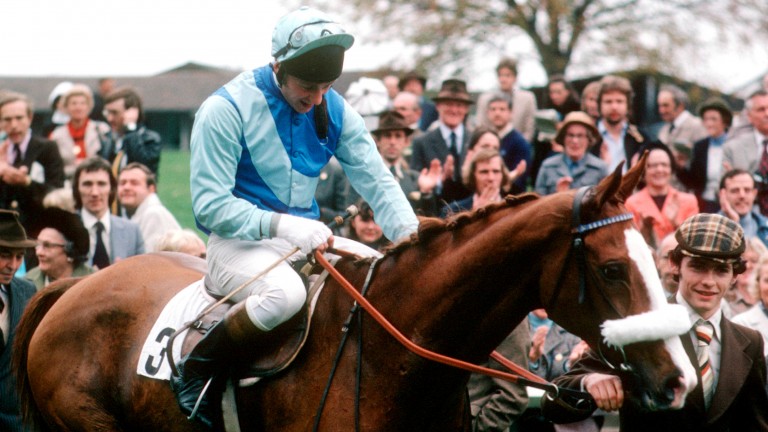
Tingle Creek after his final race - with a track-record victory at Sandown in November 1978.
©Gerry Cranham
|
|
|
COLONIAL CARDS THREE JUMP RACES FOR SUNDAY
|
|
Colonial Downs will present three steeplechase races on a special Sunday program on Aug. 2. The New Kent, Va., track scheduled the Sunday card after its opening-day program on July 27 was canceled because of excessive heat.
Three maiden hurdles with full fields and also-eligible lists will be run beginning at 3:30 p.m. The first two races are for maidens four-years-old or older, and the third race is for maiden fillies and mares. Here is a link to the entries.
As a result of the scheduling change, the two steeplechase races originally scheduled for Monday, Aug. 3, will not be run. Colonial Downs intends to run three steeplechase races on Monday, Aug. 10.
|
|
|
|
|
|
|