|
I am on Facebook! Are you?
My Legislative page is frequently updated with the latest news throughout the state and the district.
Like me on Facebook and be the first to know.
Update on Previous Issues:
Florida House Mobile App:
Follow Me:
.
|
|
| |
As we approach the midpoint of the 2015 Legislative Session, the Florida House of Representatives has been preparing a budget for the 2016-2017 year. In the coming weeks, historic investments in Florida's education system as well as providing relief to Floridians and their small businesses will be at the forefront of discussions in Tallahassee. With that in mind, I wanted to take this opportunity to provide you with critical information on Florida's Budget Process. Currently, we are in the fourth step of the process and I hope that you find the information below to be of use to you during the upcoming budget discussions between the House and Senate.
House Appropriations Overview
In addition to information about the appropriations process, I have included information on the proposed House Tax Package currently being considered by the Finance & Tax Committee. Their meeting this week considered a variety of tax cuts and tax holidays, including a reduction in the sales tax on commercial leases, that I believe would alleviate the some of the regulations Florida's business are subject to that other states do not impose.
Your Friend and Neighbor,
Greg Steube
Proudly Serving Manatee and Sarasota Counties
|
The 6 Steps Taken to Craft Florida's Budget
|
Below, you will find the steps taken each year to craft our state's budget.
- The first step is the creation of the state budget, a process that begins each fall with the development of the Long Range Financial Outlook. The Long Range Financial Outlook is a constitutionally required report that is approved by the Legislative Budget Commission each September. The Outlook provides a three-year picture of the state's fiscal position by lining up the estimated budget needs with the estimated revenues.
- Shortly after the outlook is produced, Florida's state agencies submit a detailed list of their budget needs. This is called a Legislative Budget Request.
- As required by law, thirty days prior to the start of the Legislative Session the Governor presents his budget recommendations to the Legislature.
- At this time, we are in the fourth step of the process. It occurs during the Legislative Session when both the House and Senate work to pass their own appropriations bills within their respective chambers. I have listed and linked the House and Senate documents below.
- Next, the Speaker of the House and President of the Senate appoint members from each chamber to participate in a process called the Budget Conference. The conferees are responsible for resolving any differences in the separate House and Senate budgets in order to create a single budget. During conference, they must determine not only the items that will receive funding, but also how much funding will be allocated for each item. I expect for budget conferees to be announced once a start date has been set for the beginning of the formal conference.
- Finally, following a successful conference, the two bodies produce a single conference report, called the General Appropriations Act (GAA). The GAA is then sent to the Governor, who has line-item veto authority over items within the document, for passage.

|
Important Facts on Florida's Budget
|
Florida's Fiscal Year
July 1st - June 30th
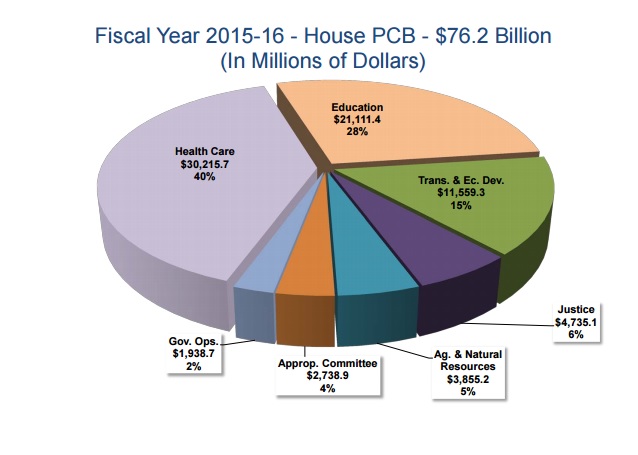
Florida's Top 5 Spending Areas in the Budget
Healthcare
PreK-12 Education
Transportation & Economic Development
Higher Education
Justice
Florida's 3 Major Categories of Funding
The General Revenue Fund
State Trust Funds
Federal funds
|
Florida Must Pass a Balanced Budget
One of the most important facts to keep in mind during the upcoming budget discussions is that Florida is constitutionally required to balance its budget each fiscal year. This means that the state cannot spend more than it receives in revenue.
|
|
2015 Appropriations Documents
|
House & Senate Appropriations Committee Meetings - Week 4
|
This week, both the House and the Senate Appropriations Committees met. Below, I have provided links to their committee meeting videos and documents.
|
- Total House Recommended Budget: $76.2 billion
- General Revenue Funds $28.4 billion
- State Trust Funds $23.4 billion
- Federal Funds $24.4 billion
- Compared to the FY 2014-15 Budget - down by $918.8 million (-1.2 %)
- General Revenue Funds - up by $461.8 million (1.7%)
- State Trust Funds - up by $588.3 million (2.6%)
- Federal Funds - down by $1,968.9 million (-7.5%)
- FTE's
- FY 2015-16 FTE = 113,652
- FY 2014-15 FTE = 114,503
- Reduction of 851 FTE; (-.7%)
- Reserves - $3.1 billion
- General Revenue Fund = $1.1 billion
- Budget Stabilization Fund = $1,353.7 million
- Lawton Chiles Endowment Fund = $611.4 million
- Trust Fund Sweeps - $332.2 million
- Agriculture & Natural Resources - $66.0 million
- Government Operations - $20.2 million
- Health Care - $35 million
- Justice - $10 million
- Transportation & Economic Development - $201.1 million
|
House Filed Appropriations Bills
|
House Proposed Committee Bills
|
|
Education
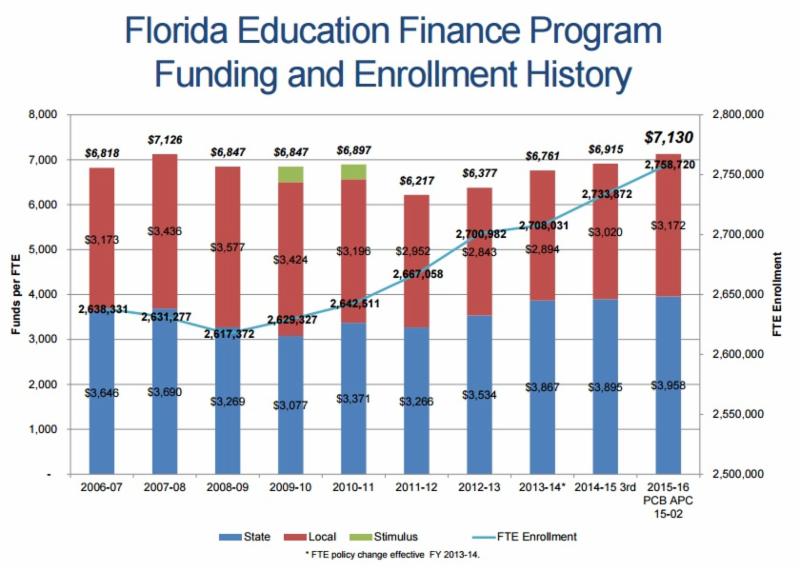
- The FY 2015-16 House Budget increases per student funding by 3.11%, or $214.74 per student, exceeding the highest level of funding previously provided in 2007-08.
- There is $2.2 million allocated to implement the Florida Achieving a Better Life Experience (ABLE) Program established in HB 935. This money will allow individuals with disabilities to responsibly save for the future services and care they will need, without losing their eligibility for state and federal benefits.
- There is an increase in state funding for the State University System of $140.9 million, not including tuition revenue, from the base budget.
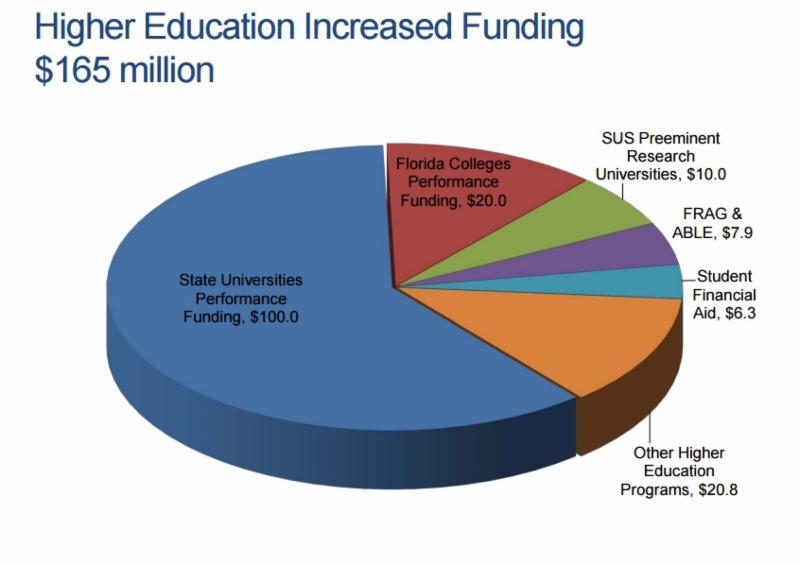
- We have also set aside $200 million for performance funding to reward state universities that help students get jobs after graduation, not just framed degrees.
- $1 million is provided for the Florida Center for Students with Unique Abilities, which will serve as the statewide coordination center for disseminating information regarding programs and services available for students with disabilities and their parents.
|
Senate Appropriations Information
|
House Finance & Tax Committee Meeting - Week 4
|
This week, the House unveiled a tax package that would provide $690 million in tax relief to Florida families and businesses. I encourage you to view the committee's presentation on the specific tax cuts introduced this week.
|
|
|
|
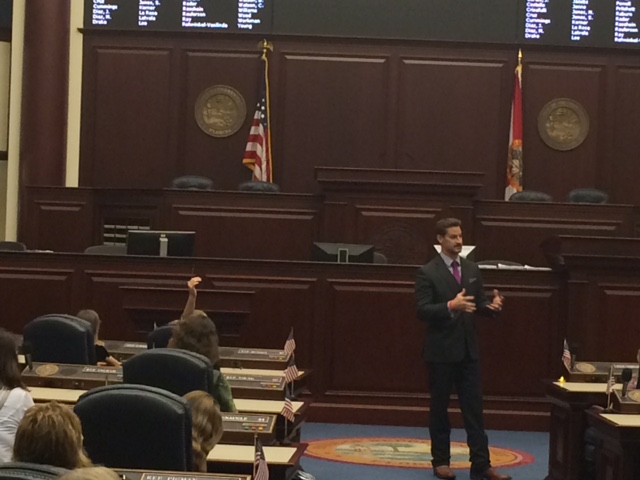
On March 10th, it was my pleasure to speak to students from Bradenton Christian School, Florida's future leaders!
|
|
|
|
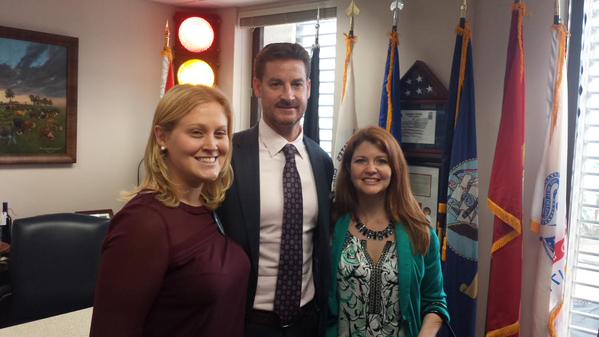
On March 11th, I met with representatives of Florida Music Therapists. Thank you for all you do!
|
|
Friday, May 1st: Last day of the 2015 Legislative Session. (Tallahassee)
|
Contact Me:
Unit A 402 South Monroe Street
(941) 341-3117 (850) 717-5073
|
|
| |
|