Mission
Pollyanna creates discussion platforms for groups of people to explore issues of diversity, inclusion and equity;
and to share experiences and knowledge. We believe in being eternally optimistic even in the face of challenge.
Pollyanna exists to be part of the solution.
|
|
Welcome from Casper Caldarola
Founder
|
|
Happy New Year!
I wish all of us a year filled with strength, growth and kindness –– that 2018 will have less of the challenges and stress many of us faced last year, and more exciting opportunities and successes. I am more committed than ever to help improve the world around me. Whether that’s not normalizing or accepting hateful behavior, or taking a moment to become more outspoken for those whose voices are quieted. For me, complacency is not an option.
While Pollyanna may not change the entire world, it can strengthen a school community. It creates the platform to have difficult conversations and helps move equity initiatives forward. Together, we can influence and foster what is and isn’t acceptable within our school communities. I hope you’ll join the Pollyanna family and help continue the work we've started. Please be in touch with me to see how easy it can be to make a difference.
With warm regards,
|
|
Contact us
to join the growing list of Schools in our family.
|
|
Meet Monique Vogelsang
Trustee & Facilitator
|
Born to a large, multiracial family, Monique developed an interest in identity from a young age, especially the ways in which we define ourselves and how we view others. Raised in the desert of southern California, Monique and her three sisters were first generation college students. As an undergraduate at University of California, Santa Barbara, Monique researched and developed a Senior Thesis that focused on Belize – her mother’s home country – and the roles that race, ethnicity, gender, and sexuality play in forming society and individual experience. Upon graduating, she joined Teach for America to become a classroom teacher in New York City. Throughout her educational career, Monique has worked with both the lowest and the highest socio-economic populations of New York, including public schools in Harlem, an independent school in Manhattan’s Upper East Side, and non-profit organizations that provide educational and artistic resources to students across the city. Having experienced the incredibly diverse educational and cultural realities that can exist within a single square mile, Monique believes that the keys to success are equal access and opportunity, and taking the time to celebrate our differences, while also recognizing our similarities.
After a decade in the classroom, Monique launched her own private education business, where she continues to work with students and consults with families. She joined Pollyanna to have a greater impact on school communities in New York City and across the country. A passionate storyteller, Monique has recently written a young adult novel about a low-income, multiracial, gay teenager who must overcome an array of obstacles in order to fulfill her dreams. This is, perhaps, Monique’s most personal lesson of all.
|
|
What made you decide that Dalton should host the very first conference?
When the concept for the first conference was presented to us at Dalton, we were already collaborating with other schools in New York City and beyond as to how best to advance efforts of diversity, equity and inclusion, but we never really had the time for extensive discussions. To be able to create a setting in which to have these conversations was very appealing. Also, holding a conference with representation from different parts of the school -- trustees, parents, students, alumni, faculty and administration -- was very important.
How do you feel Dalton has benefited by being the host of the conference?
By being the first school to host a Pollyanna Conference, we have been identified as a leader in discussions around diversity, equity and inclusion, a key part of our strategic plan. Taking a lead role has also demonstrated that we at Dalton have intentional goals in this area, which has encouraged a large number of people especially from other schools to approach me about these objectives, which might not have happened otherwise.
What feedback have you received about the conference from different heads of schools?
Many of our peer schools, and others, have indicated that the conference has impacted their strategic plan and diversity intentions, and that hearing from other institutions, which are having similar dialogues, is comforting. Learning from each other as to how to structure and encourage families in equity and inclusion discussions has been hugely beneficial. In addition, creating goals before leaving the conference has helped shape agendas going forward.
What has your particular role been in the Dalton conferences?
I’ve actively participated in all of the conferences. I think it is necessary to have the head of the school involved because diversity initiatives supported by the leadership of the organization are more often likely to permeate throughout the community.
Where do you see the conference going at Dalton?
I hope the conference continues to focus on topics that allow discussions to go in different directions. Pursuant to conversations inspired during previous conferences, we are also excited to be incorporating our own internal conference into the next school year with a similar model so we can involve even more people in our community in these conversations.
I praise Casper and the entire Pollyanna team for their leadership in organizing all of the conferences we’ve hosted to date.
|
|
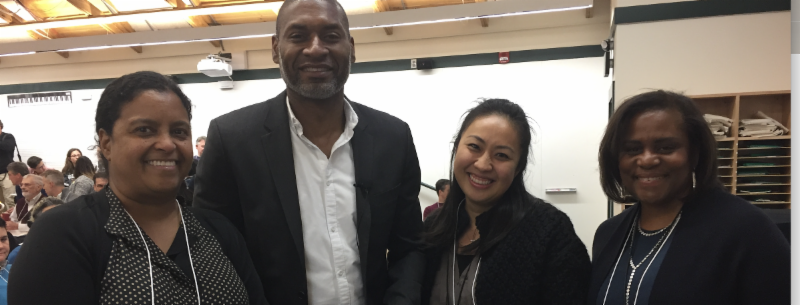
Photo taken at Far Brook's Conference
|
|
Take Action
The cost of hosting a Conference at an independent school is not completely covered in the school fee. Please consider a gift to underwrite part of or the entire cost of an independent school.
|
|
Pollyanna, Inc. is a New York not-for-profit corporation 501(c)(3). © 2017 Pollyanna.
Sarah Woods: Writer of interview | Louisa Wells: Newsletter Designer
|
|
|
|
|
|
|