|
Dear Covenant Friends,
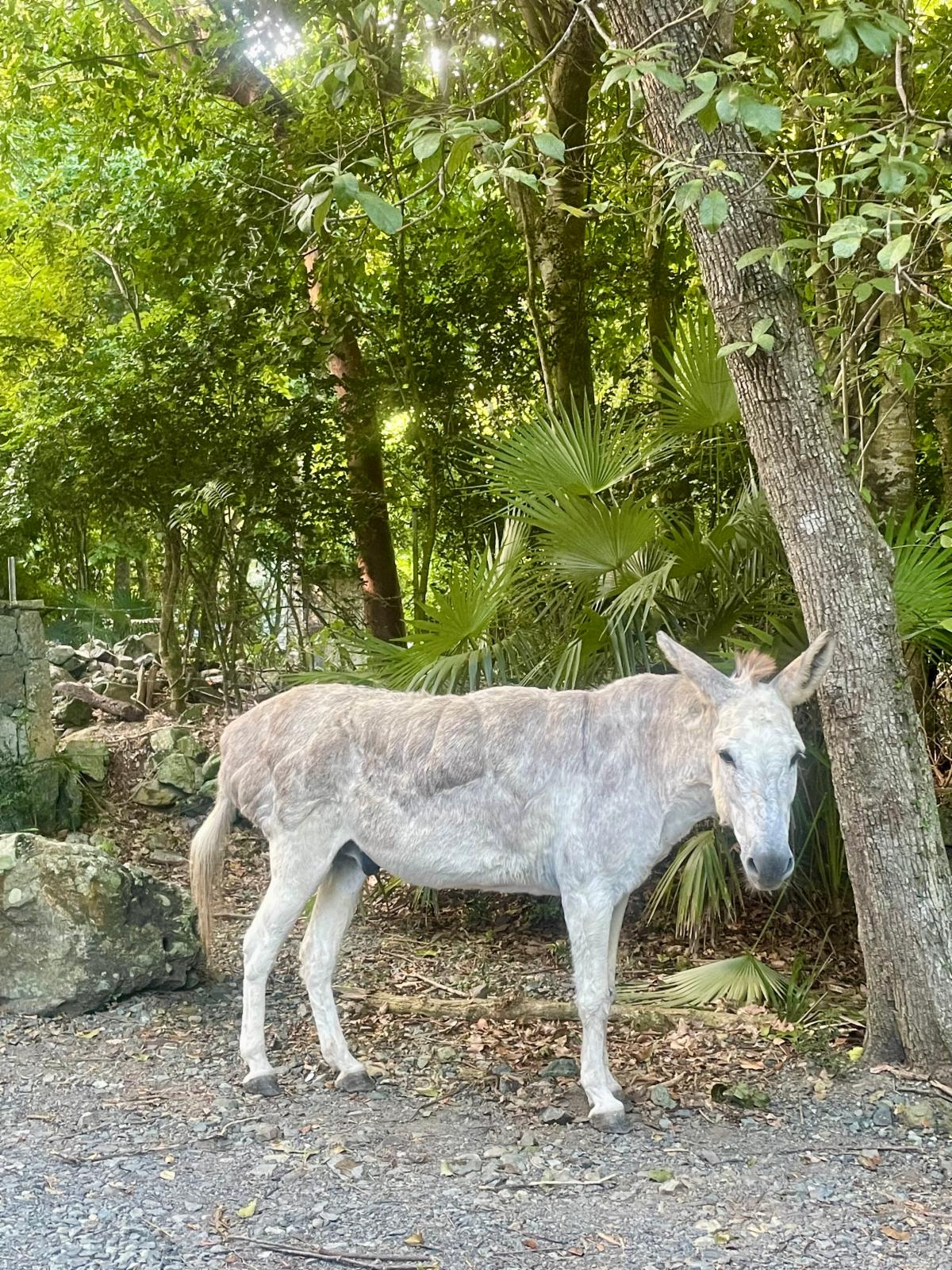
A few years ago, we met a donkey on the island of St. John. He was the wandering type, and we glimpsed him early each morning in the woods surrounding our campsite near the beach. Later, we learned that donkeys were brought to the island in the 1600s and 1700s to labor on Danish sugar plantations and were released into the wild after the abolition of slavery and the decline of the sugar industry.
Our new friend was one of a herd descended from those early beasts of burden—quiet witnesses to the long and painful history of human exploitation.
Donkeys appear throughout the Bible, but none are as famous as Balaam’s donkey. In Numbers 22, a prophet’s donkey sees what its master cannot—an angel standing in the road. Three times the animal refuses to move, and three times the prophet beats it, blind to the truth before him. Finally, God opens the donkey’s mouth. The animal speaks, rebukes the prophet, and saves his life. The donkey becomes, strangely and beautifully, a model of spiritual perception—seeing what others miss, resisting what others rush toward, bearing truth when others refuse to hear it.
In Walking with Henry, Rachel Anne Ridge writes of grace showing up in unexpected ways:
“Sometimes it arrives as a moment of joy in the middle of despair… And sometimes, grace has fuzzy ears, a bristled mane, and hope for a new start.”
Reflecting on her life with two donkeys (one named Henry), she describes how people confide in her—stories of dogs, cats, even chickens—animals who have revealed something of God’s presence to them. They are often surprised, even embarrassed, by this quiet wisdom. But this is the way of creation. Everything speaks of God.
On Palm Sunday, a donkey takes center stage once again. Matthew, attentive to the prophecy of Zechariah, tells the story with layered detail, Jesus riding two animals; the other Gospels simply say that Jesus rides into Jerusalem on a young donkey.
It is a striking image. Not a war horse. Not a chariot. Not the display of imperial might embodied by Pontius Pilate and his soldiers entering the city from the opposite side. Instead: a young, unsteady animal. A different kind of kingdom.
Preaching on the text from Mark at Dinner Church, Elder Andrew Edwards concluded his sermon with this reflection:
“The kingdom of heaven is what comes to us through the grave, and in our weariness, and on the back of a stumbling baby donkey. And that’s wild and unfathomable and altogether unsatisfactory. But that’s the journey we’re on. That’s the journey that Jesus and his disciples were taking when they came to Jerusalem. So we’re going to keep walking—not just because we have no other choice, but because even in our tiredness and despair, God’s kingdom continues to break in.”
Holy Week is nearly upon us.
It may be that we need to learn from donkeys—
when to stop and listen for God’s messengers,
when to rest or refuse the wrong path,
and how to carry Christ into the world with quiet courage.
As the poet G.K. Chesterton reminds us, even the lowliest creature may bear a holy mystery:
“Fools! For I also had my hour;
One far fierce hour and sweet:
There was a shout about my ears,
And palms before my feet.”
Peace,
Pastor Jessie
pastor@covenantweb.org
|