December 2025 Issue Features: | | |
AI is AT, but AT is not always AI
by LaShauna M. Britt, M.Ed.
Analogies like, "AI is AT but AT is not always AI," are a nice way to compare two things for explanation or clarification. However, we know that figures of speech can confuse many. A colleague and I discussed this analogy, and we agreed that Artificial Intelligence (AI) and Assistive Technology (AT) both help individuals gain access, specifically in the classroom. Additionally, this access cannot be achieved without the collaboration of all stakeholders involved in the life of a student with a disability. This conclusion brings us back to High Leverage Practices (HLPs) 1: Collaboration and 19: Use Assistive and Instructional Technologies, because both are needed to help one gain access in all meanings of the word 'access'.
| | |
Leveraging Collaboration to Improve Outcomes for Students with Disabilities
by Cathy Buyrn, M.Ed.
The July 2025 edition of the Link Lines Administrators’ Corner, Integrating High-Leverage Practices for Students with Disabilities, connected the High-Leverage Practice (HLP) domains (i.e., Collaboration, Data-Driven Planning, Instruction in Behavior and Academics, Intensify and Intervene as Needed) offered by The Council for Exceptional Children (CEC) in collaboration with the Collaboration for Effective Educator Development, Accountability, and Reform (CEEDAR) Center at the University of Florida. The September 2025 edition, Building Data Literacy & Progress Monitoring Skills, focused on the Data-Driven Planning domain. In this edition of Link Lines, the Collaboration domain pillar and embedded practice (See Figure 1) will be explored and connected to all aspects of improving outcomes for students with disabilities. While each of the HLP domains are distinct, they work in concert with one another to establish high-quality learning conditions focused on meeting the individual needs of students with disabilities.
| | |
Educators are aware of how important it is to build positive relationships with their students and often receive training to enhance their skills. However, those skills do not always transfer to increasing positive relationships and engagement with families. One key difference is the modes of communication. Educators see students in person almost daily and build those relationships through two-way verbal communication. Families, on the other hand, are often only seen face-to-face a few times a year at events like open house or annual Individualized Education Program (IEP) meetings. Increasingly, technology has provided us with myriad ways to communicate with families beyond phone calls and in-person meetings, such as email, texting applications, and video conferencing. Family collaboration increases student success, but educators often do not receive specific training around these skills. This can lead to discomfort around communicating with families and negatively impact critical decisions that need to be made during a student’s academic career. Time is at a premium for families and teachers, so increasing effectiveness can save time as well as strengthen the relationship (Graham-Clay, 2024).
In this article, we will look at some of those critical points, including eligibility, initial and annual IEPs, and transition planning. Then we will explore some tips and tools to increase collaboration skills throughout the many modes of communication now available.
| | |
Eligibility: Build a Collaborative Foundation
The initial eligibility process is typically the first time families will engage with the school on the potential that their child qualifies for special education services. This gives schools an opportunity to start the collaboration on a strong foundation. Collaboration should first take place with the testing team to determine the different data sources that can be used to answer eligibility questions. Having conversations early about what kinds of data will be collected, and why, can help families feel more comfortable with the testing process. Discussing possible testing dates can help alleviate anxiety as well as let parents know when they will be able to see the testing results. Interpreting results can be a barrier for parents coming into the eligibility meeting, so schools can increase trust during the process by providing them with resources, including connecting them to organizations like the school division’s parent center or statewide groups like PEATC (Parent Educational Advocacy Training Center) and Center for Family Involvement. Many school divisions have a Parent Resource Center within their division, which can be a valuable resource for families beginning this process.
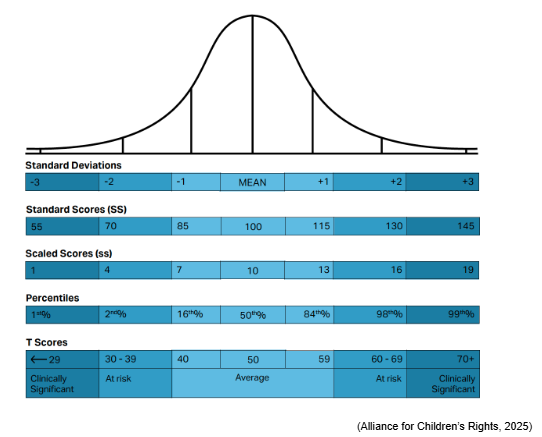
Though there are many resources available to help families understand the eligibility process, it is important for schools to share resources from credible sources that outline the process in an accurate and accessible way. The Virginia Department of Education has the Special Education Evaluation Process Video Guide which includes video modules. This series could be shared with families as well as serve as a good tool for educators who haven’t participated in the process before. Another resource is the Special Education Eligibility Checklist created by the Alliance for Children's Rights. This guide includes information about interpreting different kinds of test scores as well as eligibility criteria and rule-outs.
| |
Individualized Education Programs: An Annual Opportunity
Once a student is found eligible, school teams should be ready to explain the next steps in the special education process. PEATC has created an IEP Welcome Kit and IEP Welcome Kit Instructions that give schools the opportunity to share information not just about special education as a whole, but it can be personalized for your school.
Family involvement in the IEP process goes beyond attendance at meetings and can also give teams an opportunity to discuss positive updates and problem-solve together. A good place to start is to understand the special educator’s role in the process and put together a timeline. These documents may exist for your specific school division, but TTAC online also has a resource designed to help special educators Facilitate Collaborative IEP Meetings. Building communication pathways early and inviting collaboration before the IEP meeting takes place can help cultivate positive relationships (Gisewhite et al., 2021). This allows teachers to be responsive to any concerns or questions families may have so school teams can prepare to address any concerns before or at the meeting. For example, parents may require an interpreter or an accommodation to allow them to fully participate. Another area of note is to make sure to use clear communication and avoid educational jargon without explaining it to families. The Critical Decision Points document shared earlier in this article includes a glossary of terms that can be shared with families as well.
There are some topics that are better discussed in person rather than over the phone or through written communication. These more sensitive topics may be discussed at an annual IEP meeting or teams may decide to hold amendment meetings to make adjustments. Examples might be behavior or health issues that have come up with the student (Graham-Clay, 2024). Other topics like determining a student’s diploma track and transition services also provide opportunities for educators to collaborate with families to increase student success. These are more than boxes to be checked on the IEP and will have a significant impact on the life of the student and their families. The Virginia Department of Education’s website, Secondary Transition Services for Students with Disabilities, has many documents that help educators understand and discuss topics like the transfer of rights to students when they reach the age of majority and what state and community resources are available.
Communication Tips
Research shows that when teachers improve their communication skills families become more involved (Graham-Clay, 2024). Some ways to improve in person communication have been discussed already, such as sharing positive news and discussing important topics, like graduation, early and often. Other things to consider are scripting or outlining phone calls before speaking on the phone. Checklists like the one provided below can serve to help organize IEP meetings and can be used to think through what important points educators would like to discuss.
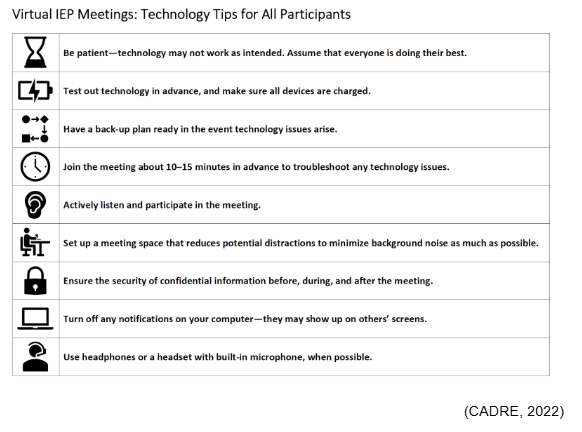
One major change in meeting structures over the last few years has been the increase in virtual meetings. The Center for Appropriate Dispute Resolution in Special Education (CADRE) shares strategies, tips, and resources that can help teams set up and facilitate successful virtual IEP meetings.
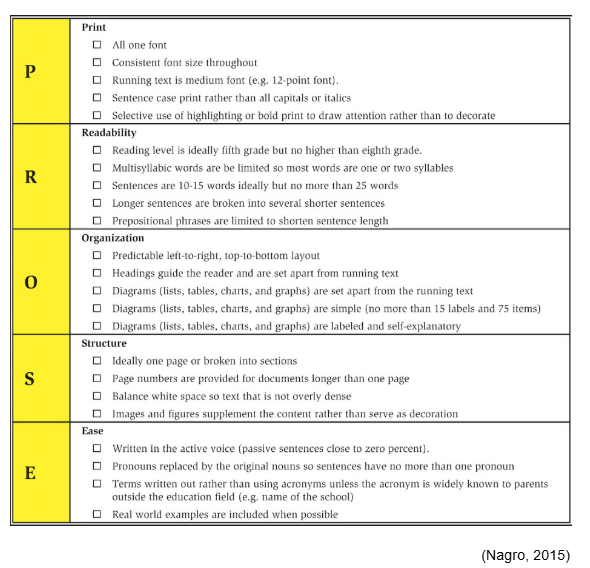
| In addition to the two-way communication that happens in meetings or over the phone, teachers are more often using text-based applications and email to communicate with families. It is important to remember that all communication, regardless of means, should be professional and easily accessible. Using a tool like the PROSE Checklist can help educators address challenges around readability, clarity, complexity, and structure (Nagro, 2015). | Collaboration with families is vitally important yet often overlooked. Building a strong foundation with collaboration starts at the first eligibility meeting and continues throughout a student’s academic career. Educators can utilize the annual IEP meeting to strengthen their relationships with families and ensure that critical decision points are being discussed long before decisions have to be made. It is important to remember that by increasing communication skills, educators can become thoughtful and respectful communicators and increase student success during school and after they graduate (Nagro, 2015). | | |
Alliance for Children’s Rights. (2025). Special education eligibility checklist. Alliance for children’s rights.
https://allianceforchildrensrights.org/resources/special-education-eligibility-checklist/.
Gisewhite, R. A., Jeanfreau, M. M., & Holden, C. L. (2021). A call for ecologically-based teacher–parent communication skills training in pre-service teacher education programs. Educational Review, 73(5), 597–616.
Graham-Clay, S. (2024). Communicating with parents 2.0: Strategies for teachers. School Community Journal, 34(1), 9–60.
Nagro, S. A. (2015). PROSE Checklist: Strategies for improving school-to-home written communication. TEACHING Exceptional Children, 47(5), 256-263. https://doi.org/10.1177/0040059915580031
The Center for Appropriate Dispute Resolution in Special Education. (2022). Virtual meetings: Virtual IEP meeting tip sheet. https://cadreworks.org/sites/default/files/virtual-iep-meeting-tipsheets.pdf
| | | | |