View as Webpage

President Obama said, "… no program and no policy [that] can substitute for a parent involved in their child's education from day one…" (U.S. Congress, 2009, para. 34). Creating a collaborative team that includes families and schools is the job of all stakeholders involved in the lives of a student with disabilities. The goal of the Individual Education Program (IEP) team is to incorporate all stakeholders in the decision-making process to make decisions that are best for the student and their educational future (Alsaeed et al., 2023; Morningstar & Clavenna-Deane, 2018; Scott et al., 2021; Trainor et al., 2019). The goal of the Individuals with Disabilities Education Act (IDEA) is to ensure that all students with disabilities have access to a free and appropriate education (FAPE) while ensuring that the parent(s) or caregiver(s) of these students are given specific rights and protections (procedural safeguards) to ensure they are involved in their child's education (IDEA, 2004). Providing students with access to a FAPE while engaging families is one way to ensure students with disabilities experience a successful secondary transition process and achieve high school graduation.


Collaboration, IEPs, specially designed instruction, students, schools and families; Oh my! Creating collaborative relationships within any organization can be a daunting process, now add in families, educators, and the legality of IDEA. The product of these paradigms is the process of secondary transition for students with disabilities, which is the goal of an IEP, SDI, and family engagement. This article will focus on briefly connecting the classroom with the reality and complexity of the lives of students with disabilities, using the Taxonomy for Transition Programming and High Leverage Practices. The administration component to this article will focus on SDI while this article will discuss information and resources that help create a cohesive transition from classroom SDI to real world connections of secondary transition for students with disabilities.  

Taxonomy for Transition Programming


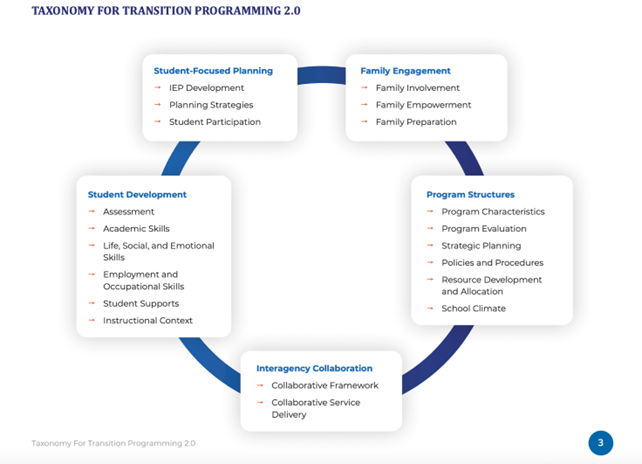
The Taxonomy for Transition Programming is a framework that organizes the key components of effective transition planning for students with disabilities and focuses on preparing them for a post-school environment and experiences (or activities). This framework is a guide to assist educators in designing, organizing, and evaluating transition programs and services for students with disabilities while incorporating all stakeholders, including the students and parents of these students (Koher et al., 2016).


The framework focuses on the following five areas of transition planning: student-focused planning, student development, interagency collaboration, program structures, and family engagement. The focus of this article is to highlight the need to develop and foster sustainable family engagement. We often use family involvement and family engagement interchangeably; however, family involvement is participating in school activities, while family engagement is actively partnering with schools to support a child's learning and development. 

Note: Taxonomy for Transition Programming 2.0, Paul D. Kohler, June E. Gothburg, Catherne Fowler, & Jennifer Coyle, https://transitionta.org/wp-content/uploads/docs/NTACT-C_TaxonomyforTransition.pdf, Copyright 2016.

High Leverage Practices


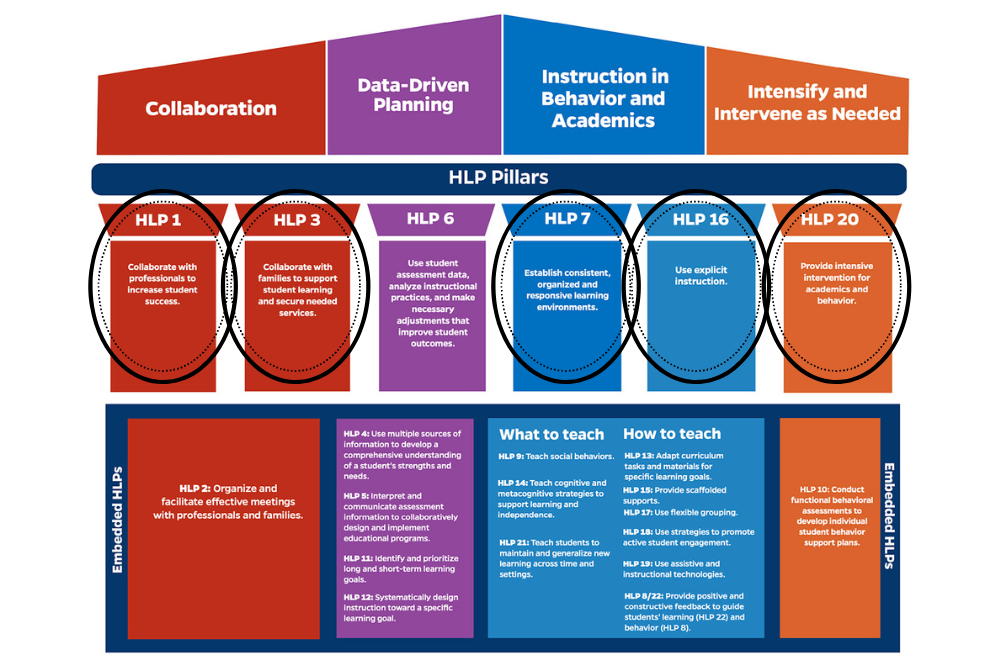
In previous Link Lines issues, we discussed High Leverage Practices and how to incorporate them into the classroom. HLPs can be used as an entry point for classroom teachers to introduce families to practices that support collaboration between stakeholders while lending opportunities for families to engage with schools around instruction, behavior, and academics. The following is the diagram of the High Leverage Practices with circles to show the HLPs that support the Taxonomy for Transition Programming. 

High Leverage Practices

Note: High Leverage Practices Resources, CEEDAR, 

https://ceedar.education.ufl.edu/wp-content/uploads/2024/03/HLP-Pillars-.pdf, Copyright 2023.

In education, we receive new initiatives every school year. Many educators struggle to incorporate these new initiatives with the old initiatives. Over the years these initiatives may or may not have included family engagement for students with disabilities. The Taxonomy for Transition Programming and High Leverage Practices are intentionally combining instruction and family engagement to improve the outcomes for students with disabilities. This intentionality can be used to leverage family engagement while intensifying instruction for not only students with disabilities but for all students. To support these statewide initiatives, we have included helpful resources below to assist in supporting students and families access a successful K12 educational experience. 

Resources


References:

Aceves, T. C. and Kennedy, M. J. (Eds.) (2024, February). High-leverage practices for students with disabilities. 2nd edition. Arlington, VA: Council for Exceptional Children and CEEDAR Center.


Alsaeed, A. H., Shogren, K. A., Raley, S. K., Kurth, J. A., & Scott, L. A. (2023). Implementing the self-determined learning model of instruction in culturally responsive ways. Inclusive Practices, 2(4), 91-100. https://doi.org/10.1177/27324745231210864


Individuals with Disabilities Act, 20 U.S.C. § 1400 et seq. (2004). https://sites.ed.gov/idea/statute-chapter-33 


Kohler, P. D., Gothberg, J. E., Fowler, C., & Coyle, J. (2016). Taxonomy for transition programming 2.0: A model for planning, organizing, and evaluating transition education, services, and programs. Western Michigan University.


Morningstar, M. E., & Clavenna-Deane, B. (2018). Your complete guide to transition planning and services. Paul H. Brookes Publishing Co.


Scott, L. A., Thoma, C. A., Gokita, T., Bruno, L., Ruiz, A. B., Brendli, K., Taylor, J. P. & Vitullo, V. (2021). I'm trying to make myself happy: Black students with intellectual and developmental disabilities and families on promoting self-determination during transition. Inclusion, 9(3), 170-188.  


Trainor, A. A., Carter, E. W., Karpur, A., Martin, J. E., Mazzotti, V. L., Morningstar, M. E., Newman, L., & Rojewski, J. W. (2019). A framework for research in transition: Identifying important areas and intersections for future study. Career Development and Transition for Exceptional Individuals, 43(1), 5-17. https://doi.org/10.1177/2165143419864551 (Original work published 2020)


U.S. Congress. (2009, February 24). Remarks of President Barack Obama – As Prepared for Delivery Address to Joint Session of Congress [Press Release].  

https://obamawhitehouse.archives.gov/the-press-office/remarks-president-barack-obama-address-joint-session-congress

TTAC would like to know more about your experiences with TTAC Online.

Facebook  X