Hi from Roger Linn-- 


Here's my June 1st, 2026 LinnStrument Newsletter, featuring some items of possible interest to LinnStrument owners or enthusiasts. If there's anything you'd like to see in future newsletters, please let me know.


- Roger

Video: Erica Synths Steampipe

I'm a fan of physical modeling synthesis, which is well-suited to LinnStrument's expressive touch control. Recently I've heard good things about the Steampipe physical modeling hardware synth from Erica Synths. LinnStrumentalist Quincas Moriera has created a video in which he does a deep dive into this this new synth.

Video: Setup for Guitar Sounds

I'm a guitarist and enjoy playing guitar sounds on LinnStrument. using my LinnStrument MPE sounds file for Apple's Logic or MainStage, which includes some very good guitar sounds.


But I also enjoy seeing videos of other LinnStrumentalists playing guitar techniques. One particularly good player is Juhani Haverinen of FInland, who not only has excellent technique for realistic guitar gestures on LinnStrument, but also gets very high quality guitar sounds. His skill is demonstrated in these video performances of Hexdrix's "Little Wing" and John Mayer's "Belief". Recently, he's created an instructional video in which he describes his setup for guitar-style play on LinnStrument using The "Ample Guitar SC" plug-in instrument.

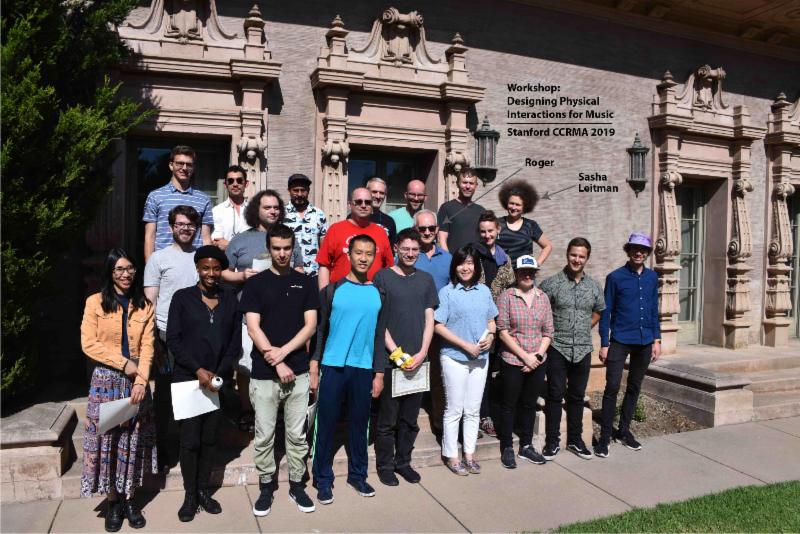
Stanford Workshop with Roger

Every year in June, Sasha Leitman and I co-teach a one-week, five full days, hands-on workshop about designing and creating electronic music/audio projects at Stanford University's CCRMA computer music school, either in-person or remote via Zoom. The workshop is called "Designing Physical Interfaces For Music". This year, it will take place on June 15 through 19. The cost is $500 in-person, or $250 remote via Zoom, plus a small fee for Eventbrite.


In the workshop, Sasha and I provide lots of information about sensors, actuators, software, mechanical design and materials, and lots more. We help you come up with a project idea and help you build it. If you're attending in person, you'll have access to sensors, actuators and electronic/mechanical tools in the CCRMA Max Lab. Or if you're attending remotely online, you'll obtain the needed items in advance. Either way, we'll provide one-on-one help with your project.


Given that the workshop is only one week, the projects are generally simple, providing a novel way of interacting with sensors to generate sounds, controlled by software written for a Teensy microcontroller board (or an MCU board of your choice) sending MIDI, with sound generated on the Teensy or on a connected laptop. 


To learn more and see examples of past student projects, click here.

To see the workshop schedule on Sasha's site, click here.

To register for the workshop, click here.

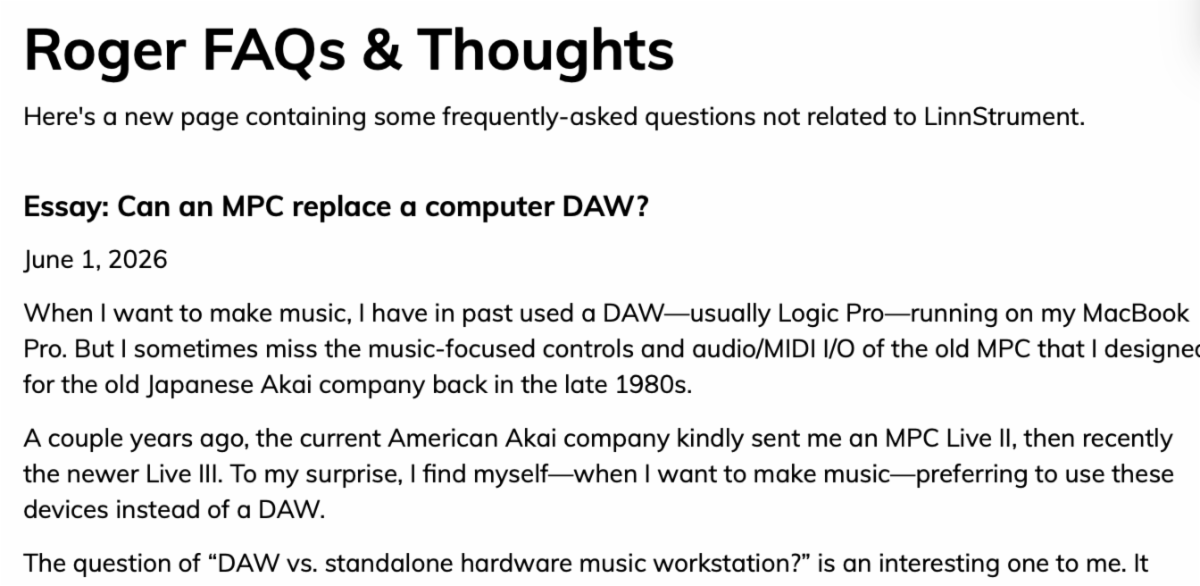
Essay: Can an MPC replace a DAW?

When I want to make music, I generally use Logic Pro running on my MacBook Pro. But I sometimes miss the music-focused controls and audio/MIDI I/O of the old MPC that I designed for the Japanese Akai company back in the late 1980s. 


A couple years ago, the current American Akai company kindly sent me an MPC Live II, then recently the newer Live III. To my surprise, when I want to make music I often find myself preferring to use these devices instead of a DAW. 


This begs the question "Can an MPC replace a DAW?". I've written an essay on the topic on my site's "Roger FAQs" page.

Good Y-axis Destinations

I sometimes find some confusion among new LinnStrument owners about how to best use Y-axis. A good use of Y-axis is to provide a continuous change in timbre without changing apparent loudness, analogous to bowing a cello at different string positions between the bridge and neck, or varying embouchure on a wind instrument. In synthesis, this is best done by using modulation destinations that alter the source waveform. Here are some suggestions, as well as examples from Surge XT's "LinnStrument MPE" library:


  • Pulse width modulation. Example: Pads>Pulse Wave & Filter.
  • Continuous morphing between two waveforms. Example: Winds>Duduk.
  • Oscillator hard sync. Example: Leads>Snarling Cat.
  • Changing the balance between two waveforms.
  • Changing the balance between a waveform and another waveform an octave (or a fifth) above it. Example: Pads>Warm Pad.
  • Detuning one of two mixed oscillators to change beat frequency.
  • In FM, FM modulation amount or modulation ratio. Example: Brass>FM Horn.
  • Comb filter frequency. Example: Winds>Hollow Wind Tube, or Leads>Screaming Octaves.
  • For trilled sounds, vary the envelope decay time of the repeated sound. Example: Pads>Hammered String.
  • In Surge XT, the Vowels/Speech Engine's "Segment" slider. Examples: Vox folder.
  • Generally, lowpass filter frequency isn't a good destination because it changes apparent volume. But it can sometimes work well. Examples: Organs folder, in which Y-axis pulls out the upper harmonic drawbars of a Hammond organ.
  • Various methods of waveform warping. Each synth has its own unique ways of waveform warping or manipulation. Surge XT has a wide variety of such methods.


If you're on a Mac, the synthesis sounds in my sounds file for Logic or MainStage have some good examples of Y-axis control. To get this file, click the link on the LinnStrument Support page.

Next Zoom Call

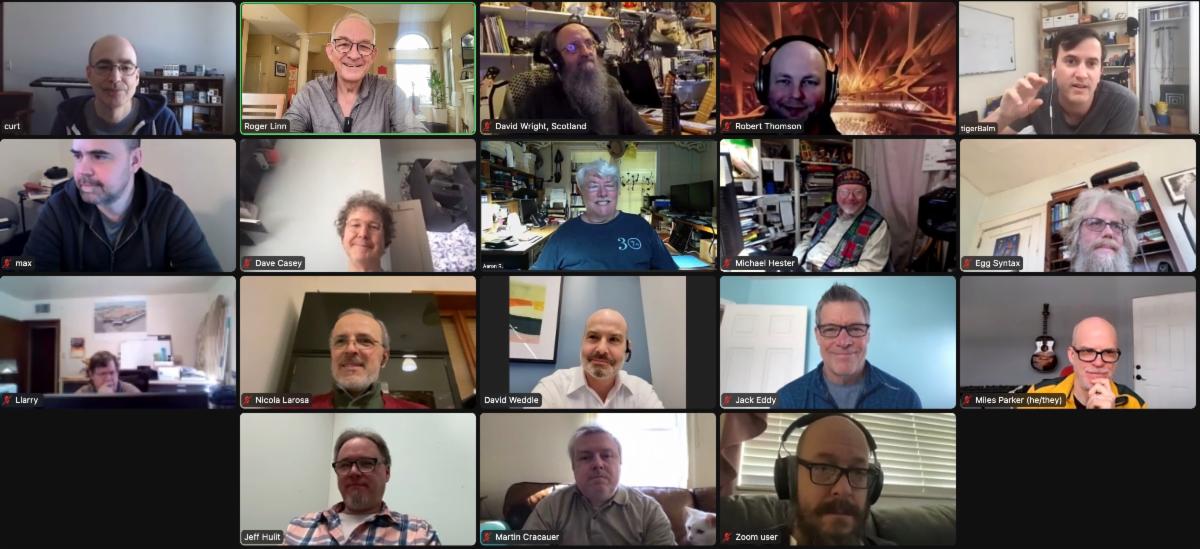
The next "All things LinnStrument" Zoom call is this Tuesday June 2nd at 10 am California time. All are welcome-- LinnStrument owners and those interested in LinnStrument. I'm happy to answer questions from potential buyers or newbies, and interesting discussions often ensue between owners about tips, techniques, specific synths, or editing the source code.


To get the Zoom meeting link, click here or click "Monthly Zoom call with Roger" from the LinnStrument Support page. I hope you can join the meeting, if not this one then on any future first Tuesday of the month at 10 am California time.

Note: The only way you got this newsletter is if you intentionally opted in to my monthly email newsletter list. If you no longer want to receive these newsletters, simply click the "unsubscribe" link below. But please don't mark this email as spam because it can result in LinnStrument owners not getting my support responses.


Please feel free to pass this message on to anyone who might be interested. If you're not on the Newsletter email list and would like to receive these monthly newsletter, visit the LinnStrument Support page and click "Email Newsletters". And thanks for owning, or having interest in, LinnStrument.