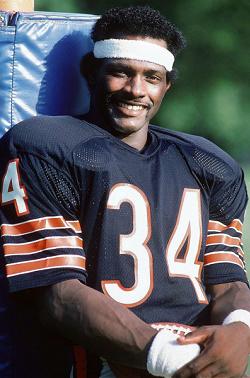
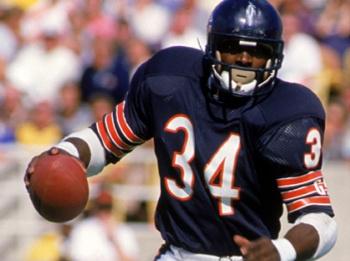
This coming Tuesday, November 1 marks the passing of one football's greatest running backs — Walter Payton of the Chicago Bears. Payton (1954-99) was selected to nine Pro Bowls and was voted the league's Most Valuable Player in 1977 on the way to his 1993 induction to the Pro Football Hall of Fame. His life was the "total package" and his experience can offer some guidance to our Lancers.
Unfortunately, Walter Payton lived during a period when civil rights and integration were still a serious problem plus he did not come from a wealthy family. However, he dedicated himself both to getting an education and excelling athletics, especially football. He was also very good with people in general. He was likeable and would joke around with anyone even if not from his community which helped to break the integration transition when it came to Columbia, Mississippi, his hometown. Payton simply went out of his way to be a good person and teammate throughout his career. Hence his "Sweetness" nickname.
Walter Payton's debut season in the National Football League hardly signaled a "sweet" career. In his first pro game in 1975, he carried the ball eight times for a grand total of zero net yards. That is not a misprint. Zero. He did finish the year with 679 yards rushing and seven touchdowns. The Chicago Bears finished his first season at only 4-10.
Coming off that personal and team performance, Payton could have become discouraged. Instead, he returned in the summer of 1976 to his alma mater, Jackson State in his home state of Mississippi, with a new purpose. He worked on a master's degree in special education and ran every day along the sandy shores of the Pearl River.
Walter Payton was very goal oriented and was not one to quit at anything he started. From 1976 to his last season of 1987, Payton exceeded 1,000 yards rushing 10 times. He finished with 16,726 yards, which at the time was No. 1 in NFL history and today stands second to Emmitt Smith's 18,355.
In terms of being the best you can be, W.C. Gorden, one of Payton's college assistant coaches at Jackson State said: "Fifty percent of talent is height, is weight, is strength and is speed. The other 50% — the most important 50% — is that the youngster has to want to be a superb football player. And Walter had that compelling desire — to lift weights, to condition himself, to run a riverbank up and down, to run the stadium steps."
With respect to personal goals, Payton once said: "You have to have a goal, a challenge to motivate you. I've accomplished most of my goals, but you have to have something to motivate you more, to stimulate you to bigger heights."
Outside of football, Walter Payton was very supportive of kids and youth programs. While giving speeches, Payton would talk about his life. "If you go somewhere," he said, "always have pictures of your children with you. They're the meaning of it all."
He meant it. Payton was given to extraordinary acts of kindness with kids. If he heard about a sick child, he'd visit him in the hospital. The same held true if a youngster stopped him on the street.
Jeff Pearlman in his 2011 biography, "Sweetness: The Enigmatic Life of Walter Payton," touched upon the importance of helping kids to Walter Payton.
"He was amazing with kids," Pearlman said. "He was as good as he could be, giving, warm and affectionate. They'd say, 'Mr. Payton,' and he'd say 'Call me Walter.' He'd pose for picture after picture. He was one of a kind."
Payton died of cancer at age 45.