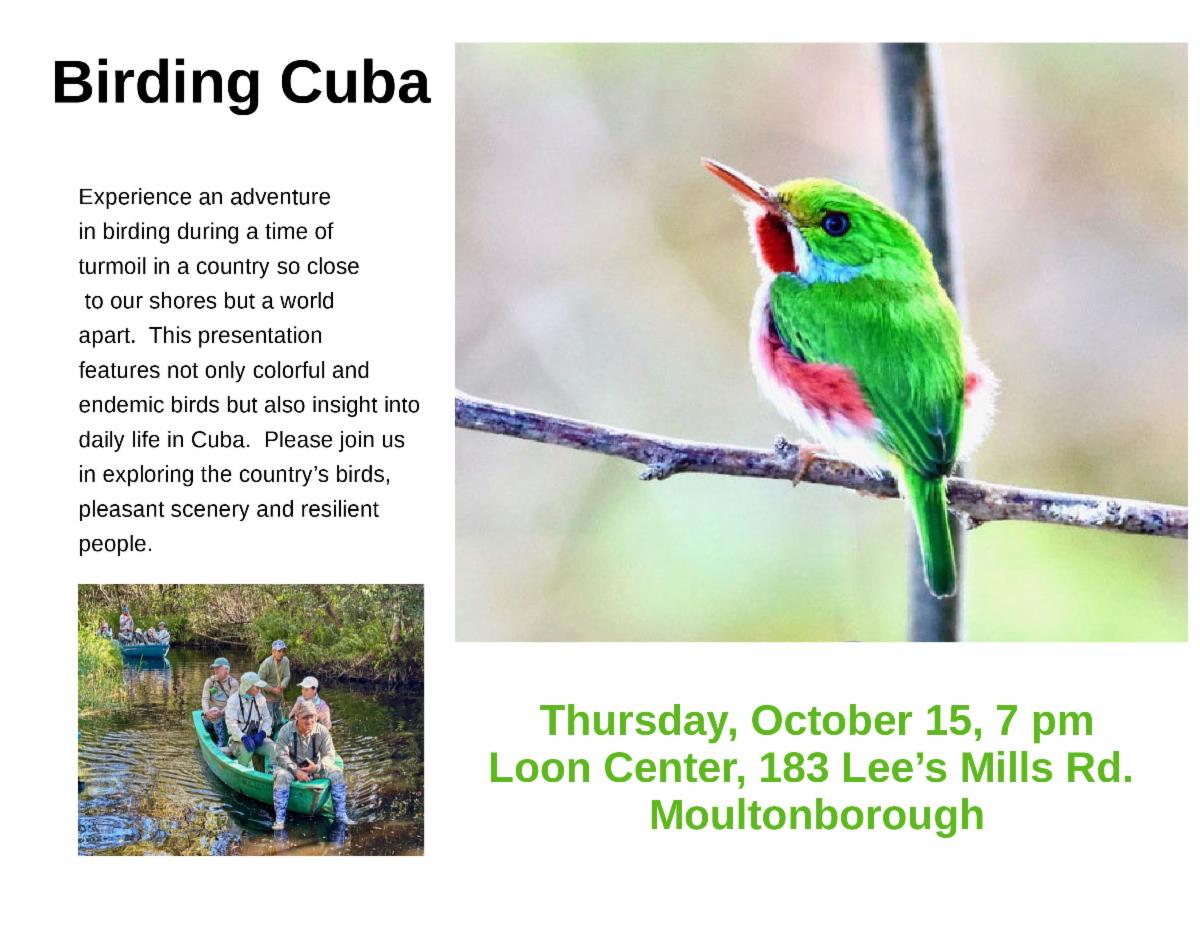
October 15: Birding Cuba, presentation sponsored by the Lakes Region Chapter of NH Audubon | | This presentation is sponsored by the Lakes Region Chapter of NH Audubon. It is hosted at The Loon Center (183 Lees Mill Road, Moultonborough NH). Due to technological challenges associated with hybrid meetings, this presentation is offered in-person only. | Save the Date—LPC's Holiday Open House is coming up! | | Get ready for festive fun and a FREE event at our upcoming Holiday Open House at The Loon Center! Join us on November 28, 2026, from 10:00 am to 2:00 pm for a celebration packed with holiday cheer. The perfect opportunity to bring the whole family together for fun and joy. We have planned a fantastic lineup of activities to make the day truly special. Little ones will be thrilled to meet St. Nick, create a loon-themed holiday crafts, marvel at the incredible creations from our balloon twisting station, and everyone can enjoy the charm of horse and wagon rides. We’ll also have plenty of seasonal refreshments on hand to keep you fueled while you enjoy the festivities. We can't wait to see you there! | | |
In September, LPC staff spent time wrapping up the field season, including finishing checking on the survival of chicks, continuing to document resights of banded loons, and retrieving the rafts and signs that we floated across the state to help nesting loons this past summer.
Unfortunately, September also kept us busy with loon rescues, mortality collections, and necropsies. In total, we collected 9 dead loons in New Hampshire in September. That number itself is not necessarily concerning. We expect to lose roughly 10% of our adult loons every year, and September is a time of year where loons are going through a lot—they are beginning to molt (an energetically intensive process), they are starting to move around from lake to lake, and they are beginning to think about migrating. It can be a time when chronic ailments can start to catch up with those loons who may have been doing poorly (but not showing signs of it) for months. So far, we have necropsied 7 of the 9 loons collected in September. We have found that some of these loons succumbed to natural causes of death, including infections. However, three of the loons collected in September had human causes of death—one from a boat strike, and two from lead poisoning resulting from the ingestion of lead fishing tackle.
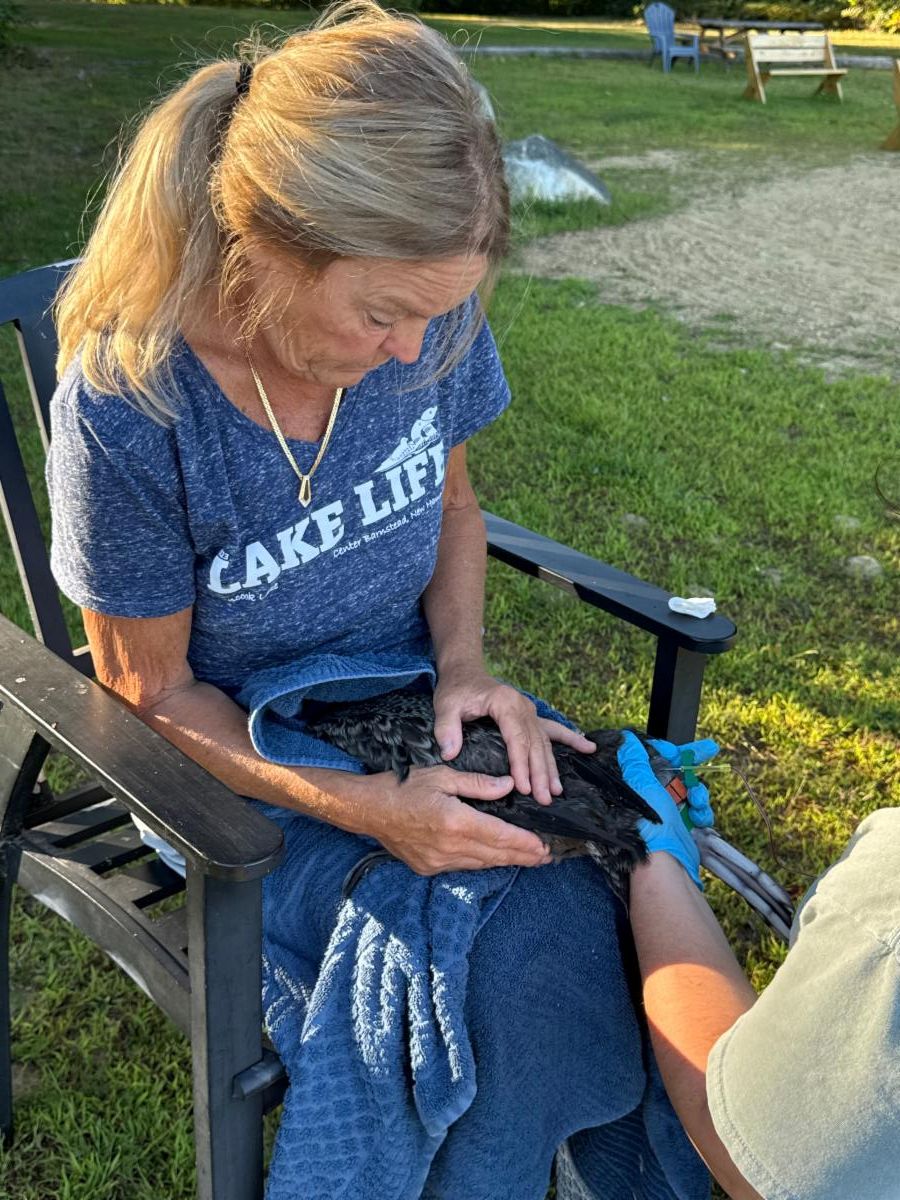
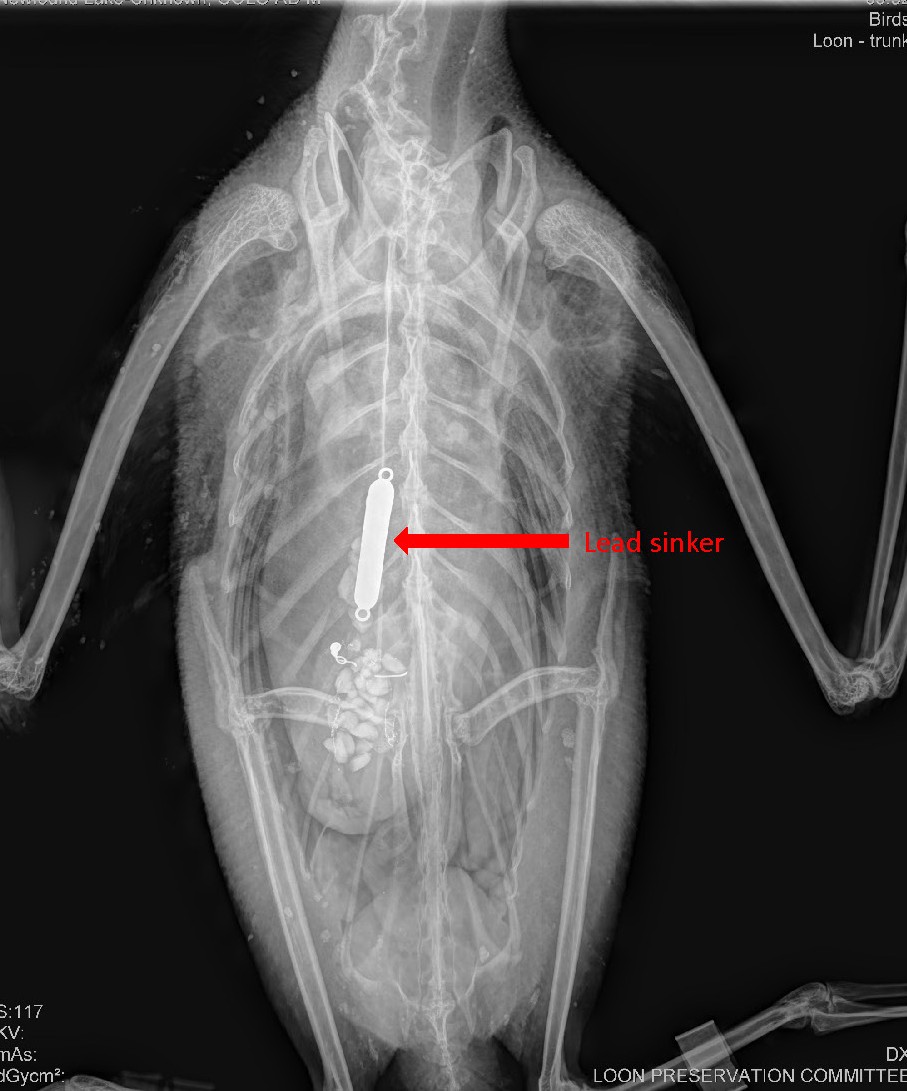
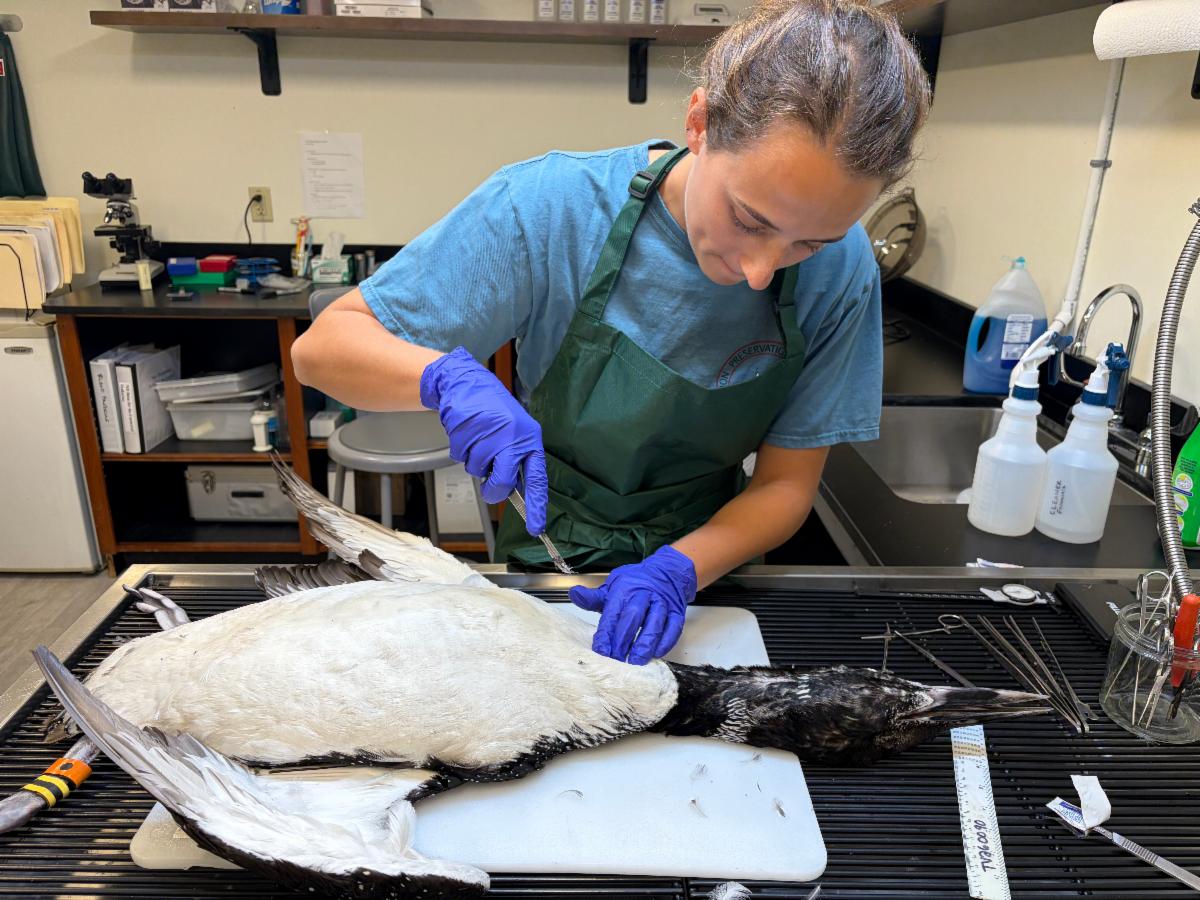
| LPC volunteer, Linda Haney, holds a rescued juvenile loon while LPC Outreach Biologist, Caroline Hughes, draws blood. This loon sadly became one of the mortalities collected in September. While we are awaiting histopathology result to confirm its exact cause of death, the blood work performed prior to death and the gross necropsy results suggest a systemic infection. | One of our September lead poisoned loons came to us initially as a rescue. On September 16th, LPC received a call from members of the public on Newfound Lake, where a loon had beached itself. Upon instruction from LPC staff, they approached the loon, and they were able to take the video below. Warning: this video may be difficult to watch, and discretion is advised. We share it not to be upsetting, but to show just how debilitating lead poisoning is for loons. | LPC staff arrived to the lake shortly after and captured the loon. Blood work confirmed that the loon had a blood lead level more than three times the clinical threshold for lead poisoning in loons, and x-rays revealed that he had ingested a lead sinker. We consulted with veterinarians and wildlife rehabilitators and concluded that given the loon's behavior and blood lead level, he had no chance at recovery, and attempts at treatment would only prolong his suffering. Sadly, the most humane action for this loon was euthanasia. | This x-ray shows the lead sinker that the Newfound Lake loon had ingested. | LPC Intern, Talia Ungarelli, prepares to necropsy the Newfound Lake loon, which died from lead poisoning after ingesting a lead sinker. | | |
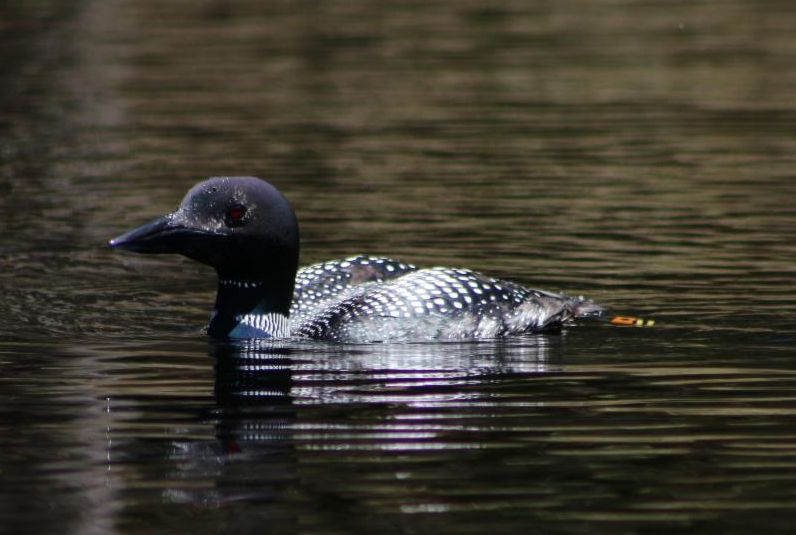
You may have noticed in the video and photo above that the loon that died of lead poisoning on Newfound Lake was banded. We first encountered this male in January of 2024, after he became iced-in on Paugus Bay. We rescued him, banded him, and released him on the coast.
He returned to New Hampshire's lakes during the summer of 2024, spending the breeding season as a floater moving between lakes including Winnisquam and Wicwas. In 2025, he found a territory of his own, settling on Pickerel Pond, where he and his mate hatched two chicks.
Prior to his rescue this September, we had not resighted him in 2026. There was a nesting pair on Pickerel Pond again this summer, and it is possible that he was part of that pair and we simply didn't get a look at his bands. Alternately, he may have been evicted from the territory and spent his summer as a floater, bouncing from lake to lake as he had in 2024. In any case, it is disappointing to lose this loon, which had been rescued and given a second chance after icing in on Paugus Bay, to a preventable, human cause like lead poisoning.
| A photo of the loon in happier times, taken in summer 2024 on Wicwas Lake. Photo courtesy of Scott Powell. | | |
Sadly, lead poisoning resulting from the ingestion of lead fishing tackle remains the leading cause of known adult loon mortality here in New Hampshire, accounting for 36% of documented adult deaths from 1989–2025. The loon on Newfound Lake is the 6th adult loon that we have lost from our population due to lead tackle ingestion in 2026. Since his death on September 17th, we have collected another lead poisoned loon, bringing our 2026 total up to 7 loons lost in NH due to lead fishing tackle ingestion.
Loons typically die within 2-4 weeks of ingesting lead tackle, and, as was the case with the Newfound Lake loon, they usually will not show signs of being in trouble until the poisoning is so advanced that there is no chance of saving them. Because of this, the best way to protect loons and other fish-eating wildlife from lead poisoning is to prevent them from ingesting it in the first place by not using lead fishing tackle.
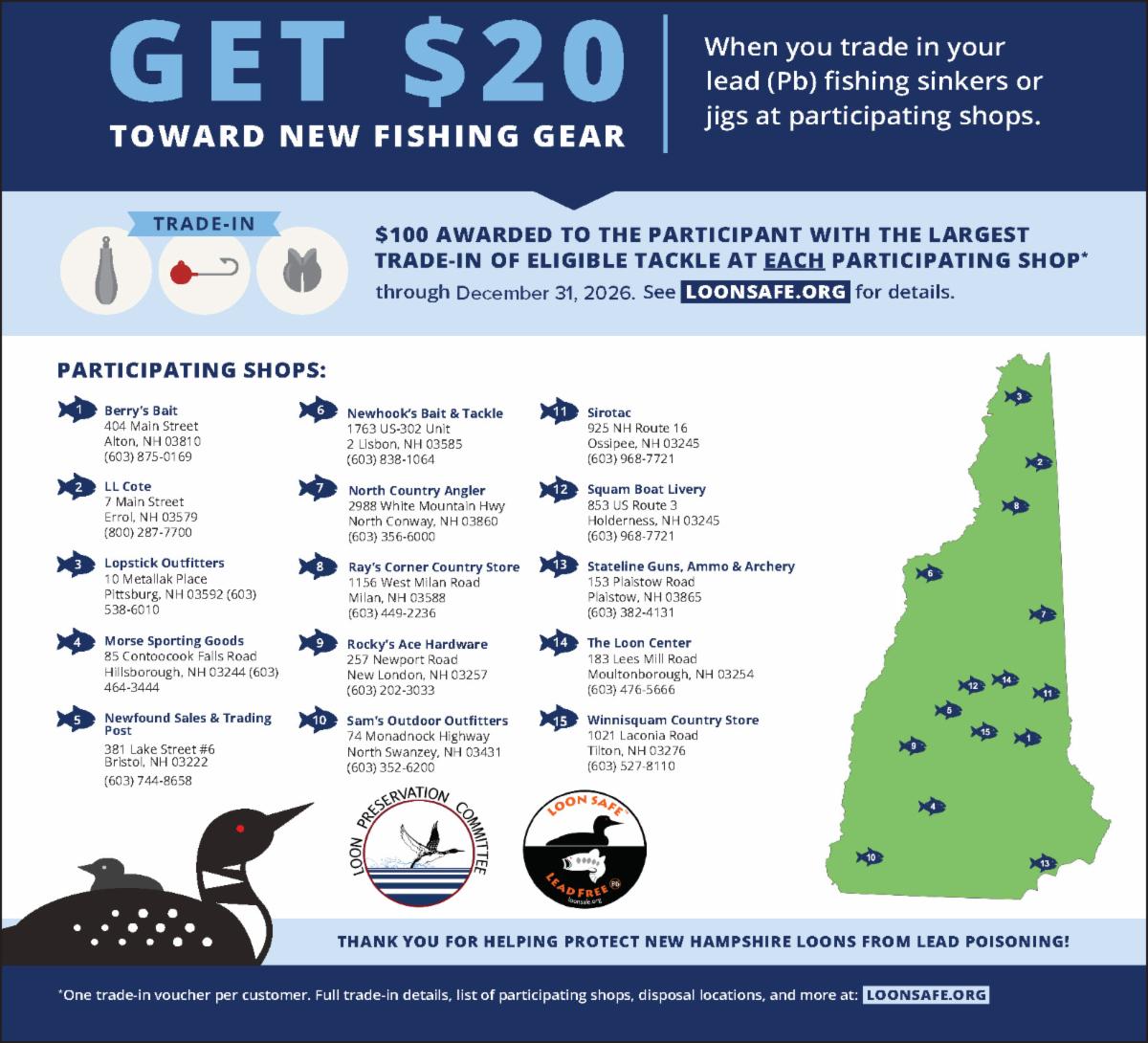
| | LPC operates a Lead Tackle Buyback Program in partnership with tackle shops across NH. Through this program, anglers can exchange 1 oz. or more of banned lead fishing tackle (lead sinkers and lead-headed jigs individually weighing 1 oz. or less) for a $20 voucher at one of our participating shops. We have also begun to distribute lead tackle collection receptacles and signs to transfer stations in NH to facilitate easier safe disposal of lead tackle. To find the closest participating shop or transfer station, please visit loon.org/loonsafe. And if you are involved with your local transfer station and would like a lead tackle collection receptacle, please reach out to us by emailing volunteers@loon.org. Thank you for helping to protect our loons! | | About Loons: Built for the water | | |
If you’ve ever seen a loon sink underwater and pop up hundreds of feet away in a short time, you know that these birds are incredible divers. Though they make it look easy, moving through the water presents unique challenges. Water is denser than air, creating more resistance that an animal must work against in order to move. Additionally, in water, animals must overcome the upward forces of buoyancy before they can submerge. These factors combine to mean that for the average animal, movement in water, and especially diving and navigating under water, requires a lot of energy.
Over time, loons, which spend the overwhelming majority of their time in the water and capture their prey by diving, have evolved morphological, physiological, and behavioral traits to help them move through water more efficiently. These traits include specialized skeletal structures, reduced skeletal pneumaticity (air-filled cavities in bones), and large, webbed feet, among other adaptations.
| | |
Specialized Skeletal Structure
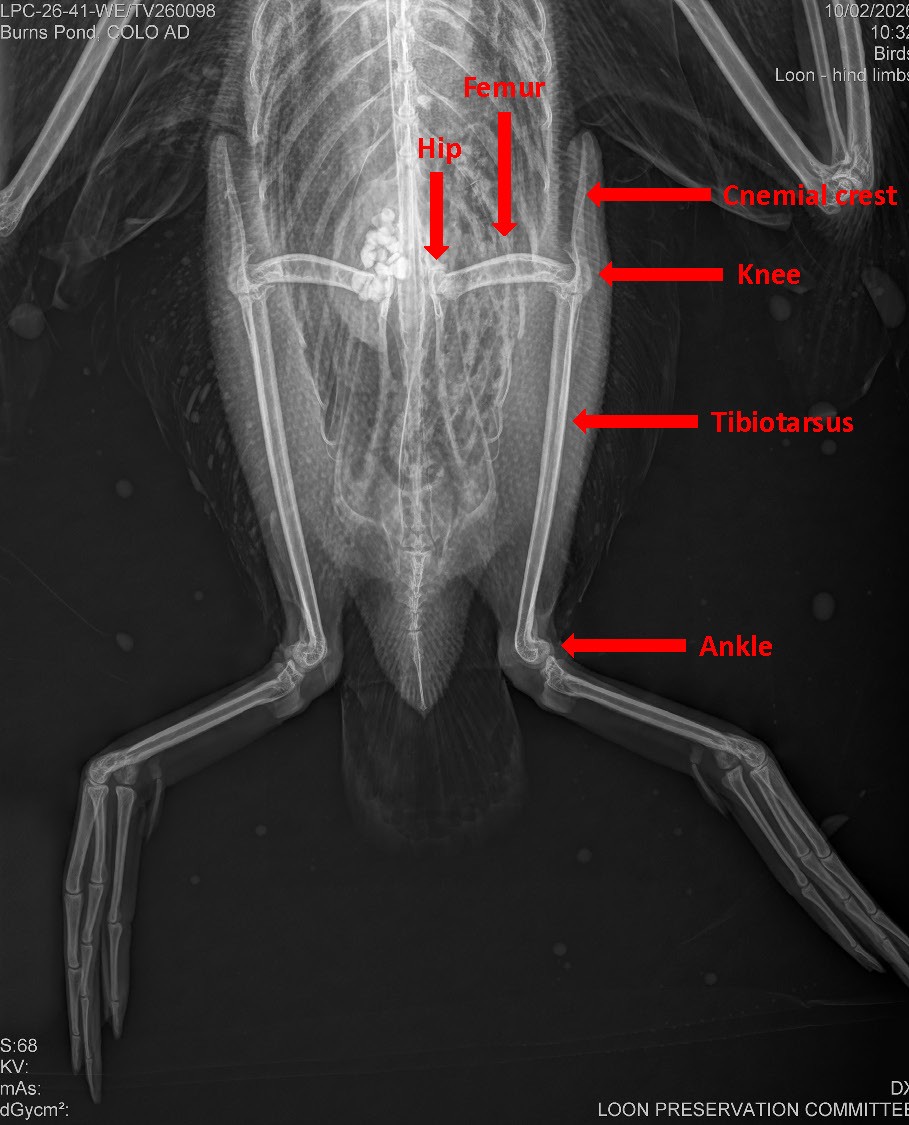
Did you know that the portion of a loon’s leg that you can see outside of the body is only the ankle and foot? In loons, the hip, femur, knee, and tibiotarsus (shin) are tucked alongside the ribcage, beneath the skin covering the abdomen, and only the ankle and foot are visible externally. This positioning streamlines the body, creating a smooth surface that experiences less drag.
Loons also have an enlarged cnemial crest (an outgrowth of the tibiotarsus that extends from the knee joint) which serves as an attachment point for several large, strong leg muscles. These muscles help to stabilize the hip and knee during paddling.
| | The structure of the loon’s hip and femur also pivots the femur away from the vertebral column. As a result, loons are able to paddle their feet laterally. Instead of kicking their legs directly backward like humans have to do when swimming, loons sweep their legs out to the sides and then backward in a curved path. The lateral motion likely generates hydrodynamic lift that moves them rapidly through the water. | A loon swimming underwater—note the lateral movement of the legs. Video by Kevin Biskaborn. | |
Reduced Skeletal Pneumaticity
In many birds, portions of the skeleton are pneumatic, which means that they contain air-filled cavities. These air cavities develop after hatching, through a process called pneumatization, during which the air sac system expands and extends into the bones.
The amount of space taken up by these air cavities varies among bird species, and a particular species’ degree of skeletal pneumaticity is thought to be an adaptation for energy conservation. Higher skeletal pneumaticity means more air cavities in the bones, which contributes to greater buoyancy. Birds with higher skeletal pneumaticity likely therefore have higher energetic costs associated with submerging and diving underwater.
Species that dive frequently, especially pursuit divers (birds that capture their prey by diving and chasing it underwater) have been found to have significantly lower pneumaticity compared to other species of their same size. Loons in particular are largely considered to be apneumatic— they have very little skeletal pneumaticity. This adaptation likely saves energy by reducing their buoyancy (therefore reducing the amount of force they need to generate to overcome that buoyancy and submerge underwater).
| |
Large, Webbed Feet
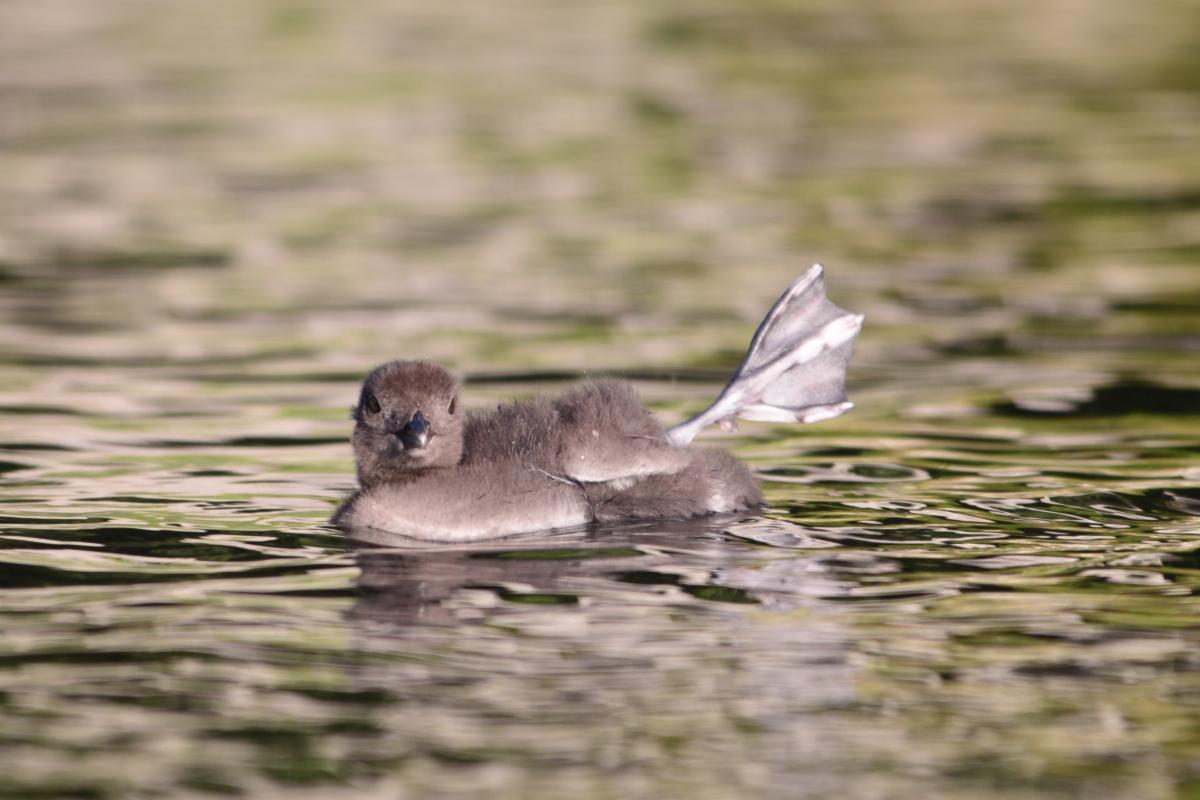
Like many other foot-propelled divers, loons have adapted to have large, webbed feet. More surface area on the foot allows them to catch and push against a larger volume of water than would be possible with a smaller surface area, increasing thrust. After each kick, when loons pull their foot forward through the water in preparation to kick again, they fold the foot, reducing the surface area in order to reduce resistance.
| Large webbed feet help loons to move more efficiently through the water. | |
Other Potential Adaptations
There are other adaptations for more efficient swimming and diving that have been documented in other diving bird species and have been theorized to be true of loons. These include:
- The ability to reduce the volume of air trapped between feathers during dives. Less air in the feathers means reduced buoyancy to overcome in order to submerge.
-
Reduced heart rate and altered circulation. Some diving birds are able to redistribute circulation, reducing blood flow to some tissues in order to conserve oxygen for their more oxygen-sensitive organs, like the brain and heart.
These mechanisms may be used by loons to some degree, but have not been specifically measured or tested in common loons.
| |
Tradeoffs Associated with Specialization
Loons spend the vast majority of their time in water, so it makes sense that they have evolved to move efficiently through it. However, these adaptations come with tradeoffs—the same traits that make loons excellent in the water make both flight and walking more difficult for loons.
The internal skeletal structure of loon legs means that they cannot position their feet underneath their bodies on land, making it impossible for them to walk upright. Additionally, the large size of their feet is cumbersome, making walking awkward. As a result, movement over land is slow and requires a lot of energy.
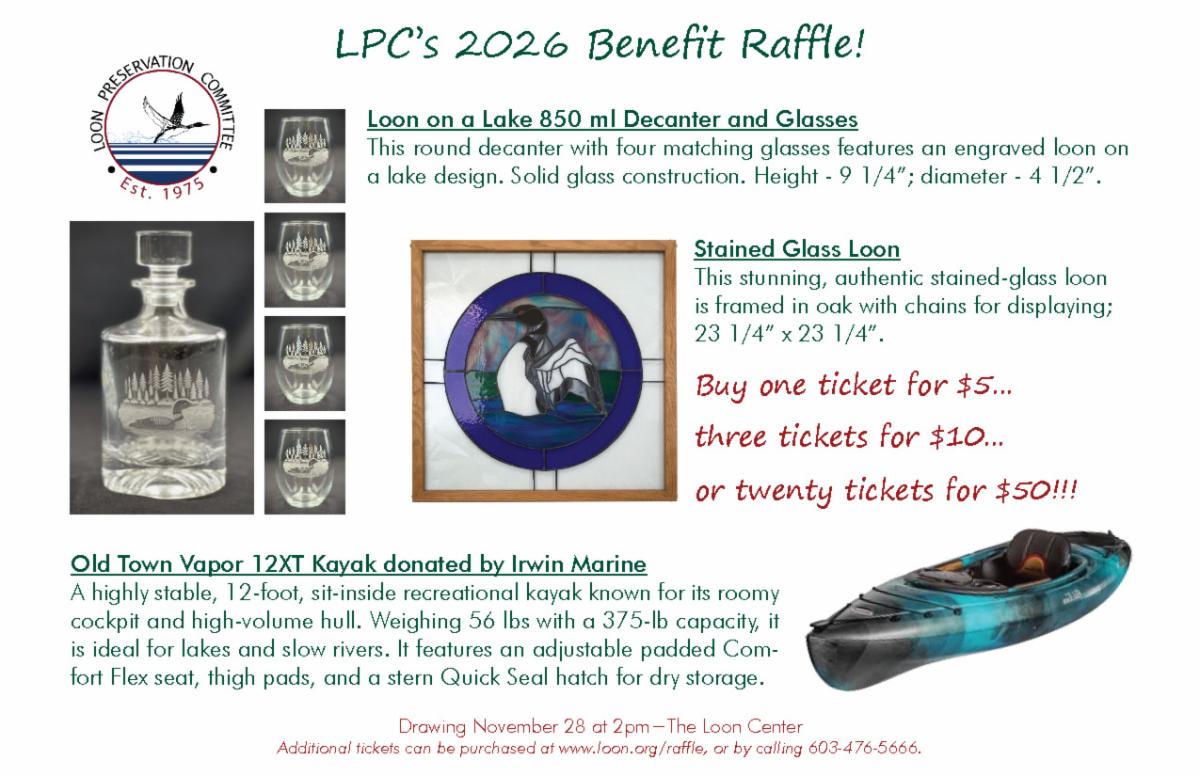
| On land, loons are slow and clumsy. Movement across land is energetically expensive for them. Video by Nicki Steel. | Loons also face a tradeoff when it comes to flight. They have relatively small wings for their body size, giving them high wing loading (the amount of body weight that must be supported by a given area of wing). As a result, loons must reach a high speed before they can generate enough lift to take off, which is why they must run across a long stretch of water (up to a quarter mile on a calm day), flapping all the way, before achieving liftoff. Once in the air, loons beat their wings steadily and rapidly in order to remain aloft. | Taking flight is also an energetically expensive process for loons! Video courtesy of Wild Adirondacks. | While these tradeoffs increase energy expenditure on land and in the air, they are the consequence of being highly specialized for life in the water. For a bird that spends the overwhelming majority of its life in the water swimming, diving, and pursuing prey, the benefits of these adaptations far outweigh the costs. | Take a Chance for Loons! LPC's Annual Benefit Raffle is ongoing! | There is still time to buy tickets for our Annual Benefit Raffle! Take a chance at winning one of three great prizes (shown below), and support our work for New Hampshire's loons in the process! Tickets can be purchased online at loon.org/raffle, by in-person at The Loon Center (183 Lees Mill Road in Moultonborough, NH) or by phone at 603-476-5666. Winners will be drawn at our Holiday Open House on November 28. You do not need to be present at the Open House to win. | | This month, the "It's Never Too Late to Love a Loon" tote bag is on sale for 15% off! This spacious canvas tote measures 20"x18" and hangs nicely over the shoulder. Get yours in our online store, or stop in to The Loon Center to take advantage of this deal! All proceeds from our store sales help to fund our work on behalf of New Hampshire's loons. Thank you for your support! | | We’re rated by Charity Navigator! You can give with confidence knowing that we have been independently evaluated for effectively stewarding donations. | | Loon Preservation Committee | 603-476-LOON (5666) | www.loon.org | | The Loon Preservation Committee is dedicated to restoring and maintaining a healthy population of loons throughout New Hampshire; monitoring the health and productivity of loon populations as sentinels of environmental quality; and promoting a greater understanding of loons and the natural world. | | | | |