The Epitaph
Winter 2022 Newsletter
|
|
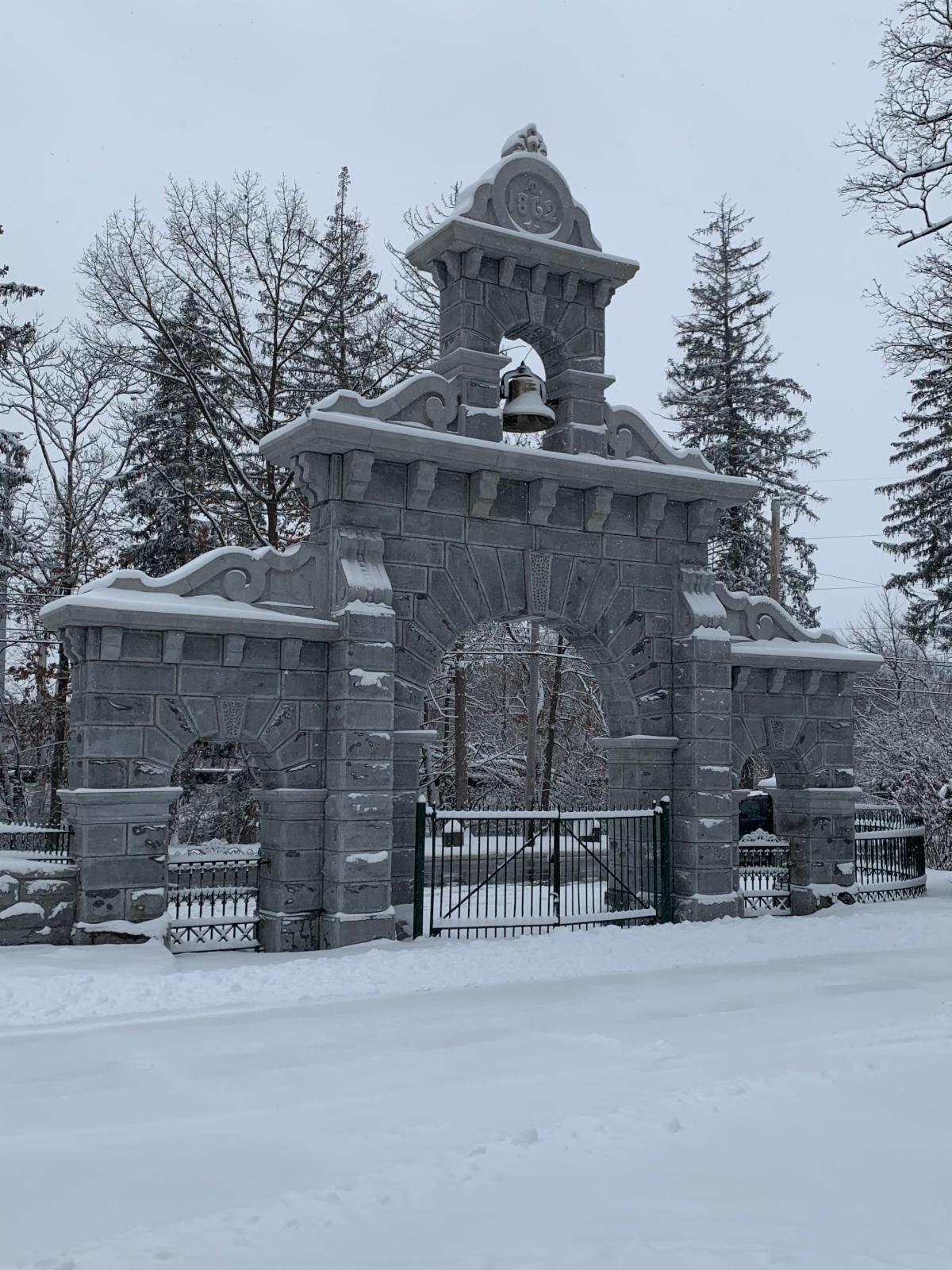
Photo Credit: Michael Lally, Lawrence Street Gate |
|
AN ACTIVE BURIAL PLACE RICH IN HISTORY |
|
Greetings!
Happy New Year from the proprietors and staff of the Lowell Cemetery. As we all know, the last two years were extraordinary in every sense of the word. Our lives were altered by an historic pandemic. This health crisis has prompted many to turn towards the Lowell Cemetery as a place of refuge. Some choose to walk Washington Ave., making the mile loop around the perimeter of our grounds. Regular dog walkers meander along pathways. Avid bird watchers have their favorite spots. The design of the Cemetery’s many routes are not direct. They curve around corners to reveal and conceal a shrub, a granite curb or a marble monument. We invite you to come to the Lowell Cemetery in 2022 and take one of our winding paths to explore special plantings, a particular monument, or a striking view.
Lowell’s role in the Underground Railroad and the Abolitionist Movement is becoming more widely known. In 1826, Lowell resident Walker Lewis was a founding member of Boston's General Colored Association, an organization formed "to promote the welfare of the race by working for the destruction of slavery." The Lewis family’s role in the Underground Railroad and their contributions to history is explored below.
The month of February also brings Valentine’s Day and the oftentimes tricky business that follows. As you’ll see, a notable citizen of Lowell found themselves in the “it’s complicated” category. Also, find out why the office staff are called by people in Kansas who are looking for directions to the Lowell Cemetery.
Wishing everyone a safe and healthy 2022.
Robert S. McKittrick, President
Lowell Cemetery
|
|
Kwaku Walker Lewis
(1798-1856)
|
|
In 1856, Elizabeth Lovejoy Lewis purchased a ten-grave lot in Lowell Cemetery. The first burial in 1857 was for her husband Walker Lewis, an African American.
Kwaku Walker Lewis (1798-1856) was born in Barre, Massachusetts to former slaves. He married Elizabeth Lovejoy in 1826 and they raised four children in Lowell. The family home was on River Road in the Centralville neighborhood. The Walkers were a stop on the Underground Railroad, assisting runaway slaves on their way to Canada. Walker was a barber and spent his time between his shops in Boston and Lowell.
Walker was a founding member of the Massachusetts General Colored Association (MGCA) created in 1826. It was the first all-black organization in the United States. Walker was also a Freemason. By 1829, he was the Grandmaster of the African Lodge #1 of the African Grand Lodge.
Walker was baptized into the Mormon faith in 1843, and within a year became an Elder in the Church of Latter-Day Saints (LDS) in Lowell. His oldest child, Enoch Lovejoy Lewis (1826-1888), also joined the LDS church. Three years after Massachusetts repealed their ban on interracial marriage in 1841, Enoch married Mary Matilda Webster, a white Mormon woman. Their only son Enoch R.L. was born in 1847.
In 1851, Walker traveled to Salt Lake City to be closer to the center of the Mormon faith. When news of his son’s interracial marriage and mixed-race child was reported to Brigham Young, Walker was told he and his family were not welcome in the Church and he returned to Lowell.
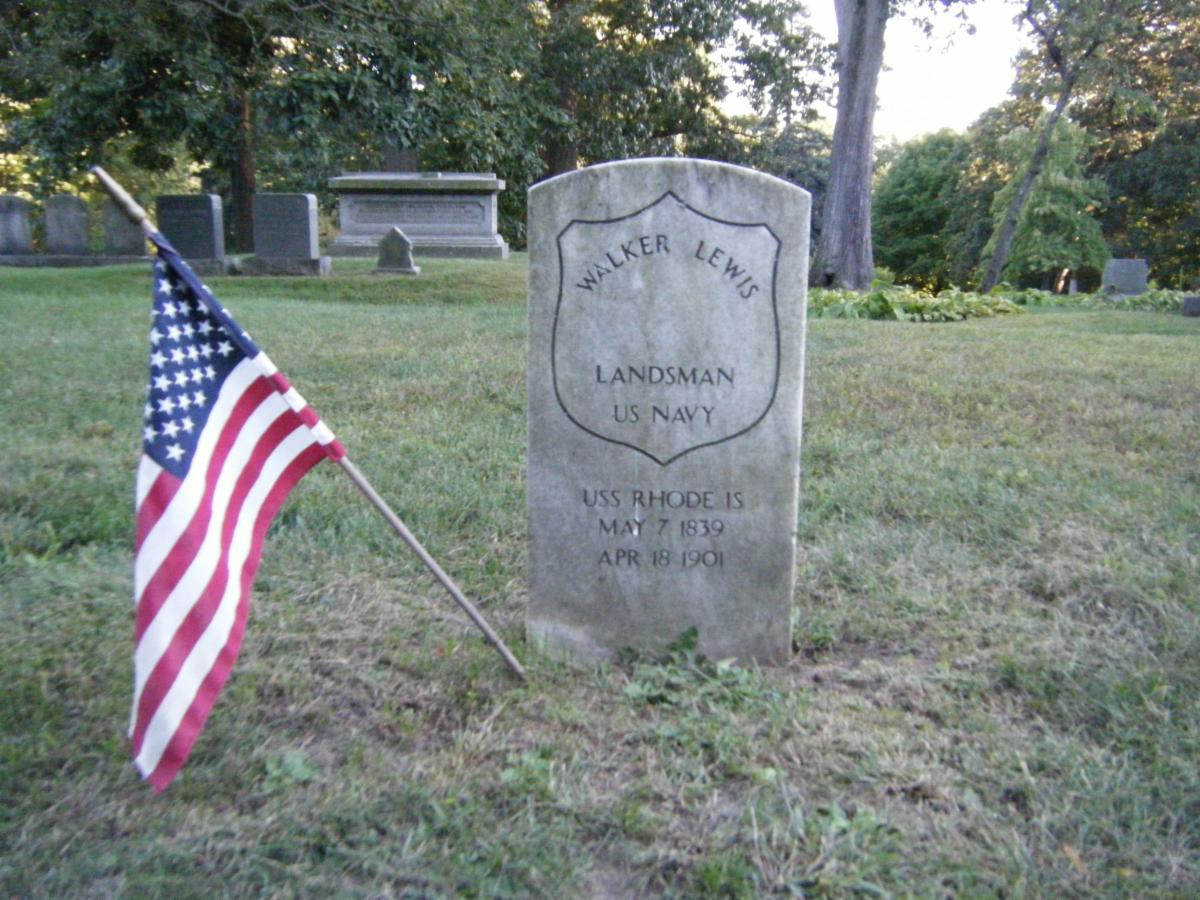
The Lewis family played a significant role in the American story. A descendant enlisted in the U.S. Navy and served in the Civil War. You can visit his grave on Hawthorn Path.
|
|
An interview with Lowell Cemetery Trustee Brian Chapman and his mother Wilda is included in "Hidden in Plain Sight: Stories of Black Lowell" produced in 2021 by Free Soil Arts Collective. It is a collection of interviews of 27 Black people who lived or worked in Lowell. |
|
A Lion's Share of the Estate |
|
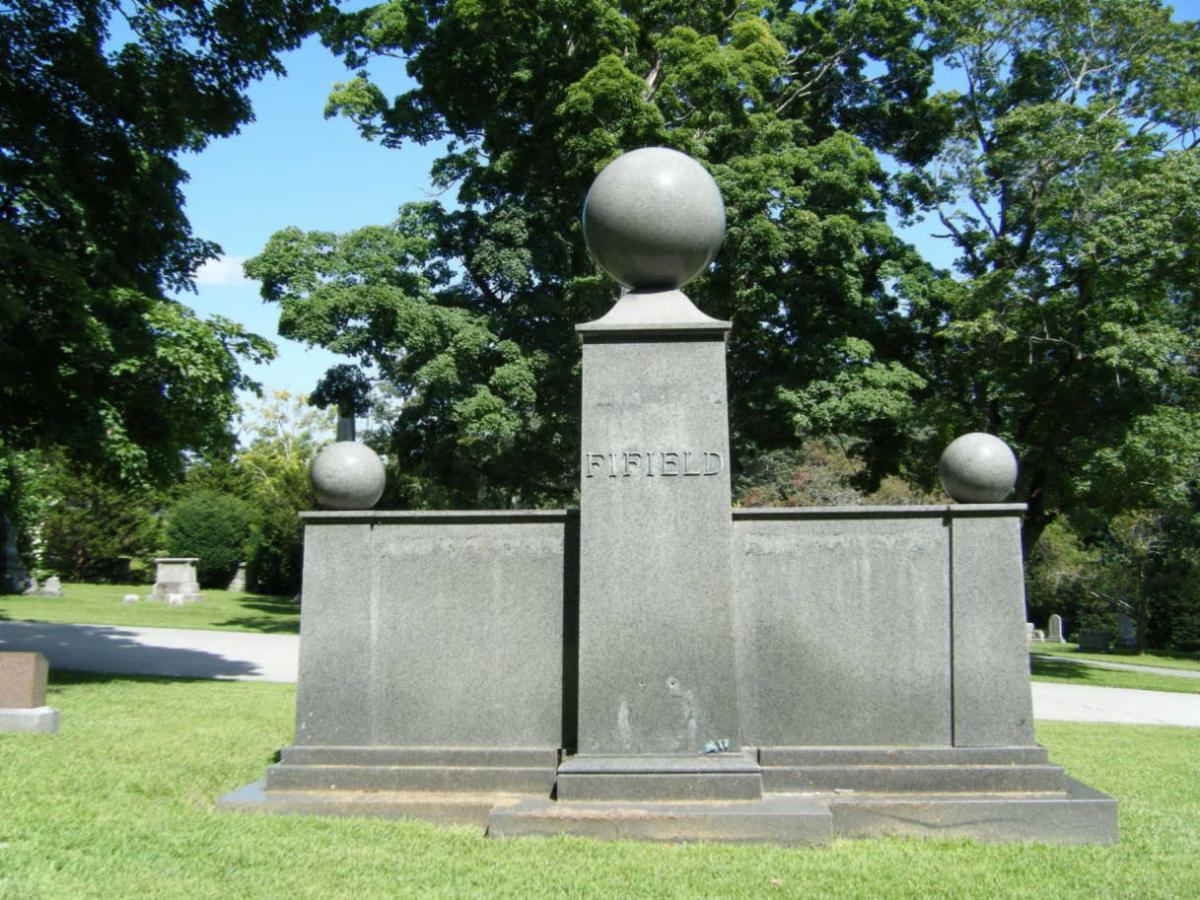
In 1913 an impressive monument was erected on lot 2357 on Park Avenue for George Washington Fifield, a former Mayor of Lowell with a successful machine shop. Four stone spheres were engraved with the names of those buried in the lot: George W. Fifield, his two wives, and his former housekeeper, Dora A. Chase.
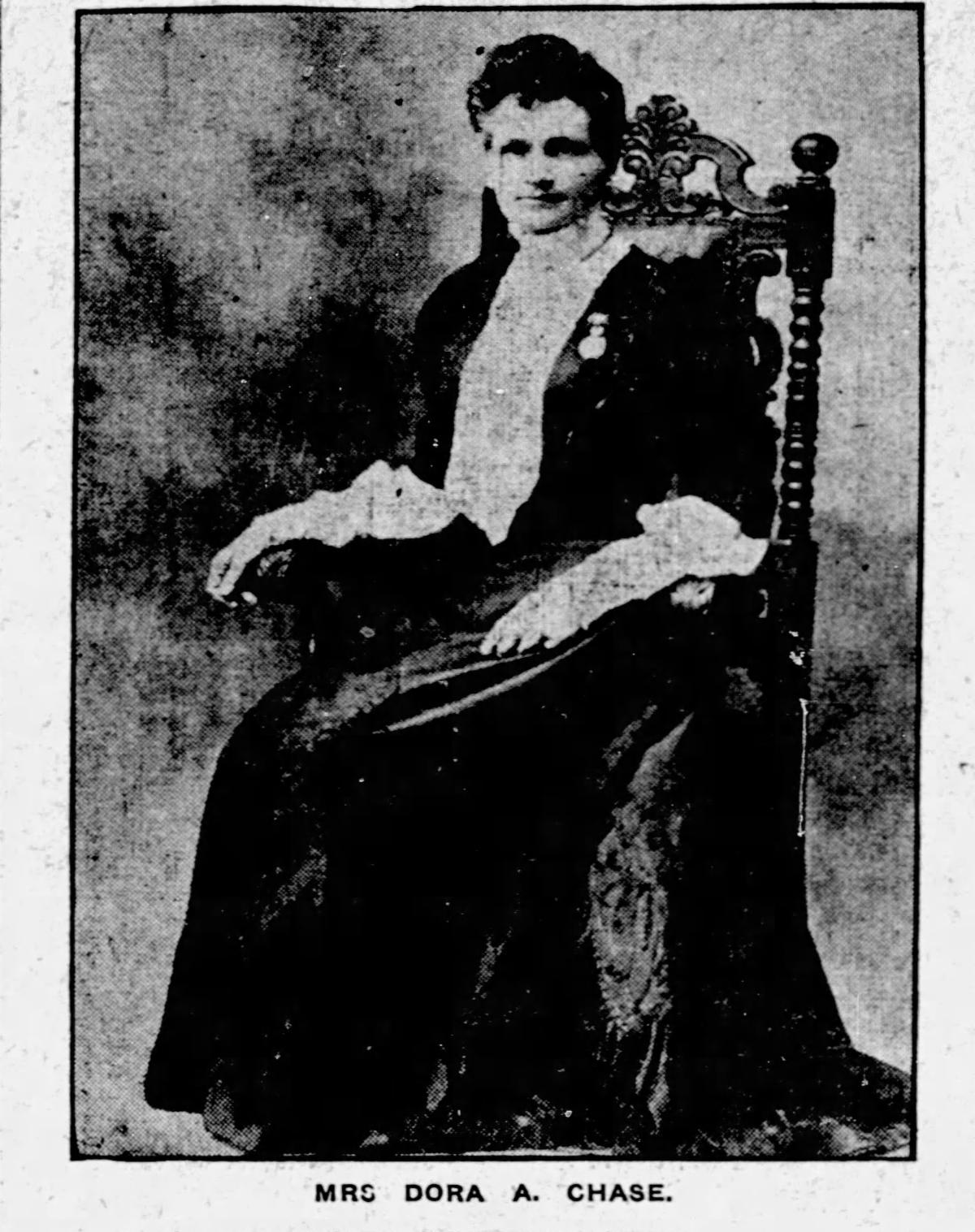
Dora Chase was born in Canada and came to Lowell in the 1870s. She was married in 1894, but was often listed as a widow, as she was estranged from her husband and did not know of his whereabouts. She came to work for George Fifield in his home on Middlesex Street in 1903. She was alternately listed as a housekeeper and a nurse and possibly attended his second wife Susan who passed away in 1905. Twice widowed with no children, it was noted that Fifield spent his time driving his automobile around Lowell and to his property at Revere Beach. Dora often accompanied him on these trips. It was reported they were quite fond of each other, and despite the twenty-year age difference they enjoyed the companionship.
No one thought twice about this arrangement until his passing in 1911. When his will was read, it was discovered that after it was all said and done, Ms. Dora A. Chase would inherit the bulk of his estate, valued at $500,000. She would also be given a grave in Fifield’s lot at Lowell Cemetery. In 1913, Dora would commission a beautiful stone monument for the lot designed by A.J. Walker, and she would be buried there after her death in 1943 at age 84, right beside George. For all the drama and scandal their relationship caused, they are peacefully at rest in Lowell Cemetery.
|
|
|
|
Fifield Lot at Lowell Cemetery |
Nellie Jerome Fifield (1852-1892)
Susan Baldwin Fifield (1848-1905)
George W. Fifield (1848-1911)
Dora Brooks Chase (1869-1943)
|
|
|
|
Lowell Cemetery, Kansas
by Kim Zunino
|
|
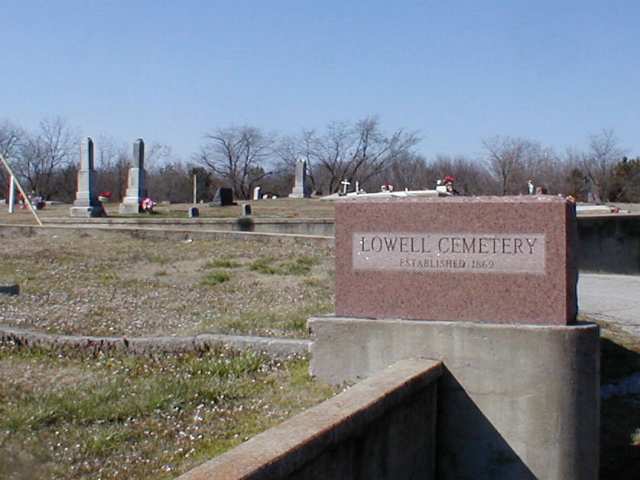
One day, Michael Lally, Director of Marketing for the Lowell Cemetery, mentioned a few calls regarding directions to the Lowell Cemetery. It was quickly clear that these people were looking for a Lowell Cemetery, just not this Lowell Cemetery. A few of those wrong numbers were about a Lowell Cemetery in Kansas. When I first heard of this happening, I was intrigued. I have always been fascinated with the settlement of the West, as my grandfather was born in a small mining community in Oklahoma Territory. I decided to look into this Lowell Cemetery in Kansas and see if there were any ties to our Lowell.
The first thing I discovered is that the other Lowell Cemetery is not within the bounds of the Township of Lowell but considered part of the neighboring town of Baxter Springs, Kansas. Baxter Springs has the distinction of being “America’s First Cow Town.” The unincorporated Township of Lowell is about 6.6 miles northeast of that Lowell Cemetery. Founded in 1869, the Cemetery has close to 6,000 burials scattered across 30 acres of flat land. In comparison, our Lowell Cemetery is 84 acres of rolling terrain with more than 18,000 burials. Photographs show many markers, but no mausoleums or burial vaults are to be seen. A chat with the caretaker of the Lowell Cemetery informed me that the Trustees are also responsible for three other local cemeteries as well as Lowell Cemetery, one being the old Boston Mills (now called Cox) Cemetery. Some of the earliest burials were for the Archer family in the 1860s. Their marble stones lie flat in their family lot.
As for the unincorporated Township of Lowell, its history has some interesting ties to our City of Lowell, although its formation is very different. The Township of Lowell is located in Cherokee County, Kansas. Cherokee County, located in SE Kansas, was established in 1860. Records show that John Rogers, a Cherokee man, had settled in the area of Lowell by 1835. The land was part of the Osage Neutral Lands, created as a barrier between the Cherokee Nation and white settlers in 1825. The Kansas Territory was organized in 1854 and was granted statehood in 1861. Another treaty in 1866 gave the lands to United States, and after it was settled in 1868, a post office was created in Lowell near the railroad tracks. The train didn’t actually stop in Lowell but had mail bags thrown onto the platform and picked up mailbags with a hook.
During the Civil War, this area had three rudimentary military posts, and one was named Camp Ben Butler after our own General Benjamin Butler. After the 1863 Baxter Springs Massacre, where 400 pro-Confederacy raiders killed 103 Union troops, the camps were purposely destroyed when the Union troops moved into Fort Scott. General Benjamin Butler was acquainted with James F. Joy, who was a railroad magnate and politician who was intimately involved with the 1866 Kansas Treaty. In a 1904 “History of Cherokee Kansas...” author Nathanial Thompson Allison states that General Butler, a native of Lowell Massachusetts, was interested in the land of Cherokee County as it was full of natural resources such as the Spring River. Allison said it was General Butler’s intention to buy up the land on both sides of the river and harness the waterpower for manufacturing purposes, but he died before he could go ahead with the project. By 1904, the Spring River Power Company built a hydroelectric dam across Spring River, and it operated until 1969.
The Township of Lowell and its mills were mentioned around 1867, when William H. Dodge wrote a pamphlet titled “Dodge’s Sectional Map of the Cherokee Neutral Lands” and noted the activity along the Shoal River, a tributary of Spring River. He declared, “Enterprising young men are erecting mills at and near the mouth of Shoal Creek, where the town of Lowell is laid out, which has superior advantages to build up a town...with unsurpassed waterpower and inexhaustible supply of good timber.” According to historian Jean Lois Durand, by the time the Quakers came to Kansas in the 1870s, the Township of Lowell had "flour mills, tin shops, wagon shops, lime kilns, pottery, grocery and blacksmith shops, a civil engineer, a Justice of the Peace, and a doctor."
It is always fun to find stories from another place that shares our name, even if we have more differences than not. While the actual process of naming the Township Lowell was not found, one can say “enterprising men” and “unsurpassed waterpower” is synonymous with our City of Lowell here in Massachusetts, which was America’s largest industrial center by 1850.
Photo Credit: Find A Grave www.findagrave.com Contribution by Big John
|
|
There is a difference between a cemetery and a graveyard. A graveyard adjoins a church, while a cemetery does not.
|
|
|
|
Private Tours of Lowell Cemetery
Private tours for school groups, garden clubs, historical societies, and social organizations can be arranged by contacting the Cemetery office at: staff@lowellcemetery.com
or by calling the Cemetery office at:
978-454-5191
|
|
The Lowell Cemetery is a private, non-municipal, non-denominational, garden-style cemetery located in Lowell, Massachusetts.
|
|
|
|
|
|
Address:
77 Knapp Avenue
Lowell, MA 01852
Phone:
978-454-5191
|
|
|
|
|
|
|
|