|
“From HNWI to aspirational buyers, the decision to buy luxury is never just a transaction. While tariffs raise prices and inflation adds more fuel, the most important force hitting pause on luxury spending isn’t economics – it’s psychology,” said Chandler Mount, Affluent Consumer Research Company.
Luxury Consumers Hit Pause As Economic Worries Mount
| |
Luxury brands were already navigating a tough market in 2025, but the Trump administration’s move to reset global trade through new tariff policies will only deepen the challenges facing the luxury market.
Luxury automobiles, which experienced a bumpy ride last year with a 5% decline to $641 billion, are bracing for further turbulence. Similarly, the personal luxury goods sector, which dropped 2% to $402 billion in 2024, faces an even steeper decline if the proposed tariffs come into effect.
As foreign leaders line up at the White House to make a deal, the fate of luxury brands hang in the balance. Globalization provided hurricane-force tailwinds for growth in the personal luxury goods market after the 2008/2009 Great Recession. Now, the winds have shifted.
In other words, luxury brands face headwinds in 2025 unlike any they have seen since the Great Recession or Covid.
| | |
“By proactively addressing the evolving luxury market trends and aligning strategies with consumer expectations, luxury brands can position themselves for continued success and relevance in 2025 and beyond,” writes Chandler Mount, The Affluent Consumer Research Company, in this guest post.
Forecasting the Future: How Does the Luxury Consumer Feel in 2025?
| |
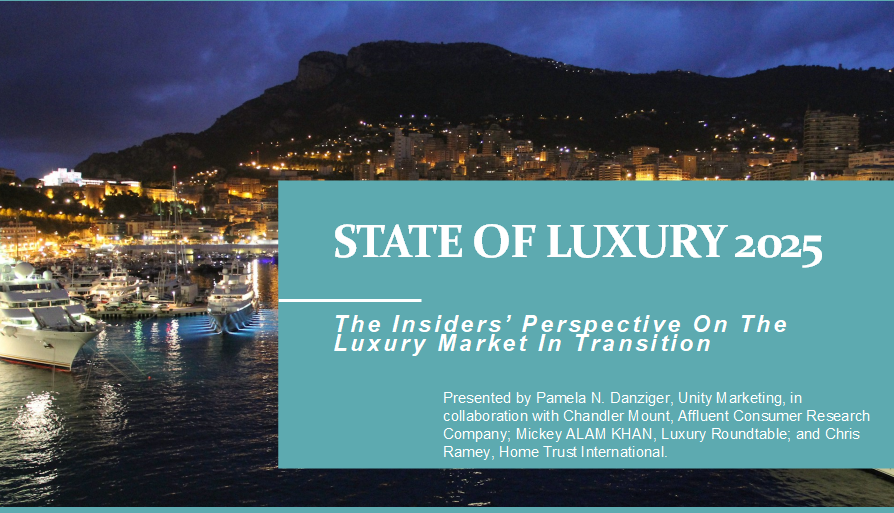
The global luxury market is navigating a complex environment, shaped by economic changes, evolving consumer expectations, and rapid advancements in digital technology. The State of Luxury 2025 report equips your company with essential insights to thrive amidst the challenges and opportunities of this year and beyond.
Now in its eighth edition, the State of Luxury report offers valuable insights to address both immediate and long-term challenges in the luxury market. It empowers brands to adapt to shifting market dynamics and meet growing customer demands for unique and immersive experiences in their luxury goods and services journey.
While economic uncertainties temper growth expectations in the short term, industry experts remain confident in the strong fundamentals of the luxury market over the long run. Brands that embrace digital innovation, enhance exclusivity, and prioritize experience-driven luxury are well-positioned to flourish in 2025.
Drawing from the results of a survey among nearly 300 luxury industry insiders, this concise 40-page report provides insights to help brands navigate economic shifts, evolving consumer demands, and digital transformation. It is an essential resource to thrive in 2025 and beyond.
Get your copy now at a pre-publication price of $50 through April 30.
| |
“For affluent consumers, luxury is a privilege, not a right, and as they look at the challenges they and the world at large face this coming year, they are signaling a willingness to trade off excess spending on luxury. Many plan to batten down the hatches and ride out any potential economic storm, as they did in the Great Recession of 2008 and 2009,” said Chandler Mount, Affluent Consumer Research Co.
Luxury Brands Must Prepare For A Reset:
Here's The How And Why
| |
Over the last three years, the luxury market has experienced a whirlwind of change. After rising 7 percent in 2019 before the pandemic, it suffered a steep decline in 2020, only to bounce back with spectacular growth through 2021 and 2022.
Bain-Altagamma expects the good times to keep rolling in 2023. “The personal luxury market is projected to see further growth of at least 3-8 percent next year, even given a downturn in global economic conditions,” they predict.
However, since the past is often the best predictor of the future, a different outlook is suggested based on results from the Great Recession of 2008 and 2009. Global personal goods luxury sales dropped 9 percent from 2007 to 2009, disproving the conventional wisdom that the luxury market is immune to economic downturns.
Whether the economy takes a slight tumble or a big fall in 2023, more economists are warning about an economic downfall that will impact the luxury market too. Analysts are warning of a potential " Richcession."
To prepare the Washington, DC-based Affluent Research Company has just published a new study among 2,000+ affluent consumers, called Research The Affluent Luxury Tracker. It provides a forward look at how the affluent will adapt their spending and purchase behavior if the economy falters, which they fully expect it will.
“Affluent luxury consumers are the most highly-educated and well-informed consumers, and some 69 percent see a recession coming within the next six months, if it isn’t already here,” said Chandler Mount, the study’s lead researcher.
“Anticipating the worst, the affluents aren’t waiting for the other shoe to drop. Nearly half (48 percent) surveyed said, ‘Now is a good time to limit my purchasing,’” he continued, noting that the survey sample was skewed heavily toward high-net-worth-individuals (HNWI) with $1+ million net worth (excluding their primary residence), a notoriously difficult consumer segment to survey.
Not unexpectedly, the HENRYs, with less than $1 million net worth, were more inclined to cut back (52 percent). But even 46 percent of the HNWI are lining up to reduce their purchasing. This will pose significant challenges to luxury brands that depend upon the HNWI’s greater spending power if they do pull back.
| |
“A groundbreaking and truly exceptional instruction manual offering a wealth of marketing insights and information, Meet the HENRYs is impressively well written, organized and presented, making it highly recommended.” writes Midwest Book Review.
Meet the HENRYs: The Millennials that Matter Most for Luxury Brands
| |
Meet the HENRYs breaks new ground by uncovering a new target consumer--Millennials with money.
It's a segment of the largest generation of Americans with more discretionary income than the rest of the cohort today and poised to acquire more money in the future.
These are the millennials that matter most to brands today and tomorrow
For the foreseeable future, millennial HENRYs (High Earners Not Rich Yet) will be the consumers that every brand manager, marketer and retail executive will need to know well.
This subset of the largest generation of Americans, earns between $100K and $250K–the income cohort that accounts for 40 percent of all household spending. Most important, however, these are the consumers who are on track to become the ultra-affluent ($250K +) of the future.
This forward-looking book examines trends and profiles emerging disruptive brands that millennial HENRYs are drawn to, and explains how many of these innovative brands are setting themselves apart from the traditional top-tier luxury brands.
It takes you on a deep-dive into the steps the smartest of the traditional luxury brands and retailers are taking to keep up with a new generation of consumers who are anything but traditional in their approach to luxury spending.
| | Unity Marketing | 717-572-9979 or pam@unitymarketingonline.com | | | | |