|
FROM THE MIDDLE EAST TO INDIANA: ASSESSING THE CONNECTIONS BETWEEN THE UNITED STATES, THE ISRAEL/GAZA WAR, AND US NATIONAL AND LOCAL POLITICS
| |
|
May 27, 2024, 9 pm Eastern time
Presented by:
The Committees of Correspondence for Democracy and Socialism (CCDS)
Socialist Education Project (SEP)
4th Monday Webinar Series
May 27, 2024, 9 pm Eastern time
register: https://us02web.zoom.us/meeting/register/tZItd-ugqz8qGNDa9czstWgM2DBP1gMuhwDq
The brutal war of Israel against Gaza (and the West Bank) has reverberated around the world. In the United States college campuses have been in upheaval with magnitudes not seen since the 1960s. Also, US support of Israel’s war on the Palestinian people has created new fissures in US politics, making the outcome of November elections more unpredictable.
This webinar will feature two speakers, one a longtime political activist and newspaper columnist, another a more recent community activist on US/Middle East politics. The panel and discussion will assess the Israeli war, US foreign policy, and the consequences of Middle East turmoil for domestic politics. After brief panel presentations webinar attendees will be invited to give their own analyses and report on activism in their areas.
Panelists:
Steven Jonas, a retired Professor of Medicine, prolific author of books on medical care, and most importantly for us a writer of books and articles on politics, including on the Middle East. An example is linked below.
URL: https://www.opednews.com/populum/page.php?f=Israeli-Nationalism-Creat-Anti-semitic_Israeli-Attacks-On-Gaza_Israeli-Abuse_Israeli-Apartheid-240315-399.html
Ming-Hwi Sun, a Taiwanese American Xennial who is native to West Lafayette, Indiana. As a local (though Purdue-unaffiliated) resident, I began attending campus protests calling for a ceasefire in Gaza last autumn and also visited the 12-day "Purdue Liberation Zone" this spring.
Inside the Purdue Liberation Zone:
https://www.purdueexponent.org/campus/article_b623a834-03ff-11ef-8948-bb122705d80d.html
TO REGISTER:
https://us02web.zoom.us/meeting/register/tZItd-ugqz8qGNDa9czstWgM2DBP1gMuhwDq
| |
Aljazeera listening post video on U.S. media coverage of campus genocide protests
Watch the video:
https://www.aljazeera.com/news/2024/5/7/pro-palestine-protests-how-some-universities-reached-deals-with-students
|  |
Tuesday, May 2, 2017
THE CRISIS OF HIGHER EDUCATION IN THE 21ST CENTURY
Harry Targ
From comments prepared for the statewide meeting of the Indiana American Association of University Professors, April 28, 2017, University of Indianapolis
Prelude to an Historical Analysis
On Thursday, April 27, 2017, President Daniels, Purdue University, announced to the university community a dramatic new program that he and the Board of Trustees had been fashioning in secret for months. Purdue University, a self-proclaimed world class university, would be acquiring Kaplan University, one of several controversial for-profit on-line universities that have emerged over the last twenty years. According to an article in the Lafayette Journal and Courier:
Daniels said the agreement with Kaplan-an affiliate of Graham Holdings Company-both allows Purdue to fully break into the growing online education sector, which the university wasn’t prepared to do on its own, and to serve more nontraditional students who are unlikely to attend a residential campus (Meghan Holden, “Purdue to Acquire Kaplan University,” Journal and Courier, April 28, 2017).
The campus community was stunned by the announcement which it learned about through a hastily called special meeting Daniels assembled with selected faculty and an e-mail announcement to the faculty. Some of us, including members of the Purdue chapter of AAUP were asked to respond to this dramatic new development in The Chronicle of Higher Education. I was quoted as follows:
Faculty should have input on educational policy matters ….Issues to be addressed should particularly include the academic integrity of whole degrees offered on-line... One would assume, since issues of staffing, developing credit, connecting with the traditional Purdue campuses are all issues of relevance to faculty who should have been consulted and informed.
Another Purdue colleague, David Sanders referred to the “Walmartization” of higher education, the provisioning of quick cheap degrees. “When speed and cost become more important than quality, faculty are going to object.” (Eric Kelderman,”Purdue Faculty and Students React Warily to Kaplan Deal,” The Chronicle of Higher Education, April 28, 2017).
The dramatic developments at Purdue University highlight a number of issues that bear upon the mission and purpose of AAUP as a protector and advocate of faculty and the integrity of higher education in general. Among the questions that should concern us are the following:
1.Who makes decisions involving higher education?
2.What is and should be the standards and vision of higher education?
3.What role do and should faculty play in higher education?
4.Are there changes occurring in the realm of economics and politics that are threatening our vision of quality education and the long-standing principle of “shared-governance” in matters of educational policy-making?
An Historical Analyses
According to Clyde Barrow, (Universities and the Capitalist State: Corporate Liberalism and the Reconstruction of American Higher Education. 1894-1928, The University of Wisconsin Press, 1990) the modern university had its roots in the period of rising capitalism after the Great Depression of the 1870s to the 1890s when mergers created an economic system in which a few hundred corporations and banks came to dominate the entire U.S. economy. Interlocking directorates of corporations and banks created a system of financial speculation, concentrated wealth, and a capitalist state. The capitalist state through pro-corporate and banking regulations, the allocation of tax and other benefits for the wealthy and powerful, and military mobilizations, such as President Cleveland’s use of the United States army to crush workers during the Pullman strike of 1894, helped create twentieth century monopoly capitalism.
Higher education, once dominated by theological pursuits, was refashioned to serve the needs of modern capitalist society. The need for scientific and technical skills coupled with a trained work force stimulated the establishment of educational institutions that could produce credentialed graduates who would serve the capitalist system. Also theoretical work and classroom education was required to educate the young to celebrate the blessings of the economic system and the conduct of the government. Young people learned about the desirability of market economies, the country’s long tradition of democratic institutions, and the manifest destiny of the United States as it conquered the North American continent and established a global empire from the Philippine Islands, to Cuba, to Central and South America.
Barrow provides data to show that members of university Boards of Trustees, the key decision makers in these institutions, came largely from big corporations, huge banks, and law firms which served big business. Some universities from the Midwest and South were led by trustees who represented regional manufacturing and finance capital, but their outlook and interests paralleled those from the major universities of the Northeast and the major state universities. There were never representatives of broader citizens groups such as labor unions on these boards.
During the early twentieth century, Trustees worked to establish an administrative class that could carry out the day-to-day operations of the university and manage the faculty who were the producers of the mental products the university was assigned to produce. Managerial procedures were adopted to control mental labor in the classroom and the laboratory. Metrics were institutionalized to evaluate the rates of productivity of the faculty; from measuring enrollments, publications, and the rankings of the university.
Federal and state governments and foundations funded the construction of a national university system that would serve the interests of twentieth century capitalism. Major foundations generated studies, did surveys, and made recommendations that found their way into institutions and policies of both public and private universities. During periods when domestic crises, such as depressions, and international ones, such as World War I, stimulated critical analyses from universities, faculty were disciplined or fired for challenging the economic system or state policy. The educational mission was to serve the interests of the capitalist elites and the state, not to provide a venue for critical thinking and debate about issues important to society.
Barrow summarized his findings about higher education:
Individual institutions were developing into centralized corporate bureaucracies administered according to nationally standardized measurements of productivity and rates of return on investment. The entire educational enterprise was being restructured within these standards as a production process that was increasingly integrated into local or regional markets for labor, information, research and professional expertise. The process was more and more a planned undertaking directed by the federal government. The construction of a national ideological state apparatus oriented toward solving the problems of capitalist infrastructure, capital accumulation, and political leadership within a capitalist democracy was well under way. (123)
This description of the emergence of the modern university system about one hundred years ago bears resemblance to the wrenching changes that are occurring in higher education in the twenty-first century. First, the further consolidation of capitalist class power in higher education in the current century comes in the aftermath of the Great Recession that began in 2008. United States capitalism continued its transformation from manufacturing to finance as rates of profit from the latter declined. Financial speculation led to banking failures and the collapse of the housing market. Consumer demand shrunk due to rising structural unemployment and falling real wages. And the cost of state support for the provision of education and various social safety nets programs rose. Economic crisis was used to justify austerity policies that included significant reductions in support for higher education.
Second, the economic shocks were used by Boards of Trustees, and their advisers in think tanks and political organizations, to demand increasing efficiencies in the production and teaching of knowledge. Programs that could not be justified as good “investments” became vulnerable. The humanities disciplines had to be justified by their use value to the so-called STEM (science, technology, engineering, and mathematics) disciplines.
Third, metrics have become omnipresent. Colleges and universities are using quantitative instruments to measure “creativity,” “critical thinking,” “personal satisfaction,” “teacher effectiveness,” and faculty “productivity.” University administrators strongly imply that if the activities at their institutions are not measurable in the narrow numerical sense, they should not be supported.
Finally, as the experience of academic critics one hundred years ago of child labor, anti-union policies, World War I, and financial speculation suggests, the nature of debate in the university is circumscribed. University policies, in response to organizations of professors and students, have expanded rights to “academic freedom” and have provided some job security through tenure. But attacks on tenure (which is a right to job security that all workers should enjoy if they perform their duties) are spreading as the twenty-first century “reconstruction of American higher education” proceeds.
To forestall these trends, faculty and students, as Barrows suggests, need to understand that “education has been and remains a contested terrain.” Most educators believe that the primary purpose of the university is or should be to stimulate a “marketplace of ideas.” However, the history of higher education, he says, is really about how the university can serve the preservation and enhancement of the capitalist state.
The Crisis of Higher Education
The crisis of higher education involves the efforts of economic elites and politicians to transform education to serve the twenty-first century needs of the larger economy and polity, and not necessarily, the citizenry at large. Barrow provides us with a useful paradigm from which to assess developments in all public institutions including colleges and universities. Power and control resides in Boards of Trustees and political elites and to a lesser extent university administrators. Their lens on educational policy is shaped by unfolding economic and political interests.
If we continue the narrative from the time period Barrow studies, we can identify the growth in higher education with the post-war United States economy, sometimes referred to as the “golden age.” After World War II economic priorities shifted to stimulating manufacturing, mass production and consumption, creating consumer and military demand, the expansion of education, and the provisioning of opportunities for higher education. Higher education became affordable for middle class Americans. War veterans had access to education via the GI Bill. Whole educational systems were constructed in big states like New York and California. Systems of community colleges were established to provide opportunities for poorer and part-time students. The size of faculties increased dramatically. Professional associations and journals increased to facilitate credentialing of new generations of faculty. And in response to uprisings in the 1960s over war, racism, and student rights universities expanded educational programs to overcome traditional “canons” of scholarship and education that left out the examination of the experiences of masses of people (particularly people of color, women, workers, immigrants). The post-war economy boomed and so did higher education.
However, economic stagnation (nationally and globally) began in the 1970s. Rates of profit declined. Consumption could not match production. Governments no longer could allocate sufficient resources to fund public programs (a political problem) and those who were critics of the modern social democracies marshalled their wealth and political muscle to challenge the vary premises of public policy.
By the late 1970s, Democrats as well as Republicans began to endorse government policies (internationally and domestically) that called for declining government support for social programs; deregulating finance, manufacturing, and markets; and the privatization of public institutions and programs. The policy agenda and this latest phase of capitalism was called neoliberalism. Some commentators refer to the economic policies adopted in the era of neoliberalism as “austerity.”
Below the political radar the billionaire Koch Brothers established The American Legislative Exchange Council (ALEC) in the early 1970s to support client state legislators, create “expert” think tanks on various policy issues, write model legislation on subjects as varied as health care, labor issues, creating charter schools, and transforming higher education. The neoliberal agenda, as was said, was endorsed to varying degrees by both political parties, and was most effectively institutionalized in state governments. Indiana in the era of Governors Daniels and Mike Pence was a model for applied neoliberalism.
Sometime in the late 1980s I heard Rush Limbaugh celebrate on his radio show the neoliberal victories that had been achieved but he declared that the one institution “we” had not been able to shape and control was the university. And that has been the project of endorsed by ALEC, state legislators, rightwing advocacy groups, and university administrators all across the nation.
As an essay by Anthony Paul Farley in a recent issue Academe suggests:
Recent struggles over higher education have taken place on the terrain of austerity, where a new ‘business’ model of higher education has called for the dramatic reduction of labor costs through such means as the elimination of tenure and the replacement of full-time academics with adjuncts. The idea of higher education as a public good has, it seems, very little purchase in the discourse of austerity.
Everything that can be measured is measured. Money becomes the measure of all things. This metaphysics of austerity has consequences for things not measurable in monetary terms. If the value of an academic discipline cannot be measured in such terms, then it does not exist.
Starving the Beast: Cutting Support for Higher Education
Purdue University President Mitch Daniels testified March 17, 2015 before a subcommittee of the House of Representatives Committee on Education and Workforce on what he calls higher education reform. He also spoke during that week to the American Council on Education and the Brookings Institute. A centerpiece of his recommendations was “income share agreements” whereby students partner with investors, particularly alumni, who would provide funds for their education in exchange “for a small share of the student’s future income.”
Daniels was touting this idea in addition to new cost-saving policies at Purdue University, such as offering three-year degree programs, using different metrics rather than course hours to measure student preparation, and tuition freezes. He has also urged a reduction in costly federal regulations.
Although some of Daniels’ proposals and programs at his home university have merit, the conversation he and other administrators around the country are having about rising tuition and the accumulation of years of debt ignore the major reason why costs and tuition are rising. In addition to the cost of higher education attributable to increased faculty salaries; layers of new administrators; the creation of new luxury amenities to attract students (housing, food, and recreational facilities), tuition has risen because state government financing of higher education has not kept pace with expenditures.
The Center for Budget and Policy Priorities issued a report on May 1, 2014 (“States Are Still Funding Higher Education Below Pre-Recession Levels”) which provides data to show that higher education funding remains below 2007-2008 pre-recession levels in 48 of 50 states. This means, according to CBPP: “the large funding cuts have led to both steep tuition increases and spending cuts that may diminish the quality of education available to students at a time when a highly educated workforce is more crucial than ever to the nation’s economic future.”
CBPP reports that since 2007-2008 state spending on higher education is down 23 percent, or $2,026 per student. Tuition increases have been substantial in public colleges and universities from fiscal year 2008 to 2014 ranging from $253 in Montana to $4,493 in Arizona. In Indiana tuition increased by $1,191 during this period. CBPP notes that in 1988 colleges and universities received 3.2 times more of their revenue from state and local governments than from students. That ratio declined to about 1.1 times more from government supports than tuition in 2013. Put another way the report states:
“Nearly every state has shifted costs to students over the last 25 years--with the most drastic shift occurring since the onset of the recession…Today, tuition revenue now outweighs government funding for higher education in 23 states…”
Not surprisingly Daniels’ idea that students find a rich supporter in exchange for future student earnings came from proposals made by free market advocate Milton Friedman in the 1980s. Friedman, the University of Chicago economist, was the most significant descendent of so-called “free market” economists who believe as did President Reagan that “government was not the solution; government was the problem.” From the vantage point of 2015, the privatization of all education, including higher education, is on the agenda of wealthy conservatives such as the Koch Brothers and the powerful state legislative lobbying organization, the American Legislative Exchange Council (ALEC). ALEC funds state politicians who support the elimination of public institutions, such as education.
Naomi Klein, author of The Shock Doctrine: The Rise of Disaster Capitalism, argued that during periods of economic or political crisis, changes have been introduced to weaken government and the maintenance of public services. The CBPP data suggests that the deep recession of 2008-2011 was an occasion for ALEC and the politicians and educators they support to reduce resources available for higher education. Despite the long history of government support for higher education, public schools from kindergarten through high school, libraries, roads, and police and fire-fighting services, the recession offered the occasion for influential and wealthy elites to pressure for policies that reduced state financial support for public services and a shift toward their privatization. In addition universities became even more dependent on big corporations, banks, and the military. Finally, tuition increased and students had to pay a higher share of the cost of their education.
Throughout much of U.S. history public education, including higher education, has been seen as a public good. The land grant system of public higher education was instituted in 1862. From then until the recent recession, public colleges and universities educated large percentages of the young and generated much of the scientific and technical knowledge that stimulated the U.S. economy, based on substantial public support and low student tuition.
After World War II, returning veterans became eligible for free higher education under the GI Bill. The program led to the training and credentialing of a whole generation of young people who went on to become educators and researchers, and also consumers of products manufactured after the war. The so-called economic “golden age,” from 1945 until the 1970s, was driven by research and development initiated by GI Bill recipients. These college graduates became members of the largest middle class in American history.
As Bob Samuels author of Why Public Higher Education Should Be Free put it:
“I actually believe that we should and could make all public higher education completely free. We’re currently spending around $185 billion on higher education annually—which includes spending on for-profit schools, which have very low graduation rates and high debt rates, as well as on merit aid for wealthy students. Given current enrollment, I estimate that it would cost about $155 billion to fund public colleges and four-year institutions completely. My argument is instead of funding the individuals, we should just fund the institutions directly” (quoted in Rebecca Burns, “Why Can’t College Be Free?” In These Times, June 13, 2014, http://www.inthesetimes.com).
However, advocates of “higher education reform” at least those collaborating with economic and political elites who advocate policies depriving government of financial resources, sometimes called “starving the beast,” envision a day when all public institutions are privatized. There is much evidence that the privatization of education will increase gaps between rich and poor and may leave the latter with inferior educations. The Daniels plan will rely on wealthy benefactors to support students while tuition costs continue to rise and those who still seek a college education will continue to accumulate a lifetime of debt.
Without a return to affordable publicly supported higher education, large proportions of young, intellectually curious, and talented students may be deterred from pursuing higher education which will have negative consequences for the entire society.
Additional Negative Consequences to Higher Education of the Neoliberal Paradigm
STEM
In a 2015 article Lindsey Russell, an ALEC Director of its Education Task Force, wrote an essay entitled “STEM-Will It Replace Liberal Arts?” In it he reports Bureau of Labor Statistics projections that from 2012-2022 there will be a growth of 13 percent in the STEM related workforce. As a result he poses the question reflected in the title of his article. His answer, although he does not say so directly is a qualified “yes.” He does quote a Forbes magazine article that suggests that STEM graduates need “critical thinking skills” to pursue their careers. These skills, the article asserts, along with those in communication, are what a Liberal Arts education can provide. In an interesting statement he says about STEM and Liberal Arts:
“STEM is the present and the future, and STEM related fields are projected to grow by more than 1 million by the year 2022….Liberal arts education may seem irrelevant today, but it is necessary if America’s youth are to become successful members of today’s STEM-dominated workforce.”
However, some empirical studies challenge the claims about preparing for a “STEM-dominated workforce.” Such analyses, and claims about shortcomings in the American educational system, go back as far as the Soviet Union’s launch of “Sputnik.” In a 2014 volume, Michael Teitelbaum (Falling Behind? Boom, Bust and the Global Race for Scientific Talent, Princeton Press) challenges the periodically claimed view that the United States is somehow “falling behind” in the production of scientists and engineers and in his words, “advocates of these shortage claims have had a nearly open field in politics and the media.”
In addition, in a Bureau of Labor Statistics Monthly Labor Review, May 2015 article entitled, “STEM Crisis or STEM Surplus? Yes and Yes,” the following conclusions are reached based upon extensive research:
*Since the STEM labor market is heterogeneous there are both shortages and surpluses depending on the particular job market segment.”
*In the academic market there are noticeable oversupplies of Ph. D’s.
*In some sectors of government jobs there are shortages of STEM-trained personnel.
*In the private sector, there are some areas were STEM demand is great, in others
where oversupply exists.
*Levels of oversupply or demand vary by geographic region.
Perhaps the most damning statement on STEM training and jobs comes from an article by Hal Salzman, “STEM Grads Are at a Loss,” US News, Sept. 15, 2014 declaring that: “All credible research finds the same evidence about the STEM workforce: ample supply, stagnant wages and, by industry accounts, thousands of applicants for any advertised job.”
While debates continue about the need to prioritize STEM in the educational process, a more important discussion should involve the substance and role of what usually is called “the Liberal Arts.” Should Liberal Arts be seen as only a training ground for honing critical thinking and communications skills or does the Liberal Arts project go much deeper?
Henry Giroux, Professor of English and Cultural Studies, McMasters University, Hamilton, Ontario, posted an essay he called “Neoliberal Savagery and the Assault on Higher Education as a Democratic Public Space,” on September 15, 2016 in which he claimed that political pressures to change and marginalize Liberal Arts had its roots in the theory and practice of neoliberal ideology, an ideology based on a crude vision of markets, privatization of public institutions, and the reduction of all of social life to commodification.
Metrics and Infantilization
At Purdue University and elsewhere administrators have advocated and enforced the use of metrics to measure the quality of the university, the “products” that are being produced, the level of “satisfaction” graduates had with their educational experience, feelings of job satisfaction among faculty, years taken to graduate, quality of jobs attained by students, employer satisfaction with graduates, trends in grades and probably others. In addition increasingly only certain professional journals are ranked high enough to warrant faculty promotion and references from only selective universities warrant consideration in tenure/promotion cases.
Therefore in virtually every phase of the education process there has been a radical transformation from qualitative to a reductionist and narrow empiricist set of university assessments. University administrators use the metrics provided by polling organizations to justify the neoliberal policies they endorse. As the section above suggests, the shift to prioritizing STEM education is defended on the basis of some empirical research to the exclusion of findings that would suggest a different set of educational policies. Numbers have replaced analysis.
The shift to metrics has been accompanied by the socialization of administrators, faculty, and students to reflect on their own performance in terms of the numbers. Numbers of articles rather than their quality become primary. Grades over knowledge acquired becomes prioritized. Numbers of students enrolled in classes, distribution of grades, amount of use of new technologies are all part of the reduction of education to the simplest common denominator. And in recent years, new university bureaucracies have been created to help “mentor” faculty and students to better perform to the metrics. The intellectual curiosity, the passion for knowledge, the encouragement for faculty and students to pursue those questions that enticed them into intellectual work are diminished as everyone is reduced to performing by the numbers.
Impacts on Faculty
Along with putting roadblocks in place for faculty to form unions, there has been a growing attack on the tenure system. Tenure means job security. Tenure means that faculty cannot be arbitrarily fired. Tenure means that after going through a period of performance and rigorous review, faculty have some job protections. And tenure means that faculty, in a work setting in which the free flow of ideas is vital, are protected from controversy in their teaching and research. Abolishing tenure is a high priority in higher education.
And, of course, there has been a qualitative decline in the percentage of college and university classes taught by tenure or tenure-track faculty and a concomitant rise in courses taught by graduate students and adjuncts. As state legislatures reduce financial allocations of resources, universities hire low paid adjuncts, often on a course-by-course basis at extraordinary savings. Of course, if an adjunct gets to teach four courses at more than one university, her/his time is spent traveling with little time to keep up with relevant literature and do research which in the long run reduces the chance for securing tenure-track employment.
And finally, returning to the new Purdue/Kaplan story: it is assumed by Boards of Trustees, spokespersons for ALEC, corporate executives, and politicians turned university administrators that on-line education is just fine. Although on-line education may have a place in the matrix of a total academic career, the appropriate mix of campus and on-line coursework; interpersonal/electronic contact; and reading versus videos and power points on computer screens needs to be discussed all across the campus. Particularly, the Kaplan model of on-line education, even for the millions of non-traditional students, requires critical scrutiny.
The Bernie Sanders proposal for free higher education for all should be part of public policy debate. Also, programs of additional support for regional campuses and community colleges, extension programs, extended hours on campuses for course offerings and other programs to meet the needs of non-traditional students might be part of a discussion of educational opportunities. It may be that several approaches in the long run might better serve the educational needs of non-traditional students than new collaboration with for-profit on-line firms with dubious performance records.
What Next?
In a 2010 essay in The Chronicle of Higher Education, Andrew Hacker and Claudia Dreifus made a series of proposals to address some of the crises of higher education today. They began by noting that tuition for public and private colleges had doubled compared with a generation ago. Rising educational costs required parents to commit large financial outlays, second only to house mortgages, to their children’s education. Alternatively students have had to take out loans that will burden them for their entire lives.
Among the proposals these authors made were the following:
-Institute free higher education for all who seek it.
-Maintain course requirements that lead to knowledge in history, the arts, sciences, and reasoned discourse.
-Provide secure full-time teaching jobs for every classroom. Eliminate the system of staffing classrooms with graduate students and temporary adjuncts who receive one-sixth the pay of the regular faculty.
-Pay presidents and other administrators salaries commensurate with public employees, not CEOs of Wall Street banks and corporations.
While our wealthiest and most powerful institutions-- corporations and banks, the military, and the health care system-- have come under some scrutiny in the new century, until recently higher education has remained hidden behind a wall of mystery even though everyone pays lip service to it as the hope for the future.
With enduring economic stagnation coupled with rising gaps in the distribution of income and wealth, education is offered as an escape route from poverty. We need to broaden public discussion about our assumptions concerning higher education; assessing its costs, accessibility, educational quality, and workplace security.
And for faculty the task is to organize effective political/lobby groups to defend the ideal of the university. In every college and university setting discussions should be organized about the strengths and weaknesses of the neoliberalism policy agenda, with particular emphasis upon its consequences for higher education.
| |
Massachusetts Peace Action | |  |
|
Here’s the link to the recording of tonight’s webinar with Massachusetts student leaders fighting genocide, facilitated by Merri Ansara:
| | |
|
Discussion in April "On the Immigration Problem'
Http://ouleft.org/wp-content/uploads/4thmonda-immigration-bacon-lewis.mp4
David Bacon
writer, photographer, labor organizer.
http://dbacon.igc.org/
""David Bacon is the conscience of American journalism: an extraordinary social documentarist in the
rugged humanist tradition of Dorothea Lange, Carey McWilliams,
| |
|
Anne Lewis
Anne comes out of a movement to make media that helps create opportunity for social change. She has made documentary films (always with limited resources) since the 1970¹s and was associate director and assistant camerawoman for HARLAN COUNTY, USA.
| |
Libby was a founding member of CCDS, along with her husband Mort, who proceded in death, They are both greatly missed. | |
Life of Libby: Chasing Peace & Justice
with Humor, Guts, & Passion
by Libby Frank (Author), Heather Shafter (Author)
5.0 5.0 out of 5 stars
4 ratings
This is a book about the life of Libby Frank and her story of chasing peace and justice with humor, guts, and passion. Libby Frank was an activist for peace and freedom since the 1940s. She participated in public swimming pool desegregation actions, support for farm and factory worker strikes, and actions to end the war in Vietnam. During the Vietnam War, Libby was the Director of the Bergen County, NJ Peace Center, which provided draft counseling and hosted Jane Fonda (and others) to speak against the Vietnam War. In the 1970s, Libby volunteered with the Women’s International League for Peace and Freedom (WILPF) Middle East Committee and developed international coalitions to work for a just peace in the Middle East. In 1981, Libby became the Executive Director of the U.S. section of WILPF. Libby relied on her bonds with fellow activists, folk music, and her sense of humor to keep her going through decades of activism. Her story shows us that the power of change lies in working with others for a common cause.
| |
"We’re dealing with the healthcare crisis in Massachusetts provoked by private equity. We built this forum with the Fund Health Care Not Warfare working group of Massachusetts Peace Action"" Sandy Eaton | |
|
Campaigns, Movements, and Organzing Strategies
with Bill Fletcher Jr.
and Carl Davidson
| |
Voting as a Tactic on the Terrain of Struggle
| |
|
Apr 30, 2024 | PDA Blog
by Randy Shannon, Secretary of the PDA BOD
“Voting” in a bourgeois democracy is a tactic, not a principle, and not a strategy. Tactics for progressives must be designed to support allies, defeat threats, and expand the terrain of struggle.
Issues must be addressed among the allies or potential allies of the progressive movement. And in this climate of the decline of imperial hegemony there are many issues. As OH Sen. Nina Turner stated on a PDA call last week, genocide is a major issue. There are others – healthcare access and affordability, homelessness, police violence, and more.
Among our allies the multi-racial labor movement is central. The labor movement has endorsed the Democrats; and from my observation this was not an automatic endorsement but a considered endorsement. Is there any question that the expansion of the labor movement is key to maintaining or expanding the terrain of struggle?
The Progressive tactic must be to work for a Democratic Party sweep of the Executive and Legislative branches of this billionaires’ government. The public will see this as a rebuff to the fascist trend and it will encourage more union organizing, more rallies, demonstrations, and other public actions against genocide, austerity, war, and militarism.
| |
The Right Reads Gramsci: Project 2025
and Neo-Fascism
by
Jerry Harris
Article published:
April 24, 2024
reprinted from Convergance
“We need to understand fascism as a dynamic and revolutionary movement. It is not a conservative political force safely embedded in US institutional power. It has a radical vision of power and reconstruction that Project 2025 gives voice to.”
It may come as a surprise, but the Right has been studying the work of Antonio Gramsci for years—and his ideas on the importance of culture and ideology have made a big impact on them. They concluded the Left has been following Gramsci’s lead ever since the cultural revolution of the 1960s, and captured the press, the universities, civil society, and most government institutions. To counter that, they have built their own media and think tanks, cultivated an institutional base in Christian churches, and developed a narrative focused on attacking abortion rights, LGBTQ+ rights, immigrants, and the civil rights advances since the 1960s.
This “war for the soul of America” is central to Project 2025’s “Mandate For Leadership” report, which presents a blueprint for MAGA and a strategic plan for the use of power should Trump win in 2024. According to its logic, left-leaning elites who promote human rights, racial justice, gender equality, and environmental protection are enemies of the people—that is, the hardworking (white) Americans for whom the ruling elites show contempt.
Referencing Gramsci, the report states: “The long march of cultural Marxism through our institutions has come to pass. The federal government is a behemoth, weaponized against American citizens and conservative values, with freedom and liberty under siege as never before.” Anyone who adheres to leftist ideology is a member of this elite, dominating most major institutions of American life: the media, big tech, education—and “nothing less than a counter-revolution will save the nation.”
Understanding how the ruling class rules
Gramsci explained how leading elements of the capitalist class build hegemonic blocs to create a ruling consensus. The bloc establishes commonly accepted forms of accumulation and political rule, as well as cultural and ideological domination, or ideas that become accepted as “common sense.” The main components are accepted by both major political parties, although there may be policy differences that exist within the scope of the broad consensus. The bloc, essentially a coalition of ruling class factions, forms a mass base by both repressing the opposition and creating political support among other sections of the population. They build that support mainly by using the tools of culture and ideology to support their political and economic project, but economic success and stability also play an important role.
From about 1932 to today there have been two major hegemonic blocs in the US. The first was the Keynesian bloc developed during the Roosevelt administration, which lasted into the late 1970s. It included social welfare, the acceptance of unions and civil rights reforms for women and people of color, measures to raise living standards, an economically active state sector, nation-centric economics, repression of the Left, building the military-industrial base, and imperialism abroad. It was replaced in the 1980s by neo-liberalism, which included the globalization of production, vast cross-border financial flows, broad-scale attacks on unions, precarity, deindustrialization, undermining the social contract, free-market ideology, expanding the military-industrial complex and imperialism, while militarizing policing and promoting the carceral state.
Ruling class splits
The deep economic crisis of 2008 began to unravel the neoliberal hegemonic bloc. A rapidly growing crisis of legitimacy disrupted politics, with social movements developing to the left and right. Significant sectors of the ruling class concluded they needed to form a new consensus to stabilize capitalism and reestablish political support for the system. Two different power blocs have formed, although neither has yet achieved hegemony.
The neo-fascist bloc seeks stability through repression, and creating a mass base through religious fundamentalism, patriarchy, and white supremacy. The neo-Keynesian bloc seeks stability and renewed political legitimacy through neo-Keynesian reformism, and economic expansion through the green modernization of the means of production. Both still pursue imperialism and maintaining military dominance.
This is a deep split within the ruling class over internal policies, different from the McCarthy era in which the ruling class and both political parties were united in purging the Left and expanding the US empire. The current splits may be beneficial to the Left in forming a common project to defend and expand democracy and protect civil society. That would entail aiming our main blow against the neo-fascist bloc, building the socialist core, working closely with progressives, and pushing the center to the left.
There are numerous important issues that unite a broad array of political forces: defending abortion rights, defending the queer and trans community, expanding voting rights, teaching about institutional racism in our public schools, defending public libraries and access to books, promoting more environmental legislation and regulations, maintaining a pro-labor National Labor Relations Board, defending Social Security and greater taxation on corporations. The list could go on. These issues encompass questions of race, class, and gender as well as democracy. Even within this common project socialists need to maintain independence and initiative, particularly in opposing US imperialism
The movement behind Trump is a coalition of reactionary and conservative forces. Its major organized elements are Christian Nationalists, reactionary Catholicism, laissez-faire capitalists like the Koch network, tech libertarians such as Peter Thiel and Elon Musk, right-wing think tanks, and neo-fascist militias. It’s important to see beyond Trump and understand the social/political movement which has gathered around him. This movement desires to coalesce as a long-term ruling hegemonic bloc, turning the US into an authoritarian Christian country, end bourgeois democracy, and severely curtail civil society.
Project 2025: a fascist vision for the US
Project 2025 was initiated and published by the Heritage Foundation, the most influential rightwing think tank, and the one closest to the power centers of the Right and the Republican Party. It has united much of the conservative movement, their think tanks, activists, and lobbying groups with the goal of installing a much more effective, more ruthless right-wing regime. It comes with tremendous funding and the backing of much of the political Right and believes there is a socialist plot in the highest echelons of American power. It sees a vast conspiracy with enemies everywhere, and that un-American forces have overtaken every institution.
Project 2025 is a major policy and ideological projection. It is a fascist document and puts forward a strategic path to create an authoritarian Christian dominated society through control of the state. There are other statements from within the authoritarian bloc with somewhat different formulations and viewpoints. Project 2025 is the most developed, and has been signed by over 100 groups and think-tanks. They want to be the ideological and policy brain behind Trump, who is useful as a mass fascist leader, but lacks the intellectual capacity to carry out a strategic project.
Donald Trump is not part of the “ruling class” (a term often used by the right to describe the elite). Instead, Trump is characterized as an outsider, a business maverick who disdains elite language and the club of Washington insiders.
China, globalists, political and academic elites, the left, socialists, communists–for Project 2025 it is all just one enemy. “Today, nearly every top-tier university president or Wall Street hedge fund manager has more in common with a socialist, European head of state than with the parents at a high school football game.” Moreover, America’s corporate and political elites, are fully in cahoots with the nation’s foreign enemies, and against the “real America made up of humble, patriotic working families.”
“Every hour the Left directs federal policy and elite institutions, our sovereignty, our Constitution, our families, and our freedom are a step closer to disappearing. Conservatives have just one shot to get this right. With enemies at home and abroad, there is no margin for error. Time is running short. If we fail, the fight for the very idea of America may be lost. This is the last opportunity to save our republic.” The solution to all the above problems is not to tinker with this or that government program, to replace this or that bureaucrat. … “We solve them by ripping out the trees—root and branch.”
We need to understand fascism as a dynamic and revolutionary movement. It is not a conservative political force safely embedded in US institutional power. It has a radical vision of power and reconstruction that Project 2025 gives voice to. As Trump has stated, he plans to rid the country of “left vermin.”
The Right’s unified plan and committed cadre
The Project outlines what the Right wants to do with the executive branch and the state apparatus immediately upon returning to power, department by department and agency by agency. Including purging 50,000 federal employees. Following is an examination of the Project’s nearly 900-page document, with much of the following content based on quotes.
Executing a president’s agenda requires a well-conceived, coordinated, unified plan and a trained and committed cadre of personnel to implement it. “We need to assemble an army of aligned, vetted, trained and prepared conservatives to go to work on Day 1 to deconstruct the administrative state and to use the state as a tool for concentrating power and entrenching ideology.” Interviews are already being conducted. Accepted are only those who agree that the 2020 election was stolen.
The president’s “needs,” “goals” and “desires” are always consistent with the law. And the president is the “personal embodiment of popular will.” Mussolini and Hitler would be particularly pleased with this section.
Plans to transform the state
- urge Left Elites in Major Departments. According to the Project, large sections of the State Department’s work force are left-wing and predisposed to disagree with a conservative president’s agenda and vision. And the Department of Justice (which oversees the FBI) “has been captured by an unaccountable bureaucratic managerial class and radical left ideologues who have embedded themselves throughout its offices and who are infatuated with the perpetuation of a radical liberal agenda.”
- Reverse Gains in Gender Justice. Women’s and gender rights are targets that generate a particular degree of fear and hatred. Project 2025 advocates the abolishment of the Gender Policy Council, and it wants to delete a host of terms such as: sexual orientation, gender identity, gender equality, gender equity, gender awareness, gender-sensitive, abortion, reproductive health, reproductive rights and diversity, equity, and inclusion out of every federal rule, internal agency regulation, contract, grant, public regulation, and piece of legislation that exists. Every U.S. state should be required to report exactly how many abortions take place, the gestational age of the child, why the abortion took place, and the mother’s home residency.
- End Environmental Justice and Protection Projects. When it comes to environmental science and regulations, the Project takes the same extreme approach. It wants to abolish the Office of Domestic Climate Policy, the Office of Environmental Justice and Civil Rights, and the National Oceanic and Atmospheric Administration because it “constitutes one of the main drivers of the climate change alarm industry.” It goes on to state that environmental extremism serves to undermine the strength of the US. “It is not a political cause, but a pseudo-religion meant to baptize liberals’ ruthless pursuit of absolute power in the holy water of environmental virtue.”
- Dismantle Diversity, Equity and Inclusion Initiatives. As for confronting racial inequality and discrimination the Project wants every department from the Department of Labor to the U.S. Agency for International Developmentto be scrubbed clean of Diversity, Equity and Inclusion (“DEI” is a policy adopted by many corporations, universities and government agencies), and treat the “participation in any critical race theory or Diversity, Equity and Inclusion initiatives as grounds for termination of employment” as they violate constitutional and moral principles. The government should prohibit the collection of employment statistics based on race or ethnicity. Illegal immigration should be ended, the border sealed. Furthermore, bureaucrats at the Department of Education “inject racist, anti-American, ahistorical propaganda into classrooms.” And “critical race theory and gender ideology should be excluded from curriculum in every public school in the country, because they poison our children.” This coincides with Trump calling immigrants “animals” that “poisons the blood of our country.”
- Restore Traditional Values Through State Action. All policies should be guided by traditional values. According to Project 2025 the pursuit of the good life is found primarily in family — marriage, children, and above all, in religious devotion and spirituality.
This is serious
For those who say there is no difference between the Democrats and Republicans, or that the US is not a democracy, or that we are already living under an authoritarian government, please take Project 2025 seriously. We are facing a well-organized, very well financed, highly motivated and an ideologically rigorous enemy. As leftists we exist in civil society. We use the political tools of free speech, free press, free association, and the right to assemble and protest to organize for our ideas, our cause, and to create a working-class mass base. There are always tensions, limitations and violence within bourgeois democracy. But what we have today is qualitatively different from the strategic plans of the neo-fascist movement.
\
There is an anti-fascist majority in the US, but it is unorganized and centrist Democrats are incapable of giving it full expression or leadership. I believe the role for socialists is to unite the many and aim our main blow against the most reactionary and dangerous enemy we currently face. We need to block MAGA as a national movement over a broad front of combat, as we build the capacities of left forces to move us toward a progressive future. It’s not just about a presidential election, but that is one aspect of the battle.
ABOUT THE AUTHOR
Jerry Harris
Jerry Harris is National Secretary of the Global Studies Association of North America. He is the author of Global Capitalism and the Crisis of Democracy (Clarity Press, 2016). His articles have been translated into Chinese, Spanish, Portuguese, German, Slovak and Czech
| |
|
By Steven Jonas
Secretary Pompeo Delivers a Speech, .After the Deal: A New Iran Strategy., at the Heritage Foundation. Boy, that worked out well, didn't it? (See an upcoming column on .Iran --- Some History.
(Image by U.S. Department of State) Details DMCA
"Either this nation shall kill racism, or racism shall kill this nation." (S. Jonas, August, 2018)
Most readers of this column will be familiar with The Heritage Foundation. It describes themselves as: "a leading think tank for policy impact, covering topics such as national security, economy, education, culture, and more." And goi on to say: "Explore its latest research, commentary, and events on the world's most pressing issues and how to fight for America's future." Some might describe them as something else. But this column is not about that latter thought. This column, rather, reviews language and policy/political proposals from a fund-raising letter of theirs dated January 2, 2024, with an occasional comment from yours truly, as noted. Reviewing the major points that they make, readers will be able to make up their own minds about which "Heritage" they are actually out to protect.
Now how, you might ask, did I happen to come across this letter? Well, for a modest sum anyone can belong to THS, and I do, just so that I can keep up with the latest-latest from the U.S. Far Right, in their own words. As we shall see, some of those words are quite frightening to those of us who believe in a capitalist bourgeois democracy --- that is the United States --- the best way to keep on as reasonably an even keel as a capitalist ship-of-state can be kept, is through having a political system that is generally characterized as "Constitutional Democracy."
Under it certain rules are set up, primarily to protect the interests of the dominant (some of us call it "the ruling") class, but which do allow a certain degree of participation in the political system, and protections in the legal system, for the majority of the population, in a system where the majority rules. (Of course, in the United States, starting with the given that each State has the same number of seats in the national Senate regardless of population, with the resulting population-imbalance in the Electoral college and the allotment of votes in it to each state, democratic rule is sharply limited. But that subject is the subject for another conversation.) And so, the Constitution establishes a number of rule-by rules. But now, as is well known, there is a leading politician who doesn't like a whole bunch of those rules, that is when they are applied to him. And, as it turns out, both a major voice putting forth policies that would lead to major damage to U.S. (bourgeois-to-be-sure-I-just-want-to-emphasize-that) Constitutional Democracy, and a major designer of such policies (see "Project 2025") is that one and the same "Heritage Foundation."
It is interesting to note (and as is widely known) that until fairly recently in the leadership of Heritage was one "Ginni" Thomas, wife of Supreme Court Justice Clarence Thomas. As The New York Times noted in the cited article about one of Washington's most well-known "power couples:" "The Supreme Court justice and his wife battled for years for a more conservative America. New reporting shows how far she was willing to go after Donald Trump's 2020 election loss [updated Sept. 21, 2022]."
But let's let Ginni's beloved Foundation speak for itself. As for Ginni, it is well known that she isn't there anymore but I wouldn't be surprised if she spoke to old friends there on an occasion or two, say through the Council for National Policy. And presumably she speaks to her husband as well, and not just about how wonderful the cherry blossoms around the Tidal Basin looked last year. As The Washington Post noted recently: "God, Trump and the Closed-Door World of a Major Conservative Group: What internal recordings and documents reveal about the Council for National Policy -- and the future of the Republican Party." A somewhat recent note has Ginni running a firm called "Liberty Consulting." But that is another matter. And so, back to "Heritage."
In that letter dated January 2, 2024, after some fund-raising stuff it states that: "For now, we must keep our full attention on defeating the Biden Administration and the entire leftist deep state must be held accountable." For what must they be held accountable, you might ask? Well, "They are destroying the very fabric of our society, eroding our civilization, and they cannot be allowed to achieve their goal of recreating America in the image of their Marxist-leftist vision." And that vision? "Pro-open borders, anti-free enterprise, anti-Second Amendment, anti-parental rights, and anti-America."
One could go on at length about what the bourgeois-democratic program of the Democratic Party is and is not. But on just one of Heritage's major policies, "guns for everybody, in abundance" (which of course we have now achieved) I will note that one Party thinks that the Second Amendment, as it was written, provided a decent framework for enacting much needed firearms regulation (see the blank, blank, and blank tragedies) while the other has gotten exactly what it (and its major supporters in the firearms-and-related industries) wanted, when Scalia's "Heller" decision as subsequently broadly interpreted, put the Second to bed without any formal process, like amending the Constitution. For the Second actually says: "A well-regulated militia [oops!] being necessary to the security of a free State, the right of the people to keep and bear arms, shall not be infringed." Which interpretation, whether intended by Scalia or not, has come to mean "guns for everybody [including children, without regulation], in abundance."
Now, ordinarily a political action group aiming to have a major influence on the upcoming election lays out in detail what their plans and program are, should they win. But so far, at least, Heritage has focused most of their attention that deals with program, other than name-calling, their so-called "Project 2025." This program would replace a significant chunk of the Federal Civil Service with operatives/staffers of their own choosing --- political/policy considerations, not professional/educational qualifications, first, of course (as they openly tell us). Has such a system ever existed in this country? In fact, it did, from the Founding right up until the passage of the first Civil Service Act in 1883, the "Pendelton." It was designed to: "[establish] the tradition and mechanism of permanent federal employment based on merit rather than on political party affiliation (the spoils system)."
On the other hand (without the benefit of legislation), Heritage says:
"Our plan will restore the rule of law to our country by training conservative and competent employees to staff the administration and very agency, and by providing a play book for correcting course on every policy area so no time is lost in getting to work repairing our nation on day one."
Imagine that. Restoring the rule of law by breaking one of the most important ones that established the form and function of the modern Federal government. That does take some imagination. As for other law-bending-and-breaking proposals, (and these, as well as, "Project 2025" are policies that Trump is promoting --- chicken-or-egg? Your guess is as good as mine):
1. On the "Border Crisis," they would "enforce the law" on the border. And in fact, as is well-known, their Republican allies in the Senate had crafted a very tough new set of immigration regulations, with the Democrats. As is also well-known, they dropped it at Trump's insistence so that he could use "immigration" as a theme in his campaign. Blatant hypocrisy? Sure. But "his folks" consistently follow the dictum that "consistency is the hobgoblin of small minds."
Trump, of course, is for massive deportation, even including illegal immigrants who have lived in the U.S. for many years (being exploited by employers who just love the low wages they can pay to them), and their children who, according to that pesky 14th Amendment are "birthright" citizens. I wonder where Heritage stands on that one. But Trump, of course, by killing the bill for (and he is not shy about stating his reason) political purposes, has put it out to pasture, at least for the time-being.
2. Heritage wants to hit the Biden Administration on "the economy." Good luck with that. It has not been this good in a long time. But Trump, and Heritage, often present a picture that is not in line with reality (as on Constitutional government and why it would be a good idea to maintain it), so they might very well be able to convince their followers that it is terrible (and was much better under Trump --- which it wasn't). And yes, Trump and Heritage have pretty much the same followers, both among --- if you will excuse me - the "MAGA" crowd, and the (much more important to Heritage, at least) segments of the capitalist ruling class that support both.
3. On education, Heritage wants to "end indoctrination." (Trump likely would too, I would think. But since he was not very well educated himself, and retained little of what he did pick up along the way about, say, basic civics, he seems to be not too interested in this one.) Of course, what Heritage really means is they want to substitute what is taught in many public schools (outside of Florida and an increasing number of "Red" [no, not that "red"] states) about U.S. history, specifically the role of racism in it (see 1619), and replace it with such gems as the famous Nikki Haley (she of South Carolina, the secessionist state that fired the first shots of the Civil War) one that slavery was not (at least) a cause of the Civil War. (This is until she was coached to "find" herself.) (My most recent analysis of the causes of the Civil War, which is hardly original since it is subscribed to by most main-line historians, at least for the most part, can be found here.) As Heritage says: "Project 2025 will restore education choices to parents" (that is except for parents who want their children taught about what really happened, as in DeSantis's Florida not).
And finishing with a flourish (before the end-of-letter fundraising stuff) Heritage tells us (right out of a Trump campaign speech --- that is if you can call Trump's rambling screeches speeches) that "The Biden Administration and their radical henchmen are destroying our country. Time is running out to save our republic!" Well, I guess if you believe that "saving our republic" means un-Constitutionally destroying one of the legislative foundation blocks on which our (bourgeois capitalist) republic stands, theirs is the way to go.
As to folk who think about who to vote for and think about a bunch of Biden policies they don't like (from The Border to Israel), they might also want to think about, let's say, the issue of preserving (bourgeois) Constitutional democracy. In that regard, they might want to think about what the Hertiage Foundation proposes to do by supplying Trump with his No. 1 gun for destroying the Federal government as we know it. And on top of that doing so without the benefit of the legislative process, as provided for in the Constitution:
"Article I, Section 1. All legislative powers herein granted shall be vested in a Con gress of the United States, which shall consist of a Senate and House of Repre sentatives."
This is what it comes down to folks. Do you want to preserve U.S. Constitutional democracy, with all of its flaws, or do you want the nation to be ruled by a Trumpstitution (actually made up as they go along) designed with a little help from their friends at The Heritage Society.
(Article changed on Feb 16, 2024 at 10:50 AM EST)
| |
|
`Buy this book in honor of incredible woman!
click HERE to purchase
| |
Understanding and Countering Fascist Movements
From Void to Hope
By Joan Braune
This book is based on the premise that understanding fascism is crucial for defeating it.
Understanding and Countering Fascist Movements suggests fascism must be understood according to two “dimensions.” First, fascism is a social movement seeking power, always already connected to sources of power. Hence, fascism cannot be defeated by policing it as a crime problem, nor therapeutically treating it as a pathology of mental health. Second, fascists have cognitive and emotional needs they are seeking to fulfill through their participation in the movement, but the presence of these motivations must be held in tension with the fact that fascists are responsible for their choices and that these individual motivations also exist in a wider social context of capitalism and systems of supremacy.
The book opens by examining some psychological elements of recruitment and disengagement from fascist movements, before addressing broader social narratives, concluding with the limitations of an approach that is grounded in the national security state that relies on individualized, perpetrator-centered interventions. Rejecting centrist paradigms that see fascism as “extremism” or “accelerationism,” Braune argues that fascism must be addressed in its specificity and uniqueness as an ideology and movement. Ultimately, she argues, fascism can only be defeated by countervailing social movements that not only demand radical social change but offer alternative spaces of belonging, community care, and the search for meaning.
Understanding and Countering Fascist Movements is a philosophical contribution to antifascist theory and practice that will be appreciated by academics, students, and activists concerned about fascism today. https://www.routledge.com/
| |
|
HARD BALL PRESS & THE MAYA BOOK PROJECT PROMOTE INDIGENOUS MAYA LANGUAGES IN GUATEMALA
Catarina Chay, director of the K'iche' department of Quetzaltenango.
Timothy Sheard | 415 Argyle Rd. 6A | Brooklyn, NY 11218 US
The Bilingual Education department of the Guatemala Ministry of Education in Quetzaltenango has printed 3,000 copies of Margarito’s Forest - 1,500 in Spanish- K'iche' version and 1,500 in Spanish-Mam version. The books will be given to Maya schools across the country as part of the movement to preserve and nurture indigenous Maya languages.
Hard Ball & Little Heroes Press is proud to support the Maya Book Project in also producing Margarito’s Forest in Spanish-K’iche’ and Spanish-Mam versions. We have also published Margarito's Forest
in English-K’iche’ and English-Mam for Maya children in North American schools as part of this campaign.
Hector Guzman, is Director of the Mam department, Guatemala Dept. of Education.
| |
|
The last few years I have been composing songs about peace, justice, climate renewal and our Covid heroes.
A wonderful company of musical theater actors and musicians have joined my Mighty Rivers Music Company and performed these songs.
Please have a listen and click on A CHILD OF MINE, a song about a woman and daughter caught in a city ravaged by war. It was inspired by the terrible events in Gaza, but could easily be sung for a mother and child in Ukraine, or in Viet Nam during the 60’s.
(Click on closed captioning for the lyrics)
More songs coming to my Youtube channel every Monday morning, 8:00 am, so check them out!
Listen to more songs and check out performance dates at my Mighty Rivers Music web site.
Out-of-towners will be able to watch shows streaming from my Facebook page, so be sure to “friend me” on Facebook.
Thank you, Tim Sheard.
| |
|
RADICAL CONNECTICUT – PEOPLES HISTORY IN THE.CONSTITUTION STATE - Andy Piascik and Steve Thornton
Who really makes history?
Radical Connecticut: People’s History in the Constitution State tells the stories ofeveryday people and well-known figures whose work has often been obscured, denigrated, or dismissed.
There are narratives of movements, strikes, popular organizations and people in Connecticut who changed the state and the country for the better.
Unlike a traditional history that focuses on the actions of politicians, generals,
business moguls and other elites, Radical Connecticut is about workers, the poor,people of color, women, artists and others who engaged in the never-endingstruggle for justice and freedom. It offers a fresh look at history that should especially inspire young people engaged in social justice work in an increasinglydangerous world.
| | |
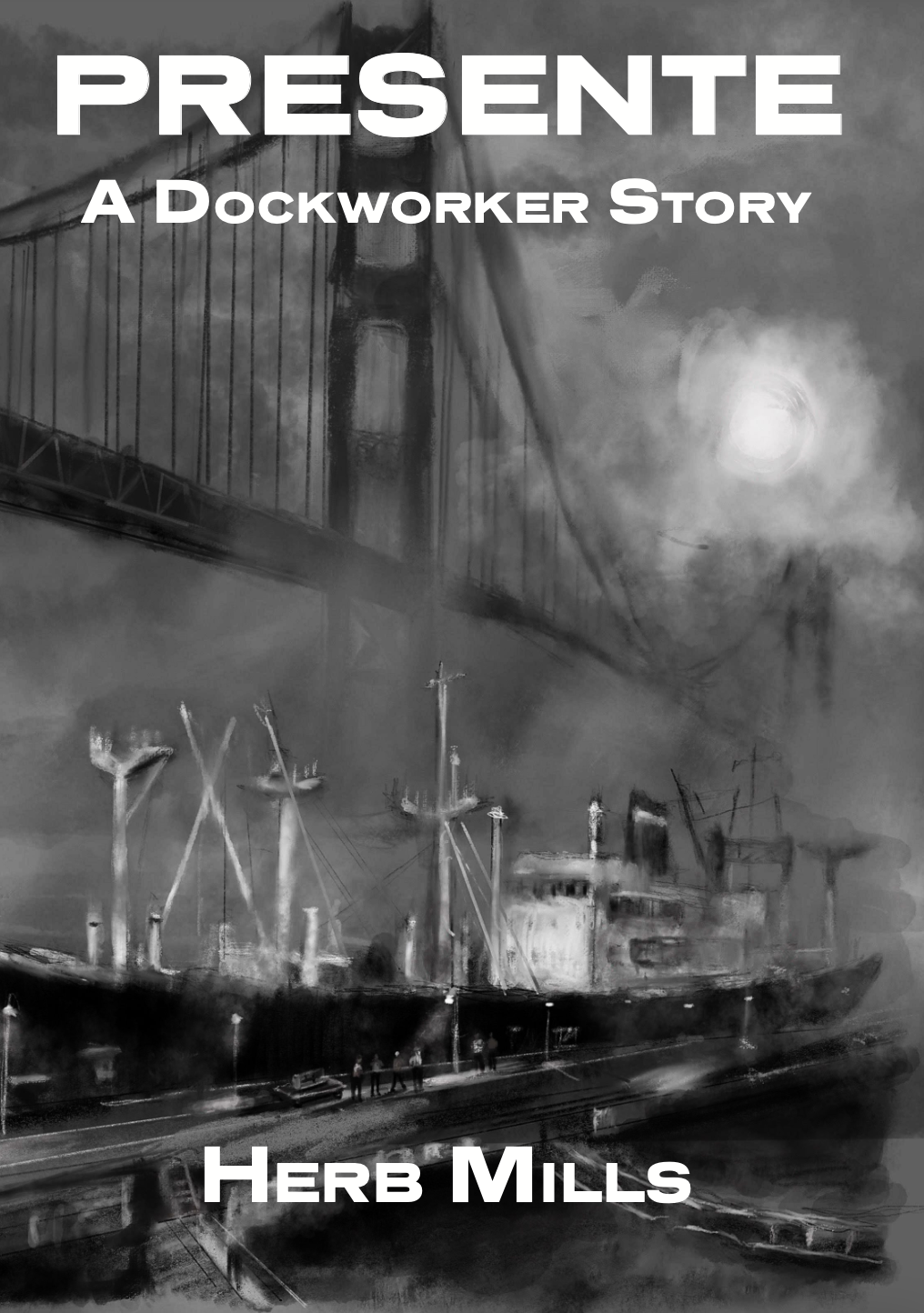 | |
PRESENTE, A DOCKWORKER STORY
Herb Mills
What would you do if ordered to load military weapons on a ship that was bound for a government that was brutally killing the people?
In December 1980, a union steward with the longshoremen’s union in San
Francisco learned that a shipment of arms on the docks was soon to be loaded onto a ship bound for the fascist government of El Salvador. While the
Salvadoran regime murdered thousands of its citizens, in the United States,
Ronald Reagan was an elected president on a conservative, anti-union platform.
Herb Mills, an officer in the ILWU (International Longshore and Warehouse
Union), led his union’s campaign to refuse to load the weapons. But such a direct
violation of their union contract could lead the government to jailing the officers
and putting the union into receivership.
How could the union stop the shipment and keep out of jail? Would the public
support them and, if so, how? Would the press vilify or praise them?
Based on his personal archives and historical union records, Mills fashions a
gripping fictional account of that campaign. The names have been changed, but
the courage and the daring of the union men and women are not made up, they
are all real, and now their story is told.
| | |
|
Children, did you know that you have real superpowers?
It’s true! Even if you are young, even if you are small, you and
your friends and schoolmates have the power to make the world a
better place.
Want to know how to release your powers? Read Little Meena and the
Big Swim/ La Pequeña Meena Y El Gran Nado and you will see that
when many little people all get together and speak in one voice, big
people have to listen. And change.
It is called Solidarity/ Solidaridad!
Release: June, 2024
_ _ _ _
Hard Ball Press is helping preserve indigenous languages through
partnering with the Maya Book Project. Little Heroes author Andy
Carter has released his wonderful children's book Margarito's Forest
in English-Mam and English-K'iche, the two most common indigenous
languages spoken by the Maya.
In Guatemala, the Ministry of Education, in partnership with the
Maya Book Project, is including the Spanish/K’iche and the
Spanish/Mam editions in their indigenous bilingual curriculum.
Children in schools across the country will be able to practice
their native language.
In addition, Little Heroes Press has released two new editions: Mam/
English and K’iche’/English. We published these versions for
children in North America to help Maya children (and parents!)
practice their indigenous language.
| |
|
The Man Who Changed Colors
By Bill Fletcher, Jr.
When a dockworker falls to his death under strange circumstances, investigative journalist David Gomes is on the case. His dogged pursuit of the truth puts his life in danger and upends the scrappy Cape Cod newspaper he works for.
Spend a season on the Cape with this gripping, provocative tale that delves into the
complicated relationships between Cape Verdean Americans and African Americans, Portuguese fascist gangs, and abusive shipyard working conditions. From the author of The Man Who Fell From The Sky.
“Bill Fletcher is a truth seeker and a truth teller – even when he’s writing fiction. Not unlike Bill, his character David Gomes is willing to put his life and career in peril to expose the truth. A thrilling read!” − Tavis Smiley, Broadcaster & NY TIMES Bestselling Author
Review by John Bachtell
Click HERE to purchase
| | |
|
From Upton Sinclair's 'Goose Step' to the Neoliberal University
Essays on the Ongoing Transformation of Higher Education
By Daniel Morris
and Harry Targ
Paperback USD 17.00
This is a unique collection of 15 essays by two Purdue University professors who use their institution as a case-in-point study of the changing nature of the American 'multiversity.' They take a book from an earlier time, Upton Sinclair's 'The Goose-Step A Study of American Education' from 1923, which exposed the capitalist corruption of the ivory tower back then and brought it up to date with more far-reaching changes today. time. They also include, as an appendix, a 1967 essay by SDS leader Carl Davidson, who broke some of the original ground on the subject.
Click HERE to Purchase
| | |
From the CCDS Socialist Education Project... | |
A China Reader
Edited by Duncan McFarland
A project of the CCDS Socialist Education Project and Online University of the Left
244 pages, $20 (discounts available for quantity), order at :
The book is a selection of essays offering keen insight into the nature of China and its social system, its internal debates, and its history. It includes several articles on the US and China and the growing efforts of friendship between the Chinese and American peoples.
| | |
|
Taking Down White Supremacy
A Reader on Multiracial and Multinational Unity
Edited by the CCDS
Socialist Education Project
166 pages, $12.50 (discounts available for quantity), order at :
https://www.lulu.com/spotlight/changemaker
This collection of 20 essays brings together a variety of articles-theoretical, historical, and experiential-that address multi-racial, multi-national unity. The book provides examples theoretically and historically, of efforts to build multi-racial unity in the twentieth century.
Click here for the Table of contents
| | |
CHANGEMAKER PUBLICATIONS: Recent works on new paths to socialism and the solidarity economy
Remember Us for Gift Giving and Study Groups
We are a small publisher of books with big ideas. We specialize in works that show us how a better world is possible and needed. Click Gramsci below for our list.
| |
522 Valencia St.
San Francisco, CA 94110
415 863-6637
| | | | | |