NJ MAT Centers of Excellence Newsletter |
|
Friday, July 16th, 2021 | Issue #27 |
|
|
|
Governor Murphy Signs Legislative Initiative to Address New Jersey’s Opioid Epidemic |
On July 2, 2021, Governor Murphy signed a new legislative package into law, with a focus on overdose prevention, bridging the gap with MOUD, strengthening public health data, and building resiliency among children and families.
S3491 expands low-barrier access for any person or entity to obtain, distribute, and administer opioid antidotes; S3803 permits certain paramedics to administer pre-hospital buprenorphine; A5595 requires the New Jersey Division of Consumer Affairs to publish on their website the retail price of certain opioid antidotes; A5597 permits school districts to administer surveys regarding student health after prior written notification to parents and legal guardians; S3814 requires the Department of Children and Families or court to consider placement of children with relatives or kinship guardians when making placement decisions; and A5703 requires certain health insurers including Medicaid to cover naloxone without imposing prior authorization requirements.
The NJ MAT Centers of Excellence are grateful for Governor Murphy’s signage of the bills into law. We will continue doing the work to end the stigma of addiction and ensure that all people struggling with SUDs have access to high-quality, evidence-based care.
|
|
|
|
|
ECHO: Case-Based Application: Concurrent Benzodiazepine Use Disorder and Opioid Use Disorder |
If you missed any of the previous MAT or continuous quality improvement ECHO sessions, they are posted on our Northern COE Website webinar archive. Please note that you are only able to receive CE credits by attending LIVE ECHO sessions.
The next ECHO session is on Friday, July 30th from 12 - 1pm
Topic: Case-Based Application: Managing Concurrent Benzodiazepine Use Disorder and OUD
This ECHO program will review real and complex patient cases of patients with chronic benzodiazepine use and opioid use disorder. Attendees will be able to apply the information discussed during the ECHO on 7/9/21.
Do you have a patient or client you would like to present to the panel to receive recommendations and suggestions for management? Please click here to email your question(s) or scenario(s).
|
|
|
|
|
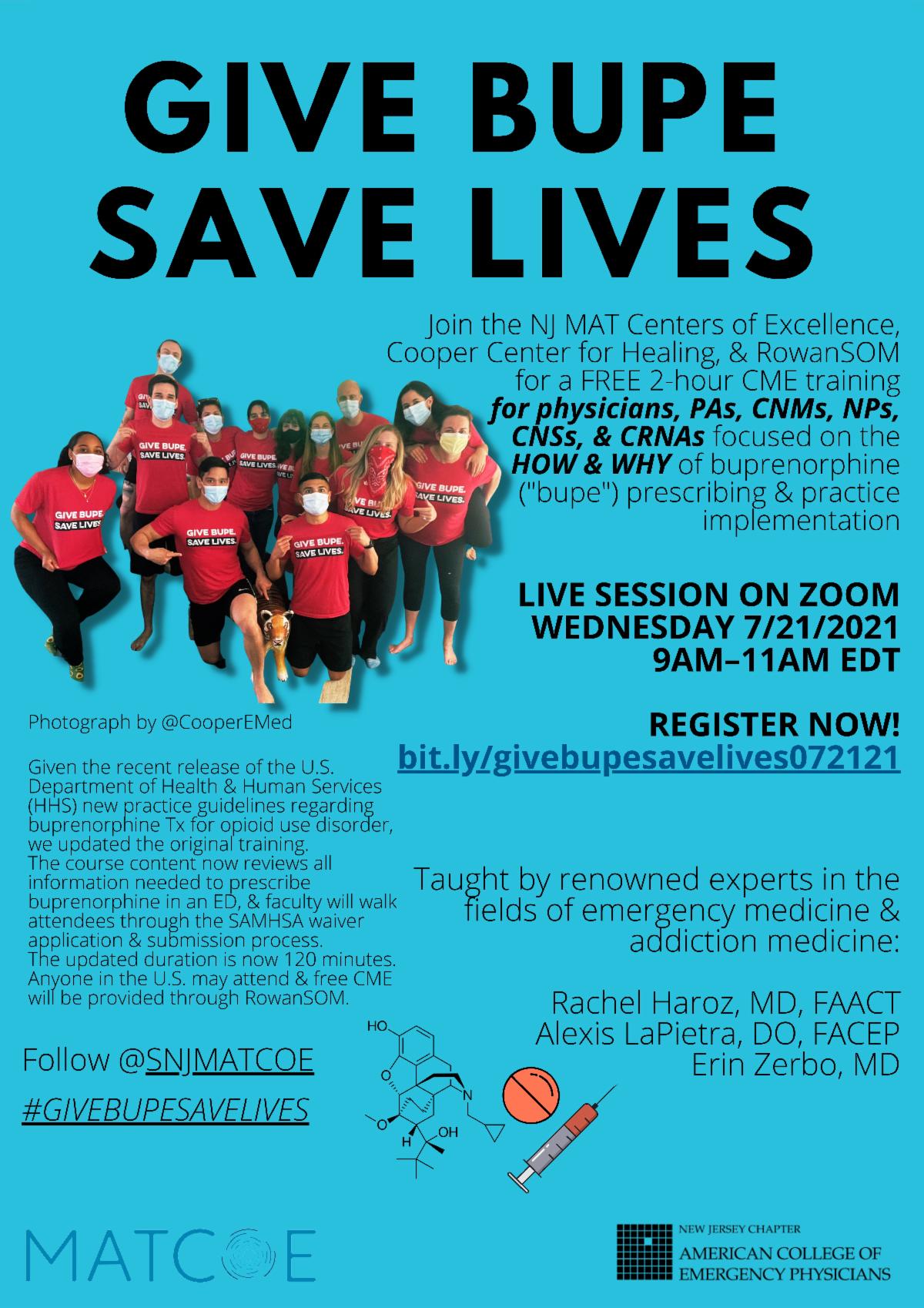
CME Event (2nd Opportunity): Do You Need More Guidance in Buprenorphine Prescribing and Practice Implementation? |
Now more than ever, providers with prescribing authority have the opportunity to play a critical role in ending the stigma against people struggling with SUDs and expanding access to evidence-based and lifesaving treatment.
Three months prior, HHS made history and enacted a positive step towards destigmatizing patients with opioid use disorder: new clinical practice guidelines officially waive requirements for providers with a DEA license to obtain an X-waiver to prescribe buprenorphine for the treatment of OUD for up to 30 patients. Of note, hospital-based physicians, such as emergency department physicians, are also eligible for this waiver and the 30 patient cap does not apply to them.
To support providers who may be unfamiliar with the prescribing of and practice implementation of buprenorphine for the treatment of OUD, the NJ MAT Centers of Excellence and American College of Emergency Physicians are hosting several free 2-hour virtual training sessions. CME certificates will be provided for MDs and DOs, and CME certificates will also be provided for advanced practice practitioners. Our next session is on Wednesday, July 21st, from 9–11am, and will be taught by our physician leaders, Drs. Rachel Haroz and Erin Zerbo, in addition to St. Joseph’s University Medical Center's physician leader, Dr. Alexis LaPietra.
|
|
|
|
|
Providers Clinical Support System (PCSS) MOUD Implementation Webinar |
This free webinar discusses the role of champions, facilitators, barriers and how to assess readiness when implementing a MOUD program. The goal of the PCSS Clinical Roundtable is to support interactions among addiction experts and health professionals. Take advantage of these unique opportunities to engage your peers and get your questions answered!
Date of Event: Friday, July 23rd, 1 - 2pm
|
|
|
|
|
MAT Lunch Hour: Cannabis Legalization/Decriminalization in NJ and Implications |
Join us and the Camden Coalition of Healthcare Providers for the next monthly MAT Lunch Hour to network, collaborate, and discuss.
The next forum will feature Ami Kachalia of the ACLU of New Jersey, who will be speaking about cannabis legalization and decriminalization in NJ, and its implications.
Next Forum: Wednesday, July 28th, 12 - 1pm
|
|
|
|
|
New Police Program in Chicago Helps People Using Drugs Get SUD Treatment Instead of Jail Time |
This is an article that discusses a new Narcotics Arrest Diversion program that offers treatment for SUD amongst those arrested for drug offenses. Should those arrested agree to participate and are screened and referred to appropriate treatment, these individuals are then released without charges and transported to a treatment center. |
|
|
|
|
Rhode Island Becomes the First State to Support Pilot Harm Reduction Center |
On July 7, 2021, Rhode Island Governor Dan McKee signed a bill to establish a two-year pilot program to establish a supervised injection site wherein people can test and use their drugs of choice in an environment supervised by trained medical staff. Rhode Island is the first state in the nation to legalize supervised injection harm reduction centers. Municipalities will be required to authorize facilities to operate in their jurisdictions during the pilot program. The bill stipulates formation of an advisory committee, with a requirement to advise the state Department of Health on how to leverage the benefits of the Centers. This law will become effective on March 1st, 2022. |
|
|
|
|
Combining Opioid Use Disorder Treatment with Prenatal Care: A Missouri Initiative |
This is an article written and supported by the substance use prevention and treatment initiative of The Pew Charitable Trusts, and discusses a multidisciplinary team of obstetric and mental health providers providing on-site behavioral and psychiatry specialist support to pregnant and mothers who have given birth within the past 3 years. Given the many barriers in treating pregnant patients with active substance use disorder, this team shows us the importance of providing access to high-risk populations, which include addressing the need for comprehensive OUD care in the prenatal stage. Addressing the psychosocial stressors that are associated with the social determinants of health are also important as they may also lead to the complications associated with substance use exposure in this population. |
|
|
|
|
Receipt of MOUD Among Youth Engaged in Primary Care: Data from 6 Health Systems |
This is a cross-sectional study that looked at the prevalence of treatment with MOUD in youth with OUD, and specific characteristics that influence OUD treatment amongst these patients. It looked at youth aged 16-25 engaged with primary care. Among the over 303,000 youth that were eligible, just over 2,000 had a documented OUD. About half of the youth had documented depression/anxiety and 1/3 had co-occurring substance use disorders. Receiving MOUD was much higher amongst the older youth (22-25) at 39% vs. those who were younger (16-17) at 14%. Since treatment with MOUD is indicated for those who are at least 16 years old, understanding the barriers that may lead to decreased access in this age group, as well as integrating treatment for other substance use and mental health disorders is paramount. |
|
|
|
|
Literature: Stigmatization of MOUD in 12-Step Support Groups and Participant Responses |
12-step groups have commonly endorsed OUD recovery without the use of MOUD. This is a study that conducted semi-structured interviews of patients to investigate how MOUD stigma is operationalized in 12-step groups and identify their responses to stigma. 30 individuals were recruited for this study. Interestingly, methods used to promote treatment without MOUD included:
1) Prohibiting those using MOUD from speaking at meetings
2) Encouraging short-term treatment with MOUD
3) Refusing to sponsor people using MOUD and refusing to let them claim recovery time
Patient responses to stigma include: feeling shame, anger, looking for other groups, not revealing they are on treatment for MOUD, speaking out on behalf of MOUD, and using cognitive approaches to avoid internalizing the stigma, which includes believing that this stigma is contrary to 12-step principles. To address this stigma, the article emphasizes healthcare systems’ roles by offering non-12 step alternative groups and encouraging providers to prepare patients for the stigma they may encounter.
|
|
|
|
|
National Harm Reduction Coalition Toolkit |
The National Harm Reduction Coalition released a free toolkit on July 13th called, It’s Our Backyard Too: Building Community-Centered Support for Harm Reduction. As the toolkit states, the goal is to provide resources for those who use drugs, trade sex, loves someone who uses drugs or trades sex, those who are directly involved in harm reduction work, wants to learn more about harm reduction, providers at syringe service/syringe access programs, and all stakeholders involved in providing evidence-based care and "sit at the intersections of justice for our communities." Enroll below to gain access to this useful toolkit.
|
|
|
24/7 MAT Provider Hotline: 844-HELP OUD (844-435-7683)
|
|
|
|
|
|
|