|
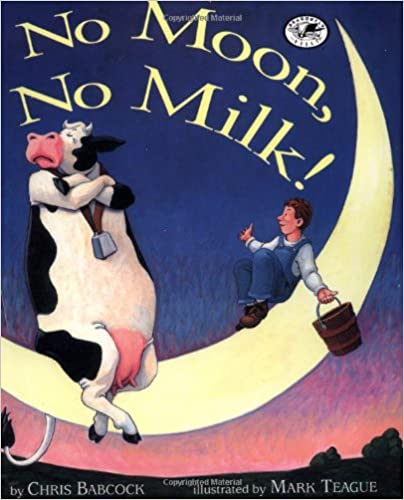
In reading the delightful children's book, "No Moon, No Milk!", our team was inspired to create this virtual learning guide and take a trip to the local Dairy Farm. Follow along with the Read-Aloud leading to the Dairy Farm Scrapbook. Stay to learn more about math and literacy as we show you how literature can inspire great learning adventures.
|
|
2. Background Building Links
|
|
|
Did you know...
...that environmental print is the print of everyday life? This includes familiar symbols, words, and numbers found on signs, billboards, coupons, and stores. Environmental print is a natural way for children to learn that writing/letters carry meaning. Their understanding that the big M means McDonald's and that the Mots label means applesauce is a first step toward learning to read and write.
Environmental Print!
Dakin Dairy is more than just a dairy farm; the property also features a Farmer's Market and Cafe. The shop was teeming with yummy smells and items for sale--including chocolate milk! Stores and other everyday trips can feature wonderful learning opportunities for children.
|
Below is a simple activity from
Reading Rockets
, that you can play on your next market/grocery trip using environmental print.
Choose a letter while heading to the store. Write it down for your child on a small slip of paper and make the letters sound aloud. Then make a game of finding things in the store that starts with that letter. For example, with the letter "
D,"
you could find the
d
airy section,
d
og treats,
d
onuts,
d
ates,
d
elicious
d
anishes, hot
d
ogs, and
d
eli sandwiches. Emphasize the letter "
d
" and the sound it makes with each of your "
d
" words. Click below to hear the letter Dd soundbite.
|
|
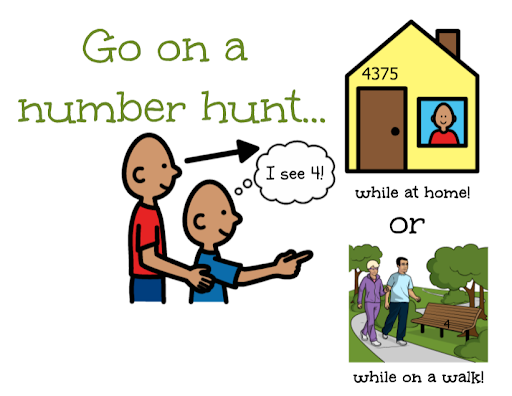
Numbers are all around us!
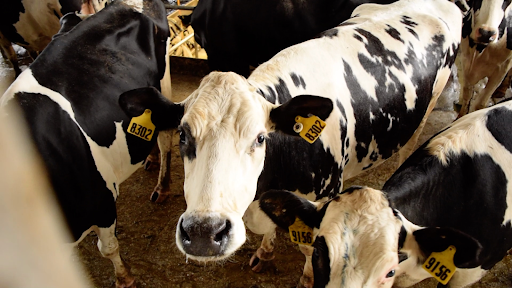
We saw numbers everywhere at Dakin Dairy! The cows had numbered ear tags, the milk gets counted and weighed before going to the store, and there were even numbers showing how much the milk costs to buy.
|
|
Review counting with movement and music!
|
|
Words are everywhere, and this activity teaches children that words have meaning.
Follow the steps below to use the letters in your child's name to make environmental print word collages.
- Assist your child with writing all the letters in their name individually on separate pieces of paper.
- Look around your home with your child and find and cut labels from cereal boxes, drink labels, wrappers from groceries, advertisements in Magazines/ Newspapers, etc. that begin with each letter in your child's name.
- Use the beginning letter of the word to match and sort the labels. Place the label on the paper with the corresponding letter in your child's name. After sorting, glue the labels on the correct piece of paper.
- Encourage your child to share his or her collages with loved ones and hang them for display!
|
Numbers all around! Play to learn with
one
or
all
of the activities below!
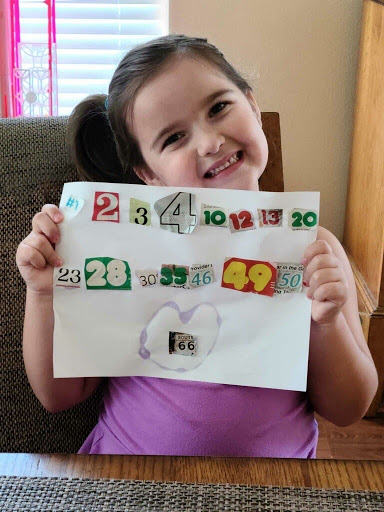
Number Collage
|
|
Ask children to practice spotting numbers by looking through magazines, flyers, or old mail. These numbers can be cut or torn out for fine (small) motor practice.
For an extra challenge ask students to sort by number, color, or place in numerical order.
|
|
|
|
Use our printable page to keep track of the numbers found or carry paper and encourage children to write the numbers they see!
|
|
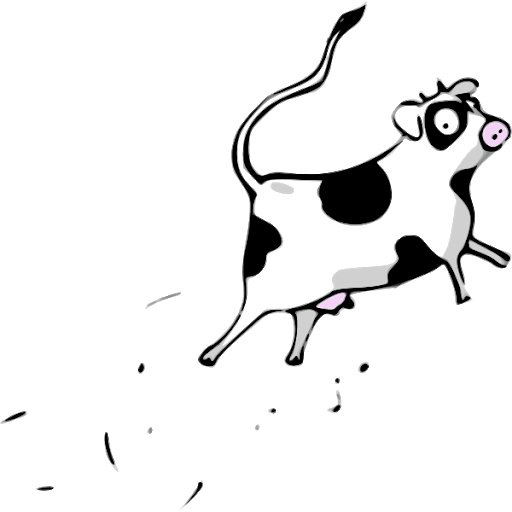
Get kids "moooo"-ving by creating your own cow themed number hunt game!
-
-
Cut out one set of numbered cows and hide them around the classroom or home.
-
Cut out the final set of numbered cows and keep them as your master set.
-
Show children a number and have them find the matching Numbered Cow.
-
Celebrate correctly matched numbers by adding that many "spots" to the cow with crayons.
-
Provide positive feedback for any missed matches. Such as,
"you found a 3, number three has two curves, let's trace it with our finger. We were looking for the number 5, see how it has one curved bottom. Let's trace it with our finger too."
|
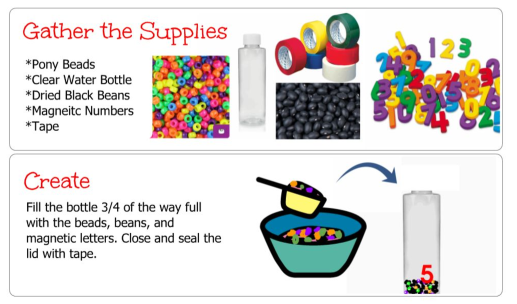
Magnetic Number Sensory Bottle
|
|
Extend learning with tools such as a magnifying glass, by asking children to write down the numbers they spot or by using directional language to describe the location of the numbers found. For example, the 4 is next to the blue bead or the 2 is in between a red bead and a black bean.
|
|
Don't forget to share a video or picture with #ELCManatee or #LearningFromAfar!
|
|
Focus Standards: 4 Years to Kindergarten
Domain 1: Physical Development
B. Motor Development
Domain 4: Language and Literacy
C. Vocabulary- Shows an understanding of words and their meanings
-
Understands or knows the meaning of many thousands of words including subject area words (e.g., science, social studies, math, and literacy), many more than he or she routinely uses
Domain 5: Mathematics
A. Number Sense
-
Counts and identifies the number sequence "1 to 31"
-
Demonstrates one-to-one correspondence when counting objects placed in a row (one to 15 and beyond)
-
Reads and writes some numerals one to 10 using appropriate activities
E. Spatial Relations
-
Describes relationships between objects and locations with words and gestures by constructing models to demonstrate an understanding of proximity (beside, next to, between, below, over and under)
|
|
|
|
|
|