|
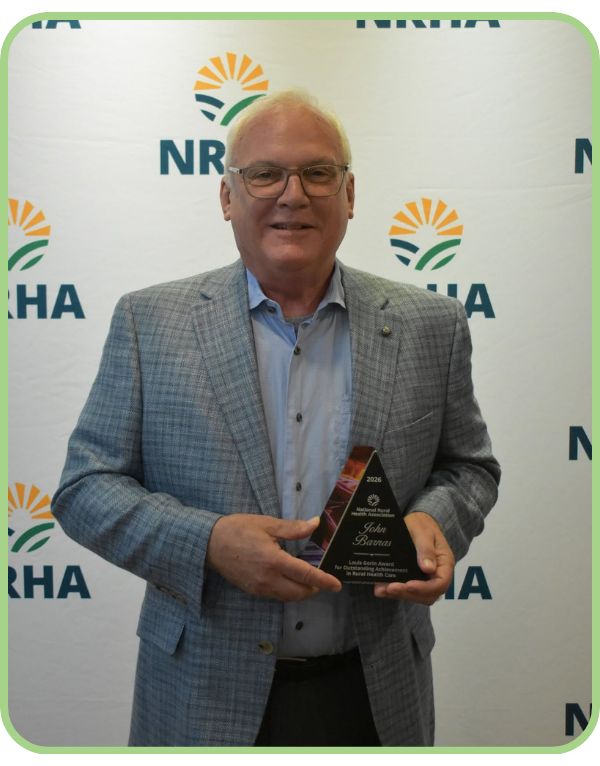
Please join us in congratulating MCRH's Executive Director John Barnas on receiving the 2026 Louis Gorin Award for Outstanding Achievement in Rural Health Care from the National Rural Health Association. From advancing innovative health initiatives to securing resources that benefit communities across rural Michigan, John's leadership has made a lasting impact on rural healthcare. Read the full story and watch his award acceptance remarks.
John was joined at NRHA's 49th Annual Rural Health Conference by Crystal Barter, Jill Oesterle, and Amanda St. Martin. Scroll to the new MCRH in Action section at the end of this newsletter for highlights from recent staff travels and activities.
| | |
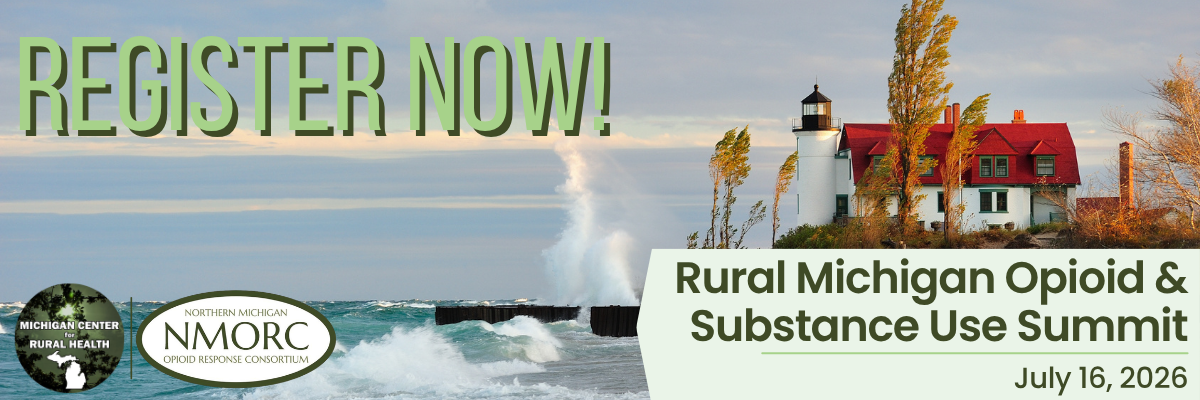
Register for the 2026 Rural Michigan Opioid and Substance Use Summit, taking place less than a month away, July 16, 2026, at Treetops Resort in Gaylord. Hosted by the Northern Michigan Opioid Response Consortium (NMORC), a program of MCRH, the Summit brings together partners working in prevention, treatment, recovery, healthcare, behavioral health, EMS, public health, and community services to support rural communities impacted by substance use.
Attendees can review the agenda and register online. Organizations interested in exhibiting can review the exhibitor prospectus and complete the exhibitor registration form.
The hotel block availability is extended to June 26, make sure to register and get your lodgings set before the July 4 holiday weekend!
| | | |
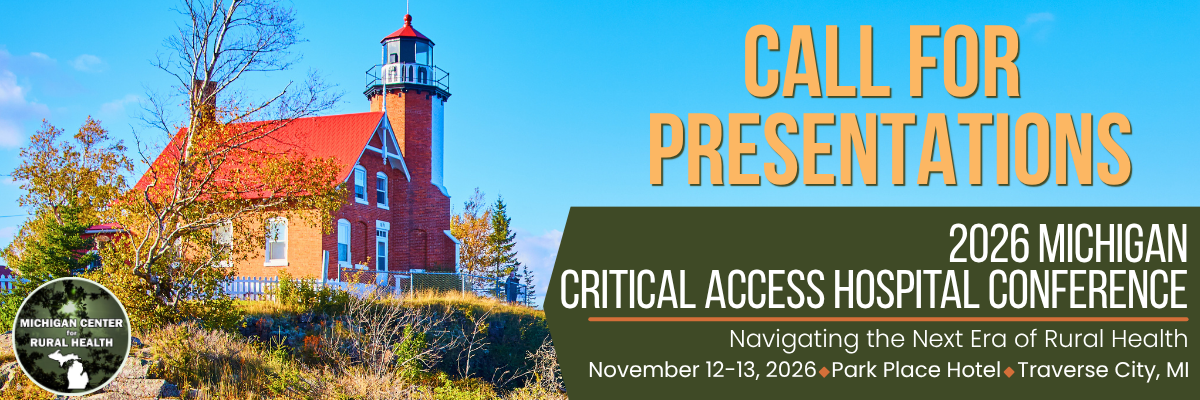
The Michigan Center for Rural Health is now accepting presentation proposals for the 2026 Michigan Critical Access Hospital Conference, taking place November 12-13, 2026, at the Park Place Hotel in Traverse City.
MCRH is particularly interested in peer-to-peer presentations from Michigan Critical Access Hospitals on topics including patient safety, workforce solutions, behavioral health, cybersecurity, leadership, Rural Health Transformation Program (RHTP) strategies, and other emerging rural health issues.
Proposal submissions are due by July 19, 2026. Renee Calkins, Education Manager, will notify submitters of their proposal status by August 14.
| | |
Do you have a story to share? Know a rural organization or individual making a difference? Email Laura Stoddard, Social Drivers of Health Manager, and let us share your story!
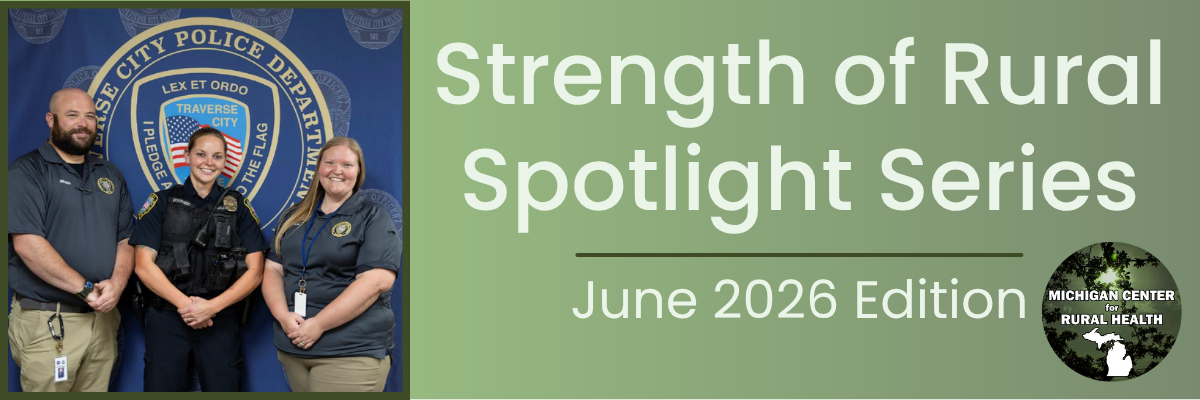
The Traverse City Police Department's RESILIENCE Program is helping strengthen coordinated care for individuals experiencing challenges related to substance use, mental health, homelessness, and justice-system involvement.
Through a network of more than 60 community partners, the program brings together organizations across healthcare, behavioral health, housing, social services, and the justice system to reduce barriers and improve access to support. By focusing on participant-led goals and collaborative problem-solving, the RESILIENCE Program is helping create a more connected and responsive system of care.
Read the full spotlight story to learn more about how the RESILIENCE Program is improving collaboration and supporting individuals across northern Michigan.
| | Rural Healthcare Provider Transition Project Applications Open | |
From the National Rural Health Resource Center, applications have opened for the Rural Healthcare Provider Transition Project. Participants in this program – including small rural hospitals, Critical Access Hospitals, and Centers for Medicare and Medicaid Services (CMS)-certified Rural Health Clinics – receive virtual and on-site technical assistance to shift from a traditional fee-for-service model focused on volume to a Value-Based Care model. The Project accepts applications on an ongoing basis, with a cut-off of August 14 for the next cohort.
Small rural hospitals and Certified Rural Health Clinics are encouraged to apply.
| | University of Michigan EMS Workforce Burnout Survey | The University of Michigan Department of Emergency Medicine is conducting a statewide study, led by Dr. Nate Hunt. The purpose of this survey is to collect information on factors that may contribute to burnout among EMS personnel in Michigan. It will take approximately 15 minutes to complete. Your feedback will help give information on current challenges experienced and guide future initiatives in reducing EMS burnout. | Rural Behavioral Health Workforce Under New Medicare Reimbursement Policy | Effective January 1, 2024, marriage and family therapists (MFTs) and mental health counselors (MHCs) were added to the list of providers eligible to independently bill Medicare for services related to the diagnosis and treatment of mental illnesses. This mixed-methods study describes how the U.S. MFT and MHC workforces changed across rural and urban counties before and after this new policy took effect, and a qualitative analysis of the perspective of rural health system leaders on the barriers and facilitators of utilizing this new policy to expand rural mental health services. | | Medicare Advantage Enrollment Update 2025 | | |
From the RUPRI Center for Rural Health Policy Analysis a new report on the percentage of rural Medicare beneficiaries enrolled in Medicare Advantage (MA) plans by metropolitan and nonmetropolitan location and plan type, from 2015-2025.
Key Findings
- MA enrollment in 2025 grew 1.5 percent from 2024, marking the smallest annual increase in a decade. However, growth remained higher in nonmetropolitan counties (2.5 percent) than metropolitan counties (1.4 percent).
- Despite past projections, nonmetropolitan MA penetration did not exceed 50 percent in 2025. Instead, it reached 49.2 percent, compared to 56.8 percent in metropolitan counties.
- Much of the growth in nonmetropolitan MA enrollment remains in local preferred provider organization (PPO) plans.
| | Michigan Rural and Critical Access Hospitals Earn CMS 5-Star Ratings in 2026 | | |
The Centers for Medicare & Medicaid Services (CMS) recently released its 2026 Overall Hospital Quality Star Ratings, recognizing hospitals across the nation for their performance in quality, safety, patient experience, and outcomes. The CMS Star Ratings program helps patients identify high-performing hospitals and encourages healthcare organizations to continually improve the care they provide. Ratings range from one to five stars, with five stars representing the highest level of achievement.
This year, five Michigan rural hospitals earned the prestigious 5-star rating, placing them among the nation’s top-performing hospitals:
- Bronson LakeView Hospital
- Corewell Health Gerber Hospital
- McLaren Thumb Region
- MyMichigan Medical Center West Branch
- UP Health System Portage
The hospitals receiving 5-star ratings excelled across multiple performance domains, including mortality, safety of care, readmissions, patient experience, and timely and effective care. Their success reflects the dedication of healthcare teams working every day to provide safe, patient-centered care close to home.
The achievement is especially noteworthy for Michigan’s rural healthcare providers. Rural hospitals face unique challenges, including workforce shortages, geographic barriers to care, and limited financial resources. Despite these obstacles, these organizations continue to demonstrate an unwavering commitment to delivering high-quality care to the communities they serve.
| | |
CMS Releases Medicaid Community Engagement Requirements Rule
The Centers for Medicare & Medicaid Services (CMS) has released an interim final rule implementing the Medicaid community engagement requirement established by Public Law 119-21.
Under the rule, certain adults enrolled through Medicaid expansion programs will be required to complete at least 80 hours per month of qualifying activities, such as employment, education, job training, or community service, as a condition of maintaining Medicaid eligibility. The rule also outlines exemptions, hardship exceptions, beneficiary reporting requirements, and state responsibilities for verifying compliance.
While implementation details will vary by state, rural healthcare providers may see impacts related to Medicaid enrollment, coverage continuity, and patient access to care as states develop and implement these requirements.
The rule takes effect July 31, 2026, and CMS is accepting public comments through July 31, 2026.
Additional resources are available through the CMS fact sheet, KFF's Medicaid work requirements tracker, Georgetown University's Medicaid Work Requirements Tracker, and NRHA's Medicaid policy hub.
| | |
Proposed Changes to RHC Recertification Process
CMS has proposed allowing Rural Health Clinics to complete a self-attestation process in place of routine on-site recertification surveys conducted by State Survey Agencies. While the proposal has not been finalized, clinics would remain responsible for maintaining compliance with all Conditions for Certification regardless of any future survey changes.
In comments submitted to CMS, NRHA encouraged the agency to proceed cautiously and consider alternative approaches to reducing administrative burden while maintaining quality oversight.
RHC leaders should continue routine compliance monitoring, policy reviews, staff training, quality assurance activities, and documentation oversight. Strong compliance programs help support quality care, patient safety, and long-term organizational stability.
MCRH encourages Michigan RHCs to stay informed as this proposal develops and to continue prioritizing compliance readiness. If you have questions about RHC certification requirements, compliance, or operational impacts related to this proposal, please contact Jill Oesterle, MCRH's Director of Provider Solutions, for assistance and technical support.
| | On-Demand Rural Grant Writing Training from NOSORH | | |
The National Organization of State Offices of Rural Health (NOSORH) offers Level I: Fundamentals of Rural Grant Writing, a three-part, self-paced training series covering grant writing terminology, project development, and strategies for identifying rural health funding opportunities. This training is ideal for individuals who are new to grant writing or looking for a refresher.
| | RHIhub Updated Resource & RHTP Webinar | | |
The Rural Health Information Hub (RHIhub) just updated their topic guide with information and resources on how and where to find rural and rural-relevant data resources. It also covers how to navigate specific statistics on data.census.gov, details related to comparing data across geographic areas, and other factors to consider when searching for and using rural health data.
Join RHIhub on Monday, June 22nd, at 12:00 p.m. CST to hear Keith Mueller from Rural Health Value discuss Rural Health Transformation Program (RHTP) activities that link to value-based payment arrangements in rural communities and relevant resources, strategies, and models to support this work. Register to attend today!
| | MBQIP Updates and Deadlines | | |
MCRH continues to provide monthly Medicare Beneficiary Quality Improvement Project (MBQIP) updates that will help improve the quality of care provided in Critical Access Hospitals (CAHs).
Resource Updates for Critical Access Hospitals that reflect the new MBQIP Core Measure Set
MBQIP Navigator
MBQIP Information Guide
Monthly MBQIP Data Submission Deadlines
Data Submission Guides
These guides provide detailed instructions for submitting MBQIP measure data. They include measure details, linked trainings and step-by-step data submission instructions for the measure:
UPCOMING DEADLINES:
July 8, 2026
Hospital Consumer Assessment of Healthcare Providers and Systems (HCAHPS) Q1 2026 encounters (1/1/26-3/31/26) is due July 8, 2026. Submission is through the HQR Secure Portal-Vendor. Quality Assurance Guidelines V.19.0
July 31, 2026
Emergency Department Transfer Communication (EDTC) Q2 2026 encounters (4/1/26-6/30/26) is due July 31, 2026. Connect with Connect with Crystal Barter @ barthcry@msu.edu for submission process details.
August 3, 2026
Reporting Median time from ED arrival to ED departure (OP-18) Q4 2025 encounters (10/1/2025-12/31/2025) is due August 3, 2026. Submission is through the HQR Secure Portal-Outpatient. Previous CART users may enter abstractions into the HQR abstraction tool. Outpatient Quality Reporting Specifications version 18.0a
| | 2025 National Critical Access Hospital Quality Inventory & Assessment Report Released | |
Researchers with the Flex Monitoring Team recently released the 2025 National Critical Access Hospital (CAH) Quality Inventory & Assessment Report, providing a high-level summary of data collected from CAHs during Fall 2025. The report highlights the ongoing commitment of rural hospitals to quality improvement, patient safety, and strengthening healthcare delivery across rural communities.
The Assessment gathers standardized information on quality improvement infrastructure, service lines, patient volume, and quality initiatives at Critical Access Hospitals nationwide. Michigan demonstrated exceptional engagement in the 2025 Assessment with 100% participation from all 35 Michigan Critical Access Hospitals. Nationally, 1,281 CAHs participated in the Assessment, representing approximately 92% of all CAHs nationwide.
The team is funded by the Federal Office of Rural Health Policy (FORHP) through the Medicare Rural Hospital Flexibility Grant Program (Flex) to evaluate CAH data and support rural hospital quality improvement initiatives.
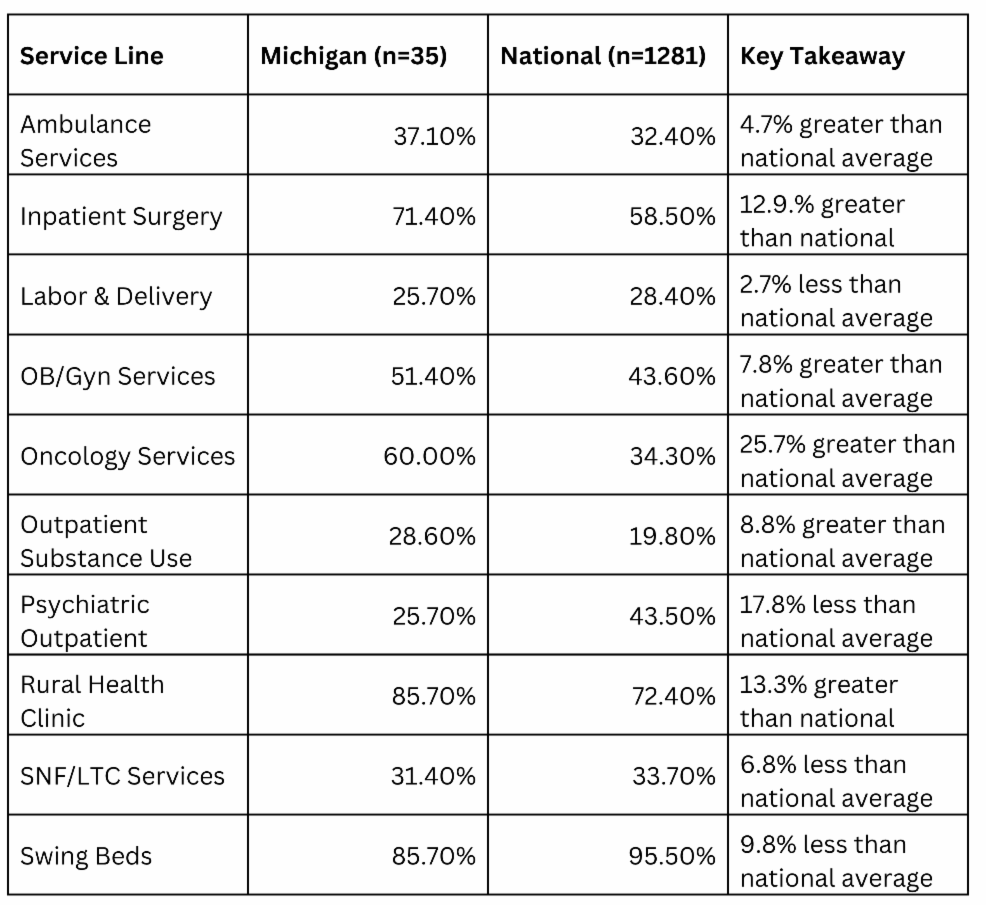
Michigan Service Line Highlights Compared to National Averages
The Assessment captured information on a variety of service lines provided by Critical Access Hospitals. Michigan CAHs continues to demonstrate strong service availability in several key areas when compared to national averages.
| |
The data demonstrates several areas where Michigan CAHs exceed national averages, particularly in Oncology Services, Outpatient Substance Use Services, Inpatient Surgery, and Rural Health Clinic availability. These findings reflect the continued commitment of Michigan rural hospitals to expanding access to specialized and essential healthcare services within their communities.
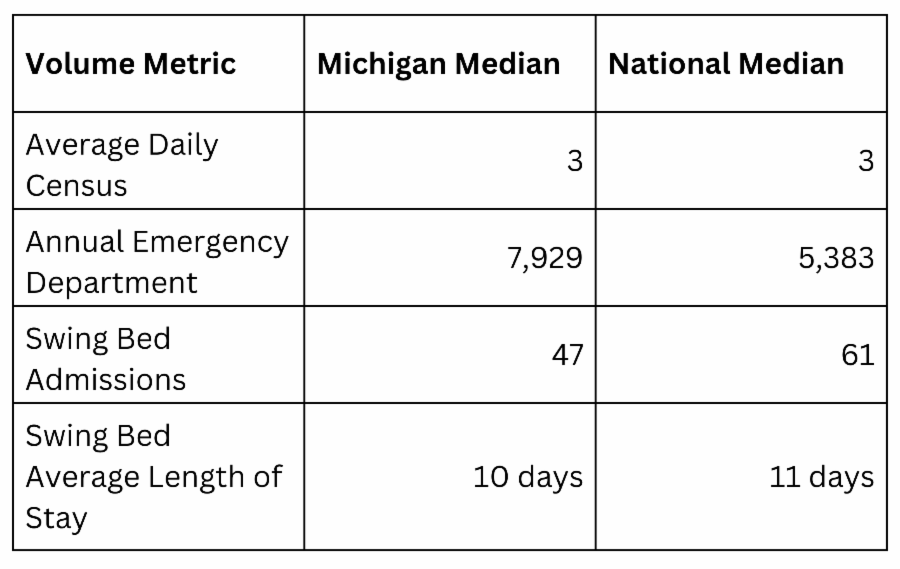
Median Volume Comparisons
When comparing patient volume metrics between Michigan CAHs and CAHs nationally, Michigan hospitals demonstrated similar inpatient utilization patterns while exceeding national median emergency department volumes.
| |
These findings suggest Michigan CAHs continue to serve as critical access points for emergency and outpatient care while maintaining efficient swing bed utilization and patient throughput. The comparable average daily census also highlights the consistent role CAHs play in supporting inpatient care needs across rural communities nationwide.
At the same time, the Assessment identifies opportunities for continued growth and collaboration in behavioral health services, Labor & Delivery, and long-term care support services to further strengthen access to care for rural residents across the state.
In addition to the national report, the Flex Monitoring Team provides valuable state-level resources and profiles that help State Flex Programs and Critical Access Hospitals benchmark performance, identify opportunities for improvement, and support strategic planning efforts.
| Expand Your Expertise in Quality and Patient Safety with Free Access to IHI Open School | | |
Members of the Michigan Critical Access Hospital Quality Network have a special opportunity to deepen their knowledge of patient safety and quality improvement through the Institute for Healthcare Improvement (IHI) Open School.
Through the Michigan Center for Rural Health free spots are available for members to complete a curated series of online learning modules and earn the Basic Certificate in Quality and Safety. These self-paced, interactive courses build foundational skills that strengthen quality improvement work in rural healthcare settings, making them an excellent fit for both new and experienced team members.
MCRH encourages hospital quality leaders to take advantage of this opportunity to stay current with best practices that drive improved outcomes for patients. This program offers practical, applicable tools for day-to-day improvement efforts while also providing nationally recognized certification.
Participants who complete the required modules will earn the IHI Basic Certificate in Quality and Safety, a credential that demonstrates commitment to excellence in patient care.
To learn more or reserve your free spot, contact Amanda St. Martin, Hospital Programs Manager, at amanda.saintmartin@affiliate.msu.edu.
| | How Montgomery County Memorial Hospital Cut Month-End Close by 79% and Created Financial Stewardship | |
Tuesday, June 23, 1:00 - 2:00 pm CST
What would it mean for your finance team if month-end close took 3 days instead of 14? At Montgomery County Memorial Hospital, that’s no longer a hypothetical scenario. With the right system and the right partnership, MCMH streamlined their financial workflows and now consistently closes the month in just 2–3 days.
Join Bryant Blay, CFO at Montgomery County Memorial Hospital, and Derek Garrett, to learn how the hospital:
- Went from a 12–14 day month-end close to just 2–3 days for monthly general ledger entries
- Integrated daily revenue data from their EMR to eliminate delays and bottlenecks
- Gave department leaders real-time access to revenue by department reports and budgeting tools—reducing manual work and improving accuracy and creating financial stewardship.
- Consolidated fragmented financial tools into a single login, improving productivity and reducing IT burden
This is a real-world roadmap to modern financial stewardship in a rural healthcare environment, led by peers who’ve been there.
| |
Upcoming MCRH Educational Events
| | |
Grand Rounds:
June 30, 2026: 12-1 pm EST
Special Topics Grand Rounds
Ethical Situations in Rural Michigan
Speakers: Leonard Fleck and Jenny McCurdy
CEs available: Nursing and SW
*Registration open to those working in rural areas currently
Register
July 21, 2026, 12-1 pm EST
Dietetics Grand Rounds : Eating Disorders in Rural Populations: What Do We Know and What Can We Do?
Speaker: Samantha Hahn, PhD, MPH, RD
Nursing, SW, CHW and Dietetics CEs available
Learn More
Register
Project ECHO:
July 15, 2026, 12-1 pm EST
Infectious Disease ECHO: Myths on Vaccines
Speaker: Dr. Peter Gulick, DO
CME is available for medical professionals: Physicians, Physician Assistants, APP, DNP, Registered Nurses
Learn More
Register
Other Education Opportunities:
See more educational opportunities at https://mcrh.msu.edu/education
| |
MCRH in Action
A snapshot of where MCRH staff have traveled and the work they've been doing across Michigan.
| |
Advocacy
-
Joyce Fetrow and Laura Stoddard presented at the 2026 Small Town & Rural Development Conference on statewide initiatives and policy changes shaping the future of rural Michigan.
-
Jill Oesterle participated in the recent Rural Health Issues Meeting, a three-day event hosted by the National Rural Health Association in partnership with the Federal Office of Rural Health Policy, which focused on high-priority issues impacting rural hospitals and rural primary care across the country.
-
Crystal Barter participated in a two-day event hosted by the National Rural Health Association in partnership with the Federal Office of Rural Health Policy, which focused on network development, including clinically integrated networks, and the evolution and future of networks in rural healthcare delivery.
-
John Barnas presented at the 2026 State of Reform Conference, serving on a panel related to Michigan’s Rural Health Transformation Program (RHTP)
Education
-
Renee Calkins exhibited at the Munson Nursing Conference, sharing MCRH resources.
-
MCRH team members, led by Jeanne Marriott, facilitated three Community Reentry Simulations during the Michigan Department of Health and Human Services Child Services Administration biannual leadership conference.
-
Joyce Fetrow, Jeff Nagy, and Jeanne Marriott coordinated the Billing & Coding Bootcamp 2026 at Soaring Eagle Casino and Resort.
EMS
-
Alli Burke participated in the Michigan Association of Ambulance Services’ EMS Expo in Kalamazoo, MI by hosting an exhibitor table and sharing information about MCRH.
- For EMS week recognition, MCRH’s Alli Burke brought baskets filled with snacks, resources, and MCRH materials to Eaton Area EMS and Castleton-Maple Grove-Nashville EMS. These were warmly received by the crews.
- Alli Burke, along with consultants Brian LaCroix, John Todaro, and Greg Friese from Cambridge Consulting Group, visited each of the 7 EMS agencies participating in the Rural Recruitment and Retention Project throughout Michigan to support the agencies’ efforts.
- Alli Burke hosted an EMS Leadership Academy with SafeTech Solutions at Soaring Eagle Casino and Resort. This Academy is for geared toward EMS leadership skills, promoting healthy culture, and influencing positive change.
Hospital Programs
-
Crystal Barter, Amanda Saint Martin and Jeff Nagy hosted the May MICAH QN Quarterly Meeting in Traverse City.
- Jeff Nagy traveled to MHA headquarters to participate in a cybersecurity Incident Response Tabletop Exercise Event. The scenario‑based session explored how leadership teams navigate a realistic cybersecurity incident—focusing less on technical details and more on what truly matters: hospital operations, patient care, and organizational stability.
Improving Veterans Access to Healthcare
-
MCRH’s Jim Yates attended the Schoolcraft Memorial Hospital Health and Resource Fair, the Alger County Community Resource Meeting, and the Marquette County Community Resource Forum to connect with community members and service providers and share information about veterans' healthcare benefits and resources.
Northern Michigan Opioid Response Consortium
-
Dr. McGreaham and Gennie Groover attended the 3rd Annual Harm Reduction Conference at the Revival Center in Cadillac Michigan to share resources and information about NMORC.
- Joyce Fetrow, Jeanne Marriott and Gennie Groover facilitated a Mental Health First Aid training in Williamsburg at Turtle Creek Casino and Resort, to train and certify staff members in MHFA.
Palliative Care
- Amanda St. Martin and Aleah Huse visited Hillsdale Hospital and Kalkaska Memorial Health Center to continue planning and development efforts for community-based palliative care programs.
Primary Care | Certified Rural Health Clinics
-
Jill Oesterle and Aleah Huse visited Trinity Health Rural Health Clinics and Kalkaska Medical Associates alongside the National Kidney Foundation of Michigan to support participating clinics in the Chronic Kidney Disease Rural Health Clinic Quality Improvement Program.
- Aleah Huse traveled to Michigan's Upper Peninsula to conduct site visits at Helen Newberry Joy Hospital and Baraga County Memorial Hospital alongside the National Kidney Foundation of Michigan as part of the Chronic Kidney Disease Rural Health Clinic Quality Improvement Program.
- Jill Oesterle and Renee Calkins visited Aspire Rural Health System's Port Sanilac Clinic to support Diabetic Retinopathy Screening programming. Renee also visited the Bay Care Rural Health Clinic in Munising to support the same programming.
Social Drivers of Health
-
Jill Oesterle and Laura Stoddard attended MSHIELD's 2nd Annual Linkage Summit, Health Beyond Healthcare: Advancing Whole Health Through Community Partnerships. Jill Oesterle presented a session showcasing the MCRH’s efforts to strengthen community partnerships and advance health across rural Michigan.
- Jill Oesterle, Crystal Barter, and Laura Stoddard attended the Michigan Hubs Statewide Collaboration Summit, hosted by MDHHS, joining partners from across Michigan to explore strategies to advance social care integration and strengthen cross-sector partnerships.
| | A SPECIAL THANK YOU TO MCRH 2026 ORGANIZATION SPONSORS | | Is your organization interested in becoming an MCRH Organization Sponsor? Please message Jeanne Marriott for more information on this branding opportunity. | | Stay updated by visiting the Michigan Center for Rural Health's website and following us on social media. | | | | |