| |
|
October 2026
Volume 8, Issue 10
| | |
Save the Date!
The 30th Annual Michigan Rural Health Conference
Currents of Change in Rural Health
When: April 8-9, 2027
Where: Soaring Eagle Resort & Casino in Mt. Pleasant, MI
This conference serves as the state’s premier gathering dedicated to advancing rural health.
MCRH’s Michigan Rural Health Conference brings together healthcare professionals, administrators, and community partners from across Michigan to:
- Foster connection and collaboration among rural healthcare providers.
- Promote knowledge-sharing and professional growth through timely, evidence-based education.
- Highlight innovative practices and emerging trends that strengthen the delivery of rural health care.
| Advancing RHTP Implementation Through Michigan RHTP Funding: Opportunities for Certified Rural Health Clinics | | |
MCRH has been awarded MI Rural Health Transformation Program (RHTP) funding by the Michigan Department of Health and Human Services (MDHHS) as a subrecipient and implementation partner to maximize collaboration and impact for rural communities.
To advance implementation with Michigan's certified Rural Health Clinics (RHCs), MCRH has launched a competitive grant funding process for certified RHCs to support:
- Chronic Disease and Collaborative Care
- Data Integration and Infrastructure
- Upper Peninsula CHW Recruitment and Retention
Selected clinics will receive funding and individualized implementation support.
Information about these opportunities was sent directly to Michigan’s 213 certified Rural Health Clinics and applications are due October 30, 2026. Any RHC that has not received this information should contact Jill Oesterle, MCRH Director of Programs and Services, at RHTP.MCRH@msu.edu.
MCRH is also planning additional opportunities through MI RHTP funding.
- To support Upper Peninsula CHW recruitment, discounted CHW certification training is available through Northern Michigan University for eligible Upper Peninsula candidates.
- Competitive grant funding opportunities for behavioral health integration and for EMS are also planned.
We are excited to share more in the near future about these additional opportunities.
This publication/activity is supported by the Rural Health Transformation Program administered by the Michigan Department of Health and Human Services through a federal award from the Centers for Medicare & Medicaid Services as part of a financial assistance award totaling $9,620,000 with 100 percent funded by CMS/HHS. The contents are the responsibility of the author(s) and do not necessarily represent the official views of MDHHS, CMS, or the U.S. Department of Health and Human Services.
| | |
Between reimbursement pressures, provider shortages, and an aging patient population, a strong primary care plan matters more than ever. Primary care supports community health, drives hospital growth, and plays an important role in value-based care.
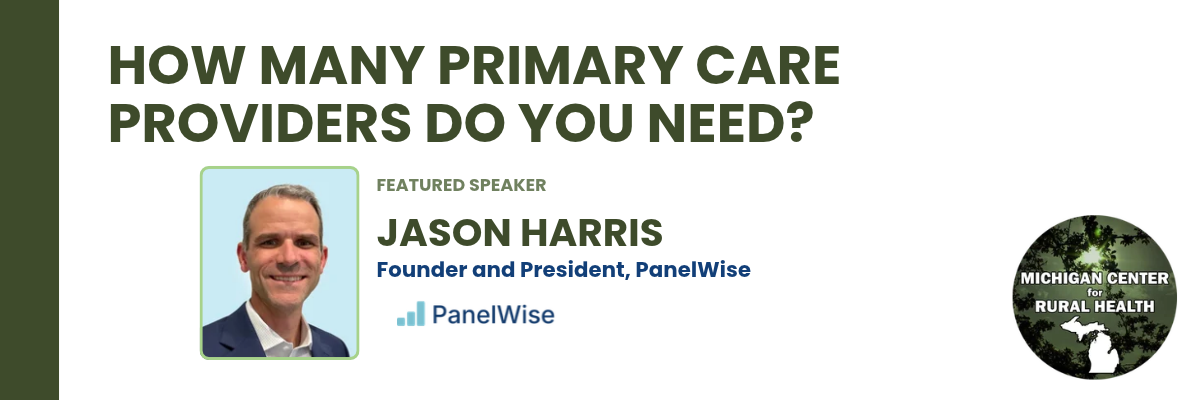
Join the Michigan Center for Rural Health for a webinar featuring Jason Harris, founder and president of PanelWise, on Wednesday, October 28, from 12:00–1:00 p.m. ET. Jason will share a practical framework to help organizations determine how many primary care providers they need, where they are needed, and how much capacity currently exists.
The session will help connect board-level strategy with clinic operations and appointment access. Registration is required.
| Opportunity to Comment on New Healthy Michigan Plan Requirements | | |
New Healthy Michigan Plan requirements begin January 1, 2027 to bring Michigan into compliance with H.R. 1. In advance of these changes, the Michigan Department of Health and Human Services (MDHHS) has released a proposed policy draft for public comment.
This proposed policy, Healthy Michigan Plan (HMP) Work Requirements, HMP Six-Month Renewals and Retroactive Coverage Changes, implements:
- Work requirements for HMP beneficiaries.
- Six-month renewals for HMP beneficiaries.
- Limits on retroactive Medicaid coverage to one or two months for all Medicaid programs, including HMP.
Public comments on this proposed draft policy are due November 23, 2026. To provide comments:
-
Access and review the proposed draft policy from the MDHHS Proposed Medicaid Changes webpage. The Notice Number for this proposed policy is 2636-Eligibility.
- Prepare your comments, including why you support or oppose the changes.
-
Email your comments to Kayla Lowers by November 23, 2026.
For more information about the new HMP Work requirements, visit the MDHHS New Medicaid Work Requirements webpage. MCRH has also gathered MDHHS and other useful resources in one resource page.
| | New State Dashboard Tracks Michigan’s Progress on Opioid Goals | | |
The Michigan Department of Health and Human Services (MDHHS) has updated the Michigan Opioid Strategy Progress Metrics Dashboard so it lines up more closely with the goals recommended by the Michigan Opioids Task Force. For rural communities, it offers a public, easy way to see where the state is making progress and where more work is needed.
The dashboard is organized around the four pillars of Michigan’s Substance Use Disorder Response Framework: primary prevention, harm reduction, treatment, and recovery support. Under each pillar are the goals Michigan is working toward with its opioid settlement dollars. Each goal is paired with a measurable way to track impact.
The goals come from recommendations by Task Force subcommittees made up of appointed volunteers with expertise and lived experience related to substance use disorder. The metrics were chosen for how well they fit each goal, how useful they are, whether data is available, how well they reflect state investments, and their relevance to health equity. MDHHS will update the dashboard as new information becomes available.
Michigan is expected to receive more than $1.8 billion from national opioid settlements by 2040. Half goes to the State of Michigan, and half goes directly to county, city, and township governments. That means many rural local governments have settlement dollars of their own, and the dashboard can help them see how their efforts fit into the statewide picture. More about proposed programming under Michigan’s Opioids Healing and Recovery Fund is available on the opioid settlements website, and additional resources are at Michigan.gov/SUD.
Rural stakeholders working on opioid use disorder or other substance use disorder activities can reach out to Joyce Fetrow, SUD Programs Manager at the Michigan Center for Rural Health, for support, connections, and technical assistance.
Joyce Fetrow, MCRH SUD Programs Manager
Joyce.fetrow@affiliate.msu.edu
989.370.1470
| | MDHHS Launches App to Help Residents Quit Tobacco | | |
The Michigan Department of Health and Human Services has launched the QuitLogix app, giving Michigan adults another way to access free, confidential support through the Michigan Tobacco Quitlink.
Available in the Apple App Store and Google Play Store, the app offers English and Spanish support, encouraging reminders, progress check-ins and the ability to order nicotine replacement products, such as patches or gum. Participants can move between the app, website and phone coaching to find support that works for them.
Healthcare professionals and community organizations can share this resource with people interested in quitting tobacco. Download QuitLogix or call 800-QUIT-NOW (800-784-8669), available 24/7.
| | |
Do you have a story to share? Know a rural organization or individual making a difference? Email Laura Stoddard, Social Drivers of Health Manager, at laura.mispelon@affiliate.msu.edu, and let us share your story!
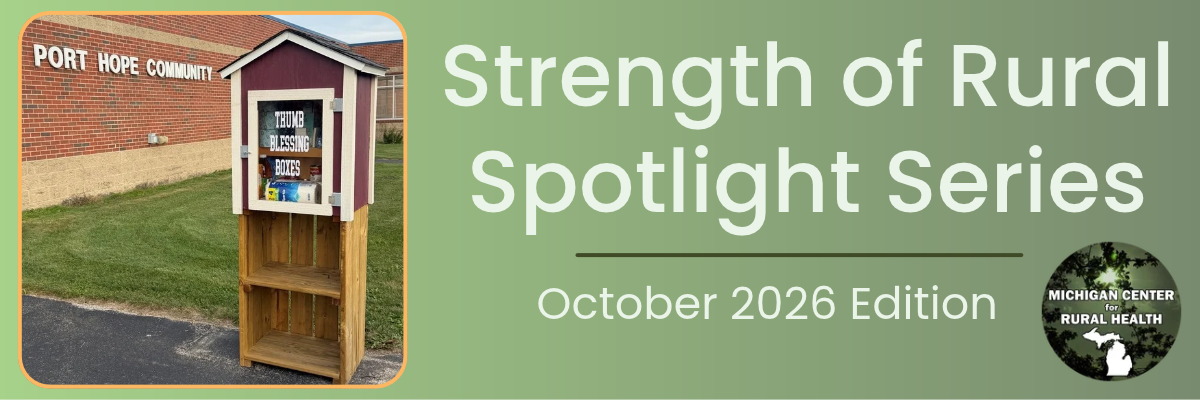
Strength of Rural Spotlight: Thumb Blessing Boxes | Neighbors Helping Neighbors Across Michigan’s Thumb
Our Strength of Rural Spotlight Series highlights the people and organizations strengthening health and well-being across rural Michigan. This month, we are highlighting Thumb Blessing Boxes, where a simple message guides a growing community effort: “Take what you need. Leave what you can. Above all, be blessed.”
Founded by Melissa Deming in May 2020, the nonprofit began with one box at Wilcox Park in Bad Axe. Today, its work extends beyond stationary boxes to help residents access food and everyday essentials with dignity, without applications or eligibility requirements.
Through community partnerships, Thumb Blessing Boxes is bringing resources onto public transportation, expanding access to fresh food through community refrigerators, and connecting older adults with fresh produce through its Senior Produce Pilot Project. Each effort addresses barriers such as distance, transportation, and mobility.
Their story shows how rural relationships and collaboration can turn a simple idea into new ways to reach neighbors.
| | |
Julie Hart has joined the Michigan Center for Rural Health as the Rural Health Transformation Program (RHTP) Manager for Health Technology and Innovation. She brings more than 20 years of healthcare experience spanning health system transformation, quality and patient safety, continuing medical education, and program management.
Julie has a strong background in teaching and workforce development. She holds a Michigan Secondary Education Teaching Certificate, has served as adjunct faculty, and is a Six Sigma Green Belt in Healthcare. That combination of education and process improvement shapes how she approaches her work: helping organizations find practical ways to improve how care is delivered.
Julie is an active member of her community. She has been involved with the Barb Smith Suicide Resource & Response Network, supporting suicide prevention, education, and community awareness efforts, and she is ASIST trained. She has also served on the Community Impact Panel for United Way of Midland County.
Julie and her husband, Steve, live in Midland. They have two adult sons and two granddaughters. Outside of work, Julie enjoys cheering on Detroit sports teams, reading, exercising, baking, and most of all, spending time with her family.
Julie is excited to join MCRH and looks forward to bringing her experience in healthcare innovation, education, collaboration, and program development to work that strengthens rural communities across Michigan.
| |
Laurel Sawyer recently joined the Michigan Center for Rural Health, where she supports the Rural Health Transformation Program's (RHTP) chronic disease and Community Health Worker (CHW) initiatives across Michigan. She is passionate about helping Rural Health Clinics and community-based organizations improve care for individuals living with chronic conditions by advancing chronic disease programs and supporting the successful integration of Community Health Workers.
Throughout her career, Laurel has maintained a strong connection to rural healthcare, supporting Rural Health Clinic operations, compliance, and practice leadership. With more than 25 years of healthcare experience, she has worked across ambulatory operations, quality improvement, population health, and value-based care. Her background includes leading initiatives focused on chronic disease management, preventive care, care coordination, and operational improvement while supporting providers and healthcare teams in delivering high-quality patient care.
Outside of work, Laurel enjoys spending time with her husband, Craig, and staying connected with their three adult children. Her family shares a deep connection to military service, with all three of her children and two of their spouses having served or currently serving in the military. In her free time, she enjoys traveling to visit family and giving back to her community through efforts that support veterans and their families.
| Breast Cancer Awareness Month | |
This Breast Cancer Awareness Month, MCRH encourages rural healthcare professionals and community partners to help connect Michigan residents with screening services and support.
The Michigan Department of Health and Human Services’ Breast and Cervical Cancer Control Navigation Program (BC3NP) helps eligible residents with low incomes access breast and cervical cancer screenings and follow-up care. Support is available for people without insurance and those whose insurance does not fully cover these services.
Share this resource with patients and community members who may face financial barriers to care. Learn more about BC3NP and eligibility, email BC3NP@Michigan.gov or call 844-446-8727 (TTY 711). Interpreters are available.
| Rural Public Health Training Plan - Updated Modules | | |
CDC Office of Rural Health: Last year, the Office of Rural Health launched the free Rural Public Health Training Plan in partnership with rural health experts. The training plan is designed to help public health professionals gain the knowledge and skills needed to effectively serve rural populations. Three new modules have been added to the training plan, expanding practical skills for public health professionals. All courses are available on CDC TRAIN with free continuing education (CE) credits and a certificate of completion. The Three Modules include:
- Practical Approaches to Rural Public Health Policy
- Build confidence and practical skills for engaging in local policy work. This module emphasizes trust, relationships, and actionable steps tailored to rural contexts.
- Practical Data Skills for Rural Public Health
- Build practical skills to collect, organize, analyze, interpret, and communicate data.
- Environmental Public Health in Rural
- Get an introduction to environmental public health, focusing on rural challenges, practice, and approaches for rural and frontier communities.
The courses in the training plan are self-paced and feature real-world rural examples from rural communities. Register on CDC TRAIN, and share these resources with your network.
Visit www.cdc.gov/rural-health for other rural health resources and information.
| | AI Resources for Rural Healthcare | | |
Resources from national organizations offer rural healthcare teams practical guidance and research to inform decisions about artificial intelligence (AI).
RHIhub’s AI in Rural Healthcare Toolkit offers program examples and tools for planning, implementing and evaluating AI. This free resource addresses workforce training, privacy, funding and sustainability, with a focus on local priorities. Explore the toolkit.
Research in NRHA’s Journal of Rural Health examines AI use for clinical and administrative tasks. The study found lower adoption among rural hospitals, particularly those farther from metropolitan areas. Read the study.
The American Medical Association’s framework guides AI development and use through the lenses of ethics, evidence and equity, offering another resource for organizations considering these technologies. Explore the framework.
| | The 3RNet Academy is Underway! | | |
Registration is ongoing – get ready for the second session on Marketing Rural Practice in a Hybrid & Telehealth Era.
The 3RNET Academy 2026: Strategic Marketing for Recruitment is a six-part webinar series designed for healthcare HR professionals and recruitment leaders in rural and underserved communities. Grounded in the Recruiting for Retention framework developed by 3RNET, this year’s focus equips participants with modern marketing strategies to attract mission-aligned healthcare providers in a competitive workforce environment.
The Michigan Center for Rural Health is covering the cost of the academy for all of our partners in rural Michigan!
Questions? Reach out to Kyra at kyra.burkeen@affiliate.msu.edu for answers!
| | |
Comment by November 20. The Centers for Disease Control and Prevention (CDC) seeks feedback from the public to inform their approach to a secure, standards-based public health data exchange for preventing disease, detecting emerging threats, and strengthening public health at the community level and nationwide. For the purposes of this RFI, a public health data intermediary is defined as a trusted organization, network, platform, or governed service that enables exchange and stewardship of health-related data among data sources and public health authorities.
To make data actionable, data intermediaries may provide additional services such as analytics, visualization, technical assistance, and community engagement. The CDC especially wants rural input on questions of standards and technical capabilities, funding and sustainability of shared infrastructure, governance, implementation, and ongoing evaluation of effectiveness.
| |
Reflection on the Inaugural
Rural Michigan Palliative Care Summit
| | |
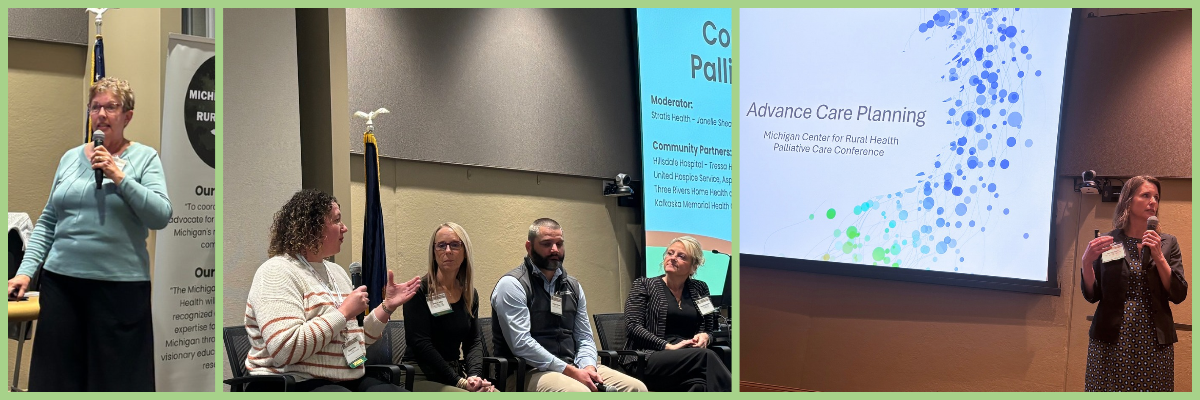
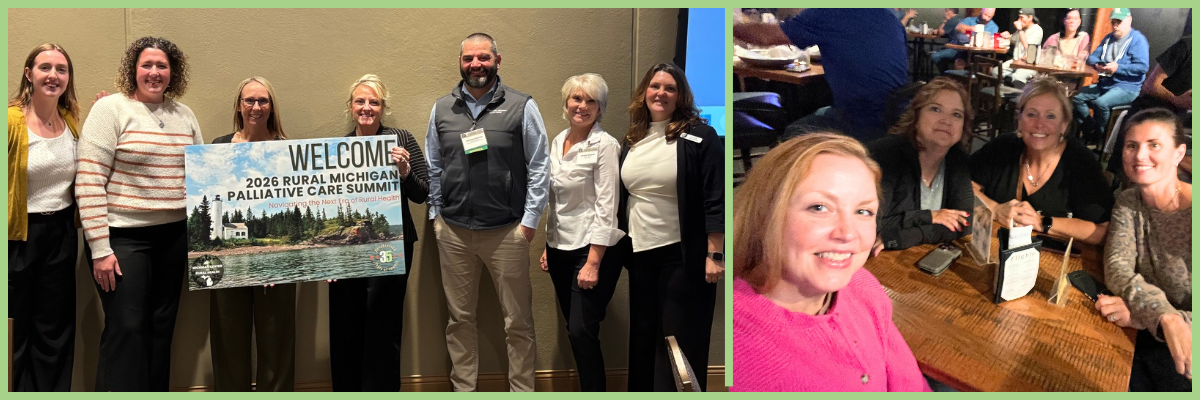
Partners representing 52 rural Michigan counties came together in Grayling on September 24 for the Rural Michigan Palliative Care Summit to learn from one another and strengthen care for older adults and individuals living with serious illness.
Through shared experiences and practical education, participants explored ways to support patients and families close to home. A central takeaway: there is no single model for rural palliative care, and every community can build on its strengths to take the next step.
Read the full recap
| | Learning and Connecting at the NARHC Conference | | |
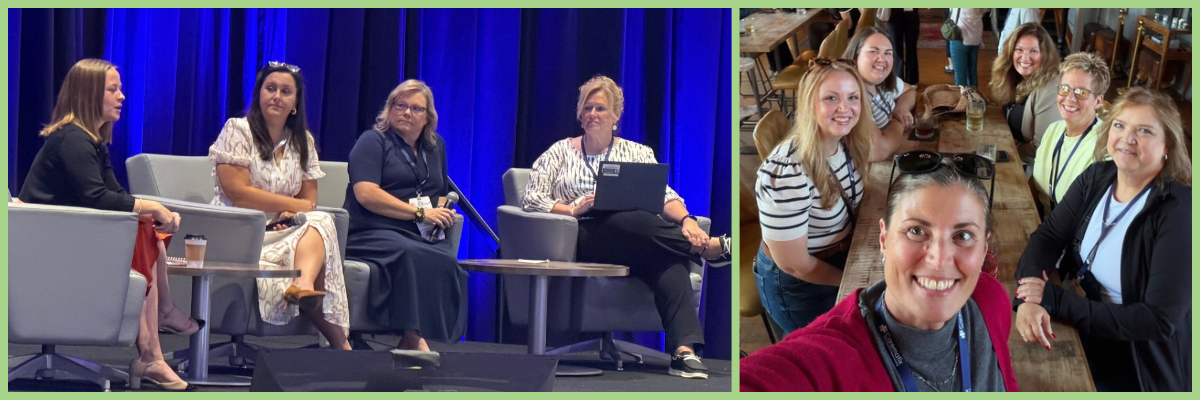
MCRH’s Jill Oesterle, Jeff Nagy, and Laurel Sawyer attended the National Association of Rural Health Clinics Conference in Louisville, Kentucky, bringing back practical tools and ideas to support Michigan’s RHCs. Jill also joined the Rural Health Transformation Program panel, contributing to the conversation on implementation.
Beyond the educational sessions, the conference offered valuable time to connect with members of the Michigan RHC Quality Network Executive Board and other Michigan RHC leaders, strengthening relationships and learning more about clinic priorities.
| | MCRH Visits Rural Hospitals to Explore Cybersecurity and Equipment Procurement | |
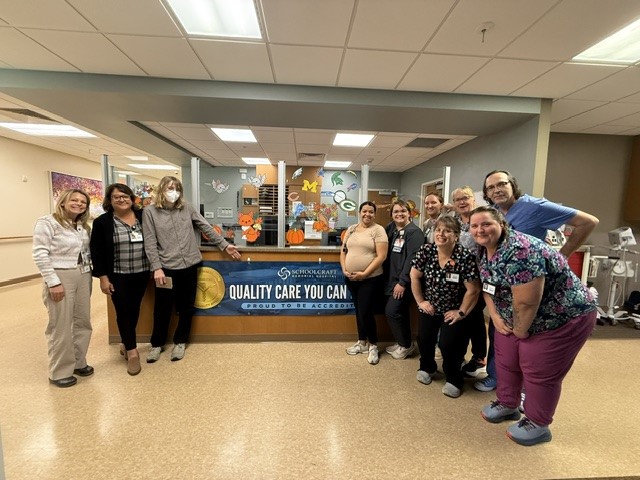
Amanda St. Martin of the Michigan Center for Rural Health (MCRH) and Cassidy Diamond, Senior Software Engineer at Bugcrowd recently visited Schoolcraft Memorial Hospital and Munising Hospital to meet with hospital IT leaders and learn more about cybersecurity practices and equipment procurement in rural healthcare settings.
Over the past 18 months, both hospitals have participated in surveys examining cybersecurity practices and decision-making processes. The site visits built on that work, providing an opportunity to see how these processes function in day-to-day hospital operations and to hear directly from Hospital and IT leaders about the challenges and needs of rural healthcare facilities.
Discussions explored vendor relationships, equipment inventory management, identifying and addressing cybersecurity vulnerabilities, network security, and coordination between IT teams, hospital leadership, and clinical staff. The team also discussed how equipment maintenance and security updates are managed while minimizing disruptions to clinical workflows and patient care.
The visits support PATCH, a collaborative medical device cybersecurity initiative led by Dr. Kevin Fu at Northeastern University. MCRH is a consultant in this effort, which brings together academic institutions, healthcare organizations, and technology partners to advance approaches for identifying vulnerabilities and implementing security updates across hospital networks.
By combining survey findings with firsthand conversations and observations, the project aims to better understand the unique operational realities of rural hospitals and inform cybersecurity solutions that support equipment safety, reliable technology, and uninterrupted patient care.
MCRH appreciates Schoolcraft Memorial Hospital and Munising Hospital for their continued participation and for sharing their time and expertise to help strengthen cybersecurity practices in rural healthcare.
| National Healthcare Quality Week: Measuring Quality, Improving Care | | |
In recognition of National Healthcare Quality Week, the Michigan Center for Rural Health (MCRH) celebrates the ongoing commitment of Michigan’s rural healthcare providers to delivering safe, high-quality care to their communities.
Through the Medicare Beneficiary Quality Improvement Project (MBQIP), MCRH supports Michigan’s Critical Access Hospitals (CAHs) in using data to identify opportunities for improvement, benchmark performance, and strengthen patient care.
The Critical Access Hospital Quality Dashboard provides a snapshot of quality performance across key measures, helping hospitals recognize strengths, identify areas for improvement, and learn from their peers.
Quality improvement is an ongoing effort that extends beyond reporting measures. Through collaboration, data-driven decision-making, and shared learning, Michigan’s rural hospitals continue working to improve patient safety, enhance patient experiences, and strengthen care delivery.
During National Healthcare Quality Week, we recognize the dedicated quality leaders, healthcare teams, and rural providers who make this work possible. Their commitment to continuous improvement helps ensure that rural communities have access to high-quality healthcare close to home.
| | Expand Your Expertise in Quality and Patient Safety with Free Access to IHI Open School | | |
Members of the Michigan Critical Access Hospital Quality Network, RHC Network, and Population Health Network have a special opportunity to deepen their knowledge of patient safety and quality improvement through the Institute for Healthcare Improvement (IHI) Open School.
Through the Michigan Center for Rural Health free spots are available for members to complete a curated series of online learning modules and earn the Basic Certificate in Quality and Safety. These self-paced, interactive courses build foundational skills that strengthen quality improvement work in rural healthcare settings, making them an excellent fit for both new and experienced team members.
MCRH encourages hospital quality leaders to take advantage of this opportunity to stay current with best practices that drive improved outcomes for patients. This program offers practical, applicable tools for day-to-day improvement efforts while also providing nationally recognized certification.
Participants who complete the required modules will earn the IHI Basic Certificate in Quality and Safety, a credential that demonstrates commitment to excellence in patient care.
To learn more or reserve your free spot, contact Amanda St. Martin, Hospital Programs Manager, at amanda.saintmartin@affiliate.msu.edu.
| |
MDHHS Releases Report to Strengthen Suicide Prevention Efforts Across Michigan | | |
The Michigan Department of Health and Human Services (MDHHS) has released the Michigan Suicide Prevention Council Report, outlining recommendations to strengthen statewide suicide prevention efforts and support implementation of the Michigan Suicide Prevention Plan 2024–2027. Released in recognition of Suicide Prevention Month, the report highlights the continued need for coordinated prevention strategies. In 2024, Michigan recorded 1,443 suicide deaths, with suicide ranking as the second leading cause of death among individuals ages 10 to 34.
Developed in collaboration with statewide partners representing public health, behavioral health, education, tribal communities and other sectors, the report identifies two key priorities: establishing sustainable state funding for suicide prevention infrastructure and strengthening workforce education through professional training and licensure requirements aligned with core suicide prevention competencies. These recommendations emphasize a systems-level approach to improving risk recognition, screening and assessment across Michigan. To review the full report and additional resources, visit the MDHHS Suicide Prevention webpage.
| | MDHHS Seeks Applicants for Michigan Opioid Treatment Access Scholarship Program | | |
The Michigan Department of Health and Human Services is offering scholarships of up to $16,000 per year to eligible Michigan students preparing for careers in opioid treatment services. The Michigan Opioid Treatment Access Scholarship Program aims to strengthen the substance use disorder workforce and expand access to care.
Eligible bachelor’s and master’s degree fields include social work, professional counseling, marriage and family therapy, nurse practitioner, physician assistant and public health. Recipients must commit to seeking employment providing opioid treatment services in Michigan for at least two years after graduation.
Applications are due Monday, November 9. Visit the Michigan Opioid Treatment Access Scholarship Program website for details and to apply, or email MDHHS-MIOTA-SP@michigan.gov.
| |
Rural Development Fund: Funding Opportunity for Michigan’s Rural Partners | |
The Michigan Office of Rural Prosperity is accepting Letters of Intent for the 2027 Rural Development Fund, with $4 million available to strengthen rural communities through infrastructure, workforce, economic development, and regional partnerships.
Two funding categories are available:
- Community and Business Development | Up to $100,000: Supports infrastructure, community facilities, workforce and business development, planning, and capacity building.
- Regional Collaboration | Up to $200,000: Supports new, formalized shared-service models that strengthen regional planning, workforce, and economic development across multiple counties.
Organizations working to improve health and well-being in rural communities are encouraged to explore this opportunity. The guidelines include health, transportation, housing, childcare, and food access among potential project areas, connecting rural development with the conditions that support healthier communities.
Eligible applicants include nonprofits, businesses, local governments, Tribes, educational institutions, and regional organizations serving eligible rural communities. Projects should align with the fund’s emphasis on sustaining Michigan’s land-based industries, including agriculture, forestry, mining, oil and gas production, and tourism. A 20% match is required and may include cash, in-kind contributions, or both.
Letters of Intent are due November 2, 2026, at 5 p.m. Eastern Time. Selected applicants will be invited to submit a full application.
| Funding Available to Improve Maternal Cardiovascular Health | |
The Michigan Public Health Institute (MPHI), in collaboration with MDHHS, is accepting applications for projects that prevent, identify and manage high blood pressure during pregnancy and up to one year postpartum.
Eligible applicants serving Michigan include nonprofits, community-based organizations, healthcare organizations and systems, medical clinics and local government agencies. Interested applicants may draw inspiration from the Hypertension in Pregnancy Change Package: A Million Hearts Action Guide. MPHI expects to make three or more awards from $132,500 in total funding, supporting projects from January 1 through June 30, 2027.
Applications are due November 13, 2026, at 5 p.m. ET. Review the opportunity and apply through REDCap. For questions, contact Amy Stagg at astagg@mphi.org.
| Nominate a Hometown Health Hero by November 6 | |
Help shine a light on the people and organizations making your rural community healthier. The Michigan Public Health Week Partnership is accepting nominations for the 2026 Hometown Health Hero Award, recognizing significant, measurable contributions to community health.
Nominations are due November 6 at 5 p.m. Submit a nomination.
| MBQIP Upcoming Deadlines, Reporting Reminders, and Resources | | |
MBQIP Data Submission Deadlines
MCRH continues to provide monthly Medicare Beneficiary Quality Improvement Project (MBQIP) updates that will help improve the quality of care provided in Critical Access Hospitals (CAHs).
Resource Updates for Critical Access Hospitals that reflect the new MBQIP Core Measure Set
MBQIP Navigator
MBQIP Information Guide
Monthly MBQIP Data Submission Deadlines
Data Submission Guides
These guides provide detailed instructions for submitting MBQIP measure data. They include measure details, linked trainings and step-by-step data submission instructions for the measure:
CAH Quality Infrastructure Improvement Strategies
The Critical Access Hospital (CAH) Quality Infrastructure measure is a structural measure to assess CAH capacity, processes, and infrastructure for quality activities based on the eight core elements of CAH quality infrastructure. The measure is submitted annually through the National CAH Quality Inventory and Assessment ("Assessment") via a Flex Monitoring Team (FMT)-administered Qualtrics platform.
The Assessment for this year is due November 20, 2026.
As you work on submitting this year's Assessment it is important to be aware of the element criteria and think of ways to improve your performance in the CAH Quality Infrastructure measure next year.
Below is a highlight of Core Element 8 and potential strategies for hospitals to implement to help them meet the element criteria.
Core Element 8—Using Data to Improve Quality
Use internal and external data comprehensively, meaningfully, and transparently to inform quality improvement.
Element Criteria
- The organization shares quality data transparently both internally and externally.
- The organization incorporates external data sources to inform quality improvement efforts.
- Leaders act on and clearly communicate the data results from quality initiatives.
- The organization uses benchmarking to identify where quality can be improved.
Strategies to Meet Core Element 8 Criteria
- Create an accessible public-facing dashboard on the hospital website that contains key quality metrics
- Implement digital dashboards accessible to all staff. Include quality improvement projects, outputs, and key performance indicators.
- Include state and regional health statistics into quality improvement initiatives.
- Include transparent reports of quality initiative successes, challenges-achievements, and abandoned initiatives
- Participate in national quality programs and use benchmarking to identify improvement areas.
For improvement strategies for all 8 of the CAH Quality Infrastructure measure review the CAH Quality Infrastructure Data Submission Guide .
Upcoming MBQIP Deadlines
For details, access the Monthly MBQIP Data Submission Deadlines
November
-
Reporting Median time from ED arrival to ED departure (OP-18) Q2 2026 encounters (4/1/2026-6/30/2026) is due November 2, 2026. Submission is through the HQR Secure Portal-Outpatient Chart Abstracted. Previous CART users may enter abstractions into the HQR abstraction tool. Outpatient Quality Reporting Specifications version 19.0a
-
Emergency Department Transfer Communication (EDTC) Q3 2026 encounters (7/1/26-9/30/26) is due November 2, 2026. Connect with Crystal Barter for submission process details.
-
Critical Access Hospital Quality Inventory and Assessment is due November 20, 2026. Connect with your State Flex Program for details.
For more information, review the MBQIP Navigator for understanding the measure reporting process for the MBQIP core measures.
| | Request for Public Comment from National Highway Traffic Safety Administration | |
The National Highway Traffic Safety Administration (NHTSA), on behalf of the Federal Interagency Committee on Emergency Medical Services (FICEMS), is seeking comments from all sources (public, private, governmental, academic, professional, public interest groups, and other interested parties) on the nationwide implementation of prehospital blood transfusion.
The purpose of this notice is to solicit comments on strategies, barriers, and solutions to advance prehospital blood transfusion capabilities across State, local, tribal, and territorial emergency medical services (EMS) and 911 systems, and to request responses to specific questions provided below. This notice is an information-gathering inquiry and is neither a request for proposals nor an invitation for bids.
| |
Upcoming MCRH Educational Events
| | |
Grand Rounds
November 3, 2026, 12-1 pm EST
Behavioral Health Grand Rounds: Treatment Planning in Behavioral Healthcare
Speaker: Genevieve Groover, MSW
SW CEs available
Register
Project ECHO
November 6, 2026, 12-1 pm EST
Community Health Worker ECHO: Mastering Mindset and Emotional Intelligence
Speaker: Shannon Lijewski, MBA, CHCEF, NCHW
MiCHWA Credit Available
Register
November 18, 2026, 12-1 pm EST
Infectious Disease ECHO: 2026-2027 Updates on COVID, Flu, and RSV Vaccines
Speaker: Dr. Peter Gulick, DO
CME is available for medical professionals: Physicians, Physician Assistants, APP, DNP, Registered Nurses
Register
| |
MCRH in Action
A snapshot of where MCRH staff have traveled and the work they've been doing across Michigan.
| | |
National Rural Health Influence
Behavioral Health
-
Gennie Groover provided two presentations on assessments and treatment planning to behavioral health staff at East Jordan Family Health Center.
- Gennie Groover presented on documentation to behavioral health staff at Alcona Health Centers.
- Gennie Groover presented on documentation to behavioral health staff at Thunder Bay Community Health Services.
Community Health and Partnerships
-
Jeanne Marriott and Aleah Huse facilitated a Community Reentry Simulation for approximately 110 people attending the MDHHS Children’s Services Administration Region 3 Supervisor Conference in Grand Rapids.
- Jeanne Marriott and Aleah Huse facilitated a Community Reentry Simulation for approximately 55 people attending the Northern Michigan HIV Summit in Traverse City, hosted by the Thomas Judd Care Center at the Haggerty Center.
-
Laura Stoddard and Amanda St. Martin attended the National Rural Age-Friendly Initiative Meeting in Washington, DC, hosted by the National Rural Health Association in partnership with The John A. Hartford Foundation, joining approximately 50 individuals representing a wide range of organizations and perspectives nationwide to shape policy and program priorities, share lessons learned, and sustain age-friendly efforts in rural communities.
-
Crystal Barter, Laura Stoddard, and Sarah Mott attended the MI HIMSS Fall Conference in Lansing, MI, which brings together Michigan’s health IT, clinical, research, and public-sector communities to focus on connected, equitable, and innovative care delivery.
EMS
-
Alli Burke attended the Women in EMS Conference to connect with other women in EMS and learn more about women EMS clinicians in leadership roles.
- Alli Burke attended the Michigan Association of Ambulance Services (MAAS) Leadership Summit to learn more about leadership and operational management of ambulance services.
- Alli Burke is exhibiting and presenting on recruitment and retention at the UP EMS Expo.
Hospital Programs
- Crystal Barter and Amanda St. Martin attended and facilitated the Michigan Critical Access Hospital Quality Network (MICAH QN) Executive Committee Meeting, which provides guidance and leadership to the network.
- Crystal Barter attended the MHA Small & Rural Hospital Council meeting to provide updates to rural hospital leadership about Rural Health Transformation Program (RHTP) funding opportunities.
- Amanda St. Martin attended the MHA Keystone Center’s Safety and Quality Symposium to gain insight on workplace safety, preparedness, and well-being and to network and share ideas with Michigan Critical Access Hospital quality leaders.
-
Jeff Nagy was onsite at Munson Charlevoix Hospital for the second session of Lean Greenbelt Training.
Improving Veterans’ Access to Healthcare
- Jeanne Marriott provided resources and information at the Cheboygan County Veteran Appreciation event, where approximately 140 veterans gathered to connect and were eligible for free haircuts, massages, and shoes through the Soles4Vets program.
-
Jim Yates visited Alpena Hospital and met with the Michigan Veterans Affairs Agency’s Veteran Service Officer (VSO), who has office space in the hospital, to discuss connecting patients with the VSO’s services.
- Jim Yates visited Thunder Bay Health Center in Cheboygan to discuss veterans’ care.
- Jim Yates attended a veterans’ death and burial benefits presentation hosted by the Ishpeming Senior Center, with presenters from the Iron Mountain VA, Marquette County Veterans Services, and a local funeral home.
- Jim Yates attended the Senior Health Expo in St. Ignace, coordinated by Mackinac Straits Health System and LMAS District Health Department with sponsorship support from U.P. Together With Veterans, to share resources for Upper Peninsula veterans.
- Jim Yates attended Mackinac Straits Health System’s health fair on Mackinac Island.
- Jim Yates presented during the VA’s monthly Veteran Coordinator Community of Practice meeting.
Northern Michigan Opioid Response Consortium
-
Jeanne Marriott and Joyce Fetrow attended and facilitated a Community Reentry Simulation for 76 people at Grand Traverse County’s Resilience Night.
- Joyce Fetrow hosted a recovery housing forum at Kirtland Community College in Grayling, bringing together 16 people from 14 counties to increase recovery housing capital in rural areas.
- Joyce Fetrow attended the National Association of Recovery Residences Best Practices Conference to gain recovery home resources and network with others in the field.
-
Joyce Fetrow presented to the Chippewa FAN chapter and the Chippewa Opioid Advisory Committee on the Recovery Housing Technical Assistance initiative, which will increase recovery housing capacity and recovery capital.
Primary Care | Rural Health Clinics
-
Jill Oesterle, Laurel Sawyer, and Jeff Nagy attended the National Rural Health Association conference to connect with rural health leaders and explore strategies to strengthen access to care and support Michigan’s rural healthcare providers.
- Jill Oesterle attended the National Association of Rural Health Clinics conference and participated in a panel on RHTP, sharing Michigan’s approach to supporting clinic participation and connecting funding opportunities with local needs.
- Jeff Nagy traveled to Northern Pines Health Center, an independent Rural Health Clinic in Buckley, MI, to facilitate a Lean RHC throughput project.
Palliative Care
- MCRH staff hosted the Inaugural Rural Michigan Palliative Care Summit, bringing together participants representing 52 rural counties to share strategies and build connections that support quality of life care close to home.
SDOH
-
Aleah Huse attended the Michigan League for Public Policy’s Champions for Kids Luncheon for the release of the 2026 Kids Count Data for Michigan, exploring how county-level data can inform MCRH’s future work to support children and families in rural communities.
Workforce
-
Laura Stoddard, Sarah Mott, and Renee Calkins attended the 14th Annual MiCHWA Meeting and Conference to learn and connect with individuals who are passionate about advancing community health.
-
Kyra Burkeen hosted a breakfast event for 11 MSU medical students to have a conversation with Mark Hamed, who directs Emergency and Hospital Medicine at McKenzie Health System.
| | A SPECIAL THANK YOU TO OUR 2026 MCRH ORGINIZATIONAL SPONSORS! | | Stay updated by visiting the Michigan Center for Rural Health's website and following us on social media. | | | | |