The Principle Investigator
Montana Clinical and Translational Research Center's
Quarterly Newsletter
| | |
Advancing discovery, collaboration, and clinical and translational research across Montana |
|
A Note from the Director
Welcome to our first issue of The MCTRC Principal Investigator. This newsletter represents an important step in keeping our Montana CTRC community informed as we strive to build clinical and translational research capacity in Montana. Through this newsletter, we aim to share opportunities, highlight successes, and provide resources that help you advance your research and professional development initiatives.
We do have some important news to share in this inaugural newsletter:
- Year 1 Pilot Projects have been approved by NIH, and we look forward to supporting Drs. Andrea Stierle, Blair DeBuysscher, and Emily Hall.
- We finally received our Year 2 Notice of Award from NIH, allowing us to move forward in engaging with our Year 2 proposed projects.
-
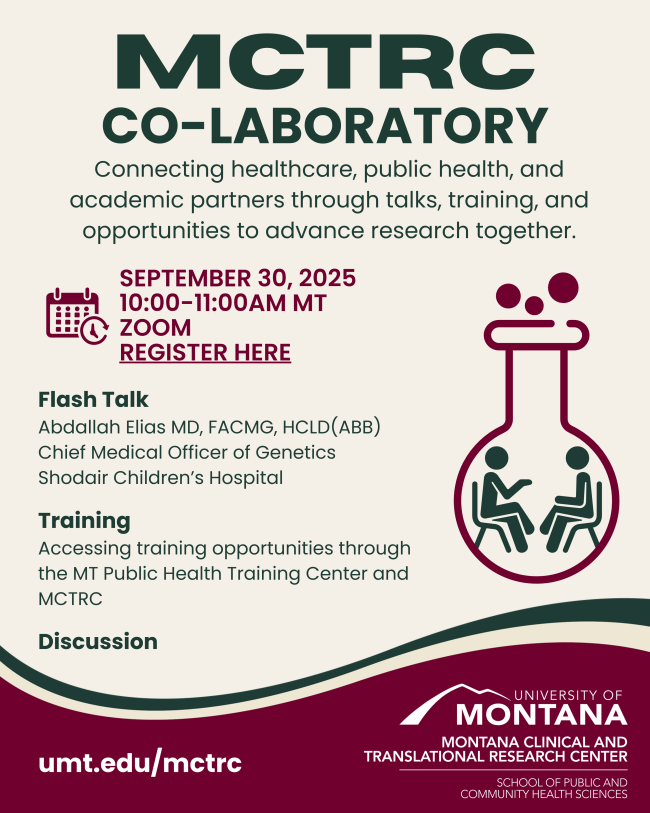
Led by our Professional Development Core, we are launching the MCTRC Co-Laboratory, a monthly virtual gathering that highlights our Partner Organizations and provides a brief training and facilitated group discussion. Our first event will feature Shodair Children’s Hospital and will be held on Tuesday September 30 (10-11am).
- In collaboration with Shodair Children’s Hospital and the Montana Department of Public Health and Human Services, our 2026 Annual Meeting will be held in Helena on June 3-4, 2026. Please mark your calendars.
- Finally, our Montana CTRC has been chosen by the American Public Health Association to feature at their upcoming annual conference in Washington DC in November. Only eight projects are highlighted each year, so this is quite an honor.
Thanks for being a part of our program, and we look forward to working with you into the future.
Tony Ward, PhD, Director
For more information regarding MCTRC and any of our initiatives, please contact Dr. Tony Ward
| | |
Advancing Discovery
Highlights in Clinical and Translational Research
| | We’re excited to share the latest pilot and developmental projects funded through MCTRC and NIH support. These awards help investigators explore innovative ideas, generate preliminary data, and advance clinical and translational research in Montana. Congratulations to Dr. Emily Hall (Pilot Award), Dr. Andrea Stierle (Developmental Award), and Dr. Blair Debuysscher (Developmental Award) on their recent funding! Read on to learn more about their exciting projects. | | |
Dr. Hall is research faculty at the University of Montana and a pediatrician by training.
The objective of this pilot project is to determine the readiness of parents and medical providers in rural Montana to implement group well child checks. A group well child check is a healthcare delivery redesign from the traditional medical provider - parent - child encounter to a group format with similar age children addressing parent concerns with a medical professional team.
This format is more common Internationally and has demonstrated impact in urban underserved but has not been studied or sustainably implemented in a rural context.
Through this pilot work, we will quantify and determine the readiness and capacity of pediatric medical providers and parents in rural Montana.
For more information, please contact Dr. Emily Hall
| | |
Dr. Stierle is a Research Professor at the University of Montana in the Biomedical and Pharmaceutical Sciences Department.
The Stierle and Priestley Research Labs are advancing development of a novel family of antibiotics, the berkeleylactones.
Berkeleylactone A (BPLA), first isolated from extremophilic fungi in the Berkeley Pit Lake in Butte, Montana, exhibits potent antibacterial activity with a unique mechanism of action. It targets multidrug-resistant Staphylococcus aureus (MDRSA), including vancomycin-insensitive strains (VISA), and both disrupts and prevents biofilm formation—one of the greatest challenges in treating persistent infections.
Because BPLA is not stable in plasma, the team synthesized a more durable lactam analog (BPLmA) with improved pharmacokinetic properties.
Their current goals are to produce sufficient quantities of BPLA and BPLmA for testing, generate new analogs informed by structure-activity relationships, and assess absorption, distribution, metabolism, and excretion. Advancement of this work could establish the berkeleylactones as a new class of antibiotics against resistant bacterial pathogens.
For more information, please contact Dr. Andrea Stierle
| | |
Dr. Debuysscher is a Research Professor at the University of Montana in the Center for Translational Medicine.
As humans age, so does their immune response, which can increase severity of infections as well as decrease vaccination efficacy. RSV is a virus that is known to have a high risk of severity in older adults or immunocompromised individuals due to factors associated with weakening of the immune system.
Preliminary findings from my lab suggest that when vaccinated against RSV, aged mice have similar levels of antibody titers compared to young mice, however these antibodies fail to effectively neutralize RSV. Because approved RSV vaccines target the induction of protective antibodies as the main mechanism of protection, we hypothesize this will limit the efficacy and durability of RSV vaccination in aged adults. By targeting this phenomenon, we aim to better understand the decrease of function seen in aged mice and apply that knowledge to human therapeutics. This work will lead to isolating and producing monoclonal antibodies for potential use as treatment to aid the aged immune system during RSV infection.
For more information, please contact Dr. Blair Debuysscher
| |
MCTRC in the News
UM Research Center Hosts First Health Care Leaders Meeting
The Montana Clinical and Translational Research Center (MCTRC) brought together local health care leaders for its inaugural meeting in Missoula. Representatives from hospitals, public health, and research institutions discussed collaborative strategies to strengthen Montana’s health care workforce and advance clinical and translational research.
Read Full Article Here
| | |
Core Connections
Spotlight on Core Services and Support
| | |
The MCTRC is building a Resource Toolbox designed to support researchers and partners with practical trainings and tools. The Toolbox will continuously expand to include training topics identified by our healthcare and public health Partner Organization.
Examples of current training resources on key professional development topics include:
- Mentor/mentee training
- How to format a NIH biosketch
- Guidance for Other Support documents
- Building a budget and budget justification
In addition, we have developed a dedicated training on using the MCTRC Portal for Individual Development Plans (IDPs). The IDP is a living document to set milestones and guide MCTRC researchers and their respective mentor(s) on career development and project planning. Stay tuned as new trainings and resources are added, creating a go-to hub for building skills, streamlining applications, and supporting successful research careers across Montana and beyond.
Please also see the Co-Laboratory section of this newsletter for details on our monthly partner gatherings. In addition to brief research or public health presentations, these Co-Laboratory gatherings will include short, broadly applicable trainings delivered by the PD Core team.
For more PD Core information, please contact Curtis Noonan.
| |  | |
The Health Research (HR) Core has now successfully facilitated the solicitation and external review of two rounds of Pilot and Developmental Grant applications (the Year 1 and Year 2 calls for proposals). Following external review, the applications were handed off to the Administrative Core, led by Dr. Tony Ward and assisted by Aimee Elliott, for funding selections, with input from the External Advisory Committee. All projects must be reviewed and approved by the NIH, which has been experiencing backlogs, causing delays in their approval process. We were excited in late August 2025 to learn that NIH approved three Year 1 MCTRC projects. The Admin Core is now working with MCTRC investigators to start the NIH approval process for Year 2 applications.
The HR Core is continuing to work with Partner Organizations on developing Memorandums of Understanding (MOUs). These MOUs are intended to describe the mutual understanding between the MCTRC and the Partner Organization regarding shared objectives and joint activities for collaborative clinical and translational research. The HR Core has engaged in collaborative planning meetings with Partner Organizations. These meetings have addressed the following topics: clinical and translational research interests and objectives, available resources at both the MCTRC and the Partner Organization for collaborative research, training and professional development needs, regulatory considerations, and dissemination and implementation planning. Three MOUs - one with Shodair Children's Hospital, one with Logan Health and Billings Clinic, and one with Missoula Public Health - are currently under development.
For more HR Core information, please contact Sophia Newcomer.
| | | |
The Community Engagement and Outreach (CEO) Core has initiated work on the Montana Health Issues Priorities (M-HIP) assessment to help guide potential priorities for the research within the Montana CTRC. This included compiling and analyzing the findings from the most recent County and Tribal Health Department community health assessments (CHAs) and the non-profit hospital community health needs assessments (CHNAs). The CEO Core team is now working to identify, recruit and establish members of the community advisory board (M-CAB), which will provide feedback to the CTRC on potential research priority areas.
Aim 2 of the CEO Core is to provide training, mentoring and resources to the CTRC investigators to promote high-level community engagement. This past year the CEO Core in collaboration with the PD and HR cores coordinated mentorships for CTRC researchers and provided two well received trainings for CTRC partners, one on outreach and engagement for culturally diverse communities and one on community-informed dissemination and implementation strategies. Additional mentorship and training will be provided in year two as well.
The CEO Core team is beginning to develop the Montana specific framework for the Practice Based Research Network (PBRN). This will include researching other successful PBRN programs across the U.S. and identifying key lessons learned regarding engaging and recruiting clinical and public health sites and sustaining meaningful participation among sites. The goal for year two is to recruit ten clinical/public health sites as part of the Montana PBRN.
For more CEO Core information, please contact Todd Harwell.
| | | |
The MCTRC Research Design, Compliance, and Data Management (RDCD) Core is focused on meeting Montana’s unique clinical and translational research needs and priorities by providing expert epidemiologic, biostatistical, and research compliance support to Montana researchers.
A major area of focus for the RDCD Core this year has been training clinical research coordinators (CRC) to assist in all phases of study development and implementation. We recently joined twelve other sites across the country partnering with the IDeA State Consortium for Clinical Research – Resource Center (ISCORE-RC). The ISCORE-RC CRC Development Program offers didactic and experiential training in clinical research and especially in clinical trials. With guidance from RDCD Core senior CRC, Jen Faiella, our first trainee, respiratory therapist Allie Schweizer, is progressing successfully through the program. We aim to continue to build CRC capacity at our site and Partner Organizations.
Please contact RDCD Core Director, Erin Semmens, if you are interested in learning more about CRC training opportunities or are launching a study that would benefit from CRC support.
| | | |
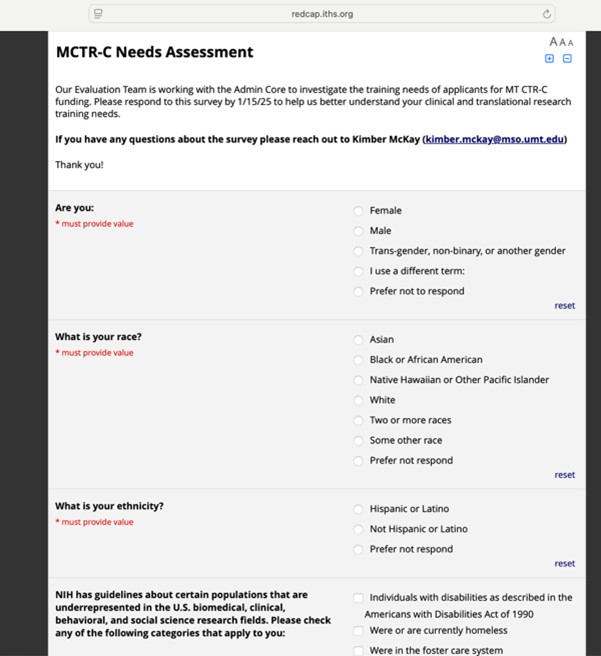
The MCTRC Evaluation Team (Prof Kimber McKay and SPCHS PhD student Chelsea Kuiper) are working closely with the PD and CEO Cores to develop research-related needs assessment tools for our partner organizations and applicants. Two surveys have been developed in REDCap and distributed so far (see first page of survey to the right!), and results were shared across the CTRC leadership to inform training needs and related matters. We are also working on developing evaluation framework for the emerging Practice Based Research Network. This will inform a paper we are giving on a panel at the Annual Meetings of the American Evaluators Association in Kansas in November. More broadly, we work in a continuous fashion to track progress toward the metrics and milestones developed by each of the Cores to understand the work being done.
For more information regarding the needs assessment, please contact Dr. Kimber McKay.
| | |
From the Co-Laboratory
Training & Professional Development
| | |
The Professional Development (PD) Core is launching a monthly virtual series - the MCTRC Co-Laboratory - to bring together our healthcare, public health, and academic partners for one focused hour.
Each session blends a partner-led research or policy spotlight, a brief PD training, and facilitated group discussion on topics shaping Montanans' health.
Kickoff: September 30, 2025, 10:00-11:00am, Zoom
Flash Talk: Dr. Abdallah (Abe) Elias, MD, FACMG, HCLD(ABB), Chief Medical Officer of Genetics, Shodair Children's Hospital
REGISTER NOW!
Looking ahead, future flash talks will feature voices from our MCTRC partners - including colleagues in public health, Montana 21C, health care, and more - plus rotating PD micro-trainings and collaborative discussion prompts.
We welcome participation from MCTRC partner organizations and other stakeholders.
Interested in presenting a future research or policy topic? Contact Curtis Noonan (curtis.noonan@mso.umt.edu) and Anna Kiley (anna.kiley@mso.umt.edu).
| | | |
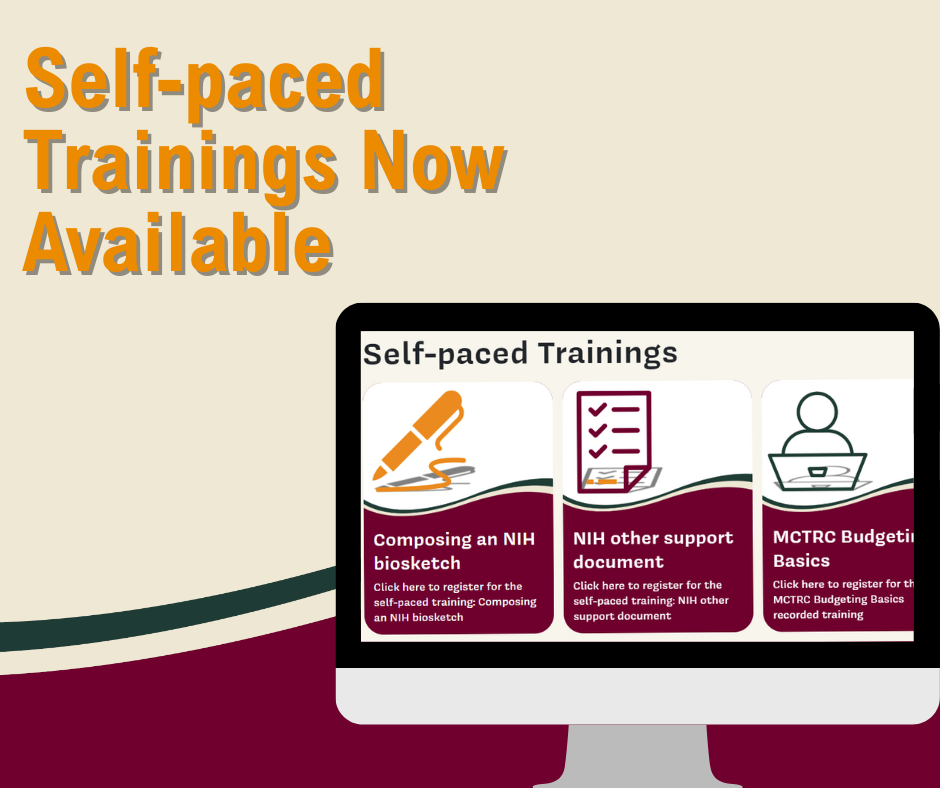
The PD Core is excited to announce a series of self-paced trainings designed to help you strengthen your grant applications and research administration skills.
These modules cover key topics every investigator needs: how to create a strong NIH Biosketch, prepare Other Support documentation, and develop effective budgets specific to MCTRC Pilot and Developmental Grants.
Whether you’re new to research or looking for a refresher, these short, flexible trainings are built to fit your schedule and provide practical, step-by-step guidance.
Trainings are located on the MCTRC Website
| | |
| | |
The MCTRC Resource Toolbox is your one-stop hub to access curated links and tools for community engagement, professional development, research design and compliance—plus a powerful search feature to quickly find resources tailored to your needs.
Find the Resource Toolbox in the MCTRC Portal
For more information about the Toolbox or help with the MCTRC Portal, contact Kathrene Conway
| | | |
Beyond the Bench
Highlights and Happenings
| |
SAVE THE DATE
Get ready for the MCTRC 2026 Annual Meeting! Join us June 3–4, 2026 at the Great Northern Hotel in downtown Helena, MT, for two days of networking, learning, and collaboration. Stay tuned—details on room reservations, schedules, and more will be coming soon!
| | | |
Be Part of the Collaboration Hub
Want to stay connected, share ideas, and collaborate with Montana’s research community anytime, anywhere? The MCTRC Collaboration Hub on Slack is your go-to space for just that. Join conversations, ask questions, and access resources across funding, training, events, and partner updates. Whether you’re an investigator, trainee, or community partner, the Hub is a place to learn, share, and grow together. Come be part of the conversation and help us build a stronger, more connected research network across the state!
Be on the lookout for your official Slack Invitation or contact mctrc@mso.umt.edu for more information.
| | | |
| |
Public Health, Unearthed -
Coming Soon
We’re excited to share that a brand-new podcast is on its way—Public Health, Unearthed: Digging into Public Health in the Treasure State. Hosted by Aimee and Anna, the series will take you behind the scenes of public health in Montana, unearthing stories, challenges, and successes that shape our communities. Stay tuned—episodes launch soon!
| | | | Research reported in this publication was supported by the National Institute of General Medical Sciences of the National Institutes of Health under award number 5P20GM155895. The content is solely the responsibility of the authors and does not necessarily represent the official views of the National Institutes of Health. | | |
website: umt.edu/mctrc contact: mctrc@mso.umt.edu |
| | | |