|
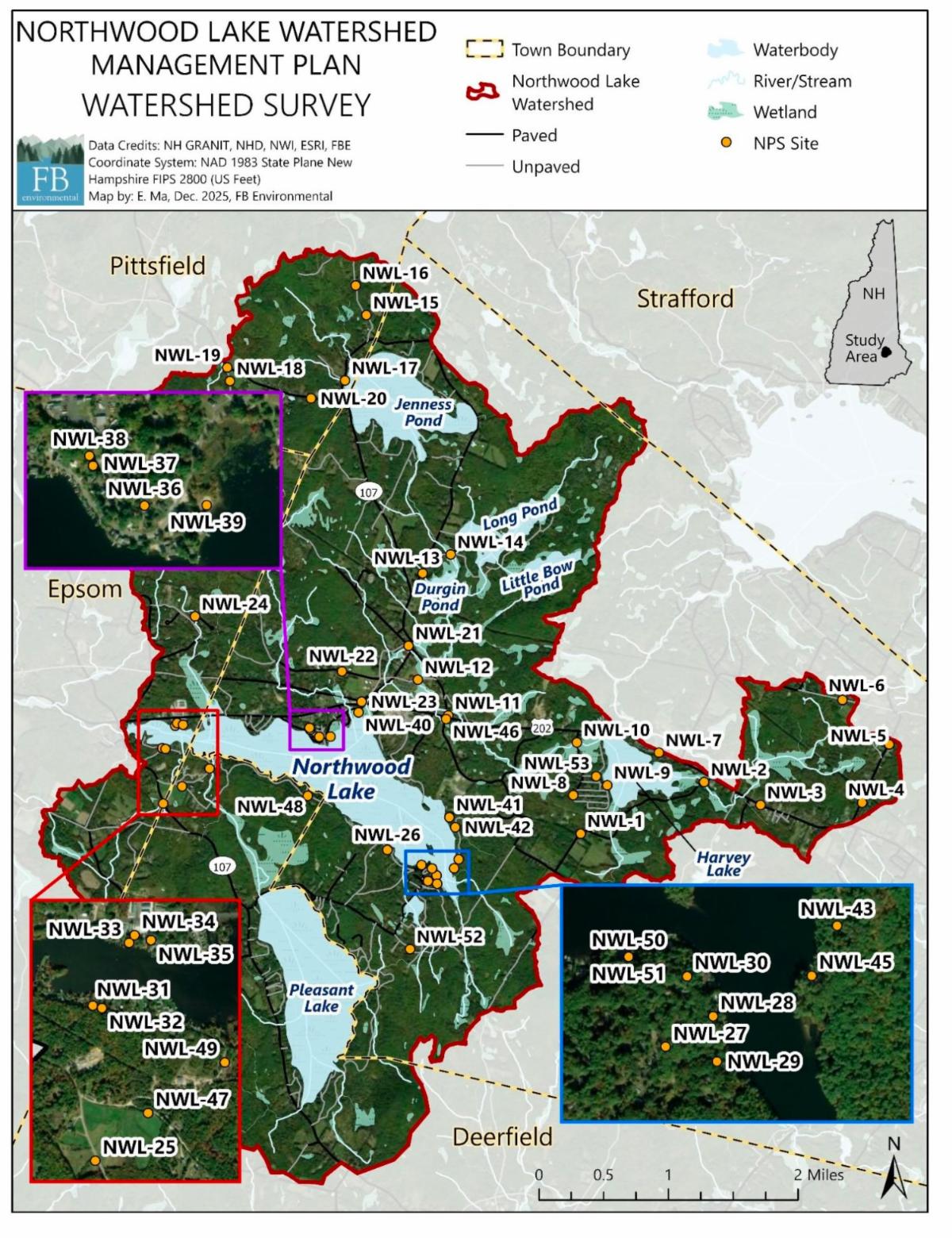
The Northwood Lake Watershed Association (NLWA) received a Watershed Assistance Grant for Water Quality Planning (604b) from the U.S. EPA through the NH Department of Environmental Services. Coupled with association funds, the NLWA has hired FB Environmental Associates (FBE) to develop a Watershed Management Plan (WMP) to help study the water quality and watershed of the lake and outline a course of action to improve the water quality and reduce the chance of harmful algal blooms.
The actions we all take on land have an impact or effect on our natural world. Sometimes for the benefit, and sometimes unknowingly, for the detriment. When considering water quality, rainwater runoff from different land uses (residential, roads, agricultural, forested) plays a large part in nutrient transport into Northwood Lake. To quantify this, as part of the second phase of developing the WMP FBE modeled the annual phosphorus load to Northwood Lake from each drainage area by land use category. We learned that although developed lands cover only 12% of the watershed, they contribute 64% of the total phosphorus load to the lake. Phosphorus is often the nutrient that dictates how “productive” a lake is because this nutrient supports the growth of algae and photosynthetic organisms like aquatic plants and cyanobacteria. Such productivity can lead to shallower water clarity and support algal blooms.
The lake model is also used to forecast future water quality as land uses in the watershed change. The investigation of this future condition, coupled with the current water quality data and a modeled “pre-people” scenario, helps us determine a realistic water quality goal for the upcoming years. Together, NLWA and FBE set the initial water quality goal to have an in-lake concentration of 12.1 ppb of phosphorus, and 3.4 ppb of chlorophyll-a over the next 10 years. This will be accomplished by reducing phosphorus loading to the lake by 5.7% from existing development and activities, while also mitigating phosphorus loading from future development. Additional reductions may be needed to decrease phosphorus concentrations further and continue to lessen the likelihood of cyanobacteria blooms.
Achieving this goal will require a community-wide effort. We need to reduce our stormwater runoff from rooftops, driveways, and roadways; enhance our shoreline buffers to stabilize our banks; continue to regularly pump out our septic systems every 1-3 years especially in the shoreline area; inspect older septic systems throughout the watershed; and continue to educate ourselves and our neighbors about how every one of us can work to improve the water quality of Northwood Lake. Ultimately, the goal is to make Northwood Lake more resilient so it can withstand the pressures from development, environmental change, severe storms, and warmer temperatures without causing detrimental effects on water quality. FBE and NLWA developed an Action Plan as part of the WMP which establishes a collective, resilient framework capable of achieving and exceeding the water quality goals by collaborating with watershed towns, county conservation commissions, regional planning commissions, local lake associations, and conservation groups. Ultimately, our success relies on building and strengthening these vibrant partnerships with local stakeholders who share a dedicated commitment to natural resource protection.
A draft of the WMP will be presented at a public meeting on August 15th at Lantern Light Camps 292 Blakes Hill Road Northwood, at the Camp Dining Hall at 2:00 PM.
For more information on the Northwood Lake WMP project, please contact Brian Lobao (brianlobao@northwoodlake.org).
Approximately half the funding for this project is provided by the U.S. Environmental Protection Agency under Section 604b of the Clean Water Act. The funding is administered by the New Hampshire Department of Environmental Services in partnership with EPA. EPA does not endorse any commercial products or services mentioned.
Established in 2001, FB Environmental Associates is a consulting firm that specializes in environmental assessment, monitoring, planning, mapping, modeling, and restoration projects in the watersheds of New England's lakes, streams, rivers, and estuaries. FB Environmental is committed to providing reasonably priced, high-quality professional products while maintaining close communication with our clients. For more information contact us at info@fbenvironmental.com.
|