|
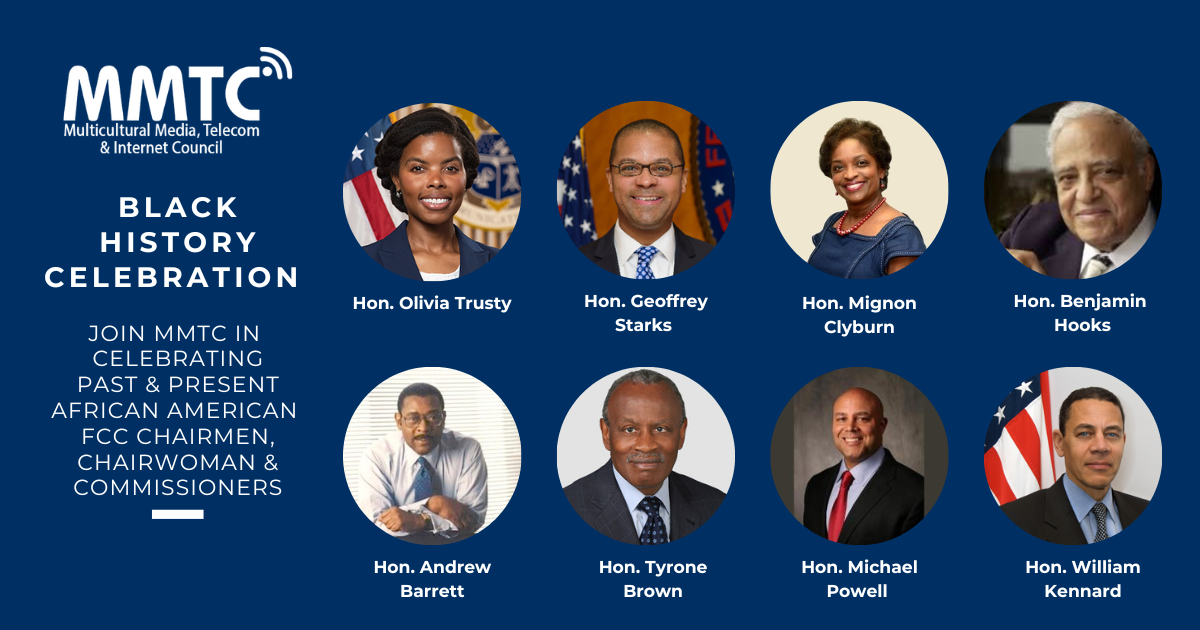
In honor of Black History Month, MMTC celebrates past and present FCC Chairs and Commissioners. Learn about them below.
Hon. Olivia Trusty has served as an FCC Commissioner since 2025. Prior to her tenure at the FCC, Trusty served as a Professional Staff Member on the U.S. Senate Committee on Armed Services under the leadership of U.S. Senator Roger F. Wicker. She also served as a Policy Director on the U.S. Senate Committee on Commerce, Science, and Transportation and a Legislative Assistant in the Office of U.S. Senator Roger F. Wicker. Learn more here.
Hon. Geoffrey Starks served as an FCC Commissioner from 2019 to 2025. During his tenure, Starks was a champion for the millions of Americans who lack access to or cannot afford a home internet connection. He advocated for consumer protection and accountability, particularly in managing the Universal Service Fund. Also, he was a leader on national security policy, working to eliminate untrustworthy equipment from America’s communications networks. Prior to his federal public service, Starks was an attorney at Williams & Connolly. Currently, he is a partner at Latham & Watkins. Learn more here.
Hon. Mignon Clyburn became the first African American woman FCC Commissioner and Acting Chairwoman. Clyburn served the FCC as a Commissioner from 2009 to 2018. She led the FCC as Acting Chairwoman for six months in 2013. During her tenure, she was committed to closing the digital divide and championed the modernization of the agency’s Lifeline Program. She also promoted diversity in media ownership, initiated Inmate Calling Services reforms, supported inclusion in STEM opportunities and fought for an Open Internet. Currently, she is the president of MLC Strategies, a Washington, DC-based consulting firm that provides advice and critical solutions in the technology, media, telecommunications and investor-owned utility industries. She also serves on Lionsgate's board of directors.
Hon. Benjamin Hooks, a civil rights leader, minister, and attorney, became the first African American FCC Commissioner in 1972. During Hooks' tenure from 1972 to 1977, he addressed the lack of minority ownership of television and radio stations, the lack of minority employment in the broadcasting industry, and the image of African Americans in the mass media. After the FCC, he became the executive director of the NAACP. He died in 2010, leaving the Hooks Institute to promote his commitment to social change. Learn more here.
Hon. Andrew Barrett, an attorney and former teacher, served as an FCC Commissioner from 1989 to 1996. Barrett was known for being an outspoken and fiercely independent Commissioner who championed consumer outreach and engagement. Before coming to the FCC, he was a Commissioner on the Illinois Commerce Commission. Before that he was a civil rights leader in Chicago, Illinois. After leaving the FCC, he joined the Edelman Public Relations Worldwide.
Hon. Tyrone Brown served as an FCC Commissioner from 1977 to 1981. Brown was a leader in the development of the FCC tax certificate policy. He also was one of the members of the Syncom group of African American-owned venture capitalists that invested funds to purchase Iridium Satellite from Motorola out of bankruptcy. He served as a consulting counsel at Wiley Rein LLP.
Hon. Michael Powell served as the FCC Chairman from 2001 to 2005 and a Commissioner from 1997 to 2001. During his FCC tenure, he oversaw the rapid transformation of communications markets into the Digital Age. As a result, the Internet came into widespread commercial use, as did smart phones, Wi-Fi networks and satellite radio. Prior to joining the FCC, he worked as the Chief of Staff of the Antitrust Division in the Department of Justice. He also served as President of the NCTA - The Internet & Television Association from 2011 to 2025.
Hon. William Kennard served as the FCC Chairman from 1997 to 2001 and the General Counsel from 1993 to 1997. During Kennard's tenure, he shaped policies that created an explosion of new wireless phones, brought the Internet to a majority of American households, that resulted in a significant investment in new broadband technologies. He also implemented new policies to bridge the digital divide in the United States and around the world. He also served as the U.S. Ambassador to the European Union from 2009 to 2013 and chairman of AT&T's board of directors from 2020 to 2025. He currently serves as lead independent director of AT&T's board.
|