Message from the Executive Director | | |
Dear MOD Community:
MOD was created in 1981 under Chapter 6, Section 185 of the Massachusetts General Laws. In the last 45 years, we've grown and adapted a lot. With the passage of the ADA in 1990, we quickly centered our focus on helping the public understand this essential civil rights law and how to implement it effectively to benefit the lives of people with disabilities.
MOD continues to provide quality, practical guidance on the ADA and what it means for real people in real life. The challenge of figuring out what works and what doesn't for asserting rights and implementing the law effectively continues too.
We answer questions like: How do I ask my landlord for a housing-related accommodation without souring our relationship? How do I balance potentially complex employee accommodations, limited resources, and successfully running my business?
We understand how the ADA intersects with other important laws too. These include the Fair Housing Act, Massachusetts’ anti-discrimination laws, and architectural access regulations. If you contact us, we'll walk you through which laws apply to you and your situation.
Understandably, there is a tendency to focus on all the ways society has changed in the last 45 years. The digital world has expanded. Legal information is available at the public's fingertips through the internet and AI. These advancements are phenomenal and provide their own opportunities to enhance accessibility and inclusivity.
But it is important to remember that a lot of the information out there may be inaccurate or doesn't tell the full story. The interpretation of law is constantly changing and best practices can shift quickly. Indeed, there remains work to do to ensure that the full intent and effect of the ADA is realized before looking too far into the future of technology and civil rights.
As our world changes, we remain committed to bringing you accurate, practical information to help you understand your legal obligations and assert your rights.
We continue trying to find new ways to support you where you are. Starting next month, we're adding office hours for Centers for Independent Living (CILs). We're on the road providing trainings to employers, state agencies, and colleges and universities. We're updating and adding to our disability rights guidance so you can get the basic information you need anytime, anywhere. And we're always listening for ways we can better serve you.
Here's to our next 45 years (and beyond),
Allan Motenko
Executive Director
Massachusetts Office on Disability
| | New digital accessibility resource hub | | |
The Commonwealth's Accessibility Center for Consulting Education and Support Services (ACCESS Team) has launched accessibility.mass.gov, a digital accessibility resource hub for state agencies, municipalities, and the general public.
Visit the new site for easy to use guides, checklists, and trainings to learn how to make your digital content accessible and comply with the law. The ACCESS Team also offers regular office hours exclusively for state and local governments to troubleshoot specific questions about digital accessibility.
Current digital accessibility requirements
On May 7, the U.S. Department of Justice published a rule extending the deadline to comply with changes to Title II of the Americans with Disabilities Act (ADA) by one year.
This rule change applies to state and local government organizations. The changes set Web Content Accessibility Guidelines (WCAG) Version 2.1 Levels A and AA as the technical standard for state and local organizations’ digital content and digital services.
What this means for state agencies:
This deadline extension has not changed current standards for state agencies.
In Massachusetts, the Enterprise Digital Accessibility Policy requires that all state digital content and services comply with WCAG Version 2.1 Levels A and AA. That policy has not changed and is currently in effect.
What this means for cities and towns:
Cities and towns have one more year to meet WCAG guidelines. The deadline depends on population size:
- Cities and towns with a total population of 50,000 or more: April 26, 2027 (previously April 24, 2026)
- Cities and towns with a total population of less than 50,000: April 26, 2028 (previously April 26, 2027)
Note that cities and towns have effective communication requirements under the ADA that have not changed. The existing requirement is that cities and towns must communicate with people with sensory disabilities as effectively as those without disabilities.
For example:
- A town that posts meeting agendas only as scanned image PDFs may not be communicating effectively with blind residents who use screen readers, because the documents cannot be read electronically.
- A city that livestreams or archives public meetings without captions may not be effectively communicating with residents who are deaf or hard of hearing.
For guidance on Title II requirements and how they apply to you, see our guidance on disability rights in government services.
| |
Massachusetts Law Continues to Protect Individuals with Disabilities Who Need Assistance Animals in Housing
The landscape regarding assistance animals in housing recently changed at the federal level after the U.S. Department of Housing and Urban Development (HUD) rescinded its long-standing enforcement guidance on assistance animals in housing.
In a recent press release, the Massachusetts Commission Against Discrimination (MCAD) confirmed that Massachusetts law continues to protect people with disabilities who require assistance animals, including emotional support animals, as a reasonable accommodation in housing.
|
Governor's Special Advisory Commission on Disability Policy re-established
MOD Executive Director Allan Motenko has been named chair of the Governor's Special Advisory Commission on Disability Policy.
The Commission is charged with advising the Governor and Lieutenant Governor on issues affecting people with disabilities in Massachusetts, with a particular focus on how to promote the inclusion, integration, and independence of people with disabilities in the programs, services, and activities of state government.
Members include leaders in disability policy, services, and advocacy. The Commission held their first meeting on September 14 to begin brainstorming up to three priorities to focus on over the next two years.
Email Allan.B.Motenko@mass.gov to share your ideas and suggestions for the Commission.
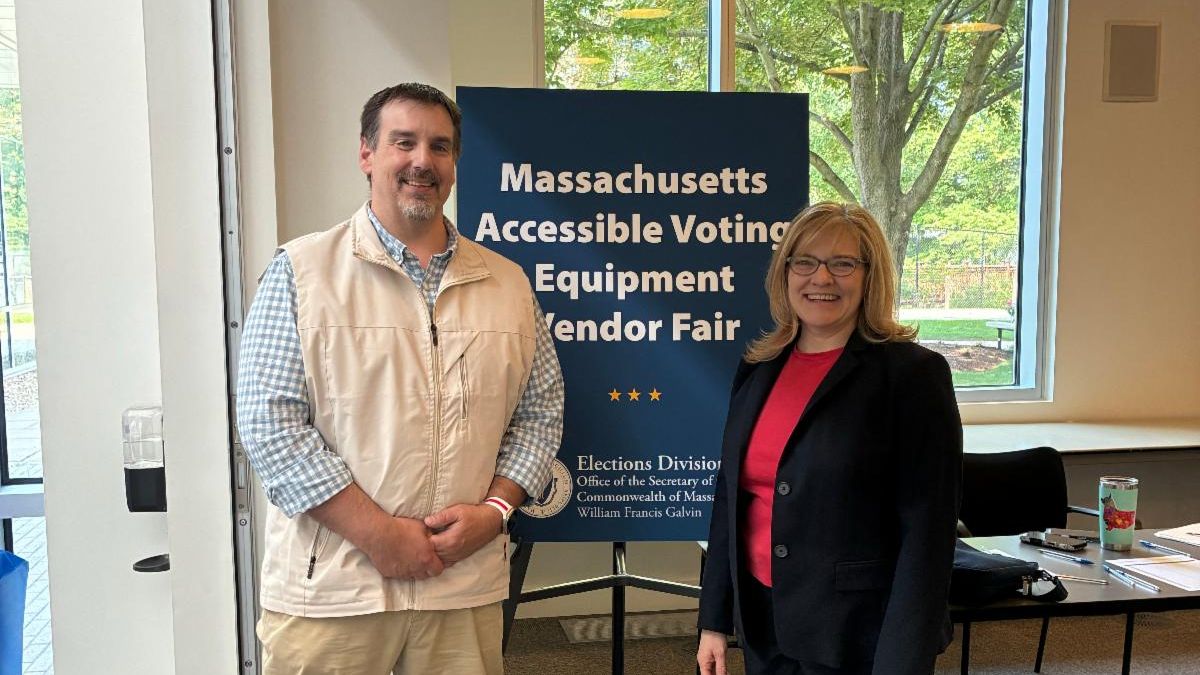
| Photo: MOD staff attend a Massachusetts Accessible Voting Equipment Vendor Fair |
Secretary of the Commonwealth exploring options for new accessible voting machines
The Secretary of the Commonwealth is considering options for new accessible voting machines. The machines will replace existing accessible voting equipment.
The Secretary hosted five Accessible Voting Equipment Fairs in August. MOD staff were pleased to attend, alongside disability community advocates and municipal officials, to test the new equipment and provide feedback.
All polling locations in Massachusetts must have at least one accessible voting machine. Currently, AutoMARK Voter Assist Terminals are the approved accessible voting machine and can assist visually impaired voters by displaying the ballot in high-contrast, magnified text and providing audio cues.
The state election is November 3. See Accessible voting: What you need to know for tips on how to prepare your municipality and yourself for a barrier-free election day.
|
Municipal ADA Improvement Grant Update
The FY26 application for MOD's Municipal ADA Improvement Grant has closed. We received over 185 applications this year. The Grant Selection Committee is currently reviewing applications and grant awardees will be announced later this fall.
The Municipal ADA Improvement Grant provides funding to municipalities for accessibility-related planning and projects. The FY28 grant will open on May 1, 2027. Municipalities, school districts, and housing authorities are eligible to apply.
If you're interested in applying for a FY28 grant, review the ADA grant information on our website and begin reviewing your ADA Self-Evaluation and Transition Plan (SETP). Grants can fund creating or updating SETPs. Grants can also fund capital improvements for accessibility-related projects. Projects do not need to be identified in your SETP to be eligible for a grant, but the SETP is a good place to begin when deciding which project you'd like funded.
|
Special Commission for State Institutions receives Shirley M. Barnes Records Access Award
The Special Commission for State Institutions (SCSI) received the Shirley M. Barnes Records Access Award from the Massachusetts Genealogical Council in July. The award was given to recognize the SCSI's work investigating the state's history of institutional care.
The SCSI issued a final report in May 2025, and Governor Maura Healey signed legislation implementing the commission's recommendations on November 25, 2025. The legislation allows the public to access institutional records that are over 75 years old.
Former MOD Executive Director Mary Mahon McCauley and MOD Counsel Camille Karabaich served on the Commission.
This Shirley M. Barnes Records Access Award is presented annually by the Massachusetts Genealogical Council for an important project that improved access to public historical records within the state of Massachusetts.
|
State Plan for Independent Living Public Input
The Massachusetts Statewide Independent Living Council (MASILC) wants to know what is most important to people with disabilities, their families, and their communities. Your answers will help set the direction of the next State Plan for Independent Living (SPIL).
Share your thoughts in any of the below ways:
For questions, contact MASILC at 508-620-7452 or info@masilc.org.
| | Resources: Finding the right place to go for help | |
Disability rights in public places
There are requirements for all places that are open to the public (for example: restaurants, hotels, doctor’s offices, stores, schools, recreational facilities and libraries) to provide equal access to goods and services.
Public places cannot discriminate based on disability, and must make reasonable changes to allow a person with a disability full and equal access to all of the activities, programs and services they offer.
If you have a complaint about how you were treated in a public place and want to resolve it, you first need to get specific about what type of complaint you have:
- Customer service (for example: unhelpful service)
- Consumer issue (for example: you didn't get what you paid for)
- Physical access issue (non-compliance with Massachusetts Architectural Access Board regulations)
- Disability rights issue (non-compliance with disability rights laws)
The right place to go for help depends on what type of issue you're facing. Visit disability rights in public accommodations to learn more about the requirements public places have to follow, and the best way to resolve different types of complaints.
|
When to contact your municipal ADA Coordinator
MOD maintains a public listing of municipal ADA Coordinators.
Municipal ADA Coordinators oversee municipal compliance with the ADA. You should contact your ADA Coordinator to:
- Report a disability-related barrier that prevents you from accessing a municipal service or program,
- Request a reasonable accommodation or modification to participate in a municipal service or program,
- Request an auxiliary aid or modification so you can effectively communicate in municipal meetings, programs, and services,
- Ask questions about what your municipality offers people with disabilities, and
- Offer feedback about disability-related issues.
If you need a reasonable accommodation to equally access a city or town program, it can be helpful to contact the program organizer directly in addition to your local ADA Coordinator.
Municipal ADA Coordinators do not oversee accessibility at private businesses, and do not enforce any laws.
Do not contact your municipal ADA Coordinator for accessibility concerns at a private business. You can contact MOD for guidance on how best to resolve accessibility concerns at private businesses.
|
When to contact your municipal Commission on Disability (COD)
MOD maintains a public listing of municipal Commissions on Disability (CODs).
Municipal Commissions on Disability (CODs) advise municipalities on systemic disability-related issues within local government programs. Not every municipality has a COD.
You should contact your local COD to discuss:
- Systemic disability-related barriers to accessing municipal programs and services;
- Architectural barriers in municipal buildings, streets, and sidewalks;
- Suggestions for policies to address disability-related issues in the municipality; and
- Getting involved with the COD’s work and projects.
CODs do not help with specific requests from individuals (such as ASL or CART services for an individual to access a town meeting or program), and they do not typically focus on accessibility issues at private businesses.
| | Upcoming events and trainings | |
Office hours with MOD
MOD is offering regular office hours for some of our key partners:
-
State ADA Coordinators: Second Wednesday of each month from 1 - 2 PM (next office hour: 10/14)
-
Municipal ADA Coordinators: Fourth Tuesday of each month from 1 - 2 PM (next office hour: 9/22)
-
Commissions on Disability (CODs): Third Wednesday of each month from 3 - 4 PM (next office hour: 10/21)
-
New! Centers for Independent Living (CILs): First Thursday of every other month from 11 AM - 12 PM (first office hour: 10/1)
If you are in one of these groups and would like to join office hours, reply to this email for the registration link.
If you are not in one of these groups but would like guidance from our team on disability rights laws or architectural access regulations, contact MOD for a consultation.
| |
Statewide COD meeting
Hosted by: Massachusetts Office on Disability (MOD)
October 8, 2026 | 10 - 11:30 AM
Virtual
Learn about MOD's support and resources for local Commissions on Disability (COD), including new initiatives; meet other CODs; and get tips on effectively achieving your COD's goals.
Statewide COD meetings are exclusively for COD chairs, members, municipal employee liaisons, and people interested in starting a COD in their community.
Register: October 8 Statewide COD Meeting
Note: You will not receive a Zoom link immediately after registering. Your registration will be approved by MOD, and then you will receive an email with the link.
|
Community Access Monitor (CAM) trainings
Hosted by: Massachusetts Office on Disability (MOD)
Various times
Virtual
The Community Access Monitor (CAM) Program trains you to survey buildings for accessibility and use your skills to advocate for compliance with various rules and regulations.
It is designed for people who want to advocate for increased access in their community and those who want to understand their obligations to provide access to the disability community, such as building inspectors, architects, business owners, builders, and Commissions on Disability.
The training covers:
- History of disability laws, regulations and rights
- Regulations of the Massachusetts Architectural Access Board (MAAB)
- Americans with Disabilities Act (ADA) standards for accessible design
- New construction/alterations and existing facilities
- Effective communication
- How to survey a facility
- How to advocate for access
- Rights and responsibilities of a Community Access Monitor
Time commitment and registration instructions:
Beginner CAM training is a two-day training from 10 AM - 3 PM each day (10 hours total). There will be short breaks throughout. Registering online will register you for day 1. The link will register you for Day 1 only. Once you register, we will register you for Day 2. You will receive emails from Zoom with the meeting links for Day 1 and Day 2.
To obtain a Course Completion Certificate for the 2-Day Online CAM training, you must attend at least 75% of each of the sessions.
Register for a CAM training (10 AM - 3 PM each day):
Please note: Registration is limited. If you receive a message that the registration is full, please sign up for another training date or contact Ralph DeCicco, MOD's Access Specialist, at Ralph.DeCicco@mass.gov or (617) 979-7312.
Advanced CAM training
Advanced CAM trainings are available for people who have completed the 2-day CAM training in the past. You will be directly invited from MOD through email.
On-site site visit training
On-site site visit trainings are available for people who have completed the 2-day CAM training in the past. You will be directly invited from MOD through email.
| | Our Company | Contact Us | FAQs | Privacy Policy |
| | | |