|
The Gleaners
Jean-François Millet
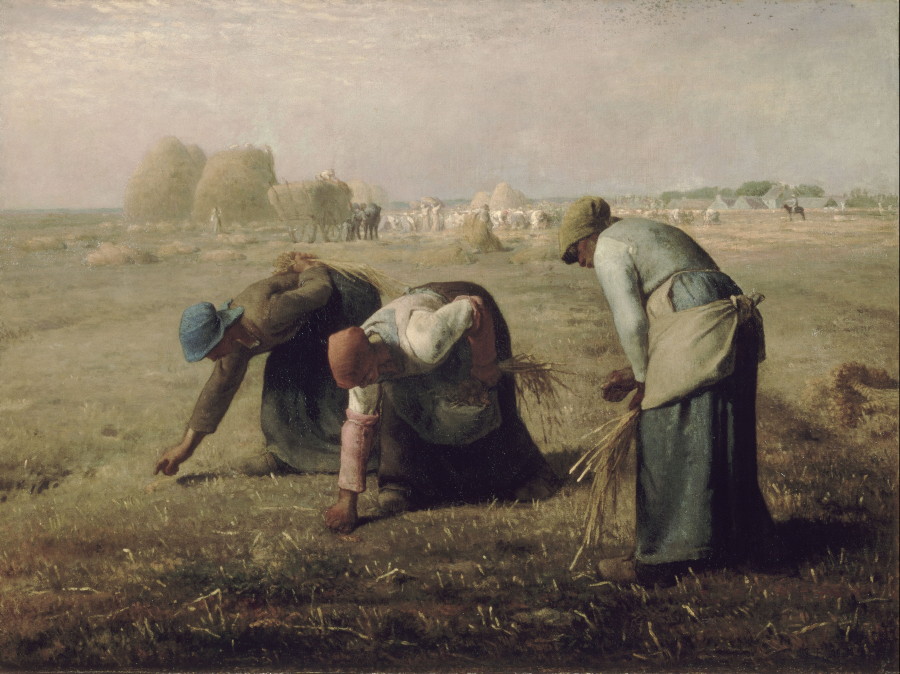
The Gleaners debuted in Paris at the 1857 Salon de Beaux Arts exhibition. The artist, Jean-François Millet, had a long-standing interest in rural peasant life. The painting was the culmination of ten years of interest in gleaners, peasant women whose job it was to search the fields after the harvest, picking up whatever grain had been left behind. The painting shows three of them, bent over, their eyes searching the ground immediately around them. The austerity of the main characters contrasts sharply with the abundant harvest depicted in the background. An overseer on horseback adds to the feeling of not only physical, but social distance. The contrast between wealth and poverty, power and helplessness, male and female spheres is forcefully rendered.
Clearly, Millet identified with rural life. He painted what suited his temperament. Having grown up on a farm in Normandy, he had a story to tell; a story that made the otherwise invisible peasant class visible to the upper and middle classes. I don’t know whether Millet was consciously a social critic. He was telling his story, just laying it out there and leaving the interpretation up to the viewer. Rollo May said: “The artist, like the lover, is a menace on the assembly line”. The point is, tell your story. It may or may not be disruptive. Just don’t succumb to the assembly line. Read more.
Martin Dunn
2020 Spiritual Art Grant Recipient
|