|
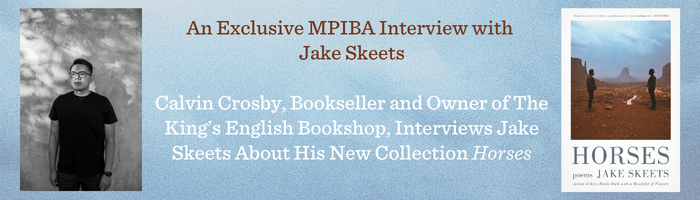
Calvin Crosby: Today, it’s an honor to have a conversation with Jake Skeets. Jake Skeets has become one of the most compelling voices in contemporary Indigenous poetry. A Diné poet from the Navajo Nation and the current Navajo Nation Poet Laureate, Skeets writes work deeply rooted in land, memory, and community, weaving together personal history, Diné culture, and the landscapes of the Southwest. His new collection, Horses, has already drawn praise from former U.S. Poet Laureate Joy Harjo, who calls his poetry “powerful and necessary.” In this conversation, Skeets reflects on the journey behind Horses, the influence of Diné traditions, and what it means to serve as a poetic voice for his nation.
Jake Skeets: Let me first introduce myself in Navajo: "Tsi’naajinii nishłí, Tábąąhá báshíshchíín. Táchii’nii dashicheii Tódík’ózhí dashinalí.” It’s nice to be here, and it’s great to talk about Horses. I finished this book back in 2023, so the fact that it’s finally coming out in 2026 says something about the revision process and the amount of time I spent really shaping it for readers. In some ways, it feels like an older book to me now, but I’m so happy to return to it and rediscover it alongside readers and audiences.
Calvin Crosby: It’s such an honor to be having this conversation. For readers who are just encountering Horses for the first time, how would you describe the heart of this collection and where it comes from in your life?
Jake Skeets: For me, this book feels more like a debut than my first book did. At the heart of the collection is a personal meditation and exploration of where I come from, which is the Navajo Nation.
My first book, Eyes Bottle Dark with a Mouthful of Flowers, was written entirely during my MFA program, so a lot of hands and perspectives helped shape it. With Horses, I wrote in a very different way. I worked mostly on my own. I didn’t have second readers or workshop participants. No one saw a draft of the manuscript until my agents, and I only sent it to one other poet, Sherwin Bitsui.
It also came out of a time of real transition in my life. I started writing it during the pandemic in 2020. Then I moved to Oklahoma, and from there I took a residency in Oxford, Mississippi. My life was changing every year, and I think the book carries that movement with it. It’s also an exploration of what it means to be a poet. I really wanted to test my ability on the page with just myself and the voices of the poets I was reading as guides and companions.
|