|
MARITIME RADIO HISTORICAL SOCIETY
7 June 2019
BULLETIN
|
|
After Action Report
Volume II, No. 14
1 - 2 June 2019 GMT
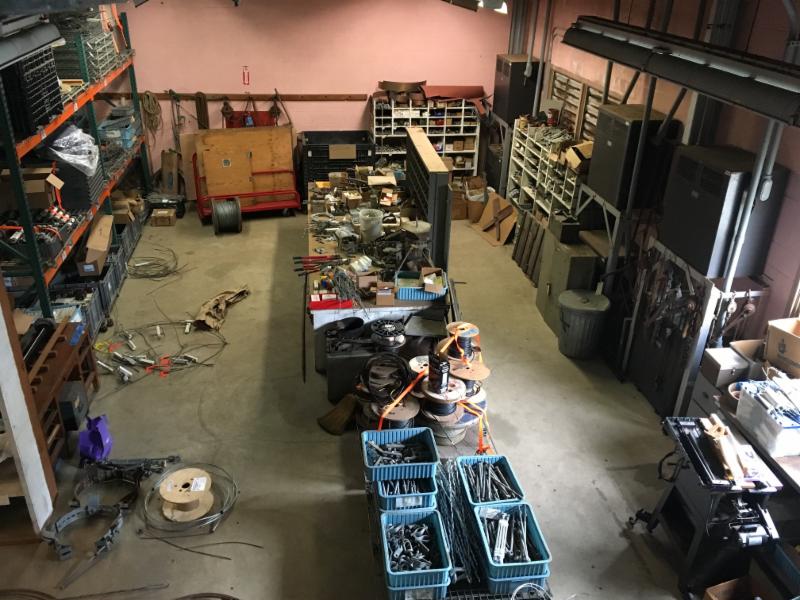
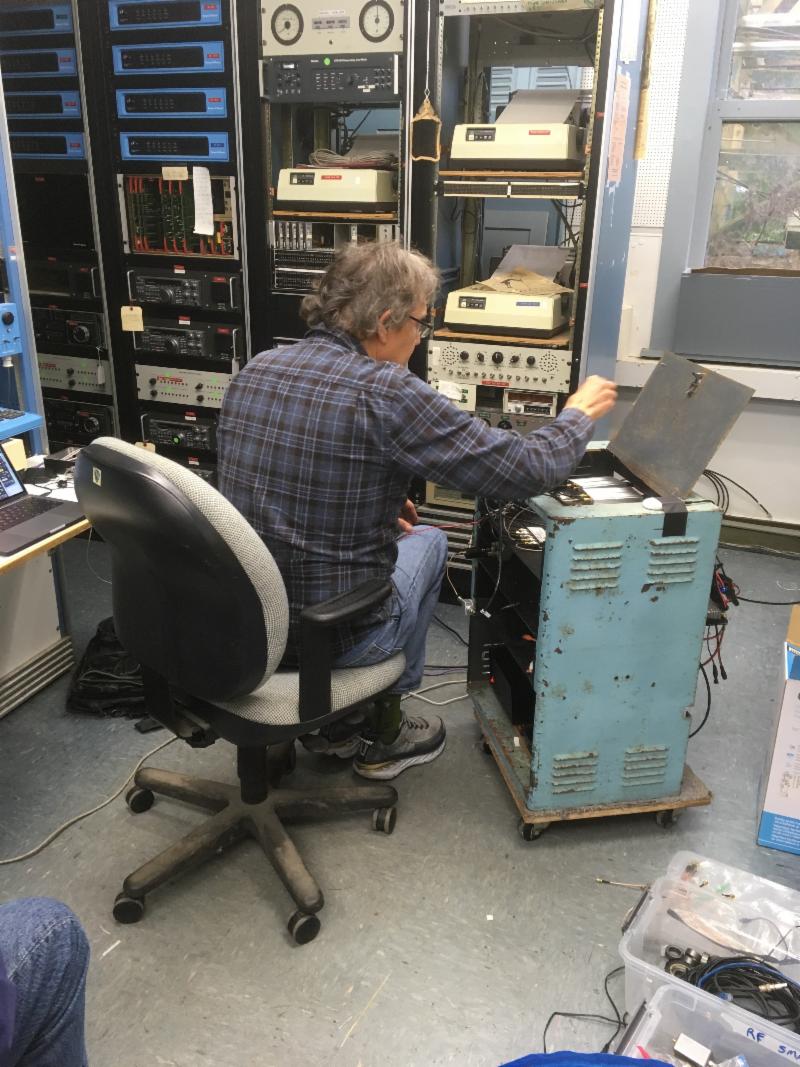
The Riggers Shop at BOLINAS RADIO.
This is where the parts and tools that are used to maintain the antenna field are kept and where indoor work is accomplished.
- "On Watch"
- In Memoriam: Bob Dildine, SK
- PX: News From Around the MRHS - Marshall History, et al.
- Errata
- Newsletter in Transition: Watch This Space!
CODH NR 14 CK NC SAN FRANCISCO RADIO/KPH 2330 GMT JUN 7 --
TO ALL TRUE BELIEVERS AFLOAT AND ASHORE --
"On Watch"
Despite the cool temperatures it was a busy day at the Receive Site (RS) of KPH in beautiful Point Reyes National Seashore. We were happy to welcome many drop-in visitors, and some who made a special trip to visit the station. While we enjoyed a lot of visitors to the station, radio conditions were not quite so good.
During the previous week the power at the Receive Site had failed, which meant that the clocks had to be reset, and the dreaded A-Tronix Memory Keyers had to be reprogrammed for the KPH and KFS marker signals, known as "the wheel." Faithful readers will remember that this project -- especially on the KPH keyer -- can be a huge exercise in frustration. This week was not to disappoint in that regard! Usually, the KPH A-Tronix keyer submits approximately 10 seconds before it is needed to be on the air, as the Free Press Broadcast ends at 1900 GMT. This week it did not capitulate until after an hour of fighting! Fortunately, we had a relatively accurate "wheel" paper tape for KPH punched and ready to go on the ancient Boehme Keying Head. So, as control of the station was passed from Bolinas to the Receive Site at 1900 GMT, the somewhat clipped Morse of the Boehme was heard once again in the ether. We were not able to put the KPH A-Tronix Keyer into service until 2034 GMT.
In the interim, SS AMERICAN VICTORY/KKUI called KPH on 12 mc at 2030 GMT, reporting that they were copying only weak signals from KPH and that they would call back in 10 minutes. However, we observed no further signals from KKUI on this day, and no other ships were heard or worked.
As scheduled, the KPH Traffic List went out at 2100 GMT, and the Pacific High Seas Weather went out at 2130 GMT.
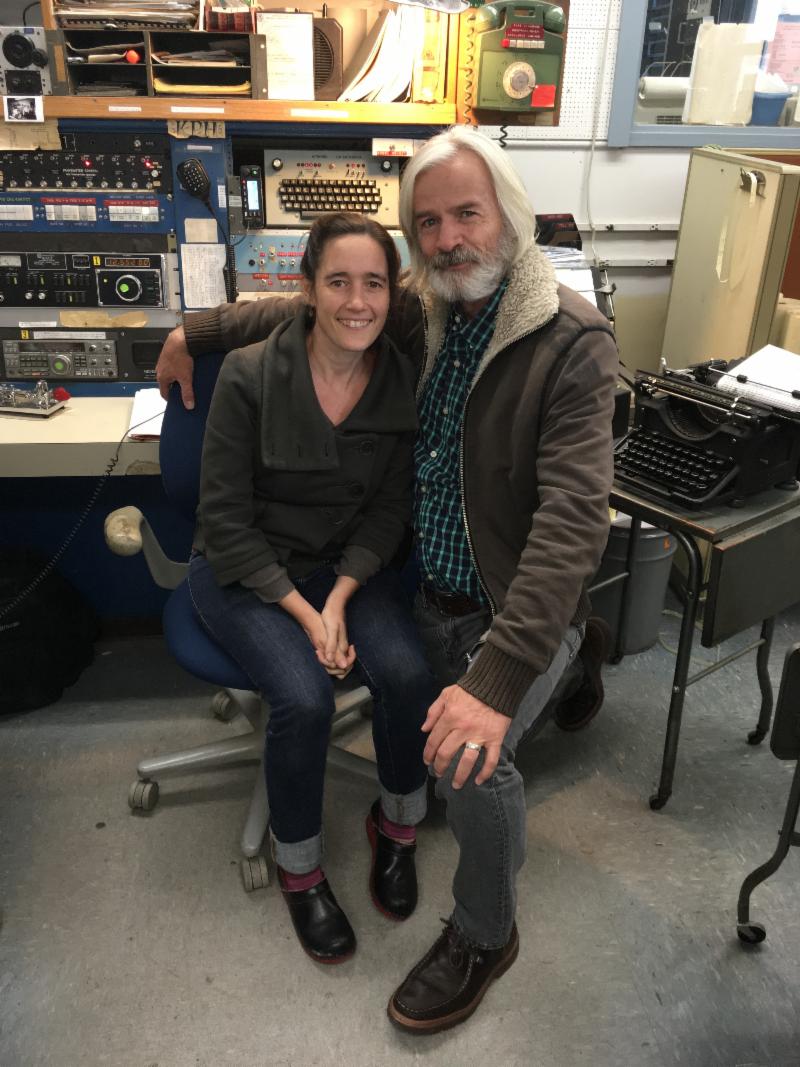
As previously mentioned, we enjoyed a steady stream of visitors throughout the day, including a special visit from two friends from Los Angeles, Ricard Lewis and Aline Gram who were visiting the Bay Area and made a special trip out to Point Reyes.
Aline Gram and Richard Lewis at Position One at KPH.
With relatively poor radio conditions, and the need to attend to our many visitors, K6KPH, our station in the amateur service, was able to make only fifteen contacts, with the best DX seeming to be a contact with our good friend, former WLO coast station operator, and current SS AMERICAN VICTORY/KKUI operator, Dean Sever, W8IM, who made a contact on 14 mc, and had one KPH signal report radiogram, as always. Thanks, Dean!
In Memoriam: Bob Dildine, Silent Key (SK)
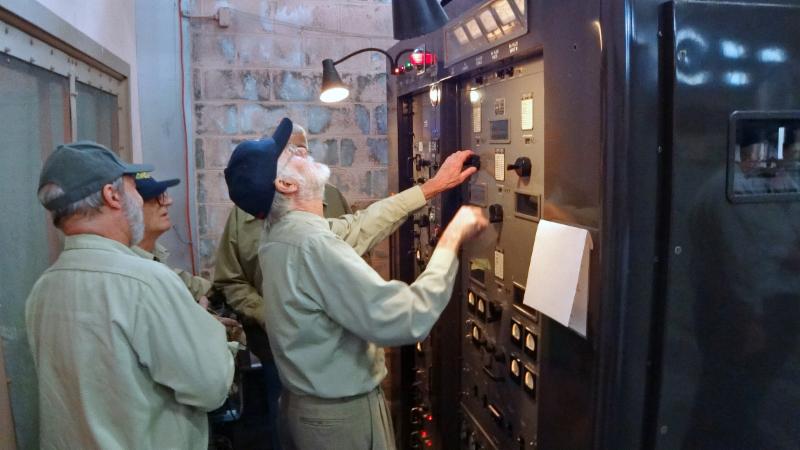
Bob Dildine, SK, tuning the historic RCA H Set transmitter that he and his colleagues from Hewlett Packard lovingly restored. This historic transmitter is back in service and can be heard on many Saturdays, and during special events. Thanks Bob for your dedication to this massive project!
Readers of these reports will recall that recently MRHS Director Bob Dildine passed away after a long illness. We promised to offer a fitting memorial to our good friend and colleague at a later date. We are happy to be able to fulfill that promise at this time.
This memorial was prepared by Bob's daughter, Maiko, and was relayed from her by MRHS member Stan Jaffe. We are grateful to Maiko for composing this memorial for us, and we are honored to share it with you all as she wrote it to honor her dad. Many thanks to Maiko and Stan for making this available to us.
"Bob grew up in Sacramento and graduated from American River High School before returning to his birth city of San Diego to attend San Diego State University as an engineering undergrad. There he met his future wife. After graduating with an engineering degree he entered the Navy Officer Candidate School and was assigned to Futenma Naval Base in Okinawa for two years and later to Atsugi Naval base for two years. In 1970 he and his wife married. He was honorably discharged in 1971.
The following summer Bob accepted an engineering position at Bechtel Corporation in Maryland. A year later he and his wife had a daughter and Bob decided to return to California to attend graduate school at UC Berkeley. He completed his M.S. in Electrical Engineering eight months later!
While finishing his M.S. at Berkeley Bob was offered a job at Hewlett-Packard in Santa Rosa ~ a company he had admired since he was very young. From there he settled into a rewarding 30 year career at HP that included two 3 year stints in their Japan offices.
As an adventurous guy he enjoyed his time in Japan very much and was an active member of TIARA (Tokyo International Amateur Radio Association) making many friends there. His only lament about Tokyo ~ with space in such short supply he had to get creative and set up his Ham Shack in the pantry of the kitchen. :)
Since he was a small boy Bob was an avid Ham Radio enthusiast. His grandfather Francis Harvey introduced him to Amateur Radio from his Ham Shack above the garage in his San Diego home. Later, teenage Bob and his friends built their own Ham Shack in the backyard of Bob's parent's Sacramento home. He would continue to enjoy and explore Amateur Radio over the rest of his years ~ entering DX contests, building antennaes, writing articles for QST, and making many good friends among like minded radio lovers in Northern California and around the world.
Over the years Bob shared his love for radio with anyone who was interested in learning no matter what their level. While a young man at HP he hosted an after school Ham Radio club at Montgomery High school and at age 70 he spent afternoons teaching a seven year old boy radios and how to build them in his radio room. He truly enjoyed teaching "non hams" the magic of radio.
Bob was diagnosed with ALS January 3, 2018. Over the next thirteen months he faced the disease with an amazing amount of courage and grace that is an inspiration to us."
Thank you so much, Maiko. Your dad was a true gentleman and a great supporter of the MRHS. He is missed. We send along to you, your mom, and your family, our deepest condolences.
PX: News from Around the MRHS -- Marshall History, et al.
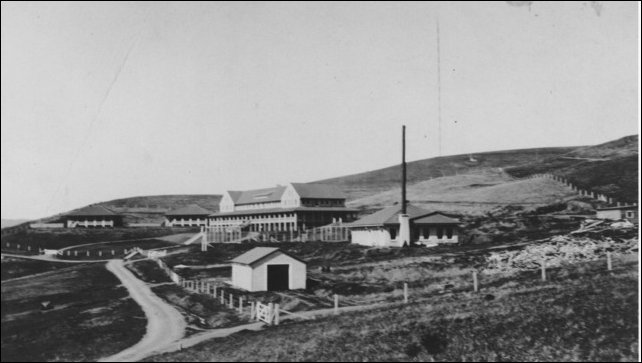
The original American Marconi/RCA Receive Site at Marshall, CA
*** In the last newsletter we mentioned that Transmitter Department member David Mortimer/DV has been doing some very important historical research, using modern digital tools, in trying to better understand the antennas at the original American Marconi receive site at Marshall, CA during the RCA era (i.e., before the point to point service moved to Point Reyes in 1930). In particular, readers of these reports will recall the anecdotal evidence of the mysterious "nine mile antenna" at Marshall. David's quest has been to attempt to discover hard historical evidence for the existence of such an antenna. This week we publish David's research, as it stands now. It is a GREAT read! To read this fascinating report, click here!
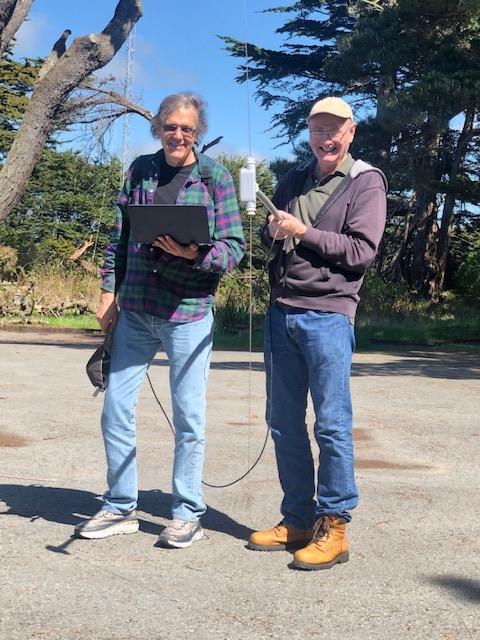
KPH SDR mavens, Rob Robinett and Lynn Rhymes sniffing out stray RF noise at the KPH Receive Site/RS!
*** Readers will recall that KPH now hosts an extensive collection of Software Defined Radios that anyone, anywhere in the world, can connect to, and listen to signals as they are heard at "The Wireless Giant of the Pacific." Rob Robinett, who has provided amazing and generous leadership on this project, has been focusing on locating and abating stray radio interference noise at the Receive Site. He sends along the following report of concerning his recent activities:
"While //kphsdr.com:8073 is very popular and it was gratifying to have it described by a listener as the quietest receive site on the West Coast, there is always room for improvement. In the last weeks, adding the wsprdaemon (WD) background noise level reporting and resulting graphs has encouraged me to reduce the background RFI (ed. Radio Frequency Interference) at the LBR ("Little Blue Rack") of KiwiSDRs.
The fabled "Little Blue Rack (LBR)," which contains the KiwiSDR receivers.
All of the the equipment in the LBR runs off 12VDC supplied by a 30 AH AGM battery now charged by a 110VAC to 30A Powerwerx SWPSU (ed. switching power supply). The system ran off that battery for all of the 8 hour Thursday morning AC power outage, which gave me a chance to see the LF/MF RFI on Kiwi72 with all other devices in the building powered off. Because the HF Kiwis are fed by the AC-powered KPH distribution amp and during the outage the HF Kiwis showed almost no signals or noise 0-30 Mhz, it appears much of the HF RFI is produced outside of the LBR. Yesterday I again verified that the 30A SWPSU is not a source of RFI by comparing the full spectrum with that SWPSU turned off and the distribution amp powered up.
However during that outage I continued to see some 54k KHz SWPSU RFI on the HF Kiwis and much more on the LF/MF Kiwi fed by the Marconi-T. All of the Kiwis are fed by 1 Mhz SWPSU, so the likely source was the 12V to 24V SWPSU feeding the Internet connection dish on the KPH roof.
In addition, the Wifi Access Point was located inside the LBR which not only placed it near the Kiwis, but also made Wifi coverage very limited inside the building.
So with the welcome assistance of Tom Yarish, on Saturday we:
1) Repurposed two unused CAT-5 cables to the roof so they now carry the LBR 13.8 VDC to that dish with very little voltage loss. I and many other Ubiquity dish users run them reliably at 12 VDC, so I am confident our Internet connection will remain stable at that supply voltage, but of course I will be monitoring it to be sure. So that final SWPSU was no longer required for our Internet connection.
2) Moved the Wifi AP out of the LBR to the top of the tall rack adjacent to the LBR.
With those changes the LF/MF Kiwi spectrum is starting to look pretty clean from 10 Khz through 20 Mhz although you can see bursts of broadband -110 dBm noise most clearly in the 2-4 Mhz region. I don't think those bursts were visible during the Thursday power outage, so I suspect they are the result of a local AC-powered signal. I have no theories about >20 Mhz noise, but this Marconi-T antenna should not be very useful at those frequencies anyway.
Even with those two impairments, I think this is outstanding performance."
Thanks Rob for all you are doing to always improve the KPH SDR''s! If you have not listened to what radio signals sound like at KPH, give the SDRs a listen! For the High Frequency SDRs,
click here. For the Low and Medium Frequency SDRs,
click here!
*** Having completed most of the work to repair the damage caused to the Bolinas antenna field by winter storms, and awaiting the completion of that work, Maintenance Supervisor Bill Ruck/RK spent some time organizing the Rigger's Shop (see the picture above). He sends along this report:
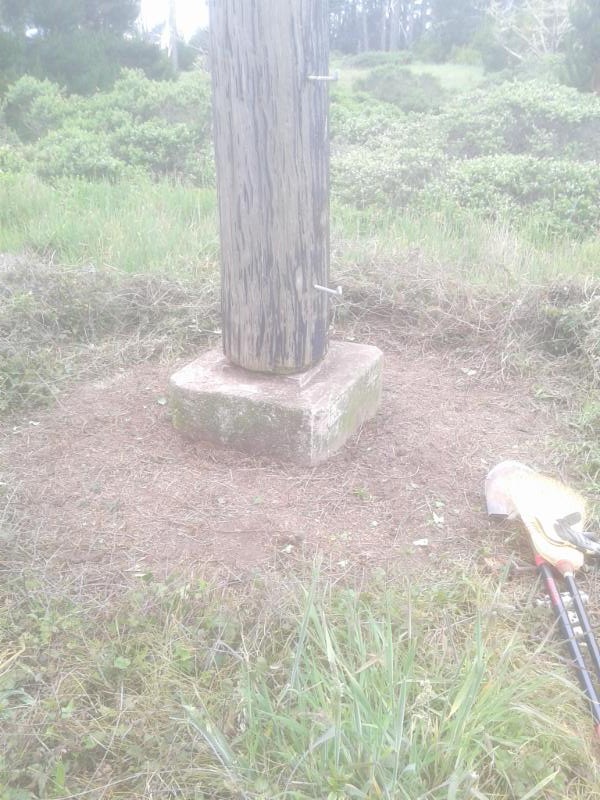
The base of one of the poles that supports an antenna at Bolinas.
"
My main objective for the day was to clean up the mess in the rigger's shop. While we were working on restoring the feed lines stuff just got dumped there.
While I was digging my way through the pile, VI (Transmitter Department member Bob Venditti) asked for thoughts about guys on the H-frame by Gate 1.
We walked out there and clearly the H-frame is leaning south due to the strain from the feed lines with no guys on the north pole. We also discovered a loose guy wire on the north side that appears to have never been connected. Also, there is a ground anchor that had rusted broken off guy remains.
So the thought was to connect the loose guy to the anchor which would offset the strain on the H-frame.
Returned to the rigger's shop for a chain hoist, pork chop, sling, and a couple fist grips. (Editor's note: If you don't know what these are: "pork chop" is a sliding grip that kind of looks like the meat; "fist grip" is a mechanical clamp for wire rope.)
We cut off the old rusted remains and then assembled the hoist on the guy wire and took up the slack. Connected the guy to the anchor with the fist grips and released the strain. We thought that the guy was kind of loose so we took up strain again with the chain hoist and added strain one click at a time until we heard the H-frame creak.
Connected the guy wire with fist grips and released the chain hoist.
Although this did not straighten out the vertical poles of the H-frame the guy is now relieving some of the strain from the feed lines.
In the process VI cut his finger and left blood on everything. We cleaned up the red stuff and I handed him a Band-Aid.
VI then went "Out Standing In The Field" to clean off the base of one of the poles while I returned to the rigger's shop.
After cleaning up most of the loose parts, I started to inventory the Preform grips. Sorted them out and found the following:
About 56 each two black mark grips. Most were missing labels but a couple had a label that had p/n GDE-1106 for 5/16" steel. These are what we mostly will use.
We have 5 boxes of 50 each and more loose of p/n BG-MS-2739 with one yellow mark. Don't know what those are used for. Look a little smaller than the 5/16" ones.
Also have a pile of ones with two red marks that are much smaller. Those might have been for the TCI antenna parts we found at MX.
And some GDE-2104 grips with two yellow marks. A few bigger ones with two orange marks.
Will need to research what those other grips are for and if they would be useful for us.
VI found that the pole was rotten and suspect. Details from him. He also found some artifacts in the weeds that are interesting. Insulators with very small wire (like #20) but using Nicopress offset dead-ends. Wonder what antenna used this? Left one of those insulators on the table in the Engineer's Lounge for examination.
VR
RK"
Thanks RK and VI for the efforts and the report! The work never ends!
Errata
In the last newsletter we misspelled the name of Bob Schuldheisz/K6DGQ. We apologize, Bob!
Newsletter in Transition: Watch This Space!
Due to circumstances beyond our control, it will no longer be possible to produce this newsletter on a weekly basis. We apologize for any inconvenience this may cause to you, our faithful readers. However, we anticipate transitioning the newsletter to a format that will appear less frequently, but on a regular basis, providing news about the Maritime Radio Historical Society and its varied activities, and items of interest to True Believers. So, keep an eye on your email inbox for the new format once we can commence producing these dispatches once again!
"Closing Message"
It is with regret that we suspend, for a time, the weekly publication of these reports of the adventures of the New Golden Age of Wireless. We have been most grateful to you, or readers, True Believers from all over the world, who have supported these reports and have offered encouragement. In the days ahead we will be considering the format for a new regular newsletter. Do you have any suggestions or ideas about what you would like to see? If so, just hit REPLY and fire away! Until the new format is developed, if any pressing news arises we will issue special bulletins. But, again, many thanks for all of your support of these weekly reports. And, more importantly, many thanks for your donations that help to keep "The Wireless Giant of the Pacific" on the air! We wish you all "fair winds and following seas!"
***
***
If you would like to show your support of the MRHS through a gift, please c
lick the "Make a Donation" button below,
or send your gift to:
MRHS
PO BOX 392
Point Reyes Station, CA 94956
The MRHS is a registered 501(c)3 non-profit organization, so your gifts are tax deductible. Our Tax ID Number is: 20-1122405.
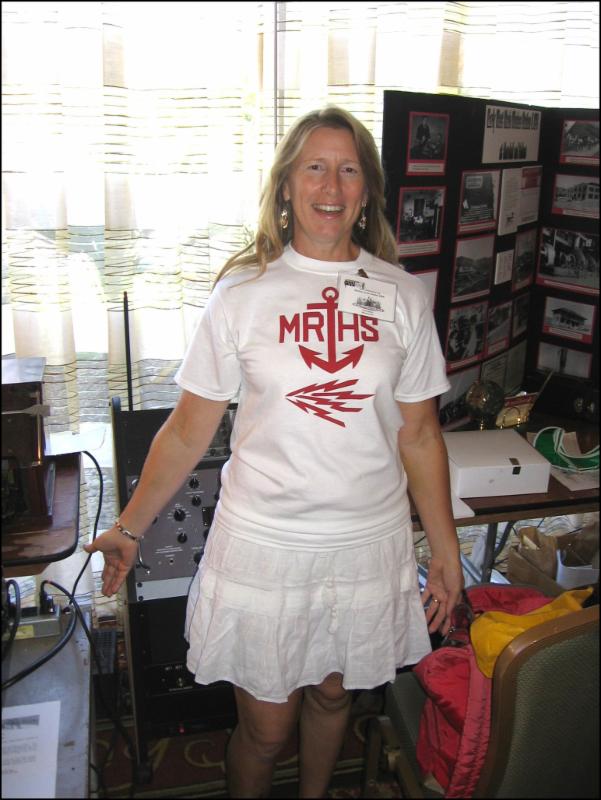
And don't miss our fabulous MRHS Swag store. Your purchases also provide some much needed income to the MRHS. To access these treasures, click on the picture of our lovely MRHS Model, Tina Shinn/TS, below!
***
The Closing Message was sent via KPH/KFS at 0021 GMT by Wally Pugh/WP. At 0027 GMT the teletype Order Wire was secured. All "sets" (=transmitters) were powered down, and the watch was suspended at 0038 GMT.
But the watch will be resumed at 1700 GMT on Saturday with the Free Press (PX) broadcast going out on all KPH and KFS channels currently in service. Control of the station will be handed over to the Receive Site on Point Reyes at 1900 GMT, and once again we will be listening for calls from ships at sea. We hope you can join us then for more adventures of The New Golden Age of Wireless! We hope you can join us at KPH, in person, or by your receiver at home! Until the next time we wish you fair winds and following seas.
... AR QRU BV ES GL 73/88 ZUT DE KPH SK EE
Thanks, in advance, for your continued support!
We are committed to using your gifts responsibly to help preserve our maritime and communications heritage!
When visiting KPH be sure to tune in to KWMR for
the great music,
local knowledge and,
most important, emergency information.
For more information about KWMR, and to listen to the live stream,
click here.
|
 |
|