|
Manitoba Sheep Association Newsletter
June 2015
|
|
|
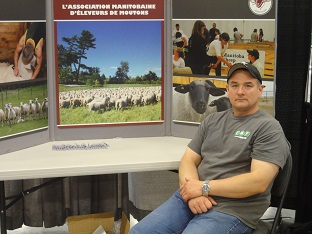
Jonathon Nichol
Central Region Director
|
| 2015 All Canada Classic |
The 2015 All Canada Classic hosted by the MSA and held at the Red River Ex grounds at Winnipeg had a good turnout for Sale day. There were over 250 lots up for auction with the sale starting at 9:00 am and going to 3:30. The Auctioneer did an excellent job keeping the animals moving through the ring while getting as much for each of the animals as the crowd was willing to spend, and this shows in the average prices as well as in the top selling animals. Of the 107 rams that went up for sale the average price of the 90 sold was $648.00 with Jim Driscoll's Sr. Polled Dorset Ram Lamb bringing top dollar at $2050.00. There were 146 ewes up for auction with the average price for the 131 that sold being $573.00, again Jim Driscoll's Polled Dorsets topped the sale with his Yearling Ewe bringing $2100.00.
 |
 |
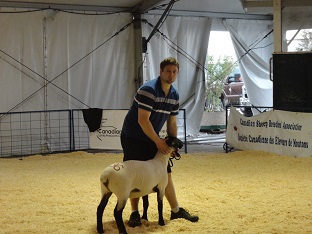
| Neil Versavel selling a ewe lamb. Neil was also the Chair of the 2015 Classic Committee doing much of the work to make the show a success. |
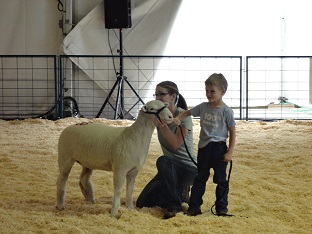
South-West District Director Sherry Bieganski selling one of their ewes. |
|
|
Director Bio's
|
|
Kate Basford, North -West District Director, MSA Treasurer
Hello Fellow Sheep Producers;
Being the new director for the North West Region, I am very excited to be a part of the MSA board.
With my husband, we run a mixed livestock operation along Lake Winnipegosis with a flock of commercial sheep, Angus & Hereford cattle and heavy horses. In the last few years, we have expanded our sheep flock, adjusting our operation and it's infrastructure from mainly cattle and horses to sheep. Currently considering expanding into pure bred registered sheep, as another aspect of our operation.
I have worked for the University of Manitoba, Manitoba Agriculture & Food, Canadian Food Inspection agency and mostly recently managed a 3300 head bison ranch. I have
an Ag degree focusing on ruminant nutrition and rangeland and pasture management.
I am looking forward to working with the MSA board, in their goal to enhance the Manitoba sheep industry. I am looking forward to talking with fellow producers in the NW region, as well as the rest of the province about sheep production, industry concerns and taking your concerns to the board and relating them to the government.
Yours truly
Kate Basford
Adam Donohoe, Interlake District Director
My wife Tara and I own and operate Lewdon Farms located in Meleb Mb.
When the family dairy farm in Petersfield sold in 2010, we moved to a sheep farm!
We have 800 acres with 400 in grass and 400 in bush/pasture.
We are lambing aprox 50 ewes, mainly North Country Cheviots and are starting a purebred flock.
We have plans to expand our grass based sheep operation eventually to around 300 ewes, and will be lambing May/June on grass.
We have 4 children; Lily May who is 6, Maria is 3, and 18 month old twins Isibéal and Waylon.
I'm very excited and honoured to be part of the M.S.A, and hope to be of great service to the sheep producers of the Interlake Region, as well as producers province wide.
|
|
Have a parasite problem and would like to participate in a Research Study?
|
The University of Calgary researcher's team is looking for volunteer sheep flocks to participate in
Sheep Parasite and Anthelmintic Resistance Survey in Western Canada.
In the summer of 2014, Drs. Michel Levy and John Gilleard and a DVM student Lana Swain, from
University of Calgary Veterinary Medicine, undertook a survey of twenty farms in Alberta to assess the
level of parasites present. They also conducted more detailed investigation of anthelmintic resistance
on four farms. The results of this work, which were published in the January issue of the Alberta
N'ewesletter, suggested that many Alberta sheep flocks have high parasite burdens and that ivermectin
and fenbendazole/albendazole resistant parasites may be more common than previously thought in the
province.
To expand the scope of the research the UOC's team has been funded by ALMA to survey the Western
Canada's sheep flocks. The project will run over three years and will look at sheep parasites in all four
Western provinces. It is a great opportunity for Manitoba sheep producers to participate in the project.
This year the project will continue to look at parasite burden and at the efficacy of treatment at the flock
level. As a part of the study molecular techniques for identification of parasites will be developed.
Detection of parasite resistance to dewormers and its evolution will be monitored over several years.
Participation in the project is voluntary and no cost to the producers. The flock selection is on first
come first basis. If you have more than 60 ewes and would like to take part in this research project
this year, please contact as below:
Mamoon Rashid - Small Ruminant Specialist
Manitoba Agriculture, Food and Rural Development
204-945-7557
Mamoon.Rashid@gov.mb.ca
|
|
Canadian Sheep Code of Practice,
|
This is a section out of the Canadian Sheep Code of Practice that all producers must comply with. To see the Code in its entirety visit
or contact your district's Director to receive a paper copy of the Code.
Fly-strike is a serious welfare issue for sheep (30). Fly-strike occurs when the eggs of blowflies are laid and hatch in moist or manure-stained wool and the maggots migrate to the skin and begin feeding on the flesh of the live animal. The maggots create painful multiple wounds, which, if undetected, can debilitate the animal to the extent that it eventually dies of shock, secondary infections and blood poisoning. In Canada, there is no approved product to prevent or treat fly-strike; therefore, producers must rely on sound practices to reduce risk. An important skill is identification of fly-strike. Common indicators of fly-strike include: * a small visible damp spot * severe irritation/scratching * biting or rubbing the hindquarters * difficulty keeping up with the flock. The risk of fly-strike is influenced by weather, management strategies that impact the number of flies, geographical region and individual animal parameters (e.g. wet conditions, dags on hindquarters, head wounds in rams and footrot).
Sheep affected by fly-strike must receive prompt treatment. Producers must understand the basic biology of the blowflies that cause strikes. Producers must determine the relative risk of fly-strike based on:
* predisposing environmental factors
* predisposing sheep traits
* relative risk factors (dags and long tails; wet wool in warm, humid conditions; footrot; open wounds)
* the seasonal presence of blowflies. Producers must take steps to reduce the attraction of flies to sheep:
* consider the risk of fly-strike in the risk/benefit analysis when deciding to tail dock (Refer to Section 5.7 Tail Docking for more information)
* preventing diarrhea or treating it quickly if cases do occur and crutching accordingly
* cleaning and treating wounds quickly
* shearing animals before fly season. Monitor flock for fly-strike as soon as fly season begins and during prolonged damp and humid weather.
For information on treating fly-strike refer to:
* Le Centre de référence en agriculture et agroalimentaire du Québec Guide: L'élevage du mouton. www.craaq.qc.ca
a. be aware of advances in fly-strike control and treatment options
b. consider implementing a baiting system for specific fly species.
|
|
Traceability
|
The CSF is currently working through the second round of CFIA consultations on ID and traceability regulatory proposal. The proposal presented in this second round of discussions has included a number of recommendations made by the Canadian sheep industry through round one of talks. Amongst the changes between the first and second set of proposals is a new set of movement reporting requirements that will have sites that receive animals report move animal move-in events rather than requiring producers to report movements off-farm. This will help minimize the amount of reporting that producers are required to do, and spread reporting workload amongst all involved stakeholders. This will also ensure that the traceability program can accurately account for every site on which an animal has resided in its lifetime. Once this second round of consultations closes on June 26th, the CFIA will begin drafting regulations. Draft regulations should be ready for circulation and comments in the fall of 2015, and are expected to come into force later in 2016.
Once regulations are drafted, producers and industry groups will have a clearer understanding of what the roles and responsibilities of each stakeholder will be.
|
| Upcoming events in Manitoba and Saskatchewan |
MSA Annual Show and Sale
The Manitoba Sheep Association is proud to be hosting its Annual Show and Sale for another year. This years sale is to be held at Carberry Agri Grounds on August 28th - 29th. Registrations are open. Entry Forms are included at the end of this edition of Sheep Sense. For more information on the Show and Sale please call 204-421-9434
Shearing School
The MSA is hosting a shearing school near Brandon on August 26th to the 28th. There is room for 6 shearers for the full three day course as well there is room each day for 2 beginners that would like to try out the craft. The instructor is Brian Greaves who is a long time shearer and has put on many shearing schools over the years. As space is limited and filling up fast reserve your spot soon. For more information and to book your spot please contact Jonathon Nichol at jnichol86@gmail.com or call (204) 246-2565.
Getting Started in Sheep "The Basics"
November 6th & 7th
Days Inn & Suites No 1- 275 Broadway St E, Yorkton, SK S3N 0N5
SSDB's AGM and Symposium at the Ramada Regina, SK
Jan 15, 2016 1pm - Jan 16, 2016 3pm
Dr. Kathy Parker - keynote speaker Veterinarian and Sheep Producer
more information will be posted at http://www.sksheep.com/events.htm
Back to Top
|
| How to Select Fleeces for a Show |
So, you have decided you want to enter some of your fleeces
in a wool competition, but are unsure which ones to select
and what the judge will be looking for. Some fleeces look
stunning on shearing day, but on closer inspection faults
become evident. Well, better to find them at home than the
judge picking them out at the competition.
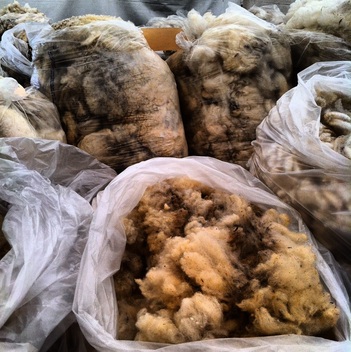 |
Let's examine what we need to be looking for at home, when
deciding which fleeces to enter.
|
Soundness is really important. Strength is one of wool's key
characteristics. How strong is the actual fibre? Grip a small
lock of wool at both ends and pull. If the fibres don't break,
the wool is sound. If you hold the wool up beside your ear
when pulling, there may be a crackling sound but the fibre
doesn't break. This is "tenderness" in the fibre, which could
make the fleece less sound. Many things can cause
unsoundness in the wool, but usually it some kind of stress
on the animal sometime during the year. This could be
lambing, illness or changes in feed. A fleece that is unsound
can be processed, but is not suitable for competition.
Next, is the cleanliness of the fleece. This is probably the
biggest issue we have with wool. In colder climates, we feed
our sheep for six months a year and the other half they are
on pasture. Vegetable matter or chaff gets into the fleece,
significantly degrading its value. There are various ways of
feeding the animals that reduces a buildup of vegetable
matter, or one can cover the animals with coats. The
presence of burrs, dags (pieces of manure) and stains from
urine or manure will reduce the fleece's value. Much of this
can be removed when the fleece is skirted.
"Handle" refers to the feel of the wool. A good fleece will
have great resilience and softness, fineness, length and is
pleasing to touch. This is based on breed specific
characteristics.
Staple length is very important especially for wool destined
for the commercial markets where the wool is processed
using machinery. Uneven fibres can result in waste or the
need for different machines. Samples of wool gathered from
across the fleece are measured for evenness of length. For
most shows, a minimum of two inches staple length is
required to enter a fleece.
Crimp refers to the natural waviness of the wool fibre. This
is a breed specific characteristic. Fine wool breeds have
more crimps per inch than the down (medium) or longwool
breeds. Crimp should be obvious the full length of the fibre.
Uniformity across the entire fleece is important. Judges will
select samples from at least three different areas of a fleece
for each judging category. For this reason, skirting the
fleece to remove kemp or hairy areas from the hind legs, any
black hairs on a white fleece, marker paint, stains and belly
wool is important to present the best fleece.
Finally, all fleeces are weighed. The fleece must fall within
the breed characteristic for fleece weights.
Most judges will also give their general impressions of each
fleece, which are recorded on the judging card. These
comments are very helpful in preparing fleeces for
subsequent competitions or for sale.
Selection of fleeces for competition can be challenging but
competing with your fleeces can also bring you much higher
returns for your wool than you ever expected. There are
niche markets for all kinds of wool and breeds of sheep, so it
is worth the effort to explore where the demand may be and
possibly a different way to market your wool.
The next article will discuss the process of skirting a fleece
for competition.
|
Manitoba Fibre Festival
|
OCTOBER 2 & 3, 2015
Mark your calendars for the third annual Manitoba Fibre Festival --- this year we are growing to include a Friday evening social gathering on October 2 and a full day of workshops, displays and sales on Saturday October 3.
Back to Top
|
|
Buyers of Manitoba Lambs in Manitoba
|
In an effort to help Lamb Producers in Manitoba make informed marketing decisions the MSA would like to inform producers of existing lamb buyers within the province. If there are any buyers that are not on the list below that would like to be please email mb@mbsheep.ca with your name, contact information and what kind of animals your are looking for.
The following listing is
not
an endorsement by the Manitoba Sheep Association, but a listing of known buyers. It is highly recommended that all producers take all necessary precautions when selling their animals and make sure that they are selling to reputable buyers. Buyers are to be licensed and bonded to operate in the province of Manitoba, unless the animals are to be kept for more then a 30 day period.
Buyers of sheep in Manitoba
Buying agent for Sheep and goats.
Parks Livestock of Canada, LP
cam.friesen@parkslivestock.com
Auction Marts handling sheep in Manitoba
Heartland Livestock Services, Virden
TELEPHONE: 204-748-2809 TOLL FREE: 1-888-784-9882
Grunthal Livestock Auction Mart
|
|
2015 Annual MSA Show and Sale Entry Form
|
To see the rules pertaining to the Show please visit our website or call 204-421-9434
Manitoba Sheep Association - 2015 Show and Sale-
ENTRY FORM
Name______________________________
Farm Name___________________________________
Address____________________________________
Phone_______________________________
Signature___________________________________
ENTRY CLASS PUREBRED
Ram ____ Ram Lamb ___ Ewe ____ Ewe Lamb _______+
Breed ________________________________
Single/Twin,etc _________ Birthdate ______________
Sire _______________________________ Dam _______________________________
Other info, exposure date, vaccinations, etc._____________________________________________
ENTRY CLASS COMMERCIAL
Pen of two _____ Pen of five _______
Breed___________________________________
Yearling____________ ewe Lamb___________
Sire breed________________________ Dam breed___________________________________
YOUTH 4-H ENTRY Name of exhibitor____________________________ Age__________
PUREBRED inc wool and hair breeds
_________ X $20.00 =______________
PEN OF TWO yearling or ewe lambs per pen
_________ X $20.00 =______________
BEST PAIR OF ANIMALS
_________ X $20.00 = _____________
JACKPOT EWE LAMB commercial or purebred
_________ X $20.00 = ______________
JACKPOT MARKET LAMB commercial or purebred
________ X $20.00= ______________
YOUTH 4-H SHOW commercial or purebred
________ X $20.00 = ______________
Total =_______________
Submit Entries and make cheques payable to:
Manitoba Sheep Association, 400 Lockwood Street,
|
|
| |
|
3 in 1 Feeders by Advantage Feeders
|
 |
Lakeland Group
|
 |
Zubot Welding & Manufacturing
|
 |
Federated Co-operatives Limited
|
 |
| Federated Co-operatives Limited - Your source for Feed and Animal Supplies
Contact Dennis Lonsdale, Feed Plant Manager, Moosomin, SK
Ph: (306) 435-3331 or d.lonsdale@fcl.ca |
East-Man Feeds
|
 |
|
Proud to be a Canadian Family Owned and Operated Business
Breaking New Ground Since The 1960's
For over 40 years we have been providing customers of all sizes with Quality Products, Quality Service and Reliability. We are here to help you build your future in the livestock industry and supply all of your needs.
Eastman Feeds provides comprehensive services, including on-farm consulting, animal nutritional information, genetics and breeding advice, and feed equipment calibration.
Tyler LaFreniere
Nutrition Consultant
East-Man Feeds
or
|
Tony Atkinson |
|
|
|
Tony Atkinson
Buying Agent for Sheep & Goats
|
| Canadian Co-operative Wool Growers Limited |
 |
|
Catering to Sheep Producers
Agricultural Supplies & Tags
1- 800-567-3693
Lethbridge, Alberta
|
SheepBytes Ration Balancer
Now Available
|

|
|
|