|
Community Update
September 2025
| | Bridging eLearning and Hands-On Skills with the CPT 4.0+ Training System | | |
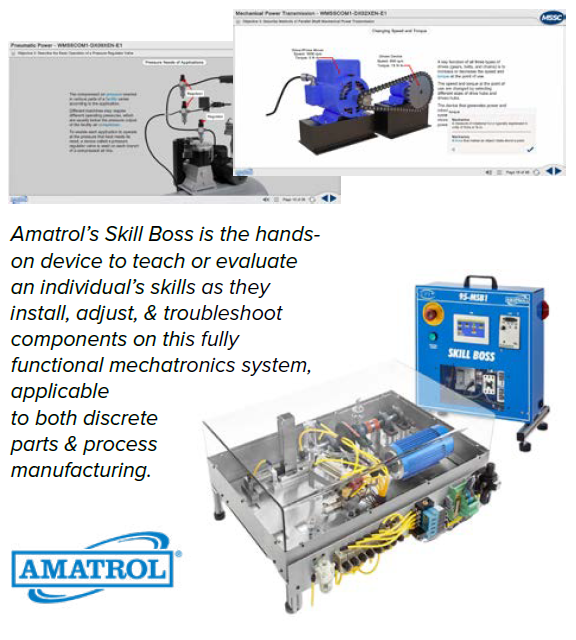
Our Certified Production Technician 4.0+® (CPT 4.0+) Integrated Training & Certification System now embeds hands-on skill development directly into the eLearning experience. Using Amatrol’s Skill Boss device, learners seamlessly translate online lessons into real-world practice—installing, adjusting, and troubleshooting components on a fully functional mechatronics system
.
This powerful integration ensures participants gain both the theoretical knowledge and the practical expertise required in today’s advanced manufacturing environments. With the opportunity to earn up to eight certificates and two full certifications, CPT 4.0+ stands as MSSC’s most immersive and job-relevant program to date. Review the program one-pager here.
| | AI on the Factory Floor: New Insights from MSSC and Industry Leaders | | |
For nearly three decades, MSSC has been recognized as the nation’s “Gold Standard” in certifying frontline manufacturing technicians, ensuring that America’s workforce keeps pace with technological change.
Today, Artificial Intelligence is projected to transform nearly every aspect of frontline manufacturing—from predictive maintenance and robotics to quality control, safety, and real-time adaptability. In close collaboration with industry leaders, MSSC has identified the most critical focus areas where AI will impact technicians on the factory floor.
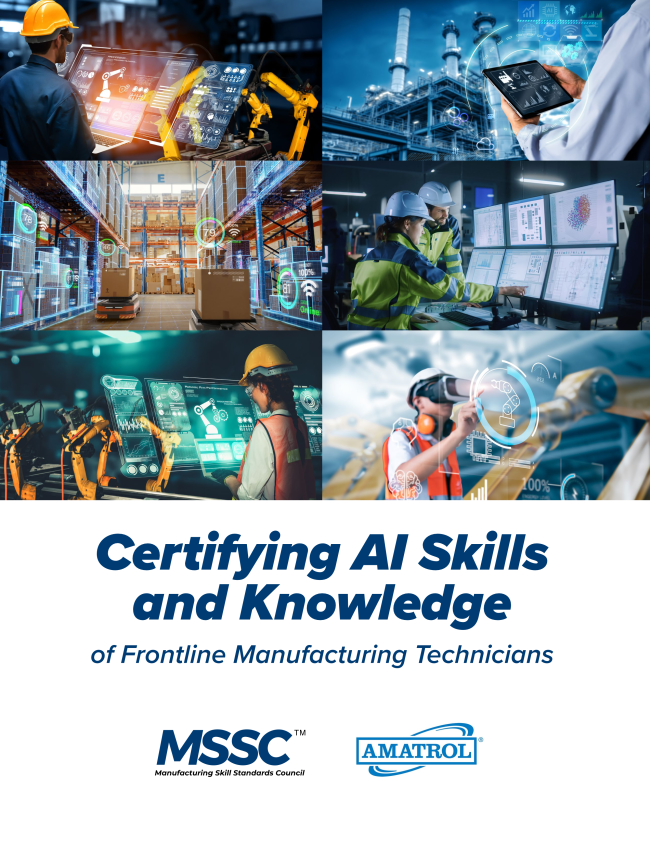
This new background paper highlights those priorities and shows how MSSC is preparing workers, educators, and employers alike to thrive in the next era of advanced manufacturing. Download the paper here.
| | |
MSSC Fall 2025 High School Video Contest
MSSC recently launched the Fall 2025 High School Manufacturing Video Contest: “What Manufacturing Means to Us.” This nationwide competition invites high school students in grades 9–12 to create original videos that showcase the exciting world of advanced manufacturing and highlight its diverse career pathways. With the theme “Redefining the Narrative: The New Face of Manufacturing,” the contest empowers students to tell their own stories while exploring career opportunities in modern manufacturing. Submissions are due January 4, 2026, with cash prizes, CPT 4.0 course licenses, and instructor training packages awarded to the top three winners, plus a UberEats gift card for all participating teams. More information can be found here.
| | |
U.S. Chamber of Commerce Foundation: Unlocking the Potential of Adult Workers
A recent article published by the U.S. Chamber of Commerce Foundation by Jaimie Francis, Vice President of Policy and Programs, and Sharon Bonney, CEO of the Coalition on Adult Basic Education (COABE) highlights how adult workers—often overlooked despite their experience and adaptability—represent a critical solution to persistent talent shortages across industries. One powerful example comes from an employee named Courtney Faulkner, who advanced from an auditor position to quality supervisor after completing training and earning her Certified Logistics Technician (CLT) credential. She credited the credential with helping her directly connect education to her day-to-day role, giving her both the confidence and practical skills to grow within her company and the broader industry. Her story illustrates how industry-recognized certifications can be transformative—providing clear pathways for advancement while strengthening employer retention and talent pipelines. The report calls on employers to lead workforce strategies, leveraging models that align training with business needs. Adult workers, it concludes, are not a backup plan but a strategic advantage for future competitiveness. Read the full article here.
| | |
Has the Apprenticeship Moment Finally Arrived?
Economist Robert Lerman, chairman of Apprenticeships for America, traces the history of U.S. apprenticeship policy, from early bipartisan interest in the 1990s through initiatives under Presidents Obama, Trump, and Biden. He notes that while registered apprenticeships have grown, the U.S. still lags far behind other nations, with apprentices making up just 0.33% of the labor force. Lerman highlights both the promise and pitfalls of past programs and outlines five steps needed to scale apprenticeships: incentivizing employers through funding, providing standardized occupational frameworks, supporting classroom learning, streamlining registration with stronger oversight, and creating apprenticeships in government. He argues that success would boost worker earnings, mobility, and national productivity. Read Lerman’s Washington Monthly piece here.
| |
Tracking CHIPS and Science Act Awards
The CHIPS and Science Act, passed in 2022, directs $52.7 billion to strengthen U.S. semiconductor manufacturing, research, workforce development, and supply chain security. Of that, $39 billion supports manufacturing projects, with major awards exceeding $6 billion going to Intel, TSMC, and Samsung. Initially finalized under the Biden administration, many of the multibillion-dollar awards are now being renegotiated under the Trump administration. The act also provides $13.2 billion for R&D and workforce training, $500 million for supply chain security, and a 25% investment tax credit for semiconductor-related capital expenses. Review the latest updates on the awards here.
| | |
Op-Ed: Ford CEO on Closing the Essential Economy’s Productivity Gap
Ford CEO Jim Farley warns that America’s “Essential Economy”—the 95 million workers in sectors like construction, transportation, energy, and manufacturing—is facing a productivity crisis. While white-collar productivity surged 28% in recent years, productivity in essential industries has declined, threatening wages, competitiveness, and community stability. Farley calls for a cultural shift in how we view workforce development: treating it as an investment rather than welfare. He highlights the need for modernized training, greater vocational funding, faster permitting, and the adoption of new technologies like robotics and AR to equip workers for the economy of 2050. Farley also announced Ford’s upcoming Essential Economy Summit in Detroit to spark solutions and collaboration. Read Farley’s Time piece here.
| | |
Gen Z’s Blue-Collar Revolution: Skipping College for the Trades
Fortune highlights how more young Americans are choosing hands-on careers over traditional four-year degrees, reflecting a generational shift accelerated by the pandemic. Rising college costs, student debt concerns, and strong demand for skilled workers are pushing many Gen Zers toward vocational pathways and entrepreneurship. Educators report growing interest in career-focused models that provide multiple options beyond the university track, while social media and peer success stories are helping reduce stigma around the trades. Together, these trends signal a cultural shift toward valuing practical skills, financial independence, and alternative routes to the middle class. Read the full piece here.
| | |
Report: Silicon Heartland – The Evolution of Ohio’s High-Tech Workforce
A new report from the Economic Innovation Group highlights Ohio’s pivotal role in America’s high-tech future. Despite decades of deindustrialization, Ohio is attracting major investments from Intel, Honda, and Anduril in semiconductors, EVs, and aerospace manufacturing. The study finds Ohio’s STEM graduate workforce has grown 60% since 2009, and the state ranks competitively on cost of living and technical talent. However, challenges remain: manufacturing apprenticeships are stagnant, and Ohio struggles to retain graduates, especially in STEM fields where fewer than half stay after 10 years. The report also offers recommendations to boost growth, including flexible workforce training, targeted immigration policy, and reforms to increase worker mobility. Access the full report here.
| | |
ManufacturingDive Op-Ed: Bridging the AI Skills Gap in Manufacturing
In a recent ManufacturingDive opinion piece, Kyndryl’s Onofrio Pirrotta highlights a growing “readiness paradox” in manufacturing: while 95% of companies report using AI, 71% of leaders say their workforce isn’t prepared to harness it. Pirrotta warns this gap threatens innovation and ROI, but points to solutions from AI pacesetters — treating adoption as a strategic change initiative, building trust and transparency with employees, and investing in scalable, role-specific training and certifications. His call to action: manufacturers must put people at the center of AI transformation to stay competitive in the era of intelligent industry. Read the piece here.
| | |
ED Issues Ed-Flex Guidance
The U.S. Department of Education’s (ED) Office of Elementary and Secondary Education issued new guidance for state education leaders regarding the Education Flexibility Partnership Act of 1999 (Ed-Flex). The law provides states with Ed-Flex authority, the ability to waive specific federal requirements for districts and schools, without having to go through a formal waiver process with ED. The goal of the updated guidance is to allow state and local education agencies to innovate and tailor education strategies to their needs. This flexibility covers select provisions of the Every Student Succeeds Act (ESSA), specifically Title I, II-A, IV-A, and Perkins V. Read the letter sent to state education leaders here.
| | |
ED Announced the Next Steps in Moving Perkins and Adult Education Funding to DOL
On Sept. 8, The U.S. Department of Education (ED) announced that the funding and administration of Perkins and Adult Education will move to DOL as called for in the Interagency Agreement (IAA) signed in the spring. DOL will now be responsible for portions of CTE and adult education funding, oversight and operations. The timeline for states to access funding under DOL is uncertain, and some congressional appropriators have weighed in opposing the move. More information can be found here.
| | |
Forging Futures: The Next Generation of Pathways
The Education Strategy Group’s report Forging Futures: The Next Generation of Pathways builds on a decade of expertise leading pathways work in states and communities nationwide to present a new vision for the future. It outlines five priorities: ensuring every student graduates high school on a pathway to success with work-based learning, college credit, and an industry credential; carrying forward students’ skills and credentials from secondary through postsecondary and into the workforce to accelerate career readiness; fostering student agency to navigate career options, develop future-resilient skills, and build social capital; recalibrating employers’ roles to leverage market intelligence and expand career-exposure opportunities; and redesigning high school success measures to focus on postsecondary outcomes. The full report provides strategies and action steps for state, local, and intermediary leaders:
| | |
Manufacturing Skill Standards Council (MSSC) Website
| |
| | | |