|
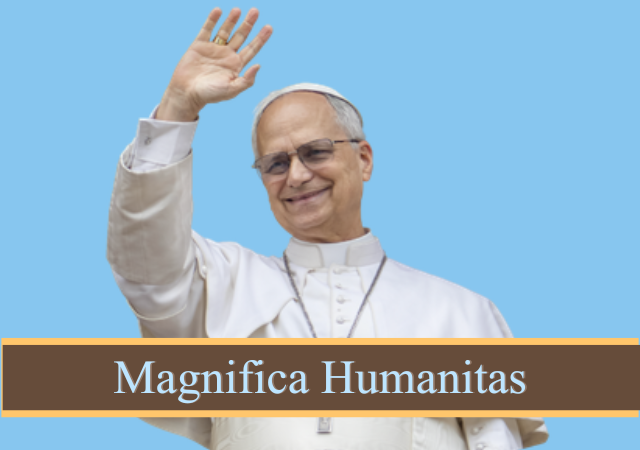
With the media coverage of Pope Leo’s first encyclical, Magnicifica Humanitas: On Safeguarding the Human Person in a Time of Artificial Intelligence, we might assume that we know what he says without reading the text ourselves. I confess to wondering if I had the energy to take it on, but the opening paragraph drew me in:
Humanity, created by God in all its grandeur, is today facing a pivotal choice: either to construct a new Tower of Babel or to build the city in which God and humanity dwell together. Each generation inherits the task of shaping its own era, of guiding history to become a place where the dignity of every person is safeguarded, justice is promoted and fraternity is made possible. Yet every era also runs the risk of creating an inhumane and more unjust world. Whenever humanity is in danger of marring its true identity, we Christians lift our eyes to the Incarnate God, knowing that it is only in the mystery of the Word made flesh that the mystery of humanity truly becomes clear.
Papal encyclicals are extraordinary documents, worthy of the global attention they receive. In "How to Read an Encyclical and Why", Brian Dikkema points out that they are written as exhortations to remember a repository of wisdom we’ve forgotten. “They take the time to pore both through the Scriptures and through the breadth of the Christian tradition to testify to the person of Christ in life right here, right now.” As Leo writes, “We wish to engage in dialogue with all men and women of our time, with whom we share in the events, questions, and aspirations of humanity.”
In that spirit, I would like to establish a diocesan working group on Artificial Intelligence, focused on education, diocesan-wide guidelines, and advocacy. If you would like to participate, please complete this interest form. We’ll organize ourselves over the summer, to begin our work in earnest this fall.
As I make my way through Magnifica Humanitas, underlining passages that stand out as worthy of deeper reflection, I invite you to join me in reading the document in its entirety, or perusing the Table of Contents for the topics that interest you. Pope Leo’s voice is worth listening to directly.
From the Introduction:
If we focus only on contingencies, we risk letting the succession of emergencies dictate the direction of our path. We are living through a rapid phase of transition, a “change of era” in which—while some are vying for the future of new technologies and others dedicate themselves to reflecting on the matter—most people are watching and waiting, observing from afar and hoping for the best. For this very reason, crucial questions impose themselves on our conscience and can no longer be avoided: where are we going? Toward what goal do we wish to orient ourselves? What direction should we choose as a people and as a human community?
The Holy Spirit challenges us today regarding our relationship with technology and the ongoing digital revolution. Technology has the power to heal, connect, educate and protect our common home; but it can also divide, exclude and generate new forms of injustice. In the abstract, technology in and of itself is not a solution to humanity’s problems, just as it is not inherently evil. In practice, however, technology is never neutral, because it takes on the characteristics of those who devise, finance, regulate and use it.
In the era of artificial intelligence, ours is the pressing duty to remain profoundly human. True progress always stems from a heart open to others, an intelligence willing to listen and a will that seeks what unites rather than what separates.
After the Introduction, there are five chapters. The first two provide Scriptural and historical context, establishing continuity with the long arc of Catholic Social Teaching.
Chapters three through five address the heart of Pope Leo’s concerns:
Near the end, there is a section entitled “We Can All Do Our Part,” in which the Pope warns against the assumption that “the problems are too big and we are too small, and that our choices, therefore, cannot make a difference.”
This is a polite form of resignation, often disguised as realism. Certainly, not everyone has the same power to make a difference. Yet, no one is without responsibility… The civilization of love will not arise from a single or spectacular gesture, but from the sum total of small and steadfast acts of fidelity that serve as a bulwark against dehumanization.
I hope to hear from those who would like to help shape a diocesan framework for artificial intelligence use in our congregations, and how we might answer Pope Leo’s call “to identify new paths for the common good and for promoting a dignified life for all.” We can all do our part, and we must.
|