|
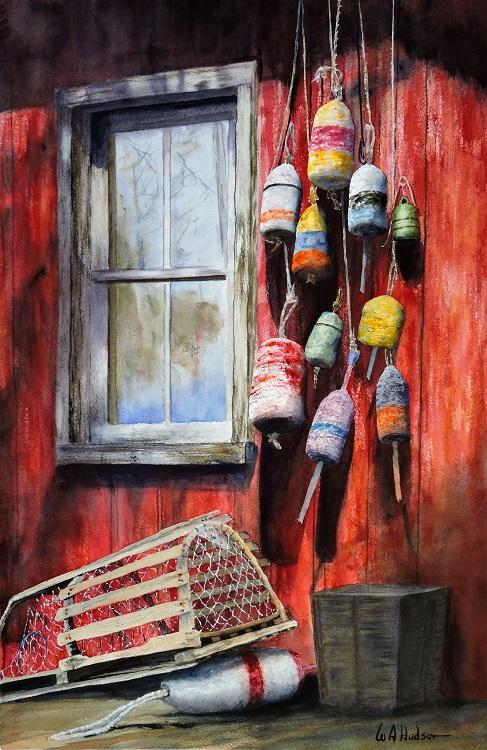
Trap and Buoys
Watercolor, 15" x 22"
by Bill Hudson
Original with custom frame ......... $1,650
Maine, Lobsters, and the Lobster War
...... by Bill Hudson.
My favorite location on planet earth is the coast of Maine. . . in the summertime! To a casual tourist with reverence for the sea, everything seems so uniquely perfect. With a coastline of 3,500 miles (comprised of peninsulas, estuaries, islands, and bays) and a total state population of only 1.4 million. . . the rocky shoreline is scattered with many small harbor towns separated by miles of thick woods. Lobster boats populate every harbor. And colorful lobster trap buoys hanging from fish shacks, or floating on the water surface, are evidence of the hard-working watermen who fish lobster in the local waters to fulfill a worldwide demand. Everything appears peaceful and content with little change over the decades.
But the climate has changed and caused ocean waters to warm. For survival, many species of marine life are moving toward the poles. For example, American clawed lobsters thrive and hatch their eggs in water temperatures between 53 degrees and 64 degrees F. But in 2012, the Long Island Sound had measured temperatures warmer than 68 degrees for nearly 100 days. . . more than twice the number of days in measurements the previous 30 years. During that 30 years, the region’s lobster catch dropped more than 90%, forcing hundreds of lobstermen out of business as the lobsters moved north.
To the north is the Gulf of Maine bounded by Cape Cod, Massachusetts on the south and Nova Scotia in the north. Although the Gulf of Maine has “warmed faster than nearly all other bodies of water on the planet,” the area is still cooler than the areas lobsters are leaving. And that warming has caused otherwise cold waters to be perfect for lobster reproduction. Coincidentally, the warming forced ground fish such as cod and haddock, which feed on young lobsters, to move even further northward.
| |
|
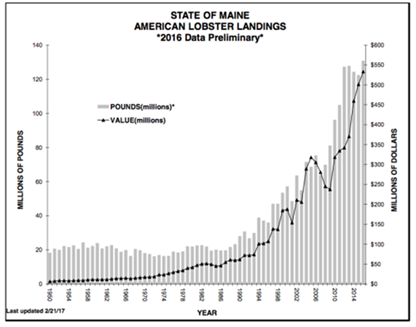
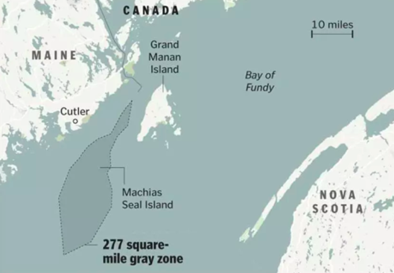
Consequently, there is a climatically perfect 277 square-mile area within the Gulf of Maine called “The Gray Zone” that lobsters multiply without natural predators. The welcomed result can be measured in pounds of lobster landed. As shown in the figure, Maine fishermen landed a nearly constant 20 million pounds of lobster each year leading up to 1987. But landings rose rapidly until 2016 when the catch exceeded 132 million pounds and began to level out.
So, why is the area in the heart of the “World’s Richest Fishing Grounds” called “The Gray Zone?” Well, in the middle of “The Gray Zone” is a tiny island that both Canada and the U.S. claim is theirs. And whoever owns that island, also owns the territorial sea around it.
| |
|
History
In 1782, a preliminary treaty between Great Britain and the United States ended the Revolutionary War and granted the Colonies ownership of all islands within 70 miles of the US shore. However, the Treaty of Paris, signed in September 1783, excluded any island that had been part of Nova Scotia.
That treaty left only one small 20-acre rocky island in dispute. . . Machias Seal Island sitting 10 miles from the Maine coast and 12 miles from Grand Manan Island, which is Canadian and part of New Brunswick. The island has an automated lighthouse built by Canada and is home to a large population of puffin seabirds which draw tourists daily from both nations. Each country has documents supporting their claim to ownership.
Owning the island determines who possesses sovereignty over the “The Gray Zone” which surrounds that island. The United Nations defined a territorial sea as: “the area adjacent to a coastal state’s land territory. It extends up to 12 nautical miles (22.2 kilometers) from the baselines, which are the low-water lines along the coast. Within this zone, coastal states exercise full sovereignty, including the right to regulate and enforce laws on customs, immigration, and pollution control. The United Nations Convention on the Law of the Sea (UNCLOS) provides the legal framework for territorial seas.”
Update
The waters surrounding Machias Seal Island had been fished for years by lobstermen from both Maine and Canada. There had been little conflict even though each country had different fishing restrictions. For example:
· Mainers are allowed to lobster year-round. Canada did not allow lobster fishing from July 1st to mid-November.
· Canadians can keep large lobsters. Mainers must throw them back.
· Canadians are restricted to 375 traps per license. Mainers can set 800 traps at a time.
· Canada allows lobstermen to fish at night. The US bans night lobster fishing.
But, tensions grew as “The Gray Zone” grew into a lobster-rich money maker. In 2002, Canada allowed their lobstermen to work in “The Gray Zone” year-round to assure their share of the bounty. Disputes grew with the increasing numbers of lobster boats, men, traps, and patrol boats from both countries. Many incidents were recorded of stolen traps, stolen catch, severed lines, pots/traps dropped near/over competitor’s, etc.
Since 2016, Maine’s lobster catch began a slow decline from 132 million pounds. In 2021, Maine’s catch was 108 million pounds while in 2022, it had fallen to 98 million pounds. The reasons are probably continued climate change with lobster migration, a greater portion going to Canadians, and/or both.
| | |
| |  | A lot of this is documented in the award-winning feature film Lobster War: The Fight Over the World’s Richest Fishing Grounds, available on multiple apps including YouTube and Tubi. I watched the documentary for the first time while I was painting “Traps and Buoys” shown above. I was surprised to see Brian Cates as a lead cast member. I met Brian while visiting Maine in 2014. I was in the town of Cutler (shown on the map), standing on a wharf I thought was public, taking many photographs of the spectacular harbor for reference. Brian was docking his new boat to the same wharf that I learned was his. But he was very friendly as we discussed his new 48-foot Newfoundland model boat, which has a wider beam than those normally made in Maine. He named her "Legacy" and had the name of his 5 grandchildren written on the cabin bridge. Brian told me his two sons were still out fishing that day and for many like himself fishing has stayed in the family for generations. He also said he had once taken a big chance and named his first boat after his wife. But he named it before he had asked her to marry him. "Turned out OK," he said.
It's almost funny now that I’ve watched the movie. Brian has lobstered The Gray Zone for 50-some years. The Legacy is featured in the film and together they faced documented threats that were occurring at the time of my visit. But for me, the casual tourist, everything appeared perfect, peaceful, and content with little change over the decades.
_____________________________________________________________________________________
References
· Lobster War: The Fight Over the World’s Richest Fishing Grounds, Documentary Film 2018, Director: David Abel, Cast: Brian Cates, Brian Guptill, Johnny Hathaway
· National Geographic, July 23, 2018, The ‘Gray Zone’ Between the U.S. and Canada: Why This Murky Border Matters
· The Working Waterfront Archives, Bob Gustafson, September 1, 2002, Lobstering in “Gray Zone” now matter of dispute
· Marineinsight.com/maritime law, Understanding International Waters: Boundaries, Jurisdiction and Legal Implications, by Rishabh Srivastava, June 26, 2023
____________________________________________________________________________________
| |
|
Join me this March where I have a booth in the:
The Pacific Coast Sportfishing Tackle, Boat, Travel and Outdoors Show
Orange County Fair & Event Center
88 Fair Drive, Costa Mesa, CA 92626
March 6-9 2025
Thur Mar 6 12 PM – 7 PM
Fri Mar 7 12 PM – 7 PM
Sat Mar 8 10 AM – 7 PM
Sun Mar 9 10 AM – 5 PM
This is the 15th year of the West Coast’s premier outdoors show. All 7 halls of the OC Fairgrounds are filled with boats, fishing tackle, apparel, travel destinations, seminars, live music, and maritime art.
Tickets are $23.18. Kids 12 and under and active-duty military are free.
Other than galleries, this is my first show in a while and I’m looking forward to it. I’ll be in my booth with help from some of my family. I’ll have many recent, custom-framed originals and unframed, double-matted limited editions ($150) ready for any standard 18” x 24” frame.
Hope to see you there.
| |
|
Studio Visits
My studio is an area within the business owned and operated by my son, Will. Will’s company Hudson Shuffleboards manufactures (entirely in the USA) and sells worldwide, custom crafted table shuffleboards of many designs and lengths from 7-feet to 22-feet. Will's and my location is:
3701 W. Carriage Drive
Santa Ana, CA 92704
I’m usually in my studio 3 days/week and welcome visitors. Stop in anytime. But to guarantee I’m there, call me at 714-795-0820 and make an appointment.
Thank You
Again, I thank each of you for your continued interest in this Newsletter. If you wish to make any art related announcements or comments that may benefit the readers, feel free to submit them for the next issue.
| |
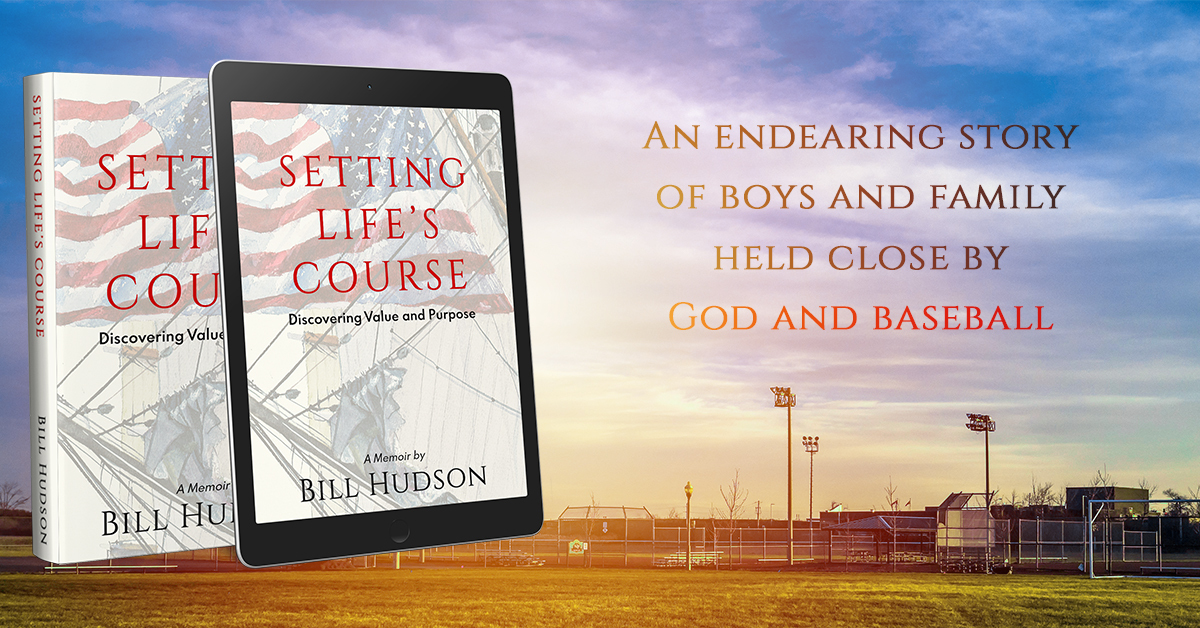
SETTING LIFE'S COURSE
Discovering Value and Purpose
by Bill Hudson
click here> www.Amazon.com
| |
|
Past Newsletters
Past Newsletters are listed chronologically by title in the Newsletter section of my website www.BillHudsonArt.com/newsletter/
Events & Galleries
Fine Art America, is an online print-on-demand gallery which sells nearly all my images. These are available in a wide range of sizes on many substrates and objects including: coffee cups, shirts, towels, greeting cards, puzzles, phone cases, and tote bags.
Pacific Coast Sportfishing Show at the Orange County Fair & Event Center, March 6-9, 2025
| | | | |