|
*Support Maine Lakes Today
*Changing Faces at Maine Lakes
*Lake Conference Updates
*Boating Safety Reminders
*Leave the Muck!
*Cyanobacteria Outreach and Reporting Resources
| | Support Maine Lakes Today | |
Maine Lakes could not succeed in our work to keep Maine's lakes healthy (by advocating for strong lake policies, training and supporting LakeSmart volunteers, and strengthening networks for lake associations, freshwater educators, and others) without the support of our members. All who donate to Maine Lakes are considered members, and we'd love to have your support today.
To read more, check out our summer appeal letter HERE, or donate directly on our secure website HERE.
We know how careful everyone has to be today with their dollars, and we appreciate gifts of any level to support lake protection. Thank you for considering a gift that helps keep Maine's lakes clean and healthy.
| Changing Faces at Maine Lakes | | Maine Lake staff: Nancy Audet, Caroline Seibert, Susan Gallo, Joshua Tait, and Andrea Stevens | | |
2026 is a year of exciting staffing changes here at Maine Lakes!
In February, Leah Gauthier left her position as office manager to handle our graphic design and website management needs on a contract basis. We miss seeing her every day but are grateful to have her help with so many design and web projects.
At the same time, Nancy Audet came on board as office and program administrator. Nancy brings decades of experience working at Maine nonprofits large and small. She manages day-to-day administrative tasks and provides support to staff in a variety of ways. Her expertise in communications and development are helping Maine Lakes expand our social media presence and grow our membership.
In April, Joshua Tait joined us as the seasonal LakeSmart assistant. He has been busy this summer supporting LakeSmart teams, reviewing evaluations, and completing lots of other LakeSmart projects. Josh is an enthusiastic and dedicated member of our LakeSmart team! He is a recent graduate of UMF where he was a first-generation, non-traditional student.
Lastly, we are bidding a fond farewell and a great big THANK YOU to our LakeSmart program coordinator Caroline Seibert. Caroline started working at Maine Lakes in 2022 and among her many accomplishments she was a talented data analyst, summarizing and presenting information about Lakesmart data and program growth; a skilled educator, leading countless on-line and in-person trainings and supporting LakeSmart teams in northern and downeast Maine; a wonderful collaborator, joining the conference planning team and helping develop Healthy Lakes videos; and so much more. Her positive attitude and collaborative spirit will be greatly missed. We her all the best in her upcoming role as a new mom!
| | |
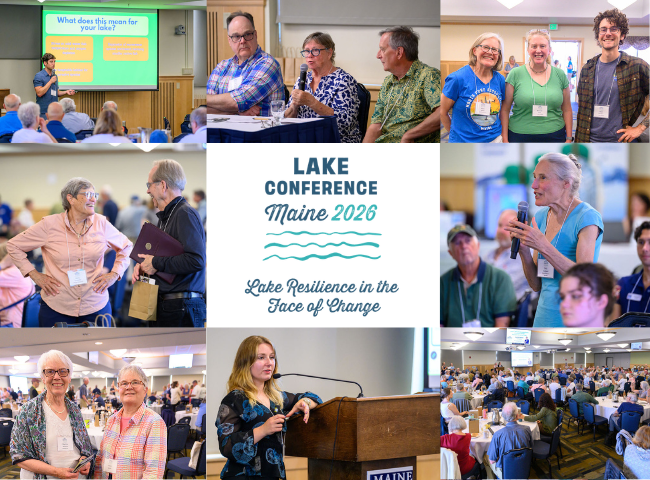
Many thanks to everyone who attended the 2026 lake conference!
By all accounts, it was one of the best conferences ever. Over 200 attendees enjoyed the wide variety of speakers, including meteorologist Keith Carson, who gave attendees tips for communicating about lakes and climate change. It was wonderful to see so many lake association representatives, active lake volunteers, and professionals in the field of lake conservation together in one place.
PRESENTATIONS: Recordings of most speaker presentations have been added to the Lake Conference website.
SPONSORS: The generous support of our sponsors, including our lead sponsor Hammond Lumber Company, helped to make the conference a success. See all conference sponsors HERE. If you connect with any of these businesses, please let them know you appreciate their support of the conference!
RAFFLE and SILENT AUCTION: Thank you to everyone who participated in the conference fundraiser that raised more than $5,000 to support this and future conferences. We are grateful for the many businesses and individuals who contributed items and the many generous participants who bid and bought tickets. Please take a look at the business donors HERE and if your paths cross, please thank them for contributing to an exceptional fundraiser.
Mark your calendars now for Lake Conference Maine 2027!
Friday, June 11
Wells Conference Center
University of Maine at Orono
Registration will open after the new year. We hope to see you there!
| | |
One of the best ways to explore a Maine lake is by boat. Whether you’re paddling, fishing, or cruising, stay safe and informed on current boating rules.
Lifejacket Requirement for Children: Starting in January 2026, Maine law requires that all children 12 years of age or younger wear a United States Coast Guard-approved personal floatation device (PFD), such as a lifejacket or buoyancy vest, whenever they are on a recreational watercraft. This includes boats, jet skis, paddle boards, kayaks, canoes, and similar vessels. The updated age requirement, raised from 10 years to 12, was passed by the Legislature to improve youth safety on Maine’s waters and now also aligns with Federal Law.
A reminder that one U.S. Coast Guard-approved PFD is required for each person on a watercraft, regardless of age. Boats longer than 16 feet are also required to have one Type IV throwable device, like a ring buoy (except canoes, kayaks, and paddleboards).
Mandatory Boater Education: A person born on or after January 1, 1999 must complete a boater safety and education course in order to legally operate a motorboat greater than 25 horsepower for recreational boating purposes on inland waters. This requirement also applies to operation of a personal watercraft (such as a jet ski). These persons must possess and present a boater safety and education course certificate for inspection upon request by a law enforcement officer.
Maine Lakes encourages all boat operators to take a boater safety course, regardless of age.
Resources for boating safety:
| | |
Don't fall for 'natural' lake cleaning claims.
If you follow a lot of lake-related content on social media, it’s likely that ads promoting “natural” chemical products for “cleaning” lake water have come across your feed. Despite claims that these products are legal in all 50 states, we can assure you they are not legal in Maine unless you have a license for discharging (see below) and there are very good reasons we want to keep it that way.
Lake-bottom “muck” is made up of decaying plant material and other organic matter, algae, and fine sediment. Chemical products containing bacteria and enzymes "clean" muck by accelerating decomposition. There are several negative side effects to lake ecosystems from accelerated decomposition, including changing nutrient cycling, altering natural microbial communities, depleting oxygen, and releasing nutrients from organic sediments.
While natural decomposition of plant material is good for the health of a lake, the speeding of decomposition is as it can result in the rapid release of nutrients from organic materials, particularly phosphorus, that fuel excess algae growth.
These products also reduce the quality of habitat in the littoral zone, the shallow water area near lakeshores where light reaches the lake bottom. This area is crucial for lake life. Fish, frogs, turtles, and aquatic invertebrates like dragon flies all use the littoral zone for feeding and as nursery grounds for their young.
Even if these products were legal in Maine, their effectiveness is reduced (and they may not work at all) in our colder more northern lakes.
There are ways you can reduce the potential for “muck” buildup while also promoting healthy lake systems.
-
Reduce runoff/erosion: Manage stormwater runoff by slowing or diverting the flow to reduce the amount of sediment (and associated nutrients) that reach lake water. Our LakeSmart program can help identify effective best management practices (BMPs) to reduce runoff.
-
Extend natural shoreline vegetation: One of the best BMPs out there, and one that is recommended to almost every shoreline property owner we talk to, is to build more robust vegetative buffers along shorelines. The deeper a buffer is along a lake shore, the more effective it will be as a “last line of defense” that captures nutrients and keeps them out of lakes.
Relevant Maine Statutes:
The Maine DEP regulates the discharge of chemicals into lakes under Maine law, specifically 38 M.R.S.A. §413 and §420, which prohibit the direct or indirect discharge of pollutants—including chemicals—into lakes, ponds, or their tributaries without a license:
“Prohibition of Discharge (38 M.R.S. §420, §413): No person or entity may place, deposit, discharge, or spill, directly or indirectly, any toxic or hazardous substances (including chemicals) into Maine's inland surface waters (lakes) or on the ice or banks where they may flow into the water.”
| | Cyanobacteria Outreach and Reporting Resources | | Gloeotrichia sp. on Swan Lake, Maine. Photo Credit: Lake Stewards of Maine, J. Ferendo | |
The Maine Cyanobacteria Group, a coalition of state agencies and lake organizations lead by Midcost Conservancy, has developed a free resource to help communities spot and safely respond to cyanobacteria (harmful algal) blooms, before they become a health risk for local families and pets.
With support from a Maine Outdoor Heritage Fund grant, the group has created a free, printer-friendly poster that explains how to visually identify a cyanobacteria bloom and where to report a suspected bloom. The poster can be customized with local details, for example, recent water testing results, current bloom status, and local contact information, making it suitable for posting at camp rentals, campgrounds, boat launches, town offices, or lake association bulletin boards. Lake associations should also consider adding it to their newsletters and websites.
You can find the poster HERE. Many thanks to Midcoast Conservancy for leading the charge on this helpful publication.
To see where cyanobacteria blooms are happening in Maine’s lakes and ponds, visit the new Cyanobacteria Bloom Reporting Dashboard from the Maine DEP. It lists locations and descriptions of blooms, and results if the DEP has tested the bloom for toxins. You can also report any potential cyanobacteria or other algal bloom that you observe on Maine’s waterbodies.
| |
|
To manage communications from Maine Lakes,
click here to change your communication preferences.
To opt out of all e-newsletters from us, including
Advocacy Alerts, LakeSmart News, and the monthly newsletter,
click the unsubscribe button below.
Join us on Facebook, Instagram and LinkedIn
| | | | |