STAY INFORMED – TALKING POINTS – ACTIONS – VOICES – STORIES MAKING NEWS | |
Collective Blame Pushes Jews Out of Public Life
| |
Much of public opinion has turned against Israel in the wake of its Oct. 7 response – bleeding into blaming Jews in the U.S. and around the world for a nation’s actions 6,000 miles away from Washington, D.C.
No one tells a Russian-born nurse to renounce Moscow for its invasion of Ukraine so she can keep her job or asks a Chinese American student to answer for Beijing’s aggressions towards its neighbors. Activists, organizations and many members of the general public hostile towards Israel now demand exactly that of Jews regardless of where they live or their views. They treat the nearest Jewish student, coworker or shop owner as a stand-in for a government thousands of miles away – to be shut out of campus events, offices and bookshops unless he or she denounces Israel.
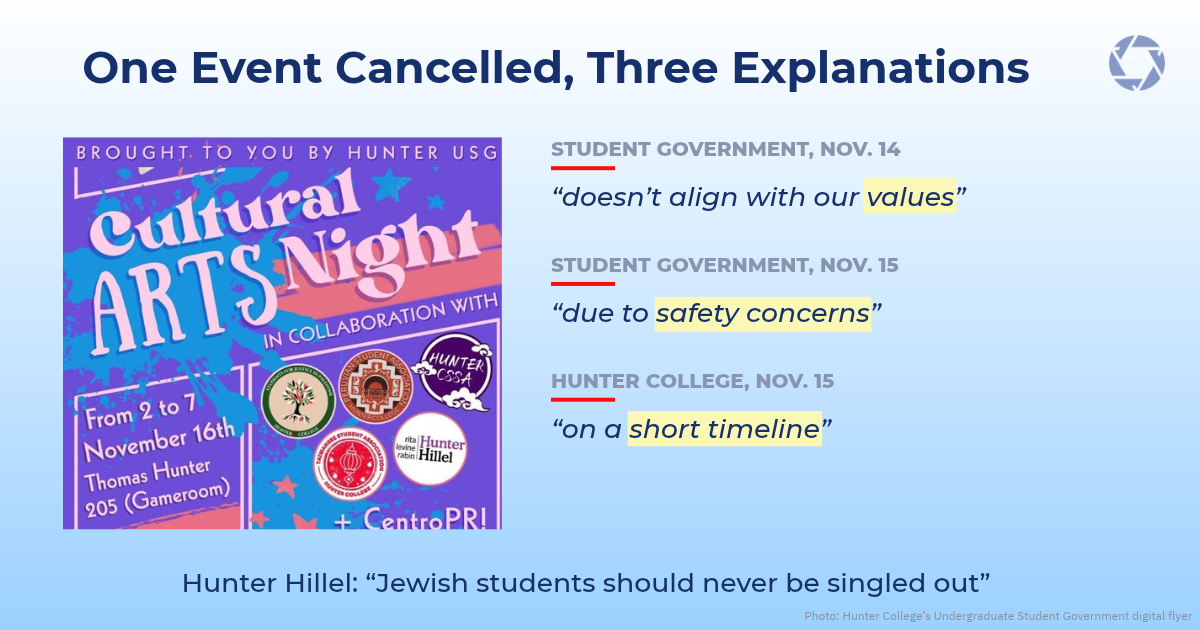
One recent flashpoint is Hunter College in NYC, where the student government canceled a Cultural Arts Night that listed Hillel – a Jewish student organization – among its six partner groups. Student leaders wrote that the event “doesn’t align with our values” and later cited “conflicting views of participating organizations.” Whatever disagreements anyone has with Israel’s leaders and actions, holding Jews collectively to blame is wrong – and it is pushing them out of public life.
Student Leaders Cancel ‘Inclusive’ Cultural Event
Campus life is where the pressure on Jews has been the most overt since the nationally televised anti-Israel encampment protests that started after the Iran-backed Hamas massacres on Oct. 7, 2023. Activists intimidated Jewish students when they tried to walk to their classes, study in the library or participate in online forums.
Hunter’s student government planned a Nov. 16 event with the anti-Israel group Students for Justice in Palestine, the Peruvian, Chinese and Taiwanese student associations, the Center for Puerto Rican Studies and Hillel. The student government president and vice president cancelled it and wrote that it “should never have moved forward.” They apologized to the clubs involved and promised that in the future every club “will know who is involved in an event before it is planned or approved.”
The explanation then changed. A second statement cited “safety concerns” and reported that several participating clubs had withdrawn. The college pointed to a short planning timeline. None of the statements named Hillel directly yet some online comments thanked student government for not working with Hillel. Back in 2024, activists at Hunter accused Hillel of complicity in war crimes and a protest leader chanted: “We say no to genocide, Jews on campus pick a side.”
Jewish students had looked forward to the evening. Hillel stated that it “had no role in the decision to cancel” and called the antisemitic responses to the cancellation “egregious and inappropriate.” Hillel closed with a message to Jewish students: “You belong here, and we are with you.”
Two NYC council members demanded an investigation. Holocaust historian Deborah Lipstadt, the former U.S. special envoy on antisemitism, summed up the cancellation: “Making Jewish life toxic.”
| |
Health Department Staff Sue NYC for Investigating Their Grief
Workplaces are holding Jewish employees to a standard that other groups do not face. The National Jewish Advocacy Center (NJAC) recently sued NYC on behalf of seven employees of the city’s health department. Their complaint says that the agency recognizes six employee groups built around a shared identity but twice refused to recognize a Jewish one on the grounds that groups cannot be based on religion. The group’s proposed charter centers on “Jewish peoplehood, ancestry and culture.”
The lawsuit alleges that the agency’s anti-discrimination director targeted the Jewish group after its members mourned Jews murdered at Australia’s Bondi Beach last year. Two Islamic State-inspired terrorists massacred 15 people during a Hanukah celebration. After the group emailed their condolences to mourning colleagues, the agency opened a discrimination investigation into eight of its leaders.
Investigators questioned them about Zionism and Israel, and one asked whether the massacre was “an antisemitic attack or an antizionist attack.” The agency closed the case without findings. The head of NJAC stated that the city told Jewish employees every identity counts except theirs, “then investigated them for grieving.”
Twice this year in the U.S. the American Psychological Association postponed a vote on recognizing the Association of Jewish Psychologists. The Anti-Defamation League called it a “double standard.” Other Jewish psychologists have been blacklisted and Jewish and Israeli patients have been “ostracized, harassed and protested simply because of their identity.”
Worldwide Targets: Poetry Night and Museum Commemoration
Activists are applying collective blame to Jews around the world. A new survey found that 79% of French Jews say they have been held responsible for the actions of Israel’s government – and 64% are considering leaving France.
A bookstore in Edinburgh, Scotland, canceled a poetry slam after asking its Jewish host to state her position on Israel. The owner feared “the perception that we’d support the state of Israel.” The host, Dr. Tracey Rosenberg, reported the incident to Scotland’s political leaders, calling it “blatant discrimination” in violation of Britain’s Equality Act.
A city museum in Amersfoort, Netherlands, recently canceled an exhibit celebrating the 300th anniversary of a synagogue in the city. Similar to Edinburgh, anti-Israel activists led a pressure campaign to boycott the event. The museum’s director cited safety concerns and did not want to expose his staff to public reactions. The head of Amsterdam’s Jewish Cultural Quarter warned that tying Jewish history to events in the Middle East means “making Jewish existence conditional.”
Following the museum’s announcement, Mayor Lucas Bolsius stepped in to ensure the exhibition could proceed and received offers of help from across the country. The mayor told the city council that the museum’s decision hurt local Jews by “reinforcing the feeling that the Jewish community is not welcome or even allowed to exist.”
| | |
Support from the Liberty Bell to a Dutch Leader’s Mezuzah
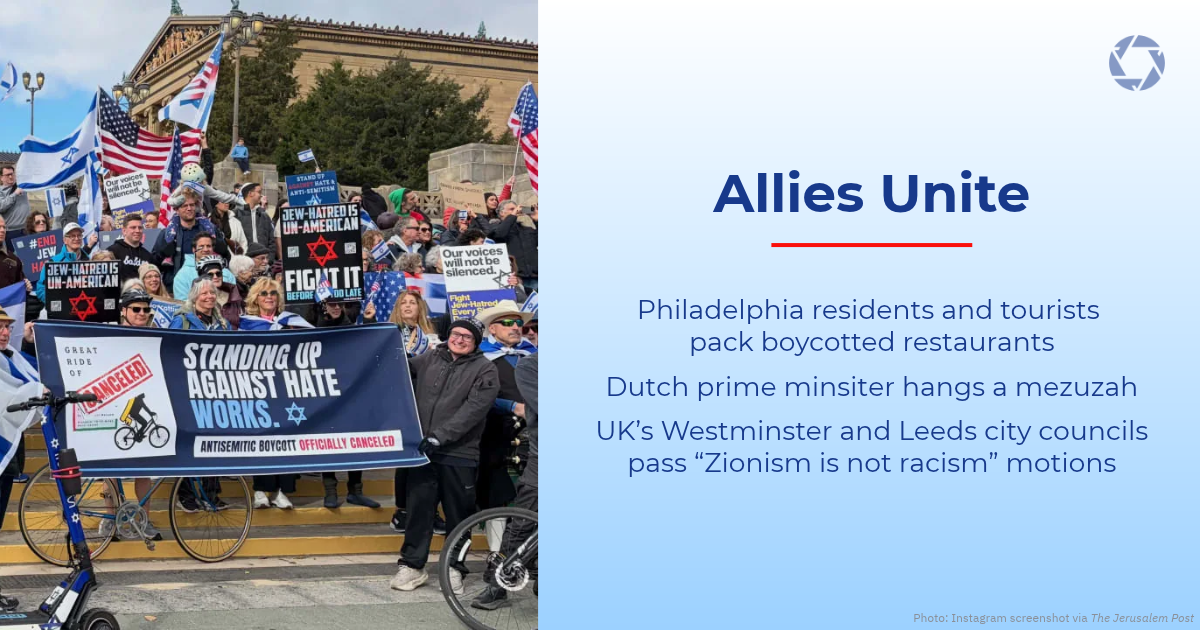
Americans also are stepping up. Philadelphia residents recently packed six Jewish restaurants that anti-Israel activists targeted with a boycott. A week later, Jews and interfaith allies marched and rode bicycles from the steps of the Philadelphia Museum of Art to the Liberty Bell and restaurants are still full of loyal patrons. Organizer Aryeh Shalom stated: “I don’t want my children to have to hide their Jewish identity.”
On the anniversary of the 1938 Nazi Kristallnacht pogrom, German Chancellor Friedrich Merz declared that “normal, open, visible Jewish life in Germany is still not possible” and that antisemitism is sometimes disguised as criticism of Israel. Dutch Prime Minister Rob Jetten answered Jewish anxieties with a public demonstration. He affixed a mezuzah, a small case holding a prayer scroll that marks a Jewish home, to his front door because he wants “to be prime minister of a country where Jewish life is visible.” He urged the Jewish community: “Do not give in, because this is your home – the Netherlands is our shared home.”
| | |
1. Collective blame wrongly punishes Jews
Antizionist activists are blaming Jews for the actions of Israel’s government – real or fabricated. Japanese Americans were not responsible for Pearl Harbor and Muslim Americans were not responsible for 9/11. U.S. Democratic Rep.-elect – and Democratic Socialists of America member – Chris Rabb waited six days to criticize the ride organizers’ tactics in the city he will represent, and still blamed Israel’s actions for what “got us here.” A person can hold any opinion about Israel and still know that punishing their Jewish neighbors is wrong.
2. Jewish life in a free society cannot come with conditions
A poetry night and a 300-year-old synagogue have nothing to do with Gaza – only with the Jews attached to them. Asking a Jewish poet, city employee or psychologist to answer for Israel before being allowed to perform or work puts a condition on one group’s right to take part in public life. Vandals in Barcelona spray-painted “Zionists, get out of the neighborhood” on an Israeli-owned ice cream store. The owner answered: “The graffiti can be wiped away, but our roots cannot.” No one should have to pass a political test to belong.
3. Silence from the moderate majority lets the extremes set the rules
The people who treat mourning murdered Jews as offensive and want Jews screened at the door are counting on everyone else staying quiet. Far-left riders outside Jewish restaurants in Philadelphia and far-right agitators outside a new Orthodox Jewish neighborhood in Florida have grown bolder. When the city council in Somerville, Massachusetts, passed an Israel divestment measure, only one member out of 11 voted no. Councilor Kristen Strezo stated that it left Jewish residents feeling “targeted,” “unsafe” and “unwelcome.” One voice is not enough. The political center has to speak up before the extremes take over.
4. The fight against discrimination is not exclusive to Jews
Despite rising hostility, many Jews are responding with renewed pride and visible Jewish symbols. They are not doing it alone. More than 60,000 Christians and Jews recently marched through Lima, Peru, to honor Holocaust victims, support Israel and oppose anti-Jewish hatred. In Philadelphia, non-Jews joined their Jewish neighbors to dine at the six restaurants targeted by activists. Acts of friendship like these show that courage and connection are stronger than hate.
| | |
Speak up when Jews are singled out: When a classmate, coworker or neighbor is told to answer for Israel, say plainly that it is wrong. Voices from outside the Jewish community carry special weight. Thank the leaders who speak up and reach out to the ones who stay silent.
Demand equal treatment and seek legal help if necessary: Ask your employer, union, professional association or college whether Jewish groups receive the same recognition, funding and protection as every other group. Students and employees who are shut out or investigated for being Jewish or supporting Israel can report it to the ADL, Brandeis Center, Campus Antisemitism Legal Line or StandWithUs. Contact your U.S. Representative and Senators and urge them to equally apply civil rights protections at school and work.
| | |
How a Christian Chose to Support Israel
Excerpts from Catholic podcast host Gates Garcia, in the City Journal:
“In February 2023, I was invited on a ten-day trip to Israel through an organization called Passages.
“Then October 7 happened, and my trip was canceled. While I struggled to comprehend the brutality, I was astonished by something else: the reaction. Some Americans were already finding ways to rationalize the murder before many Israeli families had even learned the fate of their loved ones. It wasn’t just the celebration from some of the usual bad actors, but the refusal of others to condemn it that shocked me.
“I recalled a lesson from my parents: you can tell a lot about a person by the company he keeps. The people we admire, defend, and voluntarily associate with reveal a lot about our values. I began applying this simple childhood lesson to the increasingly bitter Israel debate.
“Meanwhile, I found another group whose example pulled me in the opposite direction: Jewish Americans like Liel Liebowitz, who rides the New York City subway wearing his yarmulke, refusing to hide his identity despite what it might mean for his personal safety; Catholic Bishop Robert Barron, who defends Catholic teaching against antisemitism; and ordinary citizens willing to risk friendship, professional opportunities, and social standing to defend principles they believe matter more than popularity.
“In a world that often obsesses over choosing the winning side, I’d rather choose the company worth keeping.”
| | |
Stories of Resilience
Stories Impacting American Jews
Stories Impacting the U.S. and Israel
Stories from Around the World
| | CLICK BELOW TO ACCESS ADDITIONAL FOCUS PROJECT RESOURCES: | |
Want to Read More of Our Talking Points? | Did you miss a recent edition of The Focus Project? No need to search your inbox. Our most recently published editions are available on our website. Click below to continue reading. | | | | |
The Focus Project develops and distributes news, background, history and weekly talking points on timely issues to inform individuals and organizations about issues affecting the American Jewish community and Israel, and help readers speak with more consistency and clarity. The editions also provide potential responses for addressing incidents of antisemitism and anti-Zionism. With input from a spectrum of major American Jewish organizations, we focus on that which unites us, rising above political and individual agendas.
Recognizing that hatred of Jews comes in many forms and directions, we strive to address all sources as they arise, and educate our growing audience on topics ranging from inter-religious relations to relevant international developments. From week to week, we may focus on issues arising from the political left, university campuses, from the political right and from institutions, government, and corporations. We don’t try to address all issues in each edition. We hope you will find this information useful in your writing and/or speaking. We are always open to your feedback: info@focus-project.org.
| | | | |