|
What's the Right Size Recorder for This Part?
By Eric Haas
| |
|
When an inexperienced consort player is presented with a new piece of music, it can sometimes be a challenge to figure out which size recorder to play on each part. There are three factors to consider.
-
Ambitus or range: The highest and lowest notes of a part (or instrument).
-
Tessitura: The portion of that range in which most of the notes of a part lie.
-
Relationship to other parts: Each part must sound in the correct range compared to the other voices.
| |
A little historical background and some definitions
Pitch nomenclature
Generally speaking, musicians tend to refer to pitches relative to their own instrument and experience. A beginning soprano recorder player may refer to the note an octave above the lowest one as ‘high C’, while a more experienced player would mean the pitch above that, two ledger lines above the treble staff. Moreover, ‘high C’ on a tenor recorder is not the same pitch as ‘high C’ on a soprano, though they are written in the same way.
To be able to talk about pitch, we need a naming convention that isn’t instrument specific. To avoid ambiguity when discussing pitch, modern scientific notation (SPN) has become the standard. Octaves are designated from 0 to 9, each octave beginning on pitch name C and ending with B. Thus any pitch can be unambiguously identified as, for example, C4 (‘middle C’ on the piano keyboard). But bear in mind that a written C4 on soprano recorder actually sounds an octave higher (C5).
In order to explain the common terms ‘8’ pitch’ and ‘4’ pitch’, some historical background is useful. Before the international adoption of SPN in 1955 (and in some circles even today) terminology borrowed from organ building was used to identify pitch. An organ pipe corresponding to the pitch C two octaves below ‘middle C’ (the lowest pitch on most organ keyboards) is about 8 feet long. The pipe for pitch C one octave below middle C is roughly 4 feet in length. Thus an organ stop where all pitches sound as written is designated 8’, while one where the notes sound an octave higher than written is 4’. In this system octaves are designated by a combination of upper and lower case letters and primes:
| |
Written vs. sounding pitch
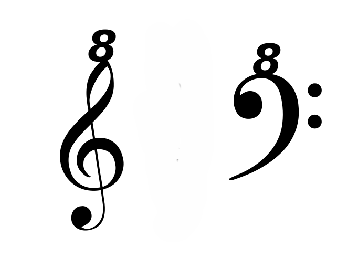
Soprano and bass recorder parts sound an octave higher than they are written. In some modern editions, a superscript 8 is written above the clef to indicate this (see image).
Whether the ‘8’ is present or not, these parts sound an octave up. Tenor recorders are almost always written at the sounding pitch. If a tenor and soprano play the same notes, the soprano will sound an octave higher. Alto recorder is often written at actual pitch as well, but especially in vocal music it may be written an octave lower. [A few modern composers have tried notating recorder music at the actual sounding pitch, with numerous ledger lines for the soprano and the bass part written in treble clef with ledger lines below.]
For more information on recorder ranges and pitches, see an ARS NOVA article by Wendy Powers entitled Foot Notes: Four-foot, Six-Foot, Eight Foot Pitches Explained.
| |
Notational conventions
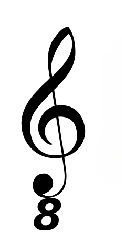
In the old organ building terminology, voices sound at 8-foot pitch (as written) while recorders sound at 4-foot pitch (an octave higher than notated). Confusion arises from the difference between vocal and recorder notation. In modern vocal notation, the alto part is written in treble clef with ledger lines below the staff as needed. Tenor voice parts are notated in treble clef as well, but by convention they sound an octave lower than written (this is usually, but not always, indicated by adding a subscript 8 below the treble clef). If vocal music is played on SATB recorders, the soprano, tenor, and bass parts will all sound an octave higher than written but will be in the correct octave relationship to the other parts. The alto part, however, will need to be played an octave higher to be in the correct range, hence the useful skill of reading ‘alto up’. In most modern editions for recorders, the alto part has already been transposed up an octave.
| |
Making your choice
Range: Scan the part to find the highest and lowest notes (some editions will helpfully provide this information at the beginning of the first line). Emily O’Brien provided a useful chart of ranges for each size recorder in a recent ARS NOVA article, Playing Recorder Consort Music With other Instruments. For example if the top line has a range of C4-G5, soprano recorder is the logical choice. If, however, it lies too low (e.g. A3-A4), it will have to be played on an alto reading up).
Tessitura: Because the middle and upper range of recorders are generally louder than the lowest octave, the ‘blend’ of a recorder ensemble sounds best if all parts are played in similar registers of their respective recorders. For example, if the bass and two middle parts lie in the first octave but the top line stays in the upper octave, the top line will be louder and ‘stand out.’ But if the top line has a low or narrow range (e.g. C4-A4) that stays in the lowest part of the recorder’s range, the part may blend better if it’s played on the next size down, where it will be in the middle register.
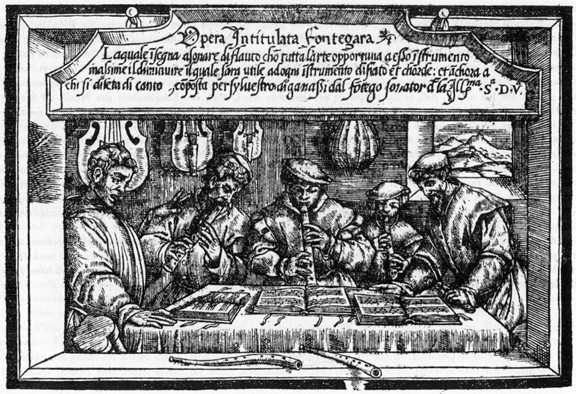
In the 16th century, a recorder consort usually consisted of instruments pitched a fifth apart: a bassett in F, two tenors in C on the middle parts, and a discantus or alto in G on the top line. This means that the top parts of much Renaissance polyphony and dance music lie quite low on a modern soprano recorder. Depending on the context, these parts often balance better if played ‘alto up.’ Sometimes middle parts are written in bass clef but lie very high for bass recorder; these parts may work better on a tenor (learning to play tenor recorder in bass clef is a useful skill).
| |
Relationship to other parts: It’s important to choose a recorder that sounds in the correct octave relative to the other parts. This parameter has the most pitfalls, especially for the inner voices. Often inner parts are written in treble clef with a subscript 8 (see image) which clarifies that they should sound lower than the top part, but this is not always the case. If the second line is in ordinary treble clef, generally in the same range or slightly lower than the top part and has no ledger lines below the staff, it may also be suitable for soprano. If it has ledger lines below the staff, ‘alto up’ is the logical choice.
| |
|
An Example
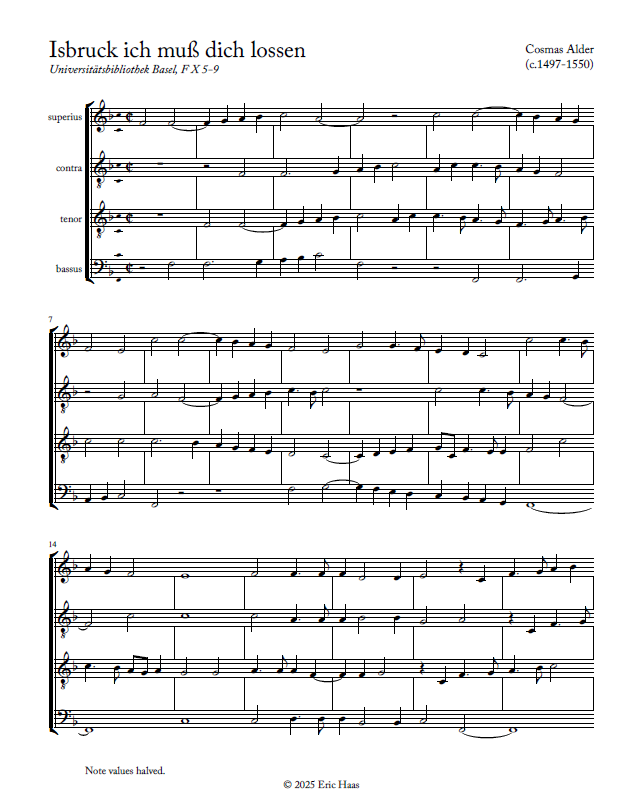
I've included a setting of Innsbruck by Cosmas Alder as an example. (Click on the image to see a PDF version.) Let's look at each part in turn, taking into consideration the three criteria.
Superius — Ambitus: will fit either a soprano or a tenor, or an alto reading up. Tessitura: lies low for a C recorder, a more powerful range on an F instrument. Part relationship: Contra and Tenor parts indicate they should sound an octave lower than the Superius. Possible choices: either a soprano, if it has a good low register, or an alto reading up (a G alto would be even better).
Contra — Ambitus: this part has a slightly larger range than the superius; it will fit on a soprano or tenor, OR on an alto or bass reading up. Tessitura: while it is mostly in the same range as the Tenor, the end extends up to a written F4, which may be difficult and would sound overly prominent on an alto or bass. Part relationship: this part must sound below the Superius, so a tenor is best.
Tenor — Ambitus: soprano or tenor, OR alto or bass reading up. Tessitura: lies low for C instruments, a more audible range for F recorders. Part relationship: These parts must sound an octave below the Superius. Possible choices: tenor or bass reading up.
Bassus — Ambitus: best on a bass recorder, though depending on the instrument it might be possible on a great bass reading up. Tessitura: covers a larger range than the other parts (typical for bass parts) and already extends into the second register. Part relationship: lowest sounding voice. Possible choices: bass is best, though great bass might possibly work.
I would characterize this piece as calm and contemplative. If played on STTB recorders, all the voices will be in the lower part of their range and the blend would be very good. If the piece is played ATTB, the upper voice will be a little more prominent that the others, which may not be a bad thing, as it contains the complete melody from which the other parts are drawn. A better balance might be ATBB. Try it both ways and see which you prefer for the instruments you're using.
| |
|
Not all editors are careful to include the subscript 8. How do you know if the part is in the same range as the top part or not? If the second voice frequently or always lies above the top part, it is probably meant to sound an octave lower than written (alto or tenor recorder). While there are 15th and 16th century works with two or even three upper parts in the same range, most commonly the middle two lines are just that, sounding between the top and bottom voices.
Choosing recorders that fit the range of each part, sound in the right octave relative to the other parts, and allow for the best overall blend will result in the most satisfying result. When in doubt, experiment with different options to decide for yourself what works best.
| |
|
Eric Haas is an ARS Board member who manages the Early Music Shop of New England in Brookline, MA. His many arrangements and transcriptions for recorders are played worldwide. His anthology of music by female composers called "Women's Work" should be available later this month (February 2025).
| |
Don't Forget to celebrate Play-the-Recorder Month in March! Click here for more details
| |
Do you enjoy our ARS NOVA emails?
Click here for our archives, with articles on many topics ranging from how to care for your recorders, to useful apps, to scholarship and grant opportunities though ARS. If you've received this from a friend, sign up for your own monthly subscription using this link.
| |
|
How to Join the ARS
Take advantage of our 1/2 price rate for first-time members! Get immediate access to all the information available on our website, as well as other member benefits including the quarterly American Recorder magazine.
Click here for info
| | |
P.O. Box 480054 Charlotte
NC 28269-5300
Phone: 1-704-509-1422
Toll Free: 1-844-509-1422
Fax: 1-866-773-1538
| |
| | | |