November 2024 E-News

Common Ground

OSCRE International Announces Data Model Collaboration with NMHC and Cherre


Over the past several months, OSCRE has been collaborating with the Real Estate Technology and Transformation Center (RETTC), a new technology community created by the National Multifamily Housing Center (NMHC) and Cherre, a leading real estate data management and intelligence platform. Participants in the project include representatives of rental housing firms of all types including affordable, conventional, senior and student, property management software developers, internet listing service providers, as well as technical advisors from Cherre and OSCRE.


This project extends the existing Multifamily Information Transaction Standards (MITS) to include a fee transparency data model using a similar approach to that undertaken in developing OSCRE’s Industry Data Model™. The public comment period runs through December 4th , and we encourage you to review the draft version of the Fee Transparency Data Model. Once finalized, this update will become MITS Property Marketing/ILS Version 5.0, enabling the transparent presentation of fees for rental housing consumers.


“OSCRE International is thrilled to be participating in this project with RETTC and Cherre. The speed with which the development project was conducted is a testament to the benefits of collaboration that address a common need, and the commitment of the project participants,” stated Lisa Shanahan Stanley, OSCRE’s CEO.   

Enterprise Asset Management (EAM) Maturity Model


OSCRE encourages the use of maturity models. They are simple, useful guides to a journey towards improved data management and practices related to assets, maintenance and repairs. This short article is to help you answer the polling question below by defining 5 levels of EAM maturity.


  • Level 1: no formal EAM processes, reactive asset management, with ad hoc maintenance and repairs.
  • Level 2: basic EAM processes, such as preventive maintenance, often manual and not fully integrated.
  • Level 3: more sophisticated EAM processes, (such as condition-based and reliability-centered maintenance), more integrated and data-driven, and EAM software to manage assets.
  • Level 4: fully integrated EAM processes with other business systems (such as financial and supply chain management systems), highly automated, and data analytics are used to optimize asset performance and reduce downtime.
  • Level 5: high level of EAM maturity, building on Level 4 with continuous improvement in place for asset performance optimization. 


Interested in more information about maturity models?

We are launching a series of LinkedIn posts featuring each of the five stages of maturity in OSCRE's data standards strategy. If your not already following OSCRE on LinkedIn join us now. Follow us on LinkedIn

Which best describes the current state of asset management in your organization?
Used for a specific and often limited purpose
Basic, manual process, not fully integrated
More sophisticated, data-driven
Fully integrated, automated with analytics
Continuous improvement, optimization

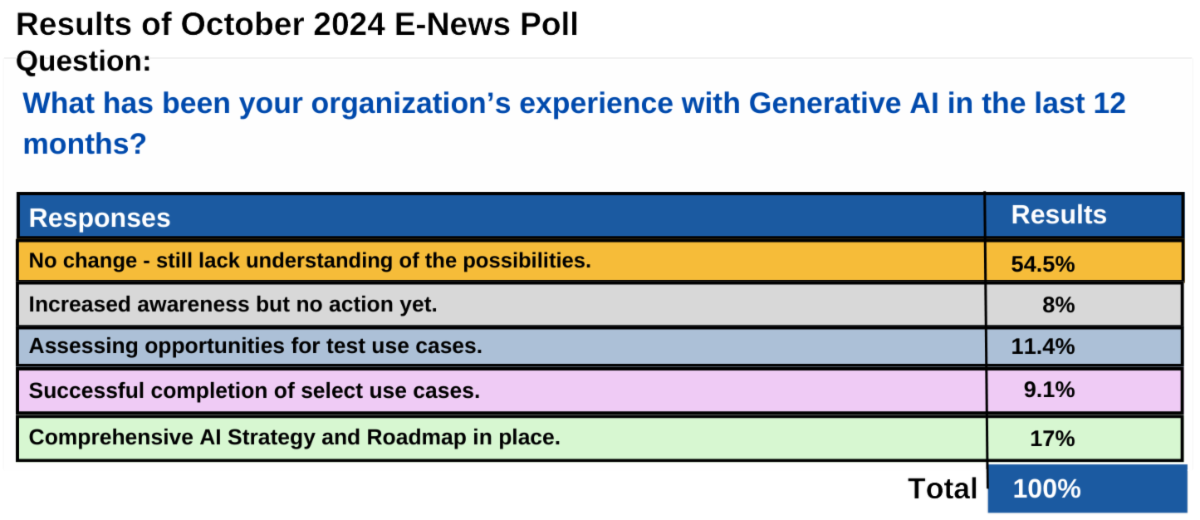
Last month’s poll question provided some startling results. Nearly 55% of the respondents reported no change in their organization’s experience with Generative AI (Gen AI) over the past 12 months. This is in contrast to the number of external business partners who have acknowledged use of Gen AI in their commercial platforms and services that are purchased by customers, including a wide array of corporate owners, occupiers and investment managers in real estate. Nearly 20% of respondents are thinking about it, even assessing opportunities but have taken no definitive action to move forward


More than 9% have completed use cases to test the waters and confirm value, while 17% have advanced to development of a comprehensive AI Strategy and have a roadmap in place to guide future advancement.    


A general lack of understanding of how Gen AI can be used is still widespread, indicating external business partners can do better to explain benefits of this powerful tool. There’s an opportunity to educate users and potential users, so expect to see more educational offerings, whether it’s easy access webinars or more extensive learning opportunities.


Stay tuned for more information on how you can build your understanding of this industry-changing technology.

Use Case of the Month

Asset Inventory and Asset Management


You can view this use case at this location. The use case featured this month relates to improved exchange of asset information. It is tied to the emergence of IoT and Intelligent Building applications, monitoring building system performance and the growth of Enterprise Asset Management (EAM). For example, improved exchange of asset management information is related to managing building performance, including monitoring building systems for energy use – a central theme in the recently published OSCRE Environmental Data Standard.


This use case applies to a data exchange supported by construction management and asset management software. It means that data can be exchanged without the need for custom data mapping, ETL or rekeying, which can be expensive and prone to errors. This data exchange provides an initial or updated asset inventory based on the existing Asset List data model. This approach is used to update planned maintenance and asset management systems and acts as one of the key inputs to multiple downstream processes.


Software providers and organizations with custom systems can develop interfaces to publish or ingest data conforming to the standard with the confidence that they can exchange data with software provided by external business partners. Common definitions mean that data exchanged in different projects, with different partner organizations will be directly comparable. 


  • Supports an asset inventory based on standard asset types
  • Foundational to asset lifecycle management
  • Enables integration of construction and asset management systems
  • Ties an asset to a location and level in a spatial hierarchy, e.g. building, floor or space
  • Allows for reporting on asset condition
  • Provides an asset classification, including building systems and asset types
  • Can be described according to COBIE/IFC standards for products and systems 

Learn more about the

OSCRE Academy

If you have any question please contact us.

Elevate your environmental data reporting skills with OSCRE's On-demand certificate program in Effective Energy Data Management Practices!


Earn a Certificate of Completion upon successfully finishing all sessions and propel your organization towards efficient environmental data strategies. The convenience of online access 24/7 allows you to pace yourself over a year to complete the ten insightful sessions.

Yes, I want to enroll

For more information on the content of this newsletter, OSCRE membership, or any of our programs, please contact us at info@oscre.org.

Visit our website at www.oscre.org

Follow us on LinkedIn