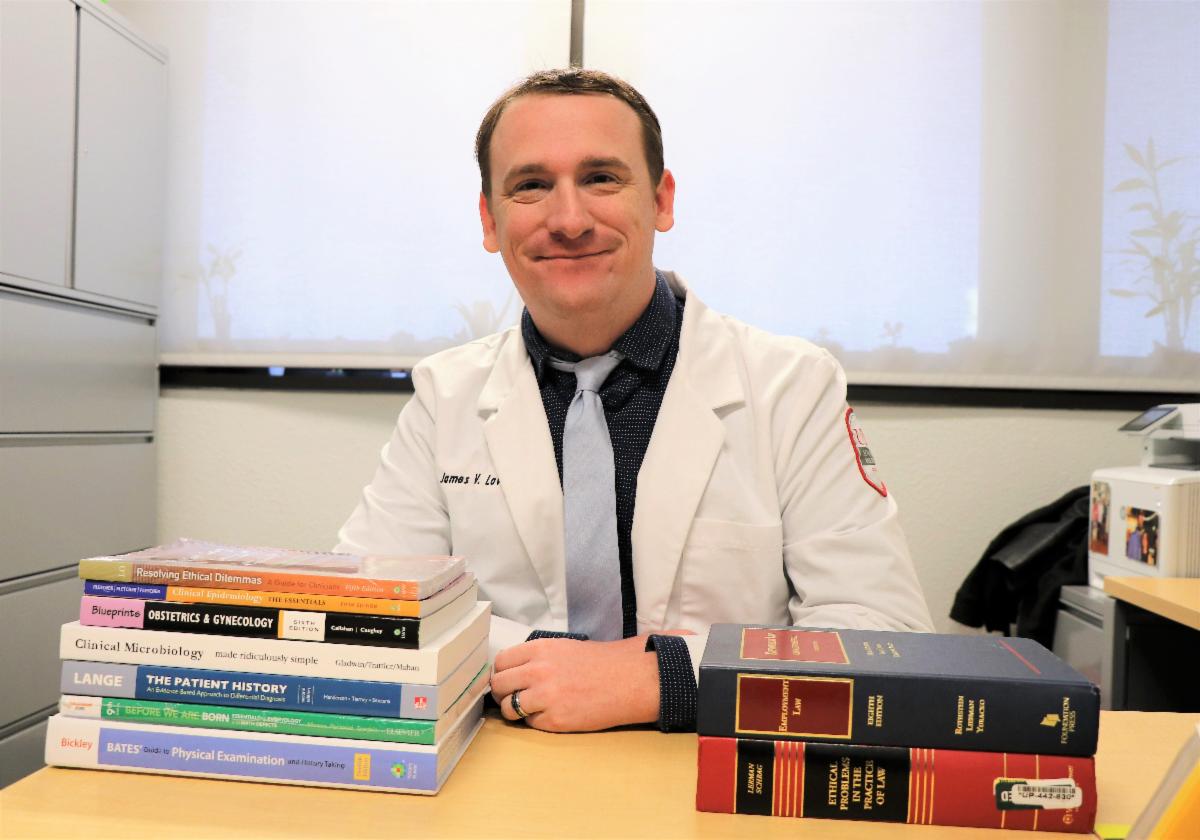
Suffice it to say that Lovett finds discussions on healthcare law topics stimulating. Informed consent, privacy and confidentiality, medical malpractice, regulation of health professions, regulation of health facilities, healthcare financing, proposals for healthcare reform, regulation of drugs and devices, end-of-life decision making, reproductive health -- he argues they’re all healthcare areas where increasing contributions of ideas from physicians could be beneficial to the country. Too often, he says, healthcare policy is largely made without sufficient input from medical professionals. “We kind of let the policy side get away from us.”
For the community service work that UNLV medical students do throughout their training, Lovett is combining the law and medicine disciplines through volunteer work at the Clark County DA’s office. “Since James had gone to law school, he wanted something where he could use those skills in his service hours, “ says Dr. Laura Culley, the associate dean of community engagement at the medical school who worked out the service agreement with the DA’s office. ”In this time when interprofessional teams are the most effective way to assist the vulnerable populations our students care for, we are working to create courses and programs which will bring students from the different UNLV Schools together in programs that benefit the community. We are working with the nursing school, school of social work, couples and family therapy, and now the law school to make these programs a part of our curriculum offerings.”
Lovett taught two courses to assistant district attorneys on wellness, which included the importance of exercise, nutrition, social health and spiritual health. Because lawyers have a stressful profession, he talked about health coping mechanisms like exercise and meditation as well as unhealthy ones, including drinking and drugging.
“There is a high incidence of substance abuse and addictive disorders among lawyers, and prosecutors deal with an immense amount of stress and secondary trauma -- thus one of the requirements of attorneys in Nevada is that we train on wellness,” says Nell Christensen, Clark County Chief Deputy District Attorney for Recruitment and Training. ”Probably because he went to law school, James can handle the attorney crowd. They ask tough, probing questions, and James rolls with it. I cannot say the same for everyone from outside of our office who trains for us. James has earned credibility with the audience here and people enjoy his training.”
Christensen says Lovett’s class on trauma for assistant DA’s was especially helpful.
“We call doctors and other medical experts as witnesses, but we really only sit down and learn about what injuries on the body can tell us from medical examiners from the coroner’s office when preparing for a trial,” she says. “It is invaluable to hear the perspective of a doctor in training who also understands what a lawyer needs to make a case.”
Whatever area of medicine he pursues -- whether it’s surgery, or healthcare policy or a combination of both -- Lovett plans on staying in Las Vegas.
“I was born and raised in Las Vegas. This is my home and I intend to stay and practice here as long as I can. I went to law school here, and to medical school, and my eventual practice is a good way to give back to and serve my home.”