|
Stanley Manne Children's Research Institute President's Message
- Investing in the Next Generation of Physician-Scientists
Research News from the Manne Research Institute Pillars
- Early Access to a Cardiac Surgical Hospital Linked to Shorter Hospitalization for Newborns with Heart Defects
- Emergency Departments Across Illinois Identify Gaps in Care for Children in Mental Health Crises
- Study Reveals a Distinct Subtype of Eosinophilic Esophagitis
- Program Dramatically Improves Safety of Surgery for Children
- Music Therapy Benefits Children in Cardiac ICU
- Videos Help New Dads Learn about Infant Safety Before Bringing Newborn Home
- Study Makes Economic Case for Teen Weight-Loss Surgery
Manne Research Institute in the Media
| | | Investing in the Next Generation of Physician-Scientists | | Physician-scientists are integral to the medical field, where they combine clinical observations and patient care with scientific research to investigate challenges and answer questions in biomedical science and healthcare. In the latest Manne Research Institute President's Message, Dr. Patrick Seed spotlights Lurie Children’s commitment to preparing promising medical residents and fellows for careers in research through the Pediatrics Physician-Scientist Training Program, administered at Northwestern University Feinberg School of Medicine. Through the experiences of three trainees, Dr. Seed shares how the program’s mentorship, education, and professional networks illuminate the path to becoming physician-scientists and research leaders. | | | | NEWS FROM THE RESEARCH PILLARS | | |
Congenital heart defects are the most common birth defects in the United States. For newborns with the most severe defects –- those needing lifesaving intervention — later transfer to a cardiac surgical center is linked to longer hospitalization compared to those born at a surgical center, according to a study published in The Journal of Pediatrics. Previous studies have shown that prolonged hospitalization is associated with higher rates of one-year mortality, as well as worse long-term neurodevelopmental outcomes for children born with severe heart defects. Results raise the question of whether reaching a cardiac surgical center sooner could impact outcomes.
“We know that newborns with severe heart defects must receive high-quality care from a big team of specialists to achieve the best outcomes. Our findings highlight how timely access to that care might relate to outcomes also,” said leading author Joyce Woo, MD, MS, pediatric cardiologist at Ann & Robert H. Lurie Children’s Hospital of Chicago and Assistant Professor of Pediatrics at Northwestern University Feinberg School of Medicine. “A lot of research focuses on optimizing the complex clinical care for these high-risk patients. Far less is known about how these patients and their families actually reach that care.”
| | |
When a child is experiencing a mental health crisis, families increasingly turn to the emergency department for help. While hospitals across Illinois are making progress in caring for these children, they face significant challenges, especially limited access to specialists and long waits for psychiatric care, according to a survey of Illinois emergency departments published in the Journal of American College of Emergency Physicians Open. The surveyed emergency departments also proposed practical solutions, such as investments in mental health staffing, therapeutic activities, and real-time bed tracking for better coordination of psychiatric resources.
“Hospitals told us what they need – better access to mental health professionals, tools to support children while they wait, and systems that make it easier to connect children with the right level of care,” said lead author Jennifer Hoffmann, MD, MS, emergency medicine physician at Ann & Robert H. Lurie Children’s Hospital of Chicago and Assistant Professor of Pediatrics at Northwestern University Feinberg School of Medicine. “Our findings provide a roadmap for improving pediatric mental health emergency care.”
| | |
Researchers from Ann & Robert H. Lurie Children’s Hospital of Chicago identified a distinct subtype of eosinophilic esophagitis (EoE) – a chronic allergic inflammatory disorder in which the esophagus narrows, interfering with food going down properly. They found that about 25% of children with EoE have hypermobile joints, meaning their joints can bend beyond the normal range of motion. These patients also tend to experience autonomic symptoms, most commonly chronic light-headedness upon standing up. This combination of symptoms leads to a significantly worse quality of life, according to the study published in the Journal of Allergy and Clinical Immunology.
“With recognition of this disease subtype, clinicians need to routinely screen children with EoE for hypermobility and chronic light-headedness because we have simple treatments for these symptoms that can make a huge difference in these children’s quality of life,” said senior author Joshua Wechsler, MD, MS, Medical Director of Eosinophilic Gastrointestinal Diseases Program at Lurie Children’s and Assistant Professor of Pediatrics and Medicine at Northwestern University Feinberg School of Medicine.
| | |
Ann & Robert H. Lurie Children’s Hospital of Chicago achieved more than a 13-fold improvement in surgical safety after implementing a series of interventions based on high reliability principles across its operating rooms. The hospital went from experiencing a serious safety event about every 2,977 surgical cases to a stretch of 39,654 cases over 585 days without a single serious safety event, according to the study published in Pediatrics.
“Operating rooms are among the highest-risk environments in healthcare due to their complexity, pace and high-stakes nature. We are immensely proud of our entire team in the Department of Surgery for adopting key safety practices that resulted in this dramatic accomplishment, even as our surgical cases increased,” said co-author Thomas Inge, MD, PhD, Surgeon-in-Chief and Chair of the Department of Surgery at Lurie Children’s, and Professor of Surgery and Pediatrics at Northwestern University Feinberg School of Medicine. “There is very limited published evidence on system-level safety interventions specifically in pediatric perioperative settings — our study helps fill that gap.”
| | |
Children recovering from heart surgery or other serious heart conditions often experience significant physical and emotional stress during their stay in the cardiac intensive care unit. While music therapy is commonly used to provide comfort and reduce anxiety, its effects on the body’s physiology have not been well understood. A study published in Pediatric Cardiology used continuous, high-resolution physiologic monitoring to examine how children responded to music therapy in the cardiac intensive care unit. The results showed that music therapy was associated with measurable improvements in physiologic markers related to circulation and oxygen delivery, with the greatest benefits observed in children who actively participated by singing, clapping, or engaging with the music.
These findings suggest that music therapy may provide benefits beyond emotional support by promoting favorable physiologic changes during recovery, says lead author Rohit S. Loomba, MD, MS, Attending Physician in the Cardiac Intensive Care Unit at Ann & Robert H. Lurie Children’s Hospital of Chicago. The study demonstrates how continuous physiologic monitoring can help researchers better understand the effects of both medical and supportive therapies in critically ill children.
| |
Brief videos shown in the hospital newborn nursery may be an effective way to educate first-time fathers on infant care topics, such as safe sleep, infant crying and car safety, according to a pilot study published in the journal Pediatrics Open Science. These topics were selected as common parental knowledge gaps and successful targets of previous educational interventions for mothers.
“New fathers often report feeling like bystanders in healthcare settings, with parenting supports primarily focused on the mother from pregnancy through the postpartum,” said Mikaela Thompson from Northwestern University Feinberg School of Medicine, who led the study supervised by Craig Garfield, MD, an expert on fathers’ role in child development, from Ann & Robert H. Lurie Children’s Hospital of Chicago. “Our study recognizes the importance of involving fathers in child health, and especially in infant injury prevention, from the very beginning of becoming a father.”
| | |
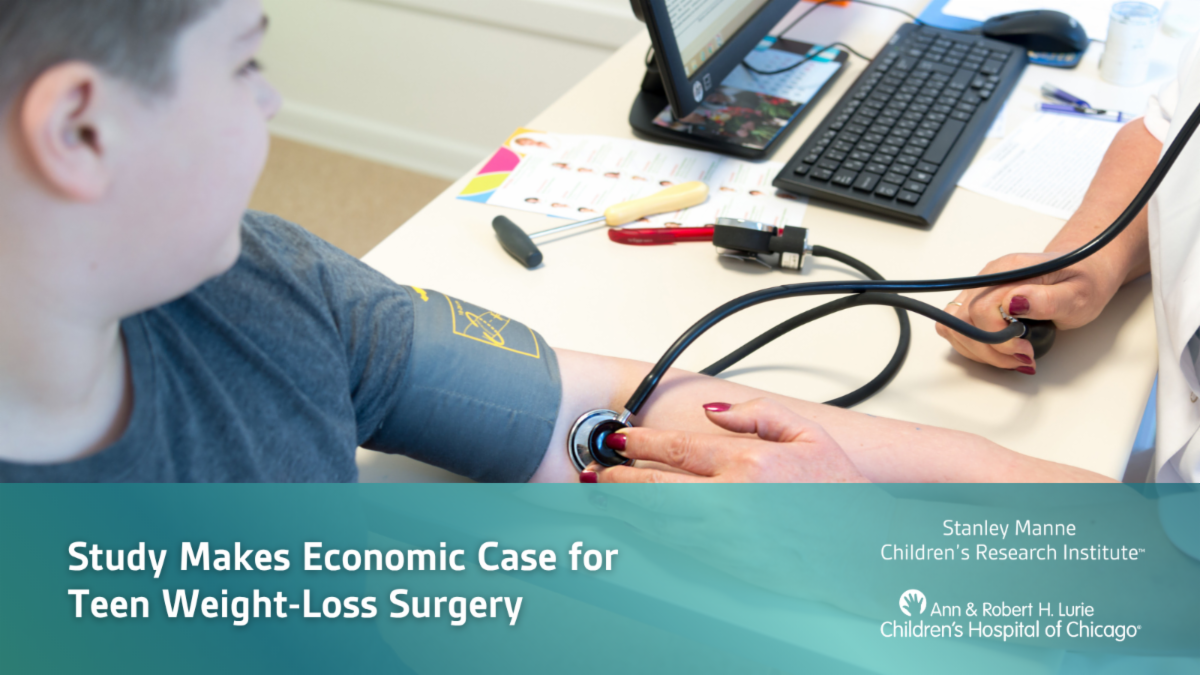
Metabolic and bariatric surgery for teens with severe obesity was found to be cost-effective over 10 years, according to the new analysis from Ann & Robert H. Lurie Children’s Hospital of Chicago published in JAMA Network Open. While long-term clinical benefits of weight-loss surgery for eligible teens have been well established, and it is recommended by the American Academy of Pediatrics, insurance coverage has been limited and few teens can take advantage of the surgery. This study strengthens the case for insurers and policymakers to support coverage and improve access to the procedure.
“Severe obesity in adolescence is a serious and expensive health problem, and with the high risk for complications like diabetes, the long-term costs can be substantial,” said lead author John Rode, MD, MS, Pediatric Surgery Research Fellow at Lurie Children’s. “Our study shows that over time, weight-loss surgery emerges as the most cost-effective option when we consider years of better health that it provides, compared to non-surgical management for teens with severe obesity.”
| | MANNE RESEARCH INSTITUTE IN THE MEDIA | | | | |