ISSUE 76 | August 16, 2022 | |
Weekly highlights for the Manufacturing community.
Subscribe to get this newsletter in your inbox each Tuesday.
| |
 | |
Robot Dog Teaches Itself to Walk in Only an Hour
Researchers from the Max Planck Institute for Intelligent Systems in Stuttgart constructed a robot dog and a learning algorithm to study how animals learn to take their first steps. The robot quadruped, named Morti, possessed reflexes similar to those found in an animal and gained the ability of mobility in about one hour. Learning to walk was assisted by a Bayesian optimization algorithm where Morti's measured foot sensor information matches with target data from a modeled virtual spinal cord acting as a program. Morti then identifies the walking process by modifying motor control patterns, running reflex loops, and comparing expected and sent sensor information. Morti's learning algorithm alters the control parameters of a central pattern generator (CPG). Animals and humans use CPGs, which are biological neural circuits in the spinal cord that make rhythmic outputs without input from the brain. CPG networks help with rhythmic, involuntary tasks such as walking or blinking. The researchers put Morti's CPG on a virtual spinal cord that controls the motion of the legs. While Morti figured out how to walk, sensors on its feet are compared to the CPG’s anticipated touch-down. If Morti found a bump in the road, the algorithm would adjust the legs' speed, time on the ground, and how far they swung back and forth. Felix Ruppert, a research team member, said, "Our robot is 'born' knowing nothing about its leg anatomy. If the sensor data doesn't match the expected data, the learning algorithm changes the behavior until the robot walks ... without stumbling." Read more at Thomas
| |
Inside Honeywell’s Advanced Recycling Research
Honeywell UOP Riverside operations in McCook, IL, outside Chicago, are a sprawling industrial site that houses a large central laboratory and dozens of pilot plants for research and development. Between the operations here and another 30 miles north in Des Plaines, IL, there are 50 of these scale-up mini-plants. It’s where bench-top laboratory experiments are developed into processes and optimized, with the goal of becoming a commercial reality. “Processes scale from drips and drops to barrels,” says Kyle Austin, a 30-plus-year veteran at Riverside. “It all leads to risk reduction for innovation.” With patents for unleaded gasoline and biodegradable detergents and numerous others over the years, Honeywell continues to be a powerhouse of innovation that generates 100 to 150 patents yearly. All of which relate to the company’s core business: designing and selling custom catalysts for industrial processes. These days “innovation” means sustainability, for renewable fuels, for better batteries, and for plastics and packaging circularity. That was a special point of interest for PlasticsToday during a July 26 on-site media tour. The first stop was a pilot plant devoted to chemical recycling, which is largely synonymous with the broader category of advanced recycling. This was where the company’s UpCycle process was tested and scaled into commercial reality. Within the last two weeks PlasticsToday reported that Honeywell’s UpCycle Advanced Recycling Tech Enters China, and in January, the news centered on Honeywell’s plans to build an advanced recycling plant in Texas in partnership with Avangard. A few months earlier in November, Honeywell announced the UpCycle technology will be deployed in a joint venture with Spain’s Sacyr to transform up to 30,000 metric tons/33,070 tons mixed waste plastics into feedstock annually starting in 2023. Read more at Plastics Today
| |  |
|
|
EY and GE Digital partner for data-driven manufacturing
Ernst & Young LLP (EY US) and GE Digital announced an alliance to help organizations transform their manufacturing operations. The alliance combines the consulting services of EY US with the more than 100 years of manufacturing experience and rich digital technology of GE, they state. As critical key performance indicators (KPIs) for the industry include the need for operational efficiency, quality management improvement, loss reduction and energy efficiency, the EY−GE Digital Alliance will provide solutions and guidance on ways to increase productivity while lowering costs, the partners believe. Through this alliance, manufacturers can leverage support from EY US teams to implement and integrate GE Digital software to develop more data-driven manufacturing operations. Read more at Smart Industry
| |
|
This 3D Printer Offers Industrial-level Speed in a Desktop Size
3D printing technology is becoming more efficient, capable, and flexible with each passing year, but a persistent issue continues to hinder users stuck in what’s known as the “additive manufacturing gap.” Those individuals or companies need capabilities beyond what’s typically offered in a desktop 3D printer, but might not have the scale or means to accommodate a large, industrial-scale system. A Southern California startup, however, believes it has the answer. Three years after its founding in 2019, Nexa3D debuted the NXE 400 photopolymer 3D printer, which offered 2.5 times the build volume at 6.5 times the speed of other printers in its class. In the wake of the system’s successful debut, the company sought to develop a smaller-scale version to help close the additive manufacturing gap. The result, coined the XiP, began shipping to customers in North America this summer. Nexa3D used the help of supply chain and sourcing powerhouse Xometry to scale down the proprietary Lubricant Sublayer Photo-curing technology from the NXE 400 to provide industrial-level speed in a desktop size. Read more at Thomas
| |
|
Sustainability in Transportation - How We Fix Congestion, Pollution, and More
With Nikolaj Koster, Head of Mobility at Deem, Inc. This fascinating discussion with Nikolaj Koster, Head of Mobility at Deem, Inc. covers a broad range of topics, including: 1. Robotaxis: How artificial intelligence will help save the world and why your kid won’t need a driver’s license. Koster predicts that before the end of this decade, the majority of cars in our cities won’t have a driver. Learn more about the role artificial intelligence is likely to play in our everyday life, what your futuristic trip across town might entail, and why we should all be excited about robots behind the wheel. 2. Sustainability There’s no denying that climate change, sustainability, and the swiftly changing culture around travel is top of mind these days. Find out why the emphasis on “going green” is both more important and exciting than ever to Koster and what kind of impact he believes modern mobility solutions can really have. Read more at ARC Advisory Group
| |
|
8 strategic imperatives for SAP transformation success
The rise of business transformation initiatives has IT leaders rethinking the way they evaluate, select, and negotiate technology and IT services deals today. Pivoting away from a serial approach to evaluation and selection, forward-thinking IT leaders are instead employing an integrated sourcing strategy tailored to facilitate business and IT transformations. Several dynamics are fueling this trend. On the buy side, business executives are looking to transform their ERP, SCM, CRM, HR, and ecommerce platforms to address inadequacies exposed by the COVID pandemic, global supply chain issues, changes in workforce dynamics, and industry-specific opportunities and challenges. At the same time, CIOs are working to reshape the business of IT, driving their organizations to the cloud and to new delivery and operating models. On the sell side, vendors have revamped their go-to-market strategies, service offerings, and partnerships. SAP, for example, has launched its RISE offering, including reimagined partnerships with AWS, Google, and Microsoft as well as its consulting partners such as Accenture and IBM to bring a vertically integrated solution to market. Meanwhile, AWS, GCP, and Microsoft are partnering with consultants to present holistic cloud migration and application modernization strategies beyond SAP. Read more at CIO
| |
|
Explosive Robot Growth Expected, New DIY Robot Tech Emerges
A recent study released by PMMI, Automation World’s parent organization, indicates that 84 percent of consumer packaged goods companies now use robots somewhere on their production lines, and this number is expected to rise to 93 percent in the next five years. And deployment of collaborative robots, also known as cobots, is also expected to see strong growth, with use more than doubling from 27 percent this year to 57 percent in 2027. Respondents to the PMMI research say improvements in robot functionality, such as vision, self-learning, and artificial intelligence are spurring manufacturers to purchase and use more robots in processing and packaging applications. Read more at Automation World.
| |
|
SSD roundup: New products deliver speed, density gains
There’s never a dull moment in the enterprise SSD market. Among the latest developments are three new products from Samsung, Micron and Kioxia. Here are the highlights. Samsung’s new computational storage drive Samsung unveiled a second generation of its SmartSSD, an SSD with a Xilinx FPGA and some memory for doing computational storage. Computational storage is the process of processing data where it lies rather than moving it around the network. It’s a new concept and only possible with SSDs; there’s no way this could be done with a mechanical hard drive. Samsung introduced the SmartSSD in 2020. The first generation featured a Xilinx Kintex processor. The new version adds software and intellectual property (IP) developed by customers, along with in-built Arm cores. Samsung claims processing time for scan-heavy database queries can be slashed by over 50%, energy consumption by up to 70%, and CPU utilization by up to 97% versus conventional data center solid-state drives. Samsung has not said when its second generation SmartSSD will ship. Read more at Network World
| |
|
This Balloon Capsule Will Take People to the Edge of Space
Space travel is still massively unaffordable for the average person. The mega-rich can cough up billions of dollars to travel the cosmos but the rest of us have bills to pay. Still, there are signs that space voyages could soon become more budget-friendly. Take, for instance, Space Perspective, a luxury spaceflight startup with plans to bring people to the edge of Earth’s atmosphere in a balloon-powered craft. The company just recently unveiled the capsule that will be attached to its proprietary SpaceBalloon. The spherical Space Lounge will provide passengers with 360-degree views of the Earth below while its shape provides some extra resistance to the immense pressure. The capsule will enhance the views for passengers by using satellite imagery and cameras that can zoom in and out, presumably so you can find your house when you’re up there. While the capsule is up there, it will rely on reflective window coating and a patent-pending thermal control system to keep temperatures regulated in the cabin. When the capsule heads back down, it should softly meet the water thanks to its splash cone before a Space Perspective ship retrieves the passengers, the capsule, and the balloon. Space Perspective is planning to begin offering six-hour round-trip space flights by the end of 2024. The company is already manufacturing its first Spaceship Neptune at its facility near the Kennedy Space Center and it said it has already sold 900 tickets. Now Space Perspective is accepting reservations for 2025 and beyond with tickets priced at $125,000 per person. That’s still a crazy amount of money, but compared to the reported $5.5 billion that Jeff Bezos spent for a couple of minutes in space, it’s a steal. Read more at Thomas
| |
|
When Prioritizing Diversity as a Hiring Manager, Don't Overlook Diversity of Thought
Prioritizing diversity in the workplace leads to increased innovation, better decision-making, greater revenue, and competitive advantage. But as organizations look to advance their diversity and inclusion (D&I) efforts, many are overlooking the importance of diversity of thought. What Is Diversity of Thought? Diversity of thought refers to the different opinions, perspectives, thought processes, and mindsets that would ideally be found within an organization’s workforce and are ultimately integral to its success. By prioritizing diversity of thought, hiring organizations acknowledge that different perspectives are valuable and important and accept that there are many ways to drive innovation and approach challenges. Before delving deeper into some of the benefits of diversity of thought, it’s important to note that advancements in this area should not be thought of as a replacement or alternative to other diversity efforts in the workplace. Hiring organizations must continue to invest in D&I initiatives that consider people from all marginalized backgrounds. In fact, diversity of thought is often a natural by-product of ensuring people of every race, ethnicity, religion, gender, sexuality, ability, and socio-economic background are provided with equal opportunities. Read more at Thomas
| |
|
Hear from All Employees in Meetings with These 6 Strategies
It’s 9:30 a.m. on a Monday. Time for your weekly team meeting and the one opportunity you have to get a clear sense of everyone’s progress. During these sessions, you want attendees to communicate what they’ve achieved and the difficulties they’ve faced in the past seven days, so you can establish how best to help or guide them. But alas, you already suspect Peter will talk too much, and Ravneet will talk too little — if at all. You’ll spend a good chunk of the meeting trying to mitigate the ever-escalating tensions between Ann and Carlos, who seem incapable of agreeing on anything, and another chunk glaring across the room at Eleanor, who you know will open WhatsApp the moment she sits down and fail to listen to a single word anyone says. Making sure everyone’s voice is heard during a team meeting can be tough. There will be the odd employee who is lazy, difficult, or disinterested, but, in most cases, the biggest challenge comes with balancing the bigger personalities alongside the more introverted ones. The latter group isn’t at fault, so it’s important to employ strategies that empower them to speak up, rather than cause them additional pressure and stress. The following techniques may help. Read more at Thomas
| |
|
7 traits of digital-savvy CIOs
Much has been made of CIOs’ need for business and leadership skills. To be truly transformational leaders, today’s CIOs must be adept at helming high-performing teams, guided by a keen understanding of how to co-create value with business colleagues. But technical skills, often relegated to the second tier of an IT leader’s necessary skill set, can give CIOs a level of digital dexterity that will help advance not only their organization’s digital initiatives but also their own careers. Read More at CIO
| |
|
If You’re Not Sure You Want to Hand Your Business Down to Your Kids, Here Are Other Options
Deciding on a succession plan that’s right for your business takes careful consideration. Many business owners devote themselves to running a successful family business with the hope of one day passing it on to their partner or children. But before assuming this is the right decision for you, you’ll need to evaluate your individual circumstances and weigh the pros and cons of various options. After all, no two businesses — or children! — are the same. Should You Hand Your Business Down to Your Partner or Kids? Handing down the family business to your partner or children might seem like the obvious choice. After all, a key incentive for starting a business in the first place is the idea that you will be leaving behind a meaningful legacy in your family name. Understandably, you’d want your partner or children to share that passion, and it’s also comforting to know that you could be providing financial security to your descendants for many years to come. Before making the final decision, however, it’s important to ask yourself the following questions. Read more at Thomas
| |
|
Bentley Acceleration Initiatives Announces Acquisition of eagle.io, a Supplier of Water and Environmental Monitoring
Bentley Acceleration Initiatives announced the acquisition of eagle.io, provider of a leading cloud-based environmental Internet of Things (IoT) platform. Bentley Acceleration Initiatives is the strategic investment fund and incubator initiative of Bentley Systems. The acquisition of eagle.io will help Bentley augment its infrastructure IoT offerings, expand its footprint Environmental Monitoringin the Australia, New Zealand, and Asia Pacific regions, and add to its capabilities of providing evergreen infrastructure digital twins globally. eagle.io is known for their highly configurable and customizable cloud-based environmental IoT platform serving water and met-ocean, meteorological and mesonet, air and noise, and construction related applications. The platform processes data from a multitude of environmental IoT sensors and generates valuable insights. Customizable dashboards offer a flexible way for systems integrators and consultants to develop insights about the performance of the assets under their charge and provide increasing value to asset owners. eagle.io complements the IoT technologies that Bentley previously acquired, including sensemetrics and Vista Data Vision. The combination of eagle.io’s customizable monitoring platform with sensemetrics’ end-user-focused applications and Vista Data Vision’s self-hosted solution will help create a more holistic infrastructure IoT offering. Their complementary features will accelerate the creation of vertical monitoring apps for targeted asset types, as well as enable systems integrators and consultants to build meaningful, profitable practices around IoT. Read more at ARC Advisory Group
| |
|
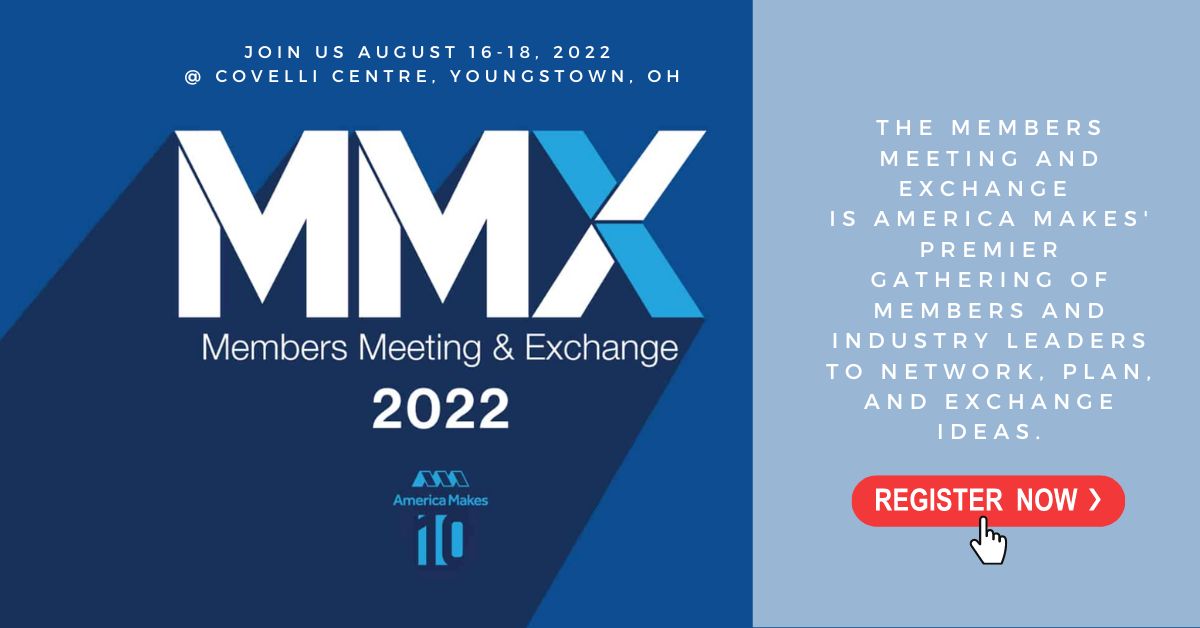
MMX Members Meeting & Exchange 2022 - August 17-18, 2022 - Youngstown, OH
The Members Meeting and Exchange is America Makes' premier gathering of members and industry leaders to network, plan, and exchange ideas.
International Manufacturing Technology Show - September 12 - 17, 2022 - McCormick Place, Chicago IL. _ IMTS – The International Manufacturing Technology Show is the leading global marketplace to connect buyers and sellers of manufacturing equipment, products, and software through exhibitions, events, and partnerships to advance the industry and its businesses. More information here.
Advanced Design for Additive Manufacturing Course - September 28 - 30, 2022 - Youngstown, Ohio - In partnership with American Makes Producing unique and optimized designs is a key differentiator for additive manufacturing, compared to conventional manufacturing. This course provides foundational information, special methods and approaches to design, and hands-on practice.
Topics covered in this three-day course include consolidating many parts into one, topology optimization, and lattice/mesh structures. The course includes considerations for metal, polymer, and composite materials, the creation of custom parts, and reducing the need for time-consuming and expensive support materials. Presentations and hands-on exercises cover these and many other topics. Learn More and Register Here
MakeMore Manufacturing Summit - October 12 & 13, 2022 - Orlando, FL
Join us as we hear from organizations and manufacturers who are finding ways to bring more talent to the manufacturing sector. Take part in important conversations. Help strengthen the manufacturing sector in Florida. Don't miss it!
| |
Share The Manufacturing News Consolidator with your network | |
|
How to Avoid Costly Mistakes in Injection Molding
To cut costs associated with injection molding, prioritizing part moldability during the design phase is critical. Optimizing moldability from the outset can saves thousands of dollars. Wall thickness is the foremost consideration in designing for moldability, according to one process expert, followed closely by optimizing ejection from the mold. Read more at Plastics Today
| |
|
Higher Energy Efficient Motors to Grow Faster as they Support Sustainability Initiatives
Limiting the increase in the global average temperature to well below 2°C and pursuing efforts to limit the temperature increase to 1.5°C: these are the goals set by the 26th UN Climate Change Conference (COP26), reaffirming the targets of the 2015 Paris Agreement. Achieving these goals will require rapid, deep, and sustained reductions in global greenhouse gas emissions, including reducing global carbon dioxide emissions by 45 percent by 2030 (relative to 2010 level), as well as deep reductions in other greenhouse gases. At the same time, meeting the challenges of growing demand for electrical energy and rising energy prices due to geopolitical issues require heavy investment in power generation and energy. The majority of these investments relies on natural resources that are rapidly being depleted due to continuous usage/extraction, impacting the environment adversely. One of the best strategies to curtail the situation is reducing energy waste and increasing energy efficiency. Electric motors play a major role in this strategy, since about 40 percent of global energy demand is estimated to be related to electric motor applications. Read more at ARC Advisory Group
| |
|
10 Ways to Introduce STEM to Your Kids This Summer
STEM — Science, Technology, Engineering, and Math — is an integral part of every classroom today and for good reason too: It’s all about creating the next batch of critical thinkers and a new wave of innovators in every field imaginable. Kids usually have a blast when it comes to fun activities as it requires them to be curious, communicative, and active for over an hour. Here are ten ways to indulge their creativity and help them learn STEM concepts this summer. 1. LEGO Coding You’ll need a LEGO person, printable mazes, and instruction cards (free printables here). The instructions help your kids navigate the LEGO person through different mazes, giving them a basic understanding of command codes, sequence, and looping. 2. Containing an Oil Spill Mix water and oil in a large bowl and add several bird feathers to the mix. Instruct your child to remove the oil from both the feathers and the water with the help of sponges, paper towels, or little spoons. 3. Melting Ice What melts ice faster: hot water, cold water, room temperature, sugar, steam, or salt? Get your toddler six ice cubes and empty cups to conduct this experiment. Read more at Thomas
| |
|
How to Evaluate the Impact of Corporate Purpose
Confronted by employees seeking meaningful work, customers demanding sustainable and traceable products, and investors who want companies to do both well and good — while inequality is rising and climate change is an increasingly dire threat — business leaders are redefining the purpose of their organizations. These days, one is hard-pressed to find a major company that has not incorporated the greater good into a statement that lays out the organization’s reason for existing. But if corporate purpose is to be more than window dressing and deliver on the promise of an engaged, motivated workforce and more loyal customers, companies must develop a capacity that is still lagging for most: They must be able to accurately assess the results of executing their purpose-driven strategy, particularly when that strategy extends to making a positive social and environmental impact. If companies measure this at all, they often outsource it to consultants, silo it in a corporate social responsibility function, or even delegate it to an intern. This attitude has led to suboptimal approaches that fail to look holistically at the core business, are not taken seriously by key stakeholders, or produce poor data that is not actionable. Read more at Sloan Review
| |
|
Five Articles for Building Resilience When Facing a Recession
Is the U.S. in a recession? As I write this article, the answers, forecasts, and models vary — considerably. While economic output in the U.S. fell for the second consecutive quarter, the job market — typically an indicator of a recession — continued to post strong numbers through June. As Jon Hilsenrath at The Wall Street Journal put it, “If the U.S. is in a recession, it’s a very strange one.” No matter the answers from economists or Wall Street, the fears of economic uncertainty being felt by businesses are very real. To be prepared for when the next recession comes, companies need to evaluate supply chains and operations, strengthen stakeholder connections, support talent and teams, and invest in the future. We’ve gathered five articles from our library that business leaders can use to navigate the uncertainty and volatility associated with downturns. Read more at Sloan
| |
|
Thermo Fisher transforms its customer experience
With its business rapidly growing and customer expectations rising, Thermo Fisher Scientific is turning to machine learning and robotic process automation (RPA) to transform the customer experience. Formed from the merger of Thermo Electron and Fisher Scientific in 2006, Thermo Fisher Scientific is one of the world’s largest suppliers of scientific instruments, reagents, and services, with more than 130,000 employees worldwide. Since 2006, it has grown with additional mergers and acquisitions, including Life Technologies Corp. in 2013, Alfa Aesar in 2015, Affymetrix and FEI Co. in 2016, and BD Advanced Bioprocessing in 2018. The rapid growth left the company highly dependent on fragmented, manual processes and disparate data sources and systems. With more than 10 million transactions and interactions per year across order entry, sales, and customer service, the company found those processes could not scale to meet the demand and deliver the experience its customers needed. Read more at CIO
| |
|
FTC Initiates Privacy and Data Security Rule-Making
The U.S. Federal Trade Commission today initiated a potentially yearslong attempt to impose new data security and privacy regulations onto the American economy. Agency commissioners voted along party lines to initiate the rule-making process. Democratic Chair Lina Khan charged technology companies with running roughshod over consumer preferences, while the two Republican commissioners accused Democrats of going beyond the agency's authority. "A significant majority of Americans today feel that they have scant control over the data collected on them and believe the risks of data collection by commercial entities outweigh the benefits," Khan said in a statement. Today's advanced notice of proposed rule-making doesn't recommend specific regulations. It instead calls for comment on a range of practices that stem from what critics have termed "surveillance capitalism" - the practice of influencing consumers through analytics culled from vast troves of behavioral data collected through smartphone apps and other smart devices. The FTC says comments on the notice could guide future potential rule-making touching on topics ranging from algorithmic bias to data security. Read more at Gov Info Security
| |
|
Anheuser-Busch Makes Beer, Seltzers, and Machines
I recently visited the Anheuser-Busch headquarters in St. Louis for a plant tour, a visit with the world-famous Budweiser Clydesdales, a tutorial on the brewing process, and, of course, some taste testing of the many varieties of beer made on site. I was also able to sit down with Ken VonderHaar, the global director of the Can Division at Anheuser-Busch InBev (AB InBev), to discuss some of the innovations happening within his group. And, not surprisingly, the primary focus these days is on flexibility around the different types of packaging—especially with the addition of seltzers and variety packs in the product portfolio. Cans (vs. bottles) is the biggest area of growth moving forward, due in large part to the pandemic and people taking 30 packs of beer home instead of going out to the bars and restaurants. That trend seems to continue. And just as consumers are bringing activities “in-house,” there’s also a trend in manufacturing to do the same. Read More at Automation World
| |
|
Top IT vendors report good financials, onging supply woes
While key network vendors continue to report good financial results, all of the players report continued supply-chain issues and increased order backlogs—challenges that show little sign of abating before the end 2023. Arista supply issues A good example is Arista Networks, which reported its first billion dollar quarter in its history despite the “challenges of an uncertain supply-chain environment,” Jayshree Ullal, Arista President and CEO said during the firm’s Q2 financial call this week. Read more at Network World
| |
|
Smart Contact Lenses for Cancer Diagnostics and Screening
Scientists from the Terasaki Institute for Biomedical Innovation (TIBI) have developed a contact lens that can capture and detect exosomes, nanometer-sized vesicles found in bodily secretions which have the potential for being diagnostic cancer biomarkers. The lens was designed with microchambers bound to antibodies that can capture exosomes found in tears. This antibody- conjugated signaling microchamber contact lens (ACSM-CL) can be stained for detection with nanoparticle-tagged specific antibodies for selective visualization. This offers a potential platform for cancer pre-screening and a supportive diagnostic tool that is easy, rapid, sensitive, cost-effective, and non-invasive. Exosomes are formed within most cells and secreted into many bodily fluids, such as plasma, saliva, urine, and tears. Once thought to be the dumping grounds for unwanted materials from their cells of origin, it is now known that exosomes can transport different biomolecules between cells. It has also been shown that there is a wealth of surface proteins on exosomes – some that are common to all exosomes and others that are increased in response to cancer, viral infections, or injury. In addition, exosomes derived from tumors can strongly influence tumor regulation, progression, and metastasis. Because of these capabilities, there has been much interest in using exosomes for cancer diagnosis and prognosis/treatment prediction. However, this has been hampered by the difficulty in isolating exosomes in sufficient quantity and purity for this purpose. Current methods involve tedious and time-consuming ultracentrifuge and density gradients, lasting at least ten hours to complete. Further difficulties are posed in detection of the isolated exosomes; commonly used methods require expensive and space-consuming equipment. Read more at SemiConductor Digest
| |
|
So that Happened: Porsche Goes Two-Wheeling, Whirlpool (Sorta) Buys the Kitchen Sink and CNC Training on the Spectrum
IndustryWeek editors look at those news stories and how established automotive suppliers are looking for new niches in the EV future and Ohio jobs grant challenges the state to upskill its workforce. Read more at Industry Week
| |
|
A single source of configuration truth: Your success metric for Industry 4.0
The manufacturing sector has been undergoing a significant digital shift in the past few years. You already know this. Industry 4.0 enables smart factories that can run themselves by using the most recent advancements in robotics, Internet of Things (IoT) sensors, artificial intelligence and communication technologies. Manufacturers must establish a collaborative single-source-of-configuration-truth to improve product time-to-market and increase product quality in the face of Industry 4.0 disruption arising from increased product complexity. Read more at National Defense Magazine
| |
|
Strengthen Your Supply Chain with Intelligent Visibility
Over the past few years, businesses have had to learn that their supply chains need to be much more resilient. Raw material and component shortages, along with increasing operating and merchandise costs, have continued to exert enormous pressures on global supply chains across the manufacturing and logistics sector, which is still recovering from a global pandemic. But the solution to these issues doesn’t lie in simply holding more inventory and building redundant capacity—both of which increase costs. Thankfully, advances in tech, specifically artificial Intelligence (AI) and analytics, have opened the door to a new, cost-effective way to improving the resilience of supply chains: intelligent visibility. Read more at Smart Industry
| |
|
Gummy, Stringy Material Meets its Match with Cut Taps, Thread Mills
Threading shouldn’t be an afterthought, though it doesn’t seem to rank high on everyone’s top 10 problems that require immediate attention. That is, until you consider the potential loss that scrapped parts can result in after a significant amount of machining has been invested in high-value parts. Read more at SME
| |
|
Making Metal Parts: Not for Dummies
Let’s pretend you know nothing about additive manufacturing (AM), more commonly referred to as 3D printing. Given that this industry-changing technology has been with us for more than three decades, that assumption is highly unlikely but is nonetheless the premise behind this “dummies” style article. If you’re already an expert on the topic, feel free to go do something more interesting, like 3D printing some cool parts or binge-watching the latest Netflix series. For everyone else, let’s start with a very simplistic overview of additive manufacturing. Each of the seven AM technologies recognized by the American Society for Testing and Materials (ASTM) begins with a 3D CAD model of the desired workpiece. This file is digitally rendered like a loaf of bread into thousands or perhaps hundreds of thousands of paper-thin slices before being fed to the 3D printer. Read more at SME
| |
|
What Are the Top-paying College STEM Majors?
With more than 60% of American high school graduates enrolling in universities each year, college degrees have become a stepping stone to landing a great first job. It comes as no surprise that many of the top-paying college majors are in STEM (science, technology, engineering, and math). Top-paying STEM majors include: Chemical Engineering You’ll have to study physics, chemistry, and math to earn a bachelor’s degree in chemical engineering. Concentration options include pharmaceutical, environmental, or biochemical engineering. Read more at Thomas
| |
|
NHS Dealing With IT Outages Due to Cyber Incident
The outage stems from a cyberattack on third-party vendor Birmingham-based technology provider Advanced's Adastra system, which supplies digital services for urgent healthcare services number 111. A company executive acknowledged the attack in an interview with the BBC. "We can confirm that the incident is related to a cyberattack and as a precaution, we immediately isolated all our health and care environments," says Simon Short, company chief operating officer. A spokesperson for the National Health Service told U.K. online magazine PulseToday that the service is working with Adastra to resolve the problem and that "tried and tested contingency plans are in place for local areas who use this service." The U.K.'s national number for emergency services, 999, appears unaffected by the cyberattack. Read more at Gov Info Security
| |
This newsletter is brought to you by Advanced Manufacturing International, Inc.
Please contact us if you would like to add your news to "The Consolidator."
| |
Advanced Manufacturing International is an SMM-first non-profit organization striving to accelerate the digital transformation of small to medium-sized manufacturers with simple, secure, and ultra-low-cost solutions. If you are interested in accelerating the digital transformation of small-to-medium-sized manufacturers please contact us and subscribe to our newsletter. Learn more about AMI.
| | | | | |