https://files.constantcontact.com/53f83e5c801/03567603-3dde-4f0e-bacf-bcfbccd0f54c.png?rdr=true
Did someone forward this to you? Click here to subscribe to this monthly newsletter

Hi All-


Hope everyone had a great summer/September. It already feels like ages ago, but Stephen and I went on vacation to Croatia the week of 8/28 and for those who haven’t been, I would highly recommend it. We started in Split and finished in Dubrovnik, and visited two islands in between, Hvar & Korcula. The whole country is a massive archipelago on the Adriatic Sea, and I’ve never seen a more beautiful cerulean blue coastline. The diet consists of a lot of seafood and olive oil, and almost all locally-sourced—we were in ‘clean eating’ heaven. I have been to Dubrovnik before and it does not disappoint—probably the most well-known and recognized cities of Croatia because of it’s iconic medieval castle walls surrounding a picturesque town full of structures with terra cotta roof tiles (and Game of Thrones!) This is my own opinion, but unlike other countries in this region, such as Italy and Greece, Croatian cities are immaculately clean and they seem to take great pride in this. Croatians are overall very happy and welcoming—most have seen deadly and destructive war in their lifetimes and seem to be more content and grateful for peace and even the simplest prosperity. While the country has been a member of the EU for 10 years, they just finally (this year) adopted the euro to make the union truly ‘official’. This was no doubt hastened by an increase in the level of insecurity now being felt in the Balkans and eastward. Anyway, if you haven’t visited yet, I’d highly recommend it. 10/10.

This fall, the MFG team is continuing to work hard on enhancements to the client experience, which we will be rolling out on a personalized basis in these final few months of the year. I have also been working on my video content production skill set, so that we can more proactively create and distribute content in which we share anticipated and/or common questions and answer them in detail, for everyone. We’ll be building a content ‘library’ for clients and will also share these videos as we produce them. You’ll probably start to see more of these roll out closer to the end of the year, as I am still very much a ‘student’ in this area and effectively ‘building the plane as it’s in flight’! In any case, I know my first few of these aren’t going to be ‘great’ in terms of production quality (although content should be strong!) so bear with me—they’ll get better and we’ll just have to take a ‘trial and error’ approach in terms of finding the right assistance with professional editing. Ultimately, the goal is to create a vast library of video Q&A’s with supporting visuals (charts, graphs, etc.) built in, and also just to get so good at making these that we can share/film a live answer to most questions within hours of being asked, to save you time. Stay tuned!


Even though we’re focusing on financial market content within the weekly updates (and in year-end deliverables going out by 11/10), I’ll talk about this briefly before getting more into financial planning strategies and ‘to-do list’ reminders. For those interested, I’ll note that John will be getting deeper into the state of the bond market, and its current opportunities and risks, in this week’s market-focused distribution.


As we enter what we hope will be the final stage of the Fed’s monetary tightening program, multiple economic and market challenges face the Federal Open Market Committee (FOMC), investors, households, and leaders in Washington DC. These challenges run the gamut from high oil prices to the threat of a government shutdown. Consumer confidence is weakening and the Biden administration’s economic approval rating is tanking. What could lie ahead?


The price of a barrel of crude has spiked to over $90/bbl, up from $70/bbl as recently as July. The move coincided with simultaneous production cutbacks by Saudi Arabia and Russia amounting to nearly one million barrels/day. Prices at the gas pump are up to $3.82/gallon, up from $3.52/gallon at the beginning of the summer.


Adding to the economic woes are the writers, actors, and autoworkers strikes. It appears that the 148-day Writers Guild of America walkout could be nearing a conclusion. However, the more than 4,000 days of idleness due to work stoppages as of the end of August dwarfed all strike activity over the last decade. This suggests labor costs will rise and, in today’s tight market, margins could compress at a time when earnings among S&P 500 companies are expected to be flat for the year.


Meanwhile, if Congress doesn’t pass a continuing resolution over the next few days the government will be forced to shut down. While policymakers attempt to negotiate a higher debt ceiling, few in Washington are focused on our immediate budget challenges. The Treasury faces $2.6 trillion in bond maturities next year with existing bonds carrying a two percent coupon, on average. That suggests interest expenses, as part of the federal budget, will likely increase by about $100 billion annually as those maturing bonds are rolled over and new bonds are issued. Current trends indicate interest expense will surpass defense spending to become the largest discretionary spending item by the end of 2025.


Another factor upsetting the equity apple cart is higher Treasury rates. The benchmark 10-year Treasury yield has been climbing steadily since the summer, pushing the yield to over 4.5 per cent, its highest reading since 2007, long before the Fed embarked on its quantitative easing program. The move was fueled by rising real rates, the 10-year Treasury yield relative to inflation expectations. Perhaps bond investors are beginning to impose a “distrust premium” on the federal government. The impending government shutdown, underscoring rating agency Fitch’s concern that fiscal intransigence poses a credit risk to our nation’s debt worthy of a downgrade. Unfortunately, higher real rates filter through to all borrowers, increasing the cost of financing businesses, housing and automobiles, among other things.


For the most part, higher energy and interest costs are helping do the Fed’s work for it, suggesting that rising energy and interest costs will serve as a tax, funneling resources away from discretionary spending. The recent deterioration in consumer confidence exemplifies that trend. That also mirrors a significant decline in President Biden’s approval rating. According to a recent ABC News/Washington Post poll, only 30% of those surveyed approve of his job on the economy, with 64% disapproving. While the Fed’s game plan may be cloudy as monetary policymakers weigh the second-order impacts of recent trends, President Biden’s game plan should be clear: he needs to offer leadership on the federal budget and spending before the bond market does.


In short, the fiscal situation of the United States is a slow-motion train wreck. If and how this situation will be resolved is not possible to predict. The outcome depends to a great extent on our finding the political will to enact the kind of pro-growth policies which have propelled us out of stagnation in the past. The reality is that things may have to get worse for that to happen.


So, as we speak with clients who presumably can only become progressively more alarmed by these trends, we won’t sugar coat it. It is a developing situation, not yet of crisis proportions but continuing to go south. I know I’m not going to train resilient investors with only happy talk.


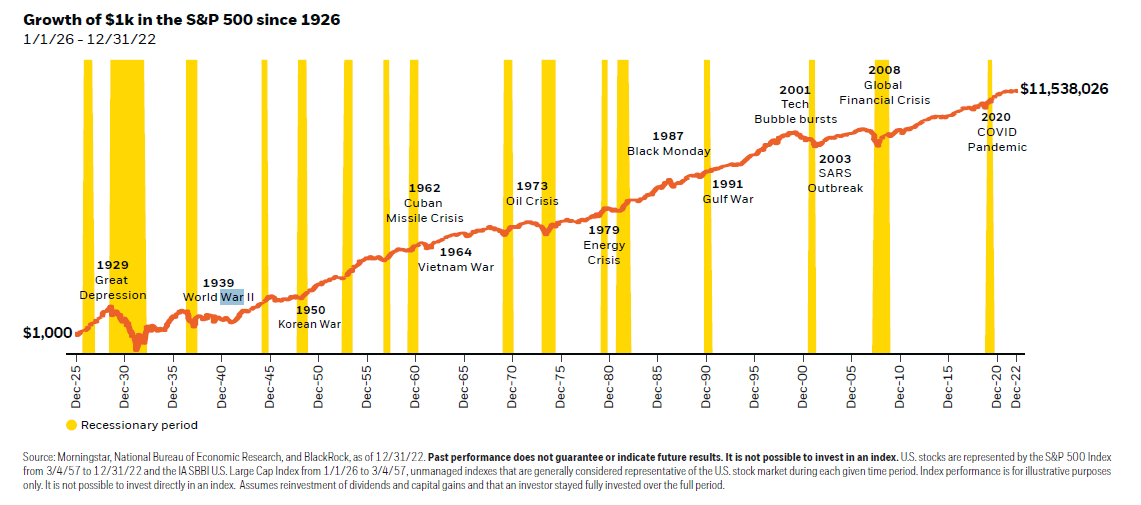
First I’ll say that I am in no position to analyze the situation intellectually nor to predict the outcome here. Instead, I’ll continue to drive home relentlessly the fact that we are not investing in the macroeconomy, nor in the ‘stock market’. We are patient, disciplined long-term owners of consistently successful profit-seeking, capital preserving companies. And we know from long-term experience that those companies—innovating ceaselessly—have prospered mightily through every kind of economic, financial, political and geopolitical nightmare. (The S&P 500 has halved three times in the last 50 years. The Index stands today 35 times higher than it was at the beginning of that gauntlet because that’s how much the earnings have grown.)


I’ll reiterate that the economy is always unknowable. It can never be reliably timed. The only way one has ever been sure to capture equities’ superb permanent returns is to ride out their frequent, sometimes significant but always temporary declines. In a market that’s been compounding at nearly seven percent net of inflation for a century and more, wealth must follow.


Macroeconomic uncertainty, alone, should not be a reason to get out of the market. Take a look at this article/chart from the Visual Capitalist which shows the risk of trying to time the market. By simply missing out on the 10 best days, an investor could lose the majority of their overall return. Really helpful read for anyone even contemplating an exit (or holding onto excessive amounts of cash due to macroeconomic uncertainty and ‘wanting to get the timing right’).


As to the question of whether there should continue to be an emphasis on US businesses in portfolios, this blog post “Is this a great country of what?” tells a good visual story. As does this article ‘The Wonders of Economic Growth’.


For further positive perspective for the long-term outlook, check out ‘The Doomslayer’ a weekly positive news roundup of humanprogress.org. It’s chock full of hopeful science, health, and environmental news and commentary cannot be found in any other single place.

Now, before I continue to build on the planning strategy content, I just wanted to quickly clarify something with respect to eMoney/Personal Financial View (the interactive website we encourage clients to use to see all of the moving parts of their financial ‘picture’ in one place and feel more organized). Of course, we firmly believe this is a valuable tool for clients, and it’s quite helpful to us when it comes time for a comprehensive review (as, if managed diligently by clients, we can see and generally be aware of balances and holdings of other accounts we don’t regularly oversee/manage). However, I’ll note that eMoney is not what we ourselves use internally to track and manage your accounts. If you see the value of eMoney and have not yet worked with us to reconstruct your site (since our transition to a new license 2 years ago), or, if you would like more ‘hand-holding’ from us in reconstructing or revitalizing your site (especially because some institutions are indeed more difficult for eMoney to properly communicate with and get balances from), we will always make ourselves available for a meeting (or five!) to guide you through this. That said, since we use other systems to manage your accounts, and only really use eMoney when it comes time to do a review or update your financial plan, we’re going to ask for a bit more involvement and communication on your part, if an account connection needs to be fixed, etc. In short, given that we don’t otherwise use this tool outside of review periods or when we get specific inquiries from clients, you won’t necessarily be hearing from us when a connection times out, etc., but if you want training with eMoney or need help adding/repairing connections, we pledge to be all over it as soon you communicate it to us.


On the planning front, our last newsletter was chock full of planning tips/reminders, so as the end of the year draws closer, if you missed it, I would encourage you to go back and look at that installment, in conjunction with this one.


I’ll highlight/reiterate a few items here, and will try to keep succinct. If any of these items is more relevant to you, and you have deeper questions, feel free to reach out and ask for more info/explanation.


  • Here’s another reminder of Important Numbers 2023 (qualified account contribution limits, etc.). Now that we are going into Q4, this is really the last stress-free moment to review your contribution withholdings and make sure you’re on track. Please let us know what we can do to help. If you simply send us a recent paystub, we can do all the auditing for you. Don’t put it off!
  • This probably sounds counterintuitive, but even an early max out of 401k/403b could be an issue we want to pay attention to, as it could result in missing out on employer matching contributions. Early max-outs can be caused by an increase in compensation (salary, bonus, or both) while the % contribution you elected at some point in the past remains the same. Once you max out the 401k, you obviously stop making contributions, and depending on how your plan is structured, your employer stops doing the match. If you share a copy of your 401k Summary Plan Description (can be found in your HR portal), we can review for a full understanding of how your company’s match works. But in general, the goal should be to try to spread 401k/403b contributions evenly over the course of the year, if possible (due to market timing/dollar cost averaging reasons as well).
  • For those of you with employee stock compensation, here are three useful pieces on issues to consider related to the different types. Over the past few years, we have seen a large increase in the number of clients with company stock compensation (partly driven by a significant shift in physician clients moving away from clinical practice and towards roles as corporate scientists/leaders/consultants). In the course of this, we have become strategic experts in this area, and are here to guide you, with the added support of some pretty sophisticated software tools.
  • What Issues Should I Consider Regarding My Restricted Stock Units 2023
  • What Issues Should I Consider Regarding My Incentive Stock Options 2023
  • What Issues Should I Consider Regarding My Non-Qualified Stock Options 2023
  • Medicare IRMAA appeal
  • Reminder that your Medicare premiums are based off how much you earned two years ago. However, if your income has declined due to retirement or semi-retirement, you can apply to have the premiums reduced. You can read more and fill out the request here
  • If you have brokerage/non-retirement account shares with gains/appreciation, and these shares are in long-term status (held more than 1 year), you can skip paying capital gains tax (and capture an income tax deduction for the full/current market value of the shares) by donating them directly to charity this year, or donating to a Donor-Advised Fund (DAF). Please let us know if you are interested in making any 2023 charitable donations via this strategy, and we can handle transferring the shares directly to the charities, or work to establish a Donor-Advised Fund. 4 reasons to donate stock to charity
  • If you have borrowed against the value of your non-retirement/brokerage investments, and paid interest via a ‘margin loan’, don’t forget that there is an investment interest expense deduction on taxes. This is something you’ll want to make sure to specifically point out to your CPA, to ensure it gets reflected on your return. More on this here


To wrap up, here are some other useful articles I’ve compiled over the past month, and I’ve categorized under either ‘investing’ or ‘planning’. Enjoy the ‘light’ reading!


Investing:

8 investing rules for your peak-earnings years

6 biggest pitfalls for investors

Why I Sold Our Target Date Retirement Funds

How to maximize Series I-bond redemptions amid falling inflation

How resilient profit margins are silencing doubters

Cash is No Longer Trash, but the Opportunity Cost Might Be Greater Than You Think

Bonds Aren’t Boring Anymore, and Investors Need to Adapt

This stock market signal points to the S&P 500 surging 25% within the next year

Nasdaq Composite could see a year-end rally, despite weakness in coming weeks, says David Rosenberg

CNBC Daily Open: High yields posed no threat to the tech rally


Planning:

You Probably Need Less Money Than You Think For Retirement   

What We Lose When We Retire

Why 72% of Retirees Are Happy

Why 28% of Retirees Are Depressed

Inherited an IRA? Four Things Every Beneficiary Should Know


Enjoy the rest of your weekend!


Charlie


Charles G. Brown

Financial Advisor, Principal
Meet the Marathon Team
Jacob Foley | Chief Operating Officer | jfoley@meetmarathon.com
Indrani Namilikonda | Client Services Coordinator | inamilikonda@meetmarathon.com
John Bay, CFA | Chief Market Strategist | jbay@meetmarathon.com
Connor Gallivan | Financial Advisor | cgallivan@meetmarathon.com
REQUIRED DISCLOSURE:
Investment advisory services provided by NewEdge Advisors, LLC doing business as Marathon Financial Group, as a registered investment adviser. Securities offered through NewEdge Securities, Inc., Member FINRA/SIPC. NewEdge Advisors, LLC and NewEdge Securities, Inc. are wholly owned subsidiaries of NewEdge Capital Group, LLC.
 
The information contained in this email message is being transmitted to and is intended for the use of only the individual(s) to whom it is addressed. If the reader of this message is not the intended recipient, you are hereby advised that any dissemination, distribution or copying to this message is strictly prohibited. If you have received this message in error, please immediately delete.
Marathon Financial Group | 857-201-34320 | 131 Dartmouth St 3rd Floor Boston, MA 02116 | meetmarathon.com