LWVUS New open logo only


"The Voter" Newsletter

March, 2026

League of Women Voters of

Berrien & Cass Counties


President's Corner

Reporting from the World’s Largest Annual Forum on Women’s Rights:

The United Nations Commission on The Status of Women (CSW)


The United Nations Commission on the Status of Women is the Largest World Gathering dedicated to Gender Equality and Gender Equity. The outcomes and discussions at CSW (this is the 70th year) will influence laws, policies, funding, and accountability mechanisms affecting women and girls across the globe for generations.


This gathering is a defining moment testing whether the world will choose to act in concert to protect and progress the laws and policies promoting women’s equality, or if countries will continue to allow injustice to continue with impunity. 


Every year, LWVUS selects a handful of delegates to represent them at this historic meeting, and I feel so fortunate to have served four years in this role.


If you would like to watch a short video on the LWVUS at the NGO CSW 69, check it out here!


The Priority theme of this year’s CSW was ensuring and strengthening access to justice for all women and girls, including by promoting inclusive and equitable legal systems, eliminating discriminatory laws, policies, and practices, and addressing structural barriers. So many of the sessions touched on these themes in various ways.


The Review theme, which follows up on the agreed conclusions from past sessions was Women’s full and effective participation and decision making in public life, as well as the elimination of violence, for achieving gender equality and the empowerment of all women and girls. Often these are re-visited as a marker of progress throughout sessions, to see how far we have come, or failed to come.


There are literally hundreds of sessions offered around the clock in locations across the U.N. Campus and Manhattan. Long days full of hopping from session to session, mixed with meet-and-greets and conversation circles are typical during these two weeks!


The offering of education, conversation, and advocacy is extremely varied and abundant. You may drink coffee at sunrise at a discussion on dismantling system barriers to legal and political access for women, then sit in a session dedicated to rural and indigenous women’s farming practices after breakfast, attend an embassy event on the International Criminal Court in the afternoon, and after dinner watch a presentation on Ai and gendered backlash in online spaces. (Yes, those were all sessions offered!). 


Presenters are leaders in their field, from every country imaginable, often undertaking dangerous journeys from war zones just to come and present in person. We also had multiple presenters speak to us from bomb shelters, and safe houses because they were unable to leave their country or city. The biggest loss to CSW this year was the absence of multiple countries’ delegates, as they were on the travel-ban list and unable to come in person to learn and share their experiences. What’s more, those barred from coming were from the global south, where we need to hear about the experiences and work the most.


Because my professional background is centered on international human rights and humanitarian law, especially as it pertains to human trafficking, gender-based violence, and conflict zones, I attended sessions like: systemic accountability, strengthening protections and recovery for conflict-affected women and girls, international procedures for conflict-related sexual violence prosecutions, economic and legal empowerment of forcibly displaced women, strategies for prosecution of reproductive violence and genocide, best practices for prevention of gender-based violence, pathways to end child marriage, gendered consequences for health in conflict zones, and promoting equitable and inclusive legal systems, just to name a few.


These sessions were hosted by various embassies, member State governments, and NGO’s, and featured speakers like U.N. Special Rapporteurs, Secretary Generals, Ambassadors, Foreign Ministers, bar associations, legal societies, the European Union, The Council of Europe, Soroptimist International, and various U.N. Affiliated Organizations like UNICEF, UNDOC, UN Women, and UNFPA. 


Additionally, I was able to attend the high-level events like the U.N. Secretary Generals’ Town Hall session, and General Assembly meetings.

For me, this meeting of the minds from every corner of the globe is a crucial part of the work we all do in our own little corners of the world. It serves as a reminder that no matter what is on the news, no matter how hopeless it feels to work in our fields sometimes —there is someone working alongside you, that everyone is pulling together in their own way towards something better, and that we are all in this together…regardless of world politics and cultural divides.

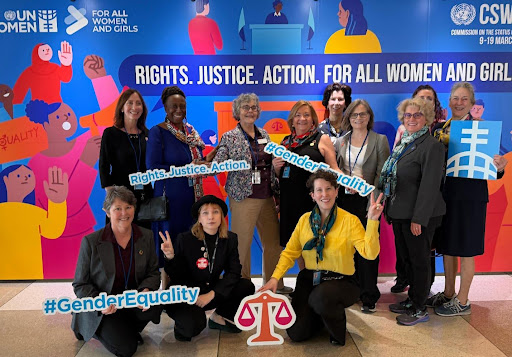
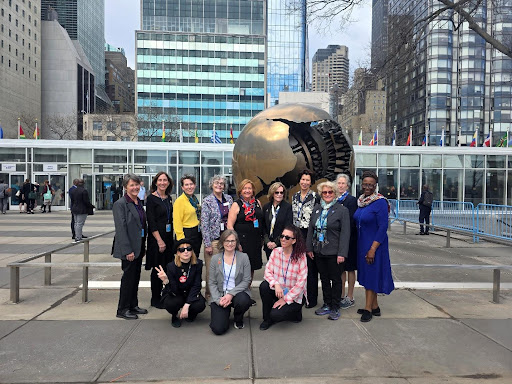
Figure 2 LWVUS Delegates of CSW 70


If you would like to learn more about this incredible meeting , check out:  In Focus: The 70th Session of the UN Commission on the Status of Women

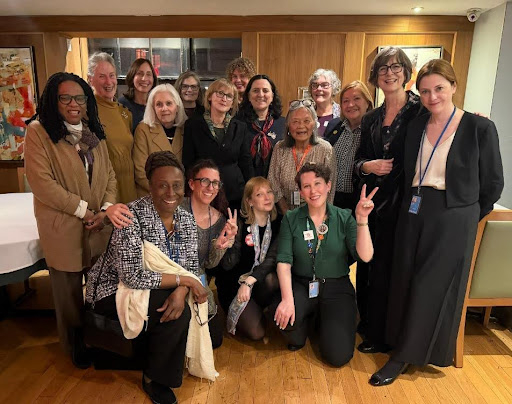
Figure 3 LWVUS Delegates, and LWVUS Affiliates

Yours In League,

S. Warner, President

lwvbccpresident@gmail.com

Board News


A VIEW FROM THE FRONT ROW: SERVICE AS A U.N. OBSERVER


Big news! 


The League of Women Voters of Berrien and Cass Counties now has a front row seat at the United Nations! 


Our President, Sarah Warner, has been named as one of the U.N. Observers for LWVUS starting this month. She will serve primarily in her areas of expertise: Human Trafficking and Conflict Zones including conflict-related-sexual-violence and gender-based-violence.


She spent part of March in New York at the United Nations Commission on The Status of Women, participating in NGO dialogues, presentations, and high-level discussions among member state officials and representatives.


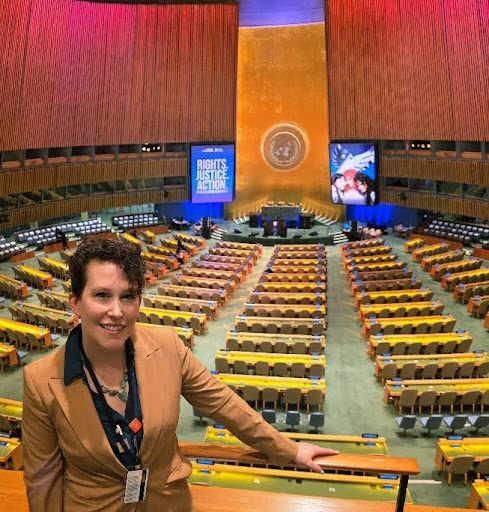
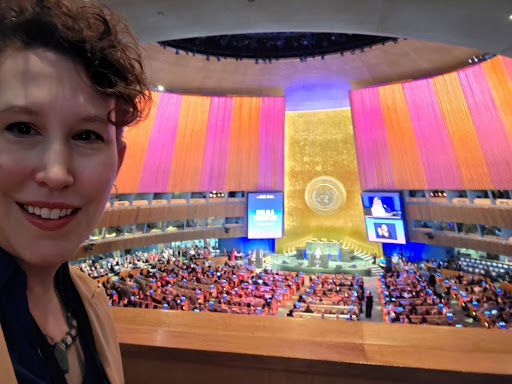
Figure 1 - The UN General Assembly Hall, preparing for UN SG's Announcements

The League of Women Voters of The United States (LWVUS) has been Intertwined with

the United Nations (UN) Since Its Inception:


In 1920, the League supported U.S. participation in the League of Nations to resolve international disputes. The LWVUS was an early advocate for international cooperation and U.S. participation in postwar reconstruction and peace organizations.


Before the U.N. was officially established, the League was working to support it: the League trained more than 5,000 speakers and distributed more than a million brochures promoting public understanding of the Dumbarton Oaks and Bretton Woods agreements. These agreements eventually led to the establishment of the U.N., World Bank, and International Monetary Fund (IMF), an organization of 190 countries, established in 1944 to promote global economic stability, foster international monetary cooperation, and provide temporary financial assistance to member nations facing balance-of-payments crises.


In 1945, the League was one of 42 NGOs invited by President Truman to the 1945 U.N. Charter Conference as a consultant to the U.S. delegation. Their work and consultative status at the U.N. (granted in 1997) continues through the U.N. Observers.


If you would like to learn more about the history of the LWVUS and the UN, check out this article!


WHAT DOES A U.N. OBSERVER DO EXACTLY? 


A small handful of observers is appointed in four-year terms to serve at UN Headquarters in New York, with portfolios at other UN locations, such as Geneva as required. 


The role of the Observer to the United Nations on behalf of the League of Women Voters of the United States (LWVUS) involves the following responsibilities:


Participation in UN Meetings: Observers attend public meetings of the Economic and Social Council (ECOSOC), its subsidiary bodies, commissions, and committees, with potential for additional participation modalities. The United Nations Economic and Social Council (ECOSOC) is the central UN platform for coordinating economic, social, and environmental work, fostering international cooperation on sustainable development. Established in 1945, it oversees 14 functional/regional commissions and links global policy to action, including managing relationships with NGOs.


Engagement in Conferences & Consultation with UN Secretariat: Observers participate in international conferences organized by the UN and their preparatory processes. They also consult with UN Secretariat officers on matters of mutual interest and concern, providing comments and expert opinion as requested.


Preparation of Studies, Statements, and Discussions: At the Secretariat's request, Observers prepare studies, organize informal discussions, and collaborate on shared concerns. Observers also submit written statements relevant to ECOSOC's work and, when requested, deliver oral statements on topics within the League's expertise.


Accreditation, Coordination, and Strategy Implementation: Observers work with the Chief Observer to execute annual strategies and goals, including expanding awareness of shared priorities, enabling League delegate participation in UN events, and developing materials and programs aligned with the League's objectives. Observers also ensure the League's official representation at the UN and maintain its accreditation with ECOSOC and subsidiary bodies.


One of the many exciting aspects of having representation in this position for our League is the opportunity to hear what is going on across the globe from a boots-on-the-ground perspective, as well as the opportunity to learn from experts and leaders in the field at the United Nations. 


We will truly be thinking globally and acting locally!

Figure 2 - Malala Yousafzai speaking at the Opening Remarks at the UN GA

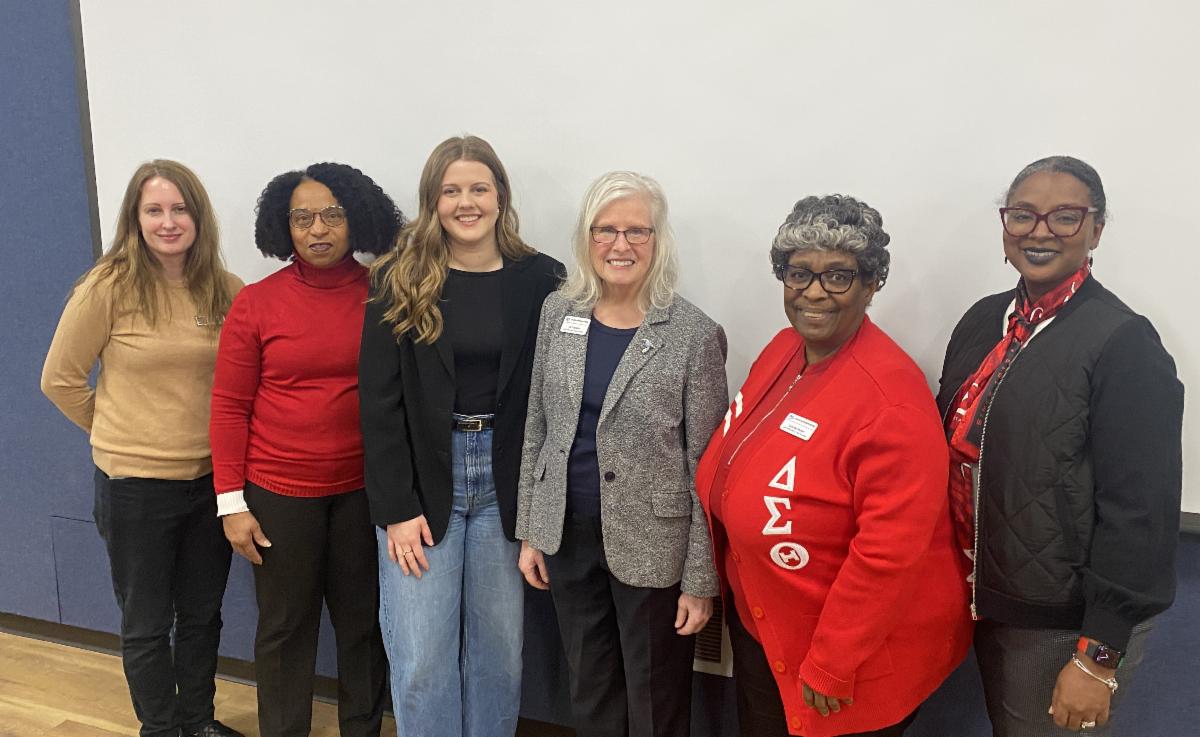
Pictured from left to right: Lisa Slavicek, Patricia Brown-May, Lily Eggers, Val Schnable, Dorothy Parker and Cidni Sanders

Membership


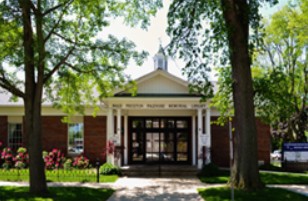
The March 11th event at the St. Joseph Maude Preston Library introduced many in the Berrien and Cass counties to important things to know about voting. 


Lily Eggers from the Michigan ACLU presented some well known and little known facts about your voting rights, and some cautionary words regarding Federal and State proposals requiring additional requirements to vote, many of which are barriers to women, minority and rural voters. Of the 53 in attendance, approximately 1/2 were not members of LWVBCC, but not for long, as we had attendees join that very evening.  


Our next event is the March 26, 2026, General Membership Meeting (GMM) at Free Run Winery, 10062 Burgoyne Rd, Berrien Springs, MI from 6:00 - 7:30 p.m. Berrien County Clerk Stacey Loar-Porter will share information about local elections and mid-terms. Please join us and bring a friend-or two.


Mark your calendars for future events -- tentative dates will be updated on the LWVBCC website lwvbcc.org. Check the lwvbcc website regularly for new events throughout the year.

  • May 21, 2026, 6:00 p.m., "Why Local Elections Matter" St. at the Joseph Public Library, 500 Market St., St. Joseph, MI.  
  • June 13, 2026 Juneteenth Celebration, Benton Harbor, MI, time and location to-be-determined.
  • June 18, 2026, 5-8 p.m., LWVBCC Members Annual Business Meeting at the Free Run Winery, 10062 Burgoyne Rd, Berrien Springs, MI. 
  • August 29, 2026. ACLU presenting "At the Booth: Voter Rights Part II", 2:00 - 4:00 p.m. St. Joseph Public Library, 500 Market St., St. Joseph, MI.
  • September 2026, "What the Constitution Means to Me" Ghostlight Theatre, 101 Hinckley St, Benton Harbor, MI 49022. Tickets at https://www.ghostlightbh.com/.  

Showtimes:

  • Friday, September 18, 7:30 - 9:30 p.m.
  • Saturday, September 19, 7:30 - 9:30 p.m.
  • Sunday, September 20, 3:00 -5:00 p.m.
  • Friday, September 25, 7:30 - 9:30 p.m.
  • Saturday, September 26, 7:30 - 9:30 p.m.
  • Sunday, September 27, 3:00 - 5:00 p.m.


We currently have 117 members. Please check your membership status and renew if you are close to or past your renewal date.


Contact Val at lwvbccmembership@gmail.com if you need assistance.


Val Schnable, Membership Chair

lwvbccmembership@gmail.com

Voter Services


Future Events


A number of organizations are conducting voter registration events in Southwest Michigan leading up to the 2026 election. As a result, LWVBCC Voter Services is switching its focus from conducting voter registration events to training organizations and individuals on conducting voter registration.


We are also planning on hosting presentations at area high schools and colleges on voter education and the importance of voting. If you are interested in volunteering at a future event, please email lwvbccvoterservice@gmail.com.  


Contacting Your Elected Representatives


Do you know how to contact your elected officials? It is vitally important to make our collective voices heard. The most effective way to express an opinion to elected officials is through a personalized, concise, and direct -message that clearly identifies you as a constituent. When contacting elected officials, it is best to identify only one or two key bills or issues and clearly state why you support or oppose. 


Phone calls are considered the most effective way to register an opinion when an issue is time- sensitive. Each phone call is logged instantly by staff. Personalized e-mails can also be an efficient form of communication but should be limited to one page or less. Lastly, personalized letters or postcards are also an effective form of communication and may garner greater attention than e-mails. 


It is important never to threaten any elected official nor use language which could be construed as threatening. Also, please be respectful to staff who answer the phones – they probably get an earful somedays.  


Here is a list of representatives for our area: 


Bill Huizinga – Michigan 4th Congressional District

Holland Michigan Office

170 College Ave. Suite 160

Holland, MI 49423

Phone: 616-251-6741

E-Mail: https://huizenga.house.gov/contact//


Tim Walberg – Michigan 5th Congressional District

Jackson Michigan Office

401 W. Michigan Ave.

Jackson, MI 49201

Phone: 517-780-9075

E-Mail: https://walberg.house.gov/address_authentication?form=/contact/email

Note: Representative Walberg also maintains an office in Niles, Michigan, but with limited hours. Hence, phone calls are best made to the Jackson, Michigan, office. 


Elissa Slotkin – US Senator for State of Michigan

Grand Rapids Michigan Office

Gerald R. Ford Federal Building

110 Michigan Street NW, Suite 335

Grand Rapids, MI 49503

Phone 616-975-0052

E-Mail: https://www.slotkin.senate.gov/contact/contact-senator-slotkin/


Gary Peters – US Senator for State of Michigan

Grand Rapids Michigan Office

Gerald R. Ford Federal Building

110 Michigan Street NW, Suite 720

Grand Rapids, MI 49503

Phone: 616-233-9150

E-Mail: https://www.peters.senate.gov/contact/email-gary


Joey Andrews – Michigan 38th House District

Lansing Michigan Office

Michigan House of Representatives

P.O. Box 30014

Lansing, MI 48909-7514

Phone: 517-373-0827

E-Mail: https://housedems.com/joey-andrews/contact/


Jonathan Lindsey – Michigan 17th Senate District

Lansing Michigan Office

P.O. Box 30036

Lansing, MI 48909-7536

Phone: 517-373-3543

Email: SenJLindsey@senate.michigan.gov


Aric Nesbitt – Michigan 20th Senate District

Lansing Michigan Office:

P.O. Box 30036

Lansing, MI 48909-7536

Phone: (517) 373-0793

Email: https://www.senatoraricnesbitt.com/contact/


Click HERE for additional Elected Officials and links to their contact information.


Beverly Gray, Vice President & Voter Services

lwvbccvoterservice@gmail.com

Democracy Matters!


This month Democracy Matters! looks at some reasons why people may not vote in person on Election Day. Because voting is crucial to a functioning democracy, we highlight ways you can cast your vote without going to the polling place on Election Day. Never forget that your voice and your vote matter!  


DEMOCRACY NEEDS YOU TO VOTE!


Have you ever heard anyone explain why they cannot vote on Election Day?


“The weather is too bad for me to drive to the polling place.”


“I have to work late and can’t make it to the polls before they close.”


“I don’t have anyone to watch my children while I go to the poll.”


“I’m afraid that there may be armed federal agents at my voting precinct.”


“I don’t know which form of identification I need to show when I vote.”


“I don’t have time to wait in line to cast my vote.”


“I don’t know anything about these candidates or issues.”


The list of reasons why people do not go to the polls on Election Day often reflects apprehension, fear, anxiety, apathy, disinterest, or frustration. We need to acknowledge that some eligible voters share these feelings and consequently skip the polls on Election Day. How can we make the voting process more user-friendly for them? More convenient? More efficient? More informative? How can we ensure that more citizens’ voices speak through their ballots?


Fortunately, the State of Michigan offers several ways for citizens to cast their vote. You can select a voting method that accommodates your lifestyle. Let’s review the options.


  • Visiting Your Polling Place


Visiting your polling place on Election Day is just one of the ways to make your vote count. Once you have registered, you can show up at your precinct to vote in person. You must present photo ID to obtain a ballot. Acceptable ID includes a Michigan or other state driver’s license; a Federal, state, county or local government-issued photo ID; U.S. passport; Military photo ID; educational institution photo ID; or tribal photo ID. If you do not have acceptable photo ID, you can still vote by signing an affidavit that attests to your identity and residence.


  • Absentee Voting


Michiganders cast 5.7 million total votes in the November 2024 general election. More than 2.2 million people cast absentee ballots by mail. All registered voters in Michigan have the right to apply by mail for an absentee ballot delivered to their home. Voters can also request an absentee ballot online or directly from their local clerk’s office. Absentee ballots are available beginning 40 days prior to every election. Voters can return the completed absentee ballot by mail, by delivering it directly to the clerk’s office, by inserting it into the vote tabulator during an early voting period, or by inserting it into the tabulator on Election Day. Regardless of the postmark on the returned ballot, the ballot must be received in the clerk’s office by 8 pm on Election Day or by close of the polls. 


  • Permanent Absentee Voting


In 2022, Michigan voters overwhelmingly passed Prop 2022-2. One provision of the constitutional amendment created the option to become a permanent mail voter. Michigan voters can now join the permanent absentee ballot list by checking a box on the application to automatically receive an absentee ballot for every future election without the need to reapply for an absentee ballot before each election.  


  • Early Voting


Proposition 2022-2 also amended the Michigan constitution to create early in person voting at poll sites before statewide and federal elections. For statewide and federal elections, the mandatory early voting period takes place for a minimum of nine consecutive days, ending on the Sunday before an election. Communities may decide to provide additional days of early voting, up to 29 days total.


  • Voter Assist Terminals


All voters, including voters with disabilities, have access to a Voter Assist Terminal (VAT) at all polling places. The VAT marks the ballot with the voter’s choice but does not tally or tabulate their vote. Once the ballot is marked, it is counted using the same method for all other ballots.  


* * *

Showing up to vote at the polling place on Election Day is a commitment. It takes time and effort. If you already know that you will not be available to vote in person on Election Day, take advantage of one of the other ways to cast your ballot. The upcoming 2026 elections are:


Special Election Day May 5, 2026

Primary Election Day August 4, 2026

General Election Day November 3, 2026


For additional information on voter registration, casting your vote, and other helpful election information, consult the following websites:


League of Women Voters

https://www.vote411.org/ 


Michigan Department of State

https://www.michigan.gov/sos/elections 


Michigan Voter Information Center

https://mvic.sos.state.mi.us/ 


Don Lenderman, Advocacy & Education Chair

lwvbccae@gmail.com

Book Club


The next meeting of the LWVBCC Book lub is Monday, March 30, at the home of Faith Schoon. Our selection is The Correspondent by Virginia Evans.


This book started out slowly hitting the NYT best seller list after five months. Bestselling novelist Ann Patchett recommended it as last summers’ must read on the PBS News Hour. Word of mouth has made the difference for this book, and I found I was enchanted.


Email fschoon@mac.com or text 708-439-4433 by Thursday, March 27 if you would like to join the discussion.


Reading ahead? Our next selection is Giving Up Is Unforgivable by Joyce Vance. 


A Film Screening & Discussion on the PBS Documentary, "The Librarians", will be held at the Bridgman Public Library on April 23, 6-8pm. Click here for more information.


Faith Schoon, Publicity Chair

lwvbccpublicity@gmail.com

Environmental News


This column has been following the plight of whitefish in Lake Michigan and some guardedly good news about the whitefish population appeared in the March 9 edition of The Bridge. 


It seems that the fish are doing quite well in Green Bay Wisconsin. One of the fishermen in southern Green Bay has called it, “White Fish Town, USA.” Even as the population has vanished from most of the lower lakes there is a population boom in Green Bay. The reason cited for the boom is nutrient pollution from farms and factories. The waters in the sheltered bay are nutrient rich providing a stable food source. 


The invasive filter feeding zebra and quagga mussels monopolized the nutrients and plankton in the lakes basically starving the whitefish. Before the Clean Water Act of 1972 and cleanup efforts, paper mills along the river dumped PCBs into the water and upstream farms poured lots of fertilizer-soaked runoff into the river. 


In the late 1990s scientists began spotting white fish in the Green Bay area along with other wildlife populations growing because of cleaner water. The thinking is that some of the Lake Michigan whitefish found their way into the Green Bay area and were able to survive and thrive. 


Now scientists are looking at ways to replicate the conditions in the bay in other tributaries and sheltered waters in Lake Michigan hoping to find a way to provide enough of a food supply for the whitefish to make it to adulthood and begin building their population again. “The hope is that if hatchlings can spend a few months fattening up before migrating into the mussel-infested big lake, they’ll stand a better chance of surviving.” (The Bridge) Maybe a bit of a blessing in disguise from farm runoff? But more likely a return to the natural balance of nutrients in the water without the invasive species taking over.


On a sadder note, the New York Times (March 12, 2026) ran an article entitled “Birds Aren’t Just Declining. They’re Declining Faster, a New Study Finds.” This is sad news for bird lovers and for the planet. Big holes are left in ecosystems when a species is no longer there to do its job in supporting the ecosystem. 


The study, published on Thursday in the journal Science, shows only correlation with intensive agriculture and temperature, not causation. It does not factor in other circumstances that may be affecting birds along migratory routes or while overwintering. 

But it adds to an ever more robust body of evidence that birds – one of the best measured families of animals on earth, and a sentinel for the health of other species – are not OK.” Here is a concerning statistic. In 2019 scientists found that the number of birds in the United States and Canada had fallen by 2.9 billion, a 29% decline since 1970. 


Because of Rachel Carson’s book Silent Spring we knew in 1970 that DDT was killing off large birds of prey and poisoning countless other living creatures. Now we are seeing evidence that intensive agriculture and rising temperatures are threatening all bird populations. Many scientists believe that there is a link between decreased insect populations and decreased populations of animals that depend on them for food (many birds!)


We may not be using DDT anymore but there are other chemicals out there that are just as harmful. Unfortunately, at least for now, we cannot rely on the EPA to continue its work of protecting the environment from harmful human activity. It is up to us to work locally to push for bans on the use of harmful lawn chemicals and herbicides (Round-UP). There is nothing wrong with “weeds” in your lawn and leaving leaves in your yards to provide habitat for insect larva. Each species has a role to play in making the ecosystem of our Earth healthy, especially humans.


Maybe Margaret Renkyl will write the next Silent Spring and inspire us to work harder to save the Earth.


Faith Schoon, Publicity Chair

lwvbccpublicity@gmail.com

Going 'Plastic-Free'


I’m sure you have heard about the 3 Rs, Reduce, Reuse, and Recycle. This month’s focus will be on the first R, Reduce. The following list includes examples of everyday items consumers use that are plastic-free along with some resources. The list is not all-inclusive, but I hope it will give you ideas on how to reduce plastics. Every small step helps.


In the Kitchen and Foods


Purchase produce not packaged in plastic or mesh bags. Not many grocery stores offer unpackaged produce, but during the summer, shop at local Farmer’s Markets. Whole Foods sells more unpackaged produce than other major grocers. Use cotton mesh bags instead of the plastic bags offered in the store to transport produce home.  Not many grocery stores offer unpackaged produce (Whole Foods has the most), and during the summer visit local Farmer’s Markets.                                                                                                                       

To store food, use glass, metal, beeswrap, or silicone bags.


For food prep, use wooden, glass, or metal cutting boards and tools.


At mealtime, skip using any plastic utensils or dinnerware. When ordering takeout, say politely, “No plastic utensils or straws, please”. Also, don’t forget to bring your own containers for left overs


For Cleaning


Use Swedish cloths, copper scrubbers, natural material brushes, cellulose sponges, reusable “paper” towels, or old washcloths and towels. Dishwasher soap is available in tablets, powder or liquid. Stay away from pods because they are coated in plastic. Dish soap comes in bar and liquid form.


In the Laundry


Detergent options include powder, liquid, or laundry sheets. In the dryer, organic wool dryer balls with natural scented oils soften clothes instead of dryer sheets.


In the Bathroom 


Bars or liquids are great for shampoo, conditioner, hand soap, shaving, and hand or body lotions, as long as they are packaged in metal or glass. For hygiene, use bamboo toothbrushes, toothpaste tablets, bamboo charcoal floss, bamboo hairbrush, swabs, and toilet paper.


You will find many of the items mentioned above at ZeroWasteStore.com and Grove.com.


In future articles, I will be focusing on the other two Rs and maybe adding some more options for going plastic-free.


Until then,


Carla Ripley, Co-Treasurer

lwvbcc@gmail.com 

Action Alert Reminders


Tell Congress to reject the SAVE ACT Suite of Bills, plus here is a link to the updated talking points for the SAVE ACT Suite of Bills before the Senate.


Tell Congress that federal immigration enforcement has gone too far, speak up.

Attend your Local

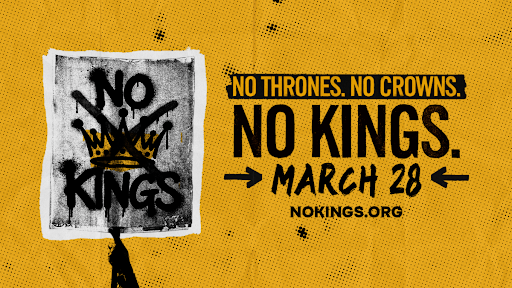
"No Kings" Protest March 28


Come out and participate in the No Kings March on March 28. LWVUS is a sponsor organization so this is a LWV approved rally. You may wear League identifying clothing and pins and mention the League on your signs. If we are together, we make a bigger impact.


One of our local events is being held in St. Joseph from 11-2. Southwest Michigan Indivisible will be meeting at 811 Port Street at 11:00. Speakers will be featured. Click on this link for more information - <Link>.


Other groups of protesters will also meet at their usual spot – Main and Park Streets. The hope is that there will be so many participants supporting democracy that we will stretch out and meet along Main

Street.


Check your local papers or check the No Kings official website for specific local events near you as the date approaches.


Together we can do great things. Thank you for being part of those willing to fight back.


Sign Suggestion: 

Empowering Democracy/Defending Voters

Voter

Information

2026!


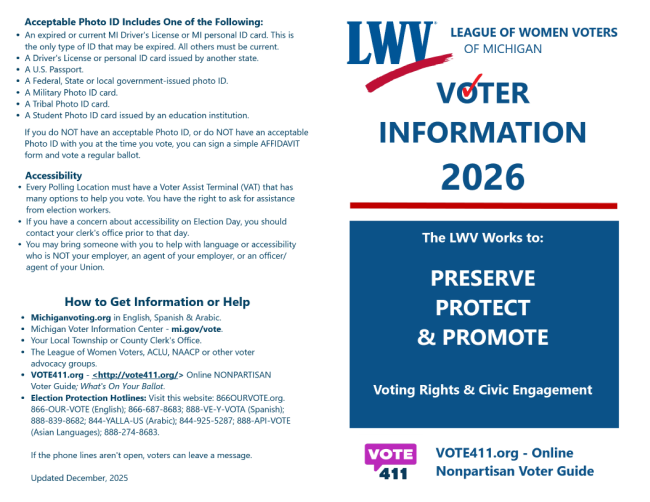
Here is the link to the very informative flyer. Please share!!


Topics include:

  • How do I register to vote?
  • Michigan has two options to vote early
  • What are the photo ID requirements to vote?
  • Accessibility

2026 MI Election News


Voters may register by mail or online if an election is 15 or more days away**.


If the election is within 14 days, a voter must register in-person with their Local Clerk and present proof of residency.


Voters in line by 8pm on Election Day have the right to register to vote in person at their local clerk's office:


  • Monday, April 20, 2026 - is the deadline to register online or by mail to be eligible to vote in the May 5, 2026 Special Election
  • Monday, July 20, 2026 - is the deadline to register online or by mail to be eligible to vote in the August 4, 2026 Primary Election
  • Monday, October 19, 2026 - is the deadline to register online or by mail to be eligible to vote in the November 3, 2026 General Election


 **Always verify your voter registration status with the Michigan Secretary of State - https://mvic.sos.state.mi.us/Voter/Index/

Trying to Renew Your Dues?


LWVBCC members are encouraged to renew their membership online using the League’s new online system.


If your dues renewal date is approaching, you will receive reminder emails 60 days, 30 days, and then on your membership expiration date asking you to renew. Please check your spam folder. 45 days after your membership expiration date you will receive your final notice, and after 60 days you will be dropped from membership if you do not renew.


To renew your membership, click on the link provided in one of the emails you have received, and follow the prompts. If you have not received the renewal email from LWVUS or have misplaced it, logon to lwvbcc.org and click on the "LWV Member Portal" button and click on the "Renew" button on the next page then follow the prompts.


If you are having trouble with the online system, feel free to contact LWVBCC Webmaster Mike Schnable at LWVBCCWebmaster@gmail.com.


If you would like to avoid the online system, you can mail your dues check to our Treasurer (a minimum of $20; the standard is $75), payable to LWVBCC:

John Ripley, LWVBCC

PO Box 1032

Niles, MI 49120


You can also give us a donation at this time by sending us a separate check. Just make it out to LWVBCC and be sure to indicate which check is for dues and which check is for the donation.


Thank you for renewing your dues. We need every single voice to save our democracy!


Mike Schnable, Webmaster

lwvbccwebmaster@gmail.com

Newsletter

Tech News

"The Voter" newsletter now has embedded links to take you to the additional information & websites referred to in the articles, or from sponsors, LWV or Vote411 logos.


Look for the text that is blue and underlined or when the "finger click image" icon appears when moving your cursor across an image or text.


Mike Schnable, Webmaster

lwvbccwebmaster@gmail.com

Picture from NAACP Niles-Buchanan Meeting

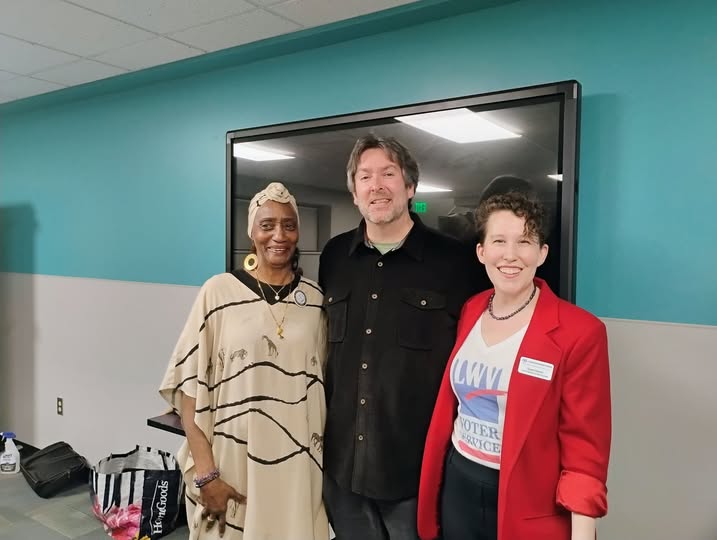
Beverly Woodson, NAACP Niles-Buchanan President pictured with featured speakers Don Lenderman and Sarah Warner at last month's NAACP Niles-Buchanan meeting.

Looking for up-to-date LWVBCC information between newsletters? Check out the LWVBCC Facebook and Website by clicking on the links in this Newsletter's footer.


Calendar of Events


March 26

General Membership Meeting

at Free Run Winery

6-7:30pm


March 28

No Kings Day


April 22

Earth Day


April 25

Bridgman Shoreline Resilience Committee

Beach Clean Up

at Weko Beach House

10am - 12 noon


May 21

Why Elections Matter

at St Joseph Public Library

6pm - 7:30pm


June 13

Juneteenth Celebration

Benton Harbor


June 18

LWVBCC Annual Business Meeting

at Free Run Winery

5pm - 8pm


June 25-28

LWV National Convention

in Columbus, Ohio


August 29

ACLU Presents

At the Booth: Voter Rights Part II

at St Joseph Public Library

2pm - 4pm


September 18-27

What the Constitution Means to Me

at Ghostlight Theater

Click Here if you would like to Volunteer to help at any Event

Book Club Calendar

All meetings are at 10am


March 30

The Correspondent

by Virginia Evans

Location: Home of Faith Schoon


May 11

Giving Up is Unforgivable

by Joyce Vance

Location: TBA

LWVBCC

Board of Directors


President - Sarah Warner

Vice President - Beverly Gray

Secretary - Dorothy Parker

Treasurers - John & Carla Ripley


Advocacy & Education

– Don Lenderman

Community Outreach

– Sarah Warner

Local & State Government Observation – Open

Membership – Val Schnable

Publicity – Faith Schoon

Voter Services – Beverly Gray 

Webmaster – Mike Schnable

Quick Links

LWVBCC SPONSORS


Please Tell Them You Saw Their Ad In The League Of Women Voters Newsletter!

Joe Jilek

Insurance Agency & Finance Services

(269) 695-2200

LWVBCC SUPPORTERS


We Appreciate Their Donations

LWVBCC PARTNERS


Collaborative Outreach Initiative

St Joseph / Maud Preston Palenske Memorial Library

NAACP Niles-Buchanan

Please Encourage 

Membership in LWVBCC


Non-Partisan Policy
The League as an organization does not support or oppose any political party, candidate for elected office, or any group that supports candidates. As individuals, though, but not as representatives of the League, members are encouraged to participate in political activity and to run for office. Our non-partisan policy does require two Board members--the President and the Voter Service Chair--to totally abstain from partisan political activity.